October 17, 1185.
The hour of the boar, corresponding to around 9 to 11 PM today.
A report reached Kujō Kanezane that war cries were rising from the north.
Kanezane himself heard those cries.
“The matter has already become reality.”
The long-rumored disturbance had finally come to pass.
Detailed information soon followed.
Over thirty horsemen from the Kodama faction of Musashi Province had attacked Minamoto no Yoshitsune‘s residence.
The attackers initially seemed poised for victory.
However, Minamoto no Yukie arrived and counterattacked, driving off the Kodama faction.
Kanezane recorded these events in his diary, “Gyokuyō.”
Meanwhile, the “Azuma Kagami,” a chronicle of Kamakura’s history, names the leader of the sixty-plus horsemen.
Tosabo Shoshun.
A warrior said to have departed Kamakura under orders from Yoritomo to pursue Yoshitsune.
At the time of Shoshun’s attack on Yoshitsune’s residence, many of the household retainers were away. Though few remained, Yoshitsune, accompanied by Sato Tadanobu and others, opened the gate and charged out.
Yukie joined in from the rear.
Shoshun’s attacking forces were defeated and fled.
Shoshun escaped to the depths of Mount Kurama, north of Kyoto.
However, on October 26, he was captured and executed at Rokujō Riverbed, as recorded in the “Azuma Kagami.”
Before departing, Shoshun had made a single request to Yoritomo.
It concerned his elderly mother and young children left behind in Shimotsuke Province.
He asked that his family be shown compassion after his absence.
Yoritomo granted this request, reportedly bestowing the Nakaizumi Manor in Shimotsuke Province.
Entrusting his family’s welfare to Yoritomo, Shoshun set out for Kyoto.
Nine days later, he attacked Yoshitsune’s mansion.
And nine days after that, he lost his life.
This incident later became known as the “Horikawa Night Attack.”
Yoshitsune’s Residence at Rokujō Muromachi
Regarding the residence attacked, the “Azuma Kagami” refers to it as “Rokujō Muromachi-tei.”
This indicates a mansion located at Rokujō Muromachi in Kyoto.
However, in military tales such as the “Heike Monogatari” and “Genpei Seisui Ki,” it is sometimes depicted as the mansion at Rokujō Horikawa.
In Kyoto, Muromachi Street and Horikawa Street were two separate roads, running east and west.
The name “Horikawa Night Attack” that is commonly used today was popularized through military tales and later performing arts.
The “Gyokuyo” records that the residence of Yoshitsune, which was attacked, was located near the imperial palace.
At that time, Yoshitsune was staying in Kyoto, serving in a court position.
In the previous year, in August of Juei 3 (1184), he had become a kebiishi, and by August 1185, he was appointed as Governor of Iyo.
The kebiishi was an official role involved in maintaining public order and policing in Kyoto.
Yoshitsune, who had led forces to pursue the Taira clan, continued to work in Kyoto even after their downfall.
While it’s possible that Yoshitsune used multiple residences in the capital, accurately pinpointing the location of the building attacked on October 17 is difficult.
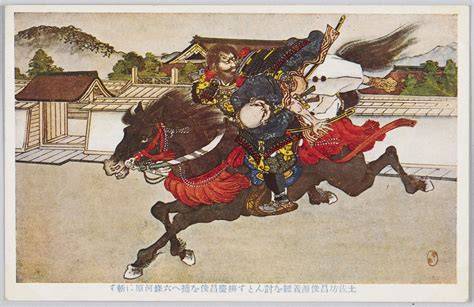
In later picture scrolls, warriors are depicted storming a Horikawa mansion equipped with large gates and walls.
However, this depiction cannot be directly applied to the Kyoto of 1185.
The warriors who attacked Yoshitsune’s residence encountered unexpected resistance there.
Yoshitsune as Seen by Kajiwara Kagesue
October 6.
Kajiwara Kagesue returned to Kamakura from Kyoto.
His father was Kajiwara Kagetoki, known as a close aide to Yoritomo.
Kagesue had gone to Kyoto to deliver the order to Yoshitsune to pursue Minamoto no Yukie.
Yukie was Yoritomo’s uncle and had once spread the imperial order of Prince Mochihito to the Minamoto clan across the regions.
Subsequently, he clashed with Yoritomo and Minamoto no Yoshinaka, and at this time was active around Kyoto.
Yoritomo had ordered Yoshitsune to eliminate Yukie.
According to the “Azuma Kagami,” when Kagesue visited Yoshitsune’s residence, Yoshitsune refused to meet, citing illness.
Upon a second visit, he finally managed to meet him.
Yoshitsune was reportedly leaning against an armrest, appearing weakened.
His body bore multiple marks from moxibustion.
When Kagesue conveyed the order to pursue Yukie, Yoshitsune replied that he wished to handle it after recovering from his illness.
He also mentioned that since Yukie was a member of the Minamoto family, it would not be easy to defeat him with just a small group of retainers.
Kagesue reported these observations back to Kamakura.
Yoritomo suspected Yoshitsune’s illness.
Yoshitsune might have been feigning illness to avoid pursuit, having allied with Yukie.
It is said that Kagetoki expressed the opinion that Yoshitsune could have been pretending to be weak or even faking the marks of moxibustion.
Whether Yoshitsune was truly ill could not be determined from Kageki’s report alone.
However, the Azuma Kagami records that Yoritomo’s suspicions of Yoshitsune deepened following this report.
Three days later, it is said that in Kamakura, selections were made for those who would go to defeat Yoshitsune.
A Task No One Wanted to Undertake
October 9th.
The Azuma Kagami notes that Yoritomo was seeking warriors to dispatch to Kyoto to defeat Yoshitsune.
However, few were willing to take on the task.
Yoshitsune was Yoritomo’s brother and a general who had defeated both Minamoto no Yoshinaka and the Taira clan.
In Kyoto, he held court positions and had deepened his ties with Minamoto no Yukie.
The task was to defeat Yoshitsune in Kyoto.
It was undoubtedly a dangerous mission.
It was Tosabo Shoshun who stepped forward.
The Azuma Kagami reports that Yoritomo was greatly pleased when Shoshun volunteered for the mission.
Little is known about Shoshun’s exact origins.
The name Tosabo suggests he might have had a background as a monk.
There is a later theory that Shibuya Konojomaru, who served Yoritomo’s father, Minamoto no Yoshitomo, became a monk and took the name Shoshun.
Konojomaru is known for anecdotes related to Yoshitomo’s death.
However, there are no records confirming that Konojomaru and Shoshun were the same person.
There are not many articles providing reliable clues about Shoshun.
The most detailed account is in the Azuma Kagami entry for October 9th.
Entrusted with a dangerous mission by Yoritomo, Shoshun made a request concerning his family before departing.
An Elderly Mother and Young Children
It is said that Shoshun had an elderly mother and young children in Shimotsuke Province.
According to the Azuma Kagami, Shoshun asked Yoritomo to show compassion to his family after the mission.
Yoritomo agreed to this.
It is recorded that he granted Shoshun the Nakaisumi Manor.
Nakaisumi Manor was an estate located in what is now centered around Tochigi City, Tochigi Prefecture.
This area, which was relatively large, is known from later records to have been an estate of the Konoe family.
It is unclear under what authority Shoshun was granted the Nakaisumi Manor, and the specific details remain unknown.
However, the Azuma Kagami recounts that Yoritomo responded to Shoshun’s request for consideration for his family by granting him land.
Shoshun likely had matters he wished to settle before heading to Kyoto.
There was no guarantee of a safe return.
Yoshitsune was a seasoned warrior who had experienced numerous battles in the campaign against the Taira, and he was accompanied by retainers who had fought alongside him.
Traveling to Kyoto to attack Yoshitsune, if unsuccessful, would make returning to Kamakura difficult.
What Shoshun was contemplating remains unknown, as no letters from him survive.
Only his plea for his family is recorded in the Azuma Kagami.
Eighty-Three Riders Depart Kamakura
According to the Azuma Kagami, Shoshun set out with eighty-three riders.
Among his companions were his brother, Mikami Yaro Iesue, Nishikiori Saburo, Kadoma Taro, and Aizawa Jiro.
Yoritomo reportedly set a nine-day journey to Kyoto.
The road from Kamakura to Kyoto was long.
The warriors would have traveled on horseback, taking necessary breaks and lodging as needed, but there are no records of where they stayed or the routes they took.
It is also unclear whether the number of eighty-three riders included foot soldiers accompanying the mounted warriors.
What stands out is the discrepancy with the number of attackers recorded later.
The Azuma Kagami entry from October 17 notes that Shoshun was accompanied by just over sixty riders.
This is fewer than the eighty-three riders at the time of departure.
Did they split their forces along the way?
Or were only those who participated in the mansion attack counted?
The sources do not explain.
Moreover, the Gyokuyo, which also records the events of the 17th, mentions a group of over thirty riders from the Kodama faction.
The information about Shoshun’s departure, the attack, and what reached Kanetsune in Kyoto cannot be treated as identical.
Was It Yoritomo’s Order?
Did Tosabo Shoshun really attack Yoshitsune on Yoritomo’s orders?
The Azuma Kagami records Shoshun’s dispatch as being under Yoritomo’s command.
It notes that on October 9, Shoshun accepted the mission, and on the 17th, he attacked Yoshitsune’s residence under strict orders from Kamakura.
However, the written order from Yoritomo to Shoshun has not survived.
The diary of the court noble Kujō Kanezane, Gyokuyo, mentions that warriors from Musashi Province, said to be Yoritomo’s retainers, attacked Yoshitsune.
It does not record Yoritomo directly ordering Shoshun to carry out the attack.
This point remains a subject of scholarly debate.
Kazunori Hishinuma, in his article “Minamoto no Yoshitsune‘s Uprising and the Tosabo Attack Incident,” reexamines the traditional understanding of the attack as being directly ordered by Minamoto no Yoritomo, focusing on the sequence of Yoshitsune’s preparations and the attack as recorded in the “Gyokuyo.”
This perspective suggests the possibility that supporters of Yoritomo in Kyoto independently launched the attack, even as Yoshitsune had already decided to oppose Yoritomo.
However, a detailed examination of the sequence and intentions of the specific events suggested by this view requires a comparison of the paper and the historical text.
The “Azuma Kagami” clearly states that Yoritomo dispatched Shoshun, and it is not possible to completely refute this with the existing records alone.
At what stage did Shoshun receive orders, from whom, and in what manner?
This remains a significant issue when considering the incident.
Unsettling News Spreads in Kyoto
As Shoshun was heading to Kyoto, the movements of Yoshitsune and Minamoto no Yukie had already attracted the attention of the court.
October 13th.
Kujō Kanezane recorded in the “Gyokuyo” that there was information about Yoshitsune and Yukie planning to rebel against Yoritomo.
It was said that the two had been secretly consulting for some time.
Yoshitsune reportedly made an appeal to Emperor Go-Shirakawa around the 11th or 13th.
Despite his significant achievements in the campaign against the Taira, Yoritomo had confiscated his lands.
Although appointed as Governor of Iyo, he could not perform his duties due to the placement of stewards across the regions.
Moreover, he had received news that Yoritomo had dispatched retainers to kill him.
Yoshitsune expressed these grievances and dangers to the Emperor.
These claims from Yoshitsune’s side are conveyed in the “Gyokuyo.”
It is not possible to determine the exact reasons for Yoritomo’s confiscation of lands solely from Yoshitsune’s complaint.
However, the conflict between Yoshitsune and Yoritomo had become widely known in Kyoto.
By the 14th, there were even reports of people moving their belongings out of fear.
Would another battle break out in Kyoto?
It had been less than seven months since the fall of the Taira.
The people of the capital feared the onset of new turmoil.
The Tale of Disguising as a Pilgrim to Kumano
In “The Tale of the Heike,” volume twelve, “The Incident of Tosabo’s Execution,” when Shoshun arrived in Kyoto, Yoshitsune learned of his presence and summoned him to his residence.
Yoshitsune asked about the reason for his visit to the capital.
Was it not under Yoritomo’s orders to kill him?
Shoshun denied it, claiming he had come to Kyoto for a pilgrimage to Kumano.
Yoshitsune remained unconvinced.
It is said that Shoshun offered to write an oath document.
An oath document is a written pledge to the gods and Buddhas to keep one’s promises.
Breaking such a vow was believed to bring divine retribution.
In military tales, Shoshun wrote seven oath documents, burned some to ashes and drank them, and offered the rest at a shrine.
Yoshitsune allowed Shoshun to leave.
That night, Shoshun led his forces to attack Yoshitsune’s residence.
The narrative suggests that he broke his vow to the gods and launched a night raid immediately after swearing it.
However, the entry for October 17 in the Azuma Kagami does not mention Yoshitsune summoning Shoshun to write an oath document.
There is also no record of the seven oath documents in the Gyokuyo.
It is unclear whether Shoshun and Yoshitsune met directly beforehand.
Later generations enjoyed retelling this scene of the oath document.
The image of Shoshun swearing an oath to the gods on the eve of betrayal leaves a strong impression in the story.
The Night of October 16
On the night of October 16.
The Gyokuyo reports that Yoshitsune sought an imperial decree from Emperor Go-Shirakawa to attack Yoritomo.
He also indicated his intention to head west if refused.
Yoshitsune had already allied with Yukie and was determined to oppose Yoritomo.
The following day was the day of the Horikawa Night Attack.
In later military tales, Yoshitsune is depicted as being attacked by Yoritomo’s assassins, leading to his furious decision to rebel against his brother.
However, the Gyokuyo records that Yoshitsune had already requested the court to order Yoritomo’s pursuit before the attack.
The court was in a difficult position.
Yoshitsune was a powerful military commander with forces in Kyoto.
If they refused his demand, there was a risk that Yoshitsune might resort to force.
On the other hand, issuing an order to pursue Yoritomo would strain relations with Kamakura, which controlled the eastern provinces.
As the court faced this dilemma, the night of the 17th arrived.
At the Hour of the Boar, a Voice Reaches Kanezane’s Ears
The entry for October 17 in the Gyokuyo.
At the hour of the boar, someone came running to inform Kanezane that battle cries were rising in the north.
Kanezane also heard those cries.
Even before the news arrived, there had been unrest in Kyoto over the actions of Yoshitsune and Yukie.
That night, a military clash finally occurred.
According to later information, over thirty riders from the Kodama faction of Musashi Province, retainers of Yoritomo, attacked Yoshitsune’s residence.
The Kodama faction is generally considered to be related to the Kodama clan, a warrior group from Musashi Province.
The attackers were said to have received information from someone before heading to Yoshitsune’s residence.
Did someone inform them of Yoshitsune’s whereabouts?
Did they learn that his household was understaffed?
The specifics of the conveyed information are not recorded.
The Kodama faction seemed poised to achieve victory for a moment.
However, Minamoto no Yukie arrived to counterattack and drove off the attackers.
Kanezane recorded the information that was relayed in Kyoto that night.
Kanezane himself heard the battle cries but did not directly witness the fighting at the mansion.
Nevertheless, the “Gyokuyo” remains an important contemporary account of this assault.
Over Sixty Riders and Mizuo Tani Juro
The “Azuma Kagami” entry for October 17 states that Tosabo Shoshun led over sixty riders, including Mizuo Tani Juro, to attack Yoshitsune’s residence at Rokujomuro-machi.
This differs from the “Gyokuyo,” which mentions over thirty riders from the Kodama faction, both in numbers and in the description of the leaders.
Mizuo Tani Juro is known as a warrior associated with the Mihoya district of Musashi Province.
This area corresponds to the present-day vicinity of Kawajima Town in Saitama Prefecture.
The “Kitamoto City History” highlights the article mentioning Mizuo Tani Juro’s participation in the Horikawa Night Attack as the first recorded appearance of his name in the “Azuma Kagami.”
Juro’s real name remains unknown.
The Kodama faction of Musashi Province and the Mizuo Tani clan.
Both were warriors from the eastern provinces.
From both historical sources, it can be inferred that warriors from the eastern provinces, connected to Yoritomo, were among those who attacked Yoshitsune.
However, it is unclear whether the over thirty riders of the Kodama faction mentioned in the “Gyokuyo” were part of the over sixty riders in the “Azuma Kagami.”
Due to the different perspectives from which the same battle was recorded, the numbers and transmitted information might have varied.
It is not possible to simply add the two records to conclude that there were over ninety riders in the attacking force.
What is certain is that warriors from the eastern provinces attacked Yoshitsune’s residence, leading to a battle with Yoshitsune’s forces.
Sato Tadanobu Left at the Residence
When the attack began, most of Yoshitsune’s retainers were away.
The “Azuma Kagami” notes that they were strolling around the Nishikawa area, leaving few behind at the residence.
The reason why so many retainers were out at that location is unknown.
It is also unclear whether Shoshun knew of their absence in advance.
In the later “The Tale of the Heike,” it is mentioned that there were only seven riders, including Yoshitsune.
However, the “Azuma Kagami” does not specify the number of retainers who remained.
The number seven is a figure passed down in military tales.
The “Azuma Kagami” names Sato Shirobei Tadanobu as one of the individuals who stayed at the residence.
Tadanobu is known as a warrior connected to Oshu and was one of the retainers who followed Yoshitsune.
Together with his brother Sato Tsugunobu, he is portrayed in later military tales as a loyal retainer to Minamoto no Yoshitsune.
There are no detailed records of how many enemies Tadanobu defeated that night or what weapons he used.
However, as someone who stayed by Yoshitsune’s side and fought back during the attack, his name is recorded in the Azuma Kagami.
Yoshitsune, along with Tadanobu and others, headed towards the gate of the residence.
Yoshitsune Opens the Gate Himself
The counterattack by Yoshitsune as conveyed by the Azuma Kagami is brief.
It is said that Yoshitsune, accompanied by Sato Tadanobu and others, opened the gate himself and charged out to fight.
With few soldiers remaining in the residence, Yoshitsune did not stay inside the gate but moved towards the attackers.
However, there is no record of what tactics Yoshitsune had in mind.
Did he charge out on horseback?
Which gate did he exit from?
Which enemy unit did he attack?
The Azuma Kagami does not provide such detailed explanations.
In the Gikeiki, Yoshitsune is depicted donning armor, riding a horse, and charging into the attacking forces.
It is said that Yoshitsune rode through the enemy ranks, shooting arrows.
Additionally, there are accounts of Genpachi Hyoe no Jo Hirotsuna being killed by an arrow and Kumai Taro being injured.
However, the names of these casualties and their manner of fighting are not recorded in the Gyokuyo or the Azuma Kagami.
There is insufficient material to reconstruct the specific tactics Yoshitsune employed to maneuver his forces skillfully.
Nonetheless, the Azuma Kagami records that he opened the gate himself and launched an attack.
Yoshitsune, along with the retainers remaining at the mansion, confronted the attacking forces.
Minamoto no Yukie Appears Behind the Enemy
Upon learning that the battle had begun, Minamoto no Yukie rushed to the scene.
According to the Azuma Kagami, Yukie reinforced the attack from behind the enemy lines.
Both Yoshitsune’s and Yukie’s forces fought back against Shoshun’s troops.
The Gyokuyo also notes that the Kodama faction was defeated due to Yukie’s intervention.
This sequence of events is consistent across both sources.
Yukie was Yoshitsune’s uncle and was already in opposition to Yoritomo.
For Yoritomo, who had ordered Yoshitsune to pursue Yukie, their collaboration in the Kyoto night battle was an intolerable issue.
Yet, the two cooperated during the nocturnal skirmish in Kyoto.
The number of soldiers Yukie led is unknown.
There are no records detailing where they came from or which path they took to circle behind the attacking force.
However, just as Shoshun’s forces attacked Yoritomo’s residence, they were also struck from behind.
The Azuma Kagami notes that when Yukie joined the fray, Shoshun soon retreated.
The Gyokuyo also reports that Yukie scattered the attacking forces.
The Azuma Kagami records that Yoritomo’s side had few men, and two historical sources mention Yukie’s reinforcements.
From this, we can infer that the attack on the lightly defended residence failed due to Yukie’s support.
The Dispersed Attackers
Shoshun’s forces retreated.
The Azuma Kagami states that Yoritomo’s retainers began searching for the fleeing attackers.
In the night of Kyoto, the attacking samurai scattered.
It is unknown how many were killed or wounded in the battle.
The exact time Shoshun decided to retreat and the direction of their escape are not detailed.
According to the Gyokuyo, the attackers initially seemed close to victory.
However, they were defeated by Yukie’s intervention.
Meanwhile, the Azuma Kagami records that Yoritomo sallied forth from the gate, with Yukie joining from the rear.
Even combining both records, it is difficult to accurately map the battlefield positions that night.
Nonetheless, it was clear that the night attack had failed.
Shoshun could not defeat Yoritomo and fled.
After the battle, Yoritomo headed to Emperor Go-Shirakawa.
The Azuma Kagami states that he reported his safety upon arriving at the palace.
The Heike Monogatari describes Yoritomo arriving at the palace in armor pierced by arrows.
However, there are no records confirming such an appearance.
The Azuma Kagami recounts that Yoritomo repelled the attack and informed the emperor of his safety.
The Order to Pursue Yoritomo Issued the Next Day
October 18th.
An imperial order was issued to Yoritomo and Yukie to pursue Yoritomo.
The Gyokuyo records the text of this order.
It commanded Yoritomo and Yukie to pursue Yoritomo for flaunting military power and disregarding the court’s authority.
This order was issued in the form of an imperial decree, reflecting Emperor Go-Shirakawa’s intentions.
Yoritomo’s residence had been attacked the previous day.
However, the request for the pursuit order had been made earlier.
By the night of October 16th, Yoritomo had already petitioned the emperor to pursue Yoritomo.
Meanwhile, the Azuma Kagami traces the events back to October 9th, when Yoritomo dispatched Tosabo to attack Yoritomo.
The conflict between the two had been escalating before the attack on the 17th.
The night attack was an incident where this conflict erupted into armed confrontation in Kyoto.
However, despite receiving the imperial order, Yoritomo struggled to gather troops as he had hoped.
Later, when Yoritomo mobilized his forces from the eastern provinces, Yoshitsune and Yukie left Kyoto.
This series of political ruptures is covered in another article, “The Split Between Minamoto no Yoritomo and Minamoto no Yoshitsune.”
Returning to the Horikawa Night Attack, by the 18th, Shoshun was still on the run.
Tosabo’s Escape to Mount Kurama
Shoshun fled to Mount Kurama, located to the north of Kyoto.
According to the “Azuma Kagami” entry for October 26, Shoshun and his companions were captured deep in Mount Kurama.
Mount Kurama has long been known as a place of temples and ascetic practices, and later became famous for the legend that the young Yoshitsune learned martial arts there.
However, the reason Shoshun headed to Mount Kurama is unclear.
Did he have acquaintances at the temple?
Did he think he could evade pursuers by hiding in the mountains?
No words from him remain.
Some versions of the “Heike Monogatari” mention that Shoshun fled to the Sojo-ga-dani in Mount Kurama.
Sojo-ga-dani is also the setting for later legends of Yoshitsune training with the tengu.
The land associated with Yoshitsune’s childhood now became the escape destination for the warrior who attacked him.
The “Azuma Kagami” only notes the location as deep within Mount Kurama.
From the night attack on October 17 to the capture on the 26th, nine days had passed.
How did Shoshun manage to hide during that time?
How did he secure food?
Did he receive help from someone?
No records remain.
However, Yoshitsune’s retainers continued their search.
October 26, Rokujogawara
October 26.
The “Azuma Kagami” records that Tosabo Shoshun and three companions were captured by Yoshitsune’s retainers deep in Mount Kurama.
“Tosabo Shoshun and three companions”
This entry notes that there were three companions with Shoshun.
The captured group was reportedly beheaded at Rokujogawara on the same day.
Beheading was a punishment where the heads of the executed were displayed in a visible place.
Rokujogawara is known as a place of execution in Kyoto.
The circumstances of Shoshun’s capture are not recorded.
Did he resist in the mountains?
Was he discovered while in hiding?
Was there someone who cooperated in his capture?
The Azuma Kagami does not provide detailed accounts.
In the war tales, there is a story of a monk from Kurama capturing Shoshun and handing him over to Yoshitsune.
However, there are no contemporary records to corroborate the monk’s specific actions.
The Azuma Kagami only records a brief entry about the capture at Mount Kurama and the beheading at Rokujogawara.
Later, the Tale of the Heike added a scene to Shoshun’s final moments.
It was the confrontation between the captured Shoshun and Yoshitsune.
Tosabo Who Refused Yoshitsune’s Offer of Mercy
The Tale of the Heike, Volume Twelve, “The Execution of Tosabo.”
Shoshun was brought before Yoshitsune.
He was the man who once disguised himself as a pilgrim to Kumano, writing an oath to clear his suspicions.
Yoshitsune is said to have remarked that the consequences of breaking the oath had come swiftly.
However, what followed were unexpected words.
Yoshitsune is said to have acknowledged Shoshun’s loyalty.
He respected Yoritomo’s orders and came to Kyoto, disregarding his own life.
Such determination was admirable.
And so, Yoshitsune reportedly offered to spare his life and send him back to Kamakura if he valued it.
But Shoshun refused the offer of mercy.
He had already dedicated his life to Yoritomo.
He could not reclaim that life.
He is said to have asked for a swift beheading.
The Tale of the Heike portrays both Yoshitsune and Shoshun as figures who valued the loyalty of a warrior.
Shoshun, who attempted to kill Yoritomo’s brother.
Yoshitsune, who recognized Shoshun’s loyalty.
It becomes a scene where adversaries understand each other’s resolve.
However, the Azuma Kagami entry for October 26 does not record a meeting between Yoshitsune and Shoshun.
Nor does it mention Yoshitsune’s attempt to spare his life or Shoshun’s refusal.
This exchange is an anecdote passed down in the Tale of the Heike.
Nevertheless, Shoshun continued to be remembered in later stories as a warrior who remained loyal to Yoritomo.
The Night Shizuka Gozen Took Up the Naginata
In the tales depicting the Horikawa Night Attack, Shizuka Gozen also appears.
Shizuka was known as a shirabyoshi dancer and was a woman who followed Yoshitsune.
In the Tale of the Heike, Shizuka is given the role of sensing the impending night attack and alerting Yoshitsune.
In the later Kōwakamai play Horikawa Night Attack, Shizuka herself is depicted taking up a naginata to fight.
This scene is also found in the Horikawa Night Attack Picture Scroll housed at Kokugakuin University Library.
This picture scroll is believed to have been created around the mid-Edo period.
This work, based on the content of the Kōwakamai dance, depicts the events from Shoshun’s journey to the capital, the attack on Yoshitsune’s residence, and his subsequent execution.
In the illustrated scroll, Shizuka is shown wielding a naginata and joining the battle.
However, there are no accounts in the Gyokuyō or the Azuma Kagami that mention Shizuka taking up arms that night.
There is also no definitive record of whether she was actually present at the mansion.
Shizuka’s valiant efforts were a portrayal shaped by war tales and performing arts.
Known as a woman mourning her separation from Yoshitsune, Shizuka is depicted here as someone who takes up arms and fights the enemy.
Such scenes reflect how later generations perceived the relationship between Yoshitsune and Shizuka.
Musashibō Benkei and Kisanta
In the Horikawa Night Attack, Musashibō Benkei is also given a significant role.
In the Gikeiki and the Noh play Shōson, Benkei is depicted protecting Yoshitsune and confronting Tosabo.
The Noh play Shōson features Tosabo Shoshun under the name Shōson.
An excuse for a pilgrimage to Kumano.
A written oath.
Night raid.
Battle with Yoshitsune’s forces.
A series of events is performed on stage.
Benkei became an important figure in protecting Yoshitsune.
However, there is no detailed account of Benkei’s combat in the Azuma Kagami entry for October 17.
The name that appears in the records is Satō Tadanobu.
The Gikeiki also describes the exploits of a retainer named Kisanta.
The Horikawa Night Attack Emaki at Kokugakuin University depicts a figure with a bow inside the gate of Yoshitsune’s residence.
The university’s explanation suggests the possibility that this figure is Kisanta.
While Kisanta does not appear in the Kōwakamai dance, in the Gikeiki, he remains at the mansion and takes up a bow to fight back.
The scroll incorporates depictions from both the Kōwakamai dance and the Gikeiki.
Benkei, Shizuka, and Kisanta.
The number of figures who save Yoshitsune in times of crisis grew as the stories were passed down.
The brief night battle recorded in the Azuma Kagami evolved into scenes with many active figures in later performing arts.
Another Horikawa Night Attack Preserved in the Emaki
The Horikawa Night Attack Emaki at Kokugakuin University Library depicts Tosabo appearing at Yoshitsune’s mansion, writing a written oath, and launching a night raid.
Furthermore, in the battle scenes, Shizuka wields a naginata, and Benkei swings a black club.
There is also a scene where Ise Saburō, who had been disowned by Yoshitsune, takes an enemy’s head to show.
In this scroll, Ise Saburō is depicted holding two heads impaled on a sword.
Other scrolls and printed books depicting the same scene show the heads placed on a rim.
Kokugakuin University’s commentary also highlights these differences in imagery.
Additionally, there are scenes where the warriors are not wearing helmets or eboshi, with their short hair standing on end.
Artists depicted the figures and events passed down through military tales using the expressions of their own times.
It is impossible to accurately recreate the battles of 1185 from the scrolls.
However, we can clearly see which scenes were favored and which figures captured the attention of people during the Edo period.
Assassins dispatched from Kamakura.
Yoshitsune fighting with a small group.
Retainers protecting Yoshitsune.
Tosabo sacrificing his life for loyalty.
The Horikawa Night Attack was cherished as such a tale for a long time.
Nakaisozu Reappears in Records
More than two years after Tosabo Shoshun was executed.
In 1188, the fourth year of the Bunji era, Nakaisozu in Shimotsuke Province reappears in the Azuma Kagami.
Yoritomo intended to donate this estate for the reconstruction of Todaiji Temple.
However, the original lord of Nakaisozu was unclear.
It is said that Yoritomo requested an investigation from the court.
As a result, it was determined that Nakaisozu was the estate of Konoe Motomichi.
The estate was to be returned to the Konoe family, and it is said that the tribute was sent to Taira no Munenori, the steward of the Konoe family.
Nakaisozu was reportedly the land given to Shoshun by Yoritomo when he departed for Kyoto.
A dangerous mission, leaving behind an elderly mother and young children.
The Azuma Kagami recorded that Yoritomo granted Shoshun’s request and gave him Nakaisozu.
However, after Shoshun’s death, the land appeared in records as a dispute over another lord’s rights.
It is unclear how much income Shoshun’s family actually received.
When did the elderly mother pass away?
How did the young children grow up afterward?
How was the family treated when Nakaisozu was returned to the Konoe family?
No records remain to convey such details.
Records Left at Rokujogawara
October 9, the first year of the Bunji era.
The Azuma Kagami tells that Tosabo Shoshun accepted the mission to head to Kyoto to attack Yoshitsune.
Before his departure, he petitioned Yoritomo regarding his elderly mother and young children in Shimotsuke Province.
October 17.
Shoshun attacked Yoshitsune’s residence at Rokujomurocho.
It is recorded that Yoshitsune, along with Sato Tadanobu, charged out from the gate, with Yukie joining from the rear.
Shoshun’s forces were defeated and fled.
October 26.
Hiding deep in Mount Kurama, Shoshun and three companions were captured and beheaded at Rokujogawara.
The Azuma Kagami succinctly conveys this sequence of events.
Eventually, the Heike Monogatari depicted a scene where Yoshitsune recognized Shoshun’s loyalty and attempted to spare his life, but Shoshun declined.
In the Noh play ‘Shoson’, Benkei’s exploits are highlighted.
In the Kōwakamai dance, Shizuka Gozen takes up a naginata.
The events of the night attack became the subject of stories, and were depicted in picture scrolls and ukiyo-e.
However, the tales rarely mention the family of Shoshun left behind in Shimotsuke Province.
The ‘Azuma Kagami’ records the pleas of his elderly mother and young children, preserved in articles before his departure.
After Shoshun was executed, what news reached those family members?
How long could the family, granted the Nakaizumi Manor, maintain control over that land?
In the fourth year of Bunji, it was confirmed that Nakaizumi Manor was the property of the Konoe family and was returned to them.
Yet, even in those records, the names of Shoshun’s elderly mother and children do not appear.
The mission Shoshun undertook at the risk of his life, and the family he entrusted to Yoritomo before that.
The name of Nakaizumi Manor is the only link between them preserved in historical records.