February 14, 1182.
A message arrived from Minamoto no Yoritomo, announcing his decision to pardon Ito Sukechika.
Sukechika had once been a powerful samurai in Izu Province who plotted to kill Yoritomo.
In 1180, he fought on the side of the Taira clan, leading over 300 horsemen to position themselves behind Yoritomo’s forces at the Battle of Ishibashiyama. Later, he attempted to join the forces of Taira no Koremori but was captured and placed under the custody of his son-in-law, Miura Yoshizumi.
Nearly a year and four months passed.
Amid rumors of Hojo Masako’s pregnancy, Yoshizumi pleaded for Sukechika’s life. Yoritomo listened to this plea and declared his forgiveness of Sukechika.
When Yoshizumi delivered the news, Sukechika agreed to present himself before Yoritomo.
However, Sukechika did not appear at the appointed place.
As Yoshizumi waited, a retainer rushed in.
Sukechika had taken his own life.
The “Azuma Kagami” records that upon hearing of his pardon, Sukechika was so ashamed of his past actions that he chose to end his life.
Yoshizumi hurried to the scene but was too late.
Sukechika had a son who once saved Yoritomo’s life.
Miura Yoshizumi, who supported Yoritomo, was also Sukechika’s son-in-law.
Despite this, Sukechika did not acknowledge Yoritomo’s uprising and remained an adversary, siding with the Taira until the end.
When Yoritomo sought to forgive his crimes, Sukechika chose to take his own life.
His life was intertwined with the territorial disputes in Izu, the conflict between the Minamoto and Taira clans, his complex relationship with his son, and even the Soga brothers’ revenge eleven years later.
The Kudo Clan’s Rise on the Eastern Coast of Izu
The exact birth year of Ito Sukechika is unknown.
The Ito clan was a branch of the Kudo family, descendants of the Fujiwara southern house, and by the late Heian period, they had established their power in the eastern part of Izu Province.
Their significant holdings spanned from present-day Ito City to Kawazu Town and parts of Izu City in Shizuoka Prefecture.
The eastern coast of the Izu Peninsula faces Sagami Bay, providing sea routes to the Miura Peninsula and Sagami Province. Inland, mountains spread out, with roads connecting coastal villages to the mountainous areas.
The ancestor of the Ito clan was a man named Kudo Suketaka.
Suketaka held lands in Kusumi Manor in Izu Province, and it is said that his family extended their influence to the areas of Ito and Kawazu.
Sukechika was also known as Kawazu Jiro.
However, there are many uncertainties in the early genealogy of the Ito clan.
Genealogies like “Sonpi Bunmyaku” and the later “Soga Monogatari” differ in their accounts of ancestral relations and the inheritance of lands.
Determining who inherited which lands and when the leadership passed is challenging.
The event that dramatically altered Sukechika’s life was a territorial dispute with Kudo Suketsune, a member of the same Kudo clan.
This conflict led to the death of Sukechika’s son and continued into the next generation.
The Struggle Over Ito’s Lands
Kudo Suketsune was a member of the same Kudo clan as Sukechika.
According to the “Soga Monogatari,” Sukechika’s grandfather, Suketaka, chose another son, Suketsugu, as his successor after Sukechika’s father, Sukeya, passed away early.
Suketsugu inherited the Ito lands, and his son was Suketsune.
Meanwhile, it is said that Sukechika was given the land of Kawazu.
Sukechika believed he was the rightful heir and was dissatisfied with Suketaka’s decision.
The “Soga Monogatari” details the course of Sukechika’s dispute over the inheritance.
However, there is a lack of reliable contemporary records about the discussions when Suketaka chose his successor or what kind of appeal Sukechika made.
It is not possible to take the conversations passed down in later stories as actual statements from that time.
Research is ongoing regarding the lands that were the subject of the dispute.
Kouichi Sakai, examining the descriptions in the “Soga Monogatari,” points out that the conflict between Sukechika and Suketsune centered on the Ito lands, which were at the heart of Kusumi Manor.
Explaining it as a struggle for control over the entire Izu region would overly broaden the scope of the actual conflict.
The issue was who would inherit the land in Ito that their ancestors had held.
Taking on the Guardianship of Young Suketsune
The “Soga Monogatari” also recounts that Sukechika was asked to be the guardian of Suketsune.
When Suketsune’s father, Suketsugu, fell ill, he entrusted his young son to Sukechika.
Suketsune was called Kaneshi in his childhood.
Suketsugu asked Sukechika to assist Kaneshi in his coming-of-age ceremony and to have him marry his own daughter.
It is said that Sukechika accepted this request.
Eventually, Suketsune grew up and married Sukechika’s daughter.
Thus, Sukechika and Suketsune, who were in conflict over land, were also bound by marriage.
However, their relationship did not last long.
When Suketsune began to be active in Kyoto, Sukechika reportedly took control of the Ito lands.
Furthermore, it is said that he divorced his daughter from Suketsune and remarried her to Doi Tohira.
For Suketsune, it was a situation where he lost both the lands inherited from his father and his wife.
It is unclear when Sukechika acquired the Ito lands or how he arranged for his daughter’s divorce.
This series of events is mainly recorded in the “Soga Monogatari.”
The book depicts Suketsune as deeply resenting Sukechika for taking his lands and wife.
Subsequently, a murder occurred in Izu.
The victim was Sukechika’s eldest son.
Losing His Eldest Son During the Okuno Hunt
In October of Angen 2 (1176).
A hunting expedition took place in Okuno, Izu Province.
This area corresponds to the present-day surroundings of Ito City in Shizuoka Prefecture.
It is said that Kawazu Saburo Sukeyasu, the eldest son of Ito Sukechika, also participated in the hunt.
Sukeyasu was a samurai based in Kawazu and was in line to succeed Sukechika.
On their way back from the hunt, the group was suddenly ambushed by arrows.
Sukeyasu was struck and lost his life.
According to the “Soga Monogatari,” the attack was ordered by Kudo Suketsune.
The assault was carried out by two samurai named Omi Kotota and Hachiman Saburo.
They reportedly lay in wait for Sukechika’s party near a place called the Three Chinoki Trees, in the vicinity of present-day Akazawa, Ito City.
It is known that Suketsune’s target was Sukechika, but the arrow hit Sukeyasu instead.
However, there is also a tradition that Sukeyasu himself was the intended target.
Who shot the arrow from where, and who was the original target? These details cannot be confirmed from contemporary sources.
Nevertheless, the background of territorial disputes between Sukechika and Suketsune, leading to the murder of Kawazu Sukeyasu, is connected to the later revenge of the Soga brothers.
Sukechika lost his heir.
And Sukeyasu left behind two young sons.
The Grandsons Who Moved to the Soga Clan
The sons of Kawazu Sukeyasu later became known as Soga Juro Sukenari and Soga Goro Tokimune.
Their childhood names were Ichiman for the elder and Hako-o for the younger.
At the time of their father’s murder, the two were still very young.
Afterward, Sukeyasu’s wife remarried Soga Sukenobu, the lord of Soga Manor in Sagami Province.
The brothers moved with their mother to the Soga household, where they were raised.
According to the “Soga Monogatari,” Sukechika was involved in arranging this remarriage.
Koiichi Sakai suggests that Sukechika’s decision to move his daughter and grandsons to the Soga clan was possibly a measure informed by his own experiences with territorial inheritance disputes.
If the young brothers had remained in Kawazu, there was a risk of new inheritance conflicts arising within Sukechika’s household.
By moving them to the Soga clan, it is thought that he aimed to secure a stable living foundation for the mother and children.
However, the specifics of how Sukechika negotiated and facilitated the remarriage remain unclear.
The two grandsons grew up in Sagami Province.
Their father’s alleged killer, Kudo Suketsune, later became a vassal serving Minamoto no Yoritomo.
The brothers avenged Sukeyasu’s death 11 years after Sukechika’s passing.
Minamoto no Yoritomo Exiled to Izu
Sukechika’s life was marked by a long-standing relationship with Minamoto no Yoritomo.
In the first year of Heiji (1159), Yoritomo’s father, Minamoto no Yoshitomo, was defeated in the Heiji Rebellion and was killed while fleeing.
Yoritomo was also captured but spared from execution, and in the following year, Eiryaku 1 (1160), he was exiled to Izu.
At that time, Yoritomo was just a boy.
He would spend about 20 years living in exile in Izu.
During this period, the Ito clan held significant power along the eastern coast of Izu.
Sukechika is said to have been tasked with monitoring Yoritomo, and it is believed that Yoritomo lived in the Ito region for some time.
However, it is not clear exactly when Yoritomo moved to Ito or how long he stayed under Sukechika’s watch.
Kouichi Sakai examines the accounts in the ‘Soga Monogatari’ and argues that Yoritomo may have spent a significant portion of his exile in Ito.
On the other hand, the ‘Soga Monogatari’ was written long after Yoritomo’s time in exile, and not all the daily life and dialogues depicted can be taken as fact.
After establishing ties with the Ito clan, Yoritomo also strengthened his connections with the Hojo clan.
To Sukechika, Yoritomo was not a Minamoto warrior invading from afar.
He was an exile who had lived within his sphere of influence for a long time.
The Legend of Sukechika’s Daughter, Yoritomo, and Chizurumaru
There is a famous story about Sukechika concerning the relationship between his daughter and Yoritomo.
It is said that during Yoritomo’s exile in Izu, he fell in love with Sukechika’s daughter, and they had a son.
The child was called Chizurumaru.
While Sukechika was away in Kyoto, Yoritomo and his daughter grew close, and upon Sukechika’s return, he was reportedly furious.
At the time, Sukechika was aligned with the Taira regime.
If it became known that his daughter had borne a child with the son of Minamoto no Yoshitomo, who had been defeated and exiled by the Taira, Sukechika himself could be held accountable.
With this in mind, Sukechika reportedly had the young Chizurumaru drowned in a river.
He is also said to have married his daughter off to another man and sent assassins after Yoritomo.
This story spread in later generations, and Sukechika’s daughter became known by the name Yaehime.
However, caution is needed when considering the historical treatment of the relationship between Yoritomo and Sukechika’s daughter, as well as the murder of Chizurumaru.
The detailed accounts are mainly found in various versions of the “Soga Monogatari” and the “Heike Monogatari.”
The “Azuma Kagami” does not contain any articles directly mentioning the name Yaehime or the murder of Chizurumaru.
Moreover, there are no contemporary historical sources that confirm Sukechika’s daughter’s real name was “Yae.”
The “Azuma Kagami” records that Sukechika attempted to kill Yoritomo.
However, it does not explicitly state that the reason was related to his daughter.
The romance between Yoritomo and the daughter, the tragedy of Chizurumaru, and Sukechika’s murder plot have been narrated as a continuous story in later tales.
The actions of Sukechika as conveyed by the “Azuma Kagami” and the tragic romance preserved in military tales should be read separately.
In the First Year of Angen, Yoritomo Faces an Attack
Around September in the first year of Angen (1175).
An incident occurred where Sukechika plotted to kill Yoritomo.
This event is recorded as a past incident in the “Azuma Kagami” entry for February 15, the second year of Yowa (1182).
Sukechika attempted to kill Yoritomo.
It was Sukechika’s son, Ito Kuro Sukekiyo, who learned of this plan.
Sukekiyo is said to have secretly informed Yoritomo.
Upon learning of the danger, Yoritomo fled to Hashiriyu Mountain.
Hashiriyu Mountain is a sacred site connected to the Izu-san Shrine, located in present-day Atami City, Shizuoka Prefecture, and was known as Izu-san Gongen at the time.
Yoritomo would later become a devout follower of this shrine.
It is unclear how Sukekiyo discovered his father’s plan and communicated it to Yoritomo.
The number of attackers and the specific method of the assault are also not recorded.
However, the “Azuma Kagami” notes that Yoritomo escaped harm because Sukekiyo informed him of Sukechika’s plan.
Sukechika targeted Yoritomo’s life.
It was Sukechika’s own son who saved Yoritomo.
Ito Sukekiyo Chooses a Different Path from His Father
Ito Kuro Sukekiyo was Sukechika’s son.
Sukekiyo’s wife is said to have been the third daughter of Hiki no Ama, Yoritomo’s wet nurse.
Hiki no Ama is known as the woman who supported Yoritomo for a long time while he was exiled in Izu.
It is believed that through this marriage, Sukekiyo had a connection with Yoritomo.
Such ties may have been a factor in Sukekiyo’s decision to inform Yoritomo of his father’s murder plot.
However, there is no personal explanation from Sukekiyo himself as to why he helped Yoritomo.
The “Soga Monogatari” includes a story where Sukekiyo advised Yoritomo to seek help from Hojo Tokimasa.
Hojo Tokimasa would later become the father of Yoritomo’s wife, Masako.
It is unclear to what extent the Hojo clan was involved at this time.
Meanwhile, even after saving Yoritomo, Sukekiyo remained with his father Sukechika.
In the fourth year of the Jisho era (1180), when Yoritomo raised his army, Sukechika sided with the Taira clan.
Sukekiyo, too, is believed to have acted alongside his father as a member of the Ito family.
Even though he had once aided Yoritomo, it did not mean he became Yoritomo’s retainer.
This situation later influenced the treatment of Sukechika and his son when they were brought before Yoritomo.
The Daughter Married to Miura Yoshizumi
Sukechika had a daughter who was married to Miura Yoshizumi, a prominent samurai of Sagami Province.
Yoshizumi was the son of Miura Yoshiaki and a member of the Miura clan, based on the Miura Peninsula.
The Miura clan held significant power in the southern part of Sagami Province and was involved in maritime transport.
The Ito family, based on the eastern coast of Izu, and the Miura family, with influence on the Miura Peninsula.
The two families faced each other across Sagami Bay, positioned to travel back and forth by sea.
The circumstances and timing of Sukechika’s daughter’s marriage to Yoshizumi are unknown.
However, the Azuma Kagami entry for October 19, Jisho 4, clearly states that Yoshizumi was Sukechika’s son-in-law.
This marriage would deeply affect Sukechika’s fate.
In the fourth year of the Jisho era, Yoshizumi joined Yoritomo’s uprising.
Meanwhile, Sukechika opposed Yoritomo as a supporter of the Taira clan.
The two families, connected by marriage, found themselves on opposing sides in the same conflict.
When Sukechika was captured, it was Yoshizumi who took custody of him.
The Fourth Year of Jisho, Yoritomo’s Uprising
August 17, 1180, the fourth year of the Jisho era.
Minamoto no Yoritomo raised his army in Izu Province.
The initial target was Yamakikanetaka, the deputy governor of Izu Province.
A deputy governor was an official who administered local governance on behalf of the provincial governor.
Kanetaka was a figure closely connected to the Taira regime.
Yoritomo, with the support of Hojo Tokimasa, Doi Sanehira, and the Sasaki clan, attacked Yamakikanetaka’s residence and killed him.
Yoritomo’s uprising forced the samurai of Izu to choose which faction to follow.
At the time, the Taira regime, led by Taira no Kiyomori, held significant power at the imperial court.
The influential samurai of Izu also maintained their lands through connections with the Taira regime.
Sukechika was among the most powerful of these lords.
Sukechika did not join Yoritomo’s uprising.
He chose to fight on the side of the Taira.
After defeating Yamaki Kanetaka, Minamoto no Yoritomo advanced into Sagami Province.
However, waiting for him there were the forces of the Taira clan, led by Oba Kagechika.
Yoritomo aimed to join forces with the Miura clan, but heavy rain caused the rivers to swell, preventing Miura Yoshizumi and his troops from advancing as planned.
August 23rd.
Yoritomo found himself facing the Taira forces at Ishibashiyama.
Ishibashiyama: 300 Riders Behind Yoritomo
August 23rd, 1180.
Ishibashiyama in Sagami Province.
Yoritomo, along with Hojo Tokimasa and his son, as well as Doi Sanehira, set up camp in the mountains.
According to the “Azuma Kagami,” Yoritomo’s forces numbered 300 riders.
Across the valley, Oba Kagechika commanded over 3,000 riders.
Moreover, another force was approaching from behind Yoritomo’s army.
This was Ito Sukechika.
The “Azuma Kagami” records the following:
“Also, Ito Jiro Sukechika, a monk, led over 300 riders and camped in the mountains behind the military camp.”
Sukechika positioned his 300 riders on the mountain behind Yoritomo’s forces.
In front was Oba Kagechika.
Behind was Ito Sukechika.
Yoritomo was caught between two armies.
Moreover, the Miura forces he relied on had not yet joined due to the swollen river.
Oba Kagechika launched an attack before the Miura clan could arrive.
The battle ended in defeat for Yoritomo’s side.
Sanda Yoichi Yoshitada and others were killed in action, and Yoritomo fled into the mountains.
Details of how Sukechika’s forces engaged in the battle are not well-documented.
There is no record of Sukechika personally clashing with Yoritomo.
However, it is clearly stated in the “Azuma Kagami” that he positioned his 300 riders behind Yoritomo’s forces.
It had been only six days since Yoritomo raised his banner in Izu.
The exile whom Sukechika once tried to kill was again on the brink of losing his life.
From Ishibashiyama to Awa
After his defeat at Ishibashiyama, Yoritomo escaped into the mountains with the help of Doi Sanehira and others.
Oba Kagechika and his forces searched the area, trying to capture Yoritomo.
It is also known that Kajiwara Kagetoki let Yoritomo go, according to legend.
At the time, Kagetoki was a warrior in Kagechika’s forces.
Yoritomo made his way through the mountains and on August 28th, he boarded a ship at Manazuru Cape and crossed to Awa Province.
This area corresponds to the southern part of present-day Chiba Prefecture.
After escaping to Awa, Minamoto no Yoritomo began gathering troops once again.
Prominent warriors from the Boso region, such as Chiba Tsunetane and Kazusa Hirotsune, joined him one after another.
Miura Yoshizumi and others also joined forces with him.
Yoritomo, who had led a small force at Ishibashiyama, now commanded a large army from the eastern provinces in a short period.
Ito Sukechika missed the opportunity to defeat Yoritomo.
Now, Yoritomo was advancing from Musashi Province to Kamakura with his large army.
Sukechika remained aligned with the Taira faction.
From Kyoto, a punitive force led by Taira no Koremori was heading to the eastern provinces.
Sukechika intended to join that force.
Attempting to Set Sail from Koinadomari
October, Jisho 4 (1180).
The Taira regime dispatched a large army to defeat Yoritomo, who was expanding his influence in the eastern provinces.
The supreme commander was Taira no Koremori.
He was the son of Shigemori, the eldest son of Taira no Kiyomori.
Koremori’s forces advanced along the Tokaido road, heading towards Suruga Province.
Sukechika sought to join Koremori’s forces.
According to the ‘Azuma Kagami’ entry for October 19, Sukechika attempted to set sail from Koinadomari in Izu Province, intending to proceed by sea.
Koinadomari is identified as a port near present-day Koina in Minamiizu Town, Shizuoka Prefecture.
Located on the southern coast of the Izu Peninsula, it was a place where one could travel along the coast by ship.
Sukechika likely aimed to avoid Yoritomo’s forces advancing by land and join the Taira forces by sea.
However, there was a warrior who detected this movement.
It was Amano Tokikage.
Tokikage was a warrior with ties to Izu Province and was loyal to Yoritomo.
Upon learning of Sukechika’s intention to join the Taira forces, he captured him.
On October 19, Tokikage brought Sukechika to Yoritomo’s quarters at Kise River in Suruga Province.
The man Sukechika once plotted to kill was now leading a large army.
Sukechika became a prisoner before he could reach Koremori.
The Son-in-law Who Took Custody of Sukechika at Kise River
When Sukechika was brought to the Kise River, Miura no Yoshizumi stepped forward before Yoritomo.
Yoshizumi was Sukechika’s son-in-law.
According to the “Azuma Kagami,” Yoshizumi requested to take custody of Sukechika.
Yoritomo agreed to this.
This arrangement was made until Sukechika’s guilt could be determined, with Yoshizumi acting as his custodian.
Yoshizumi had joined Yoritomo’s uprising and continued to support him even after the defeat at Ishibashiyama.
On the other hand, Sukechika opposed Yoritomo as a supporter of the Taira clan.
Yoshizumi found himself in the position of guarding his lord’s enemy.
At the same time, this enemy was his wife’s father.
Sukechika was not immediately executed.
On the following day, the 20th, Yoritomo’s forces faced off against the troops of Taira no Koremori and others at the Fuji River.
The result was the retreat of the Taira forces.
The forces Sukechika intended to join withdrew from the eastern provinces before engaging in a decisive battle with Yoritomo.
Sukechika awaited Yoritomo’s decision while in the custody of his son-in-law, Yoshizumi.
Meanwhile, a different fate awaited his son, Sukekiyo.
Sukekiyo’s Refusal of Yoritomo’s Reward
On October 19th, when Sukechika was captured.
The “Azuma Kagami” also records details about his son, Sukekiyo.
Yoritomo summoned Sukekiyo and intended to reward him.
Sukekiyo was the one who had previously warned Yoritomo of a plot to kill him, saving his life.
Yoritomo remembered this deed.
However, Sukekiyo declined the reward.
He stated that as long as his father was imprisoned as Yoritomo’s enemy, he could not accept a reward as his son.
Sukekiyo made this request.
The “Azuma Kagami” notes that Sukekiyo asked to leave Yoritomo’s service and headed to Kyoto to join the Taira forces.
There is, however, an issue with the names.
In the “Azuma Kagami” entry for October 19th, 1180, Sukechika’s second son, Kuro, is referred to as “Sukeyasu.”
However, when compared with other records and genealogies, this is believed to refer to Sukekiyo.
Kawazu Saburo Sukeyasu was Sukechika’s eldest son, who had already been killed in 1176.
Despite having saved Yoritomo’s life, Kuro Sukekiyo refused to accept a reward while his father was imprisoned.
If Sukekiyo truly went to Kyoto, he would have joined the Taira forces, leaving his father behind.
However, the “Azuma Kagami” does not provide consistent records of Sukekiyo’s subsequent actions.
Continued Confinement Under Yoshizumi
On October 19, 1180, Ito Sukechika was captured.
The Azuma Kagami records Sukechika’s suicide as occurring on February 14, 1182.
According to these dates, nearly a year and four months had passed since his capture.
During this time, Sukechika was held under the custody of Miura Yoshizumi.
Where was he kept under watch, and what kind of life did he lead?
Was he able to communicate with his lands in Izu?
Did he have opportunities to meet with his family?
The details of these circumstances are not recorded.
Meanwhile, Yoritomo’s influence continued to grow.
Oba Kagechika, who had defeated Yoritomo at Ishibashiyama, was later captured and executed.
Yoritomo established his base in Kamakura and, with his vassals, expanded his control over the eastern provinces.
The development of Tsurugaoka Hachimangu Shrine progressed, and many warriors began to gather in Kamakura.
The situation had changed from when Sukechika fought for the Taira.
Sukechika himself remained in captivity.
Yoshizumi was reportedly looking for an opportunity to have Sukechika’s crimes pardoned.
The event that provided this opportunity was the pregnancy of Hojo Masako.
Hojo Masako’s Pregnancy
In February 1182, rumors spread in Kamakura that Hojo Masako was pregnant.
Masako was Yoritomo’s wife.
In August of that year, Masako would give birth to Minamoto no Yoriie, the future second shogun.
At the time, Yoritomo and Masako already had a daughter, Ohime.
The birth of a son was expected to secure Yoritomo’s succession.
Masako’s pregnancy was a significant event for Yoritomo’s household.
Miura Yoshizumi sought to use this opportunity to secure Sukechika’s pardon.
According to the Azuma Kagami, Yoshizumi frequently sought Yoritomo’s intentions.
The specific words Yoshizumi used to plead for Sukechika’s pardon are not recorded.
However, it is clear that he was attempting to have Sukechika’s crimes forgiven.
For Yoshizumi, Sukechika was not only a long-held prisoner but also his wife’s father.
If Yoritomo forgave Sukechika, Yoshizumi would no longer need to keep him as a prisoner.
On February 14,
Yoritomo summoned Yoshizumi to his presence.
February 14, News of Pardon
Azuma Kagami, entry for February 14, 1182.
Yoritomo informed Miura Yoshizumi that Sukechika’s crimes were pardoned.
Yoshizumi conveyed this decision to Sukechika.
Sukechika reportedly replied that he would present himself before Yoritomo.
Yoshizumi awaited Sukechika’s arrival in response to this message.
However, Sukechika did not appear.
A lone retainer came running.
He reported that Sukechika had taken his own life.
The Azuma Kagami contains the following passage:
“Hearing the words of pardon, he was ashamed of his past deeds and suddenly committed suicide.”
This means that upon hearing of his pardon, Sukechika felt shame for his previous actions and abruptly ended his life.
The retainer conveyed that it all happened in a very brief moment.
Yoshizumi hurried to the scene.
But by then, Sukechika was already dead.
There are no records detailing exactly where Sukechika took his life or the method he used.
After responding that he would present himself to Yoritomo, Sukechika ended his own life.
This was the final account left in the Azuma Kagami.
Reasons for Not Accepting the Pardon
Why did Sukechika choose to commit suicide?
The Azuma Kagami notes that he was ashamed of his past actions.
There was a time when Sukechika attempted to kill Yoritomo.
In the fourth year of Jisho, when Yoritomo raised his army, Sukechika sided with the Taira and led over 300 horsemen to position behind Yoritomo’s forces at Ishibashiyama.
Later, he attempted to join Taira no Koremori‘s forces but was captured.
To Sukechika, Yoritomo had long been an adversary.
Yet Yoritomo declared that he would forgive Sukechika.
If Sukechika accepted the pardon, he would have to live under the man he once fought as an enemy.
It is possible that Sukechika could not accept this change in his circumstances.
Additionally, there is a widely known explanation that he committed suicide to maintain his loyalty to the Taira.
In the traditions of Ito City, Sukechika is remembered as a man who upheld his loyalty to the Taira.
However, the Azuma Kagami does not explicitly state that he died for loyalty to the Taira.
No letters from Sukechika just before his death have been passed down.
What thoughts did Sukechika have upon hearing the news of his pardon?
Did he regret his past actions?
Could he not accept being pardoned by someone he had long opposed?
No words remain to clarify his inner feelings.
The Azuma Kagami records that Sukechika took his life out of shame for his past actions.
From this explanation, we cannot fully understand Sukechika’s personal feelings.
The Report Received by Yoritomo the Next Day
February 15th.
Miura no Yoshizumi reported the suicide of Sukechika to Yoritomo through Horifuji no Chikachika.
According to the Azuma Kagami, Yoritomo lamented upon hearing the news.
Yoritomo had intended to pardon Sukechika’s crimes.
However, Sukechika took his own life before receiving the pardon.
The entry for that day also mentions Sukechika’s son, Sukekiyo.
Yoritomo summoned Sukekiyo and explained that although his father’s crimes were severe, he had intended to forgive him, but now that he had committed suicide, nothing could be done.
Furthermore, Yoritomo acknowledged Sukekiyo’s previous service in saving his life and intended to reward him.
However, Sukekiyo replied that with his father gone, there was no point in prospering alone.
He expressed a desire to die.
The Azuma Kagami records that Yoritomo, with no other choice, executed Sukekiyo.
However, there is a significant issue with this account.
The Azuma Kagami contains another entry regarding Sukekiyo’s end.
Was Sukekiyo Executed in 1182?
The Azuma Kagami presents two different accounts of Sukekiyo’s demise.
One is recorded on the 15th day of the 2nd month of the 2nd year of Yowa (1182).
After his father Sukechika’s suicide, Yoritomo intended to reward Sukekiyo.
Sukekiyo responded that there was no point in receiving a reward now that his father was dead, and he wished for execution.
Thus, Yoritomo executed Sukekiyo.
However, an entry from the 19th day of the 10th month of the 4th year of Jisho (1180) states that Sukekiyo declined Yoritomo’s offer of a reward, citing his father’s capture, and headed to Kyoto to join the Taira forces.
Furthermore, an entry from the 1st day of the 6th month of the 4th year of Kenkyu (1193) provides another account of Sukekiyo’s later life.
It states that Sukekiyo joined the Taira army and was killed in battle on the Hokuriku Road.
According to this account, Sukekiyo died in the 2nd year of Juei (1183) during the battles in the Hokuriku region between Minamoto no Yoshinaka and the Taira forces.
The Heike Monogatari also mentions a figure named Ito no Kuro Sukeyoshi, who is believed to be Sukekiyo, dying in the Battle of Shinohara.
The record of his execution by Yoritomo in 1182 and his death in battle in 1183 do not align.
The Azuma Kagami is a crucial historical source for the Kamakura shogunate, but it was compiled in a later era.
It incorporates various records and traditions, sometimes resulting in conflicting accounts about the same person.
Sukekiyo’s end is one such example.
The account of his journey to Kyoto in 1180 and his death in Hokuriku in 1183 are consistent.
Therefore, some question the account of his execution in 1182.
Additionally, there is room to reconsider the dating of Sukechika’s suicide itself.
The suicide of Sukechika is recorded in the Azuma Kagami entry for February 14, 1182, but not all related articles connect seamlessly.
When and where did Sukekiyo actually lose his life?
Did Sukechika’s suicide truly occur in 1182 as recorded?
These questions remain open for further examination.
Kudo Suketsune, Favored by Yoritomo
After Sukechika’s death, Kudo Suketsune, who had once contested land with him, served under Yoritomo.
Suketsune is said to have spent time in Kyoto and was knowledgeable in arts such as poetry and dance.
The Azuma Kagami records Suketsune’s activities around Yoritomo.
Suketsune was the one who had disputed land with Sukechika and the Ito family.
He is also said to have been involved in the incident where Sukeyasu, Sukechika’s eldest son, was killed.
Now, Suketsune had become a vassal serving Yoritomo.
Meanwhile, Sukeyasu’s orphaned children were raised in the Soga estate in Sagami Province.
To the brothers, Suketsune was their father’s murderer.
However, avenging him would mean killing a vassal serving Yoritomo.
By the time the brothers grew up, Suketsune had established his position in Kamakura.
The land disputes that began in Sukechika’s time left significant issues for the next generation.
The Soga Brothers’ Revenge 11 Years Later
On the night of May 28, 1193, in the fourth year of Kenkyu.
On the foothills of Mount Fuji, the brothers Soga Juro Sukenari and Goro Tokimune attacked Kudo Suketsune.
It was during a large-scale hunting event organized by Yoritomo.
Suketsune was killed.
This was the revenge of the Soga brothers.
The two were the sons of Kawazu Saburo Sukeyasu, who was killed in the second year of Angen.
They were the grandsons of Ito Sukechika.
Kudo Suketsune, who had contested land with Sukechika and was said to have killed his eldest son, was now avenged by the next generation.
The elder brother, Juro Sukenari, was killed during the attack.
The younger brother, Goro Tokimune, was captured and later executed.
According to the Azuma Kagami, Goro was interrogated by Yoritomo and stated that avenging his father had been his long-held wish.
Yoritomo considered sparing Goro’s life, but due to the appeals from Suketsune’s family, he ordered the execution.
This event would later be widely recounted as the Tale of the Soga Brothers.
However, the Tale of the Soga Brothers was created long after the event, and includes embellishments in the dialogues and details of the attack.
Some research also suggests that internal political affairs within Yoritomo’s regime may have been involved in the background of this revenge.
There is no definitive record that Sukechika ordered his grandsons to seek revenge.
When Sukechika died, the brothers were still very young.
They grew up in the Soga household after their grandfather’s death and avenged Kudo Suketsune.
The land disputes from Sukechika’s time, following his son’s death, eventually led to the revenge by his grandsons.
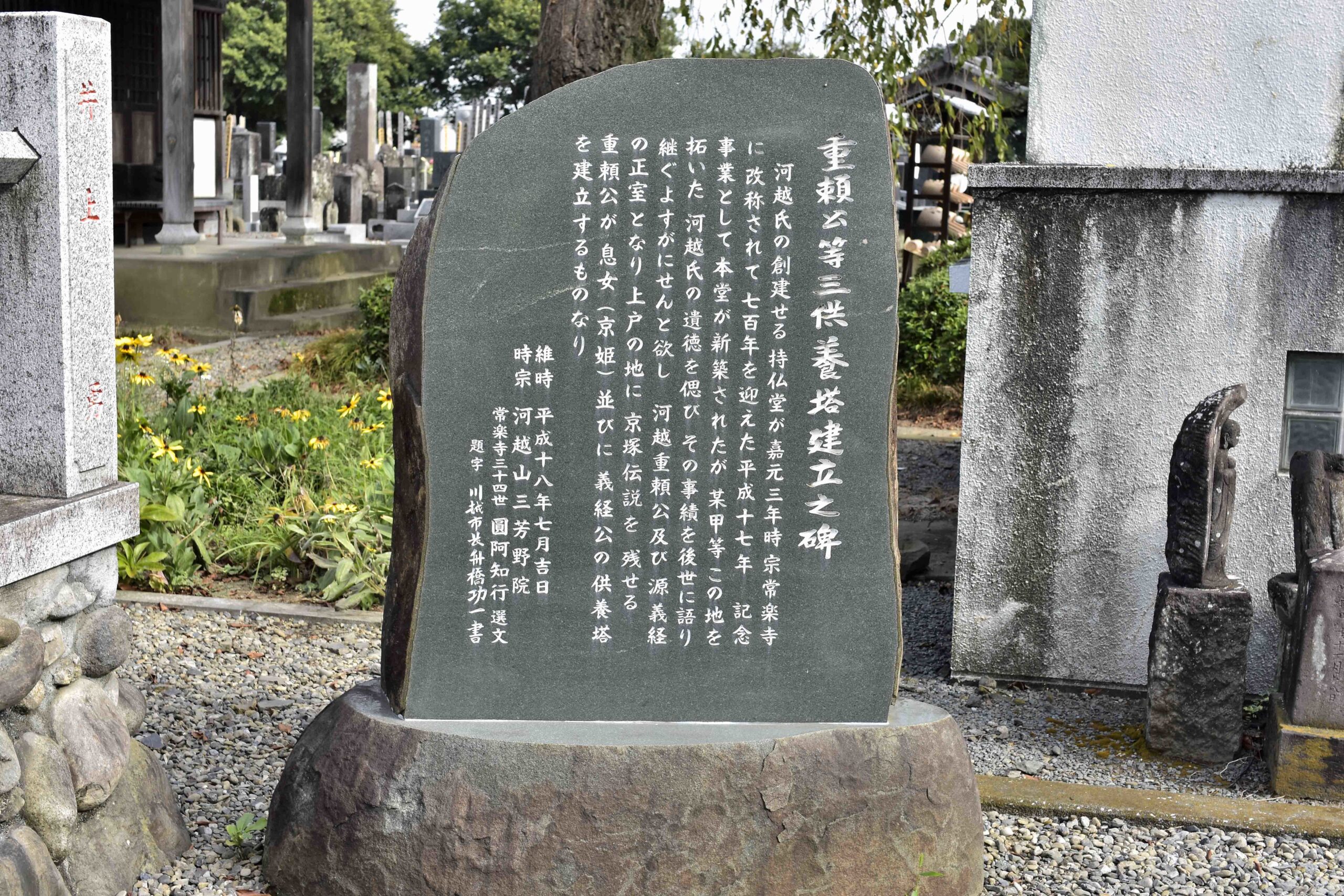
The Five-Ring Pagoda Said to Be the Grave of Ito Sukechika
In present-day Ohara, Ito City, Shizuoka Prefecture, there stands a five-ring pagoda that is traditionally believed to be the grave of Ito Sukechika.
It is a designated historic site of Ito City.
The pagoda is made of andesite and stands 140.5 centimeters tall.
However, it is not believed that the current pagoda was built during Sukechika’s time.
According to cultural property surveys by Ito City, the components of the pagoda were made at different times.
The sky, wind, and fire rings are thought to date from the early 14th century, while the earth ring is from the 13th century.
There is a gap from 1182, the year Sukechika is recorded to have died in the “Azuma Kagami.”
Therefore, the current pagoda cannot be considered a grave marker erected immediately after Sukechika’s death.
There are no definitive records of where Sukechika was actually buried.
Nevertheless, the people of Ito have passed down this site as Sukechika’s grave.
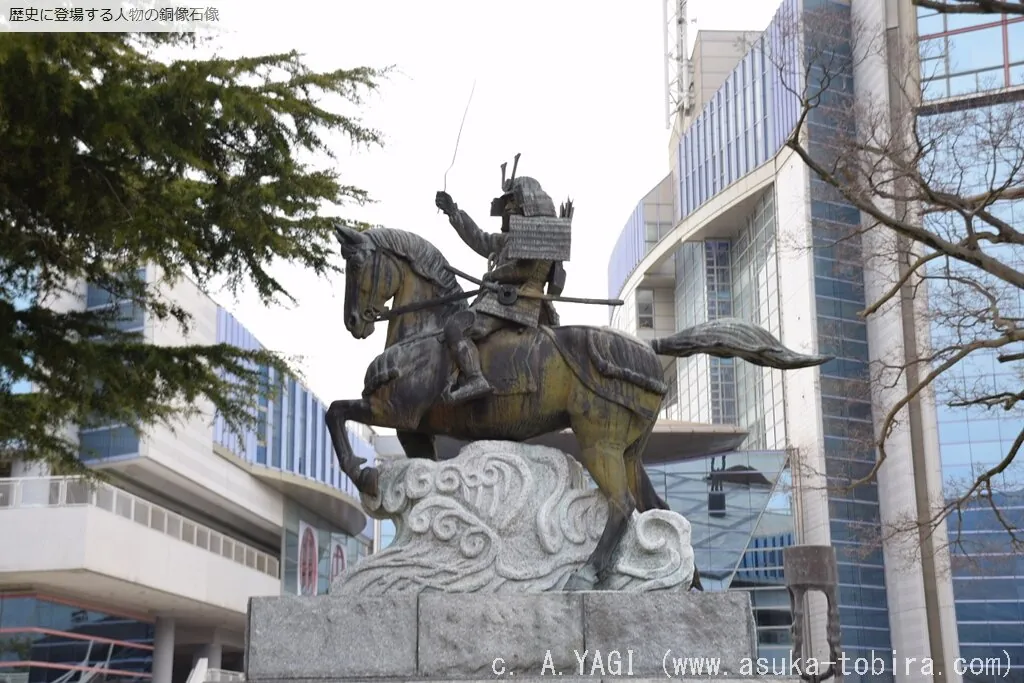
Near Ito City Hall, in Monomizuka Park, there is also an equestrian statue of Sukechika.
Once a warrior who fought against Yoritomo on the side of the Taira, he is now remembered as a representative figure in Ito’s history.
The land where Sukechika established his power still bears his name today.
Legends of Yaehime and Chizurumaru in Ito
In Ito City, there are places that tell of the relationship between Sukechika’s daughter and Yoritomo.
Around Otonashi Shrine, there is a legend that Yoritomo and Sukechika’s daughter met there many times.
At Saisho-ji Temple, stories related to the tragedy of Chizurumaru are passed down.
Shinju-in Temple in Izu no Kuni City is also known as a place connected to Yaehime.
These legends have often been introduced when recounting Yoritomo’s time in exile.
Sukechika is often depicted as the person who, in anger over his daughter’s relationship with Yoritomo, ordered Chizurumaru to be killed.
However, it is difficult to confirm the detailed course of events from sources close to that time.
Various versions of the “Soga Monogatari” and “Heike Monogatari” contain stories depicting the relationship between the daughter and Yoritomo.
However, the “Azuma Kagami” does not have entries directly mentioning Yaehime’s real name or the killing of Chizurumaru.
The reason Sukechika attempted to kill Yoritomo cannot be explained solely by the relationship with his daughter.
In historical records, Sukechika appears as a powerful lord of Izu, who followed the Taira regime and opposed Yoritomo’s uprising.
Later, it is confirmed from the “Azuma Kagami” that he was captured by Yoritomo and entrusted to his son-in-law, Miura Yoshizumi.
On the other hand, the tragedy of Sukechika’s daughter and Chizurumaru spread through later stories and local legends.
In the land of Ito, alongside these stories, memories of the era when Sukechika was active are preserved.
The Man Miura Yoshizumi Was Waiting For
February 14, 1182.
Miura Yoshizumi was waiting for Sukechika to present himself to Yoritomo.
Nearly a year and four months had passed since he had taken custody of Sukechika.
Amid rumors of Masako’s pregnancy, Yoshizumi pleaded for Sukechika’s life and finally obtained Yoritomo’s pardon.
Sukechika replied that he would come upon hearing the news.
Sukechika never appeared before Yoshizumi.
Sukechika was a warrior with significant holdings in Izu.
He clashed over these lands with his kinsman, Kudo Suketsune, and lost his heir, Kawazu Sukeyasu.
One of his daughters was married to Miura Yoshizumi, who supported Yoritomo.
His son, Sukekiyo, aided Yoritomo by revealing his father’s plot to kill him.
Despite this, Sukechika did not support Yoritomo’s uprising.
At Ishibashiyama, he led over 300 horsemen and positioned them behind Yoritomo’s forces.
Even after Yoritomo’s defeat and escape to Awa, Sukechika remained with the Taira faction and attempted to join Taira no Koremori‘s forces.
He was captured on the way.
The long-time adversary Yoritomo sought to pardon Sukechika’s crimes.
The “Azuma Kagami” records that upon hearing this news, Sukechika was ashamed of his past actions and took his own life.
Why did Sukechika choose death at that moment? His exact words have not been preserved.
The reply Sukechika gave to Yoshizumi was that he would present himself to Yoritomo.
Yoshizumi believed these words and awaited Sukechika.
It was after this that a retainer came rushing in.
“Upon receiving the words of pardon, he was ashamed of his previous conduct and suddenly committed suicide.”
The “Azuma Kagami” records it thus.
Yoshizumi hurried to the scene, but Sukechika had already passed away.
Sukechika, who had said he would present himself to Yoritomo, never fulfilled those words.