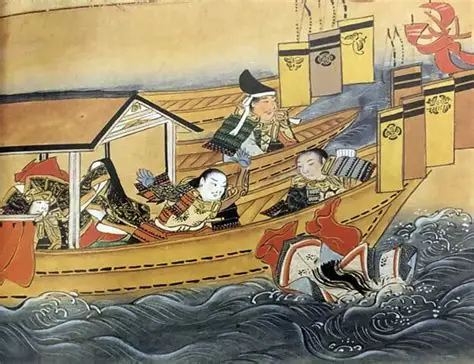
In July of the second year of Juei (1183), the Taira clan departed Kyoto, heading westward.
Having suffered a crushing defeat at the hands of Minamoto no Yoshinaka in the Hokuriku region, the Taira lost the forces necessary to defend the capital. They fled with Emperor Antoku and the Imperial Regalia.
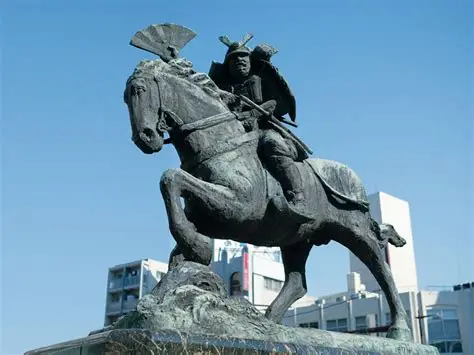
During this retreat, it is said that one warrior turned his horse back.
That warrior was Taira no Tadamasa, the Governor of Satsuma.
Taira no Kiyomori‘s half-brother, he was also renowned as a master of waka poetry.
According to the “Tale of the Heike,” Tadamasa returned to Kyoto with only a few attendants and visited the residence of his poetry mentor, Fujiwara no Shunzei.
From the seams of his armor, he took out a scroll.
On it were over a hundred waka poems that Tadamasa had composed over the years, those he deemed his finest.
Tadamasa entrusted these poems to Shunzei.
As he was about to engage in battle in the west, he had no assurance of returning to Kyoto. He wished for at least one of his poems to be included in an imperial anthology.
It is said that Shunzei accepted the scroll and bid him a sorrowful farewell.
More than half a year later, on February 7th of the third year of Juei (1184),
Tadamasa was killed by Okabe Rokuyata of the Genji faction at the Battle of Ichinotani.
The “Tale of the Heike” describes how Tadamasa’s right arm was severed in combat, and he was ultimately beheaded while chanting a Buddhist prayer.
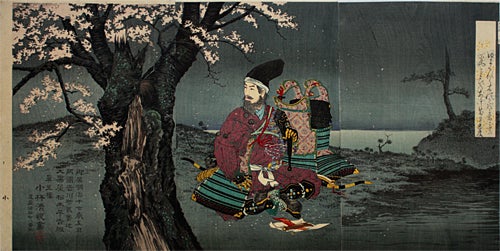
When the warrior who defeated him opened the paper tied to Tadamasa’s quiver, he found a waka poem written there.
“As evening falls, if I make my lodging beneath the trees, will the blossoms be my hosts tonight?”
Beneath it was the name “Tadamasa.”
Meanwhile, in the “Senjūshū,” an imperial anthology compiled after Tadamasa’s death, only one poem attributed to him was included.
However, his name was not recorded in the author’s section.
“Author unknown.”
As a Taira warrior who fought against the imperial court, Tadamasa’s name was omitted, leaving his poem anonymously in the imperial anthology.
Born as the sixth son of Taira no Tadamori
Taira no Tadamasa was born in the first year of Ten’yō (1144) as the sixth son of Taira no Tadamori.
His father, Taira no Tadamori, was a samurai who led the Ise Taira clan and expanded his influence by gaining the trust of the Retired Emperor Toba.
He was involved in suppressing pirates in the Seto Inland Sea and guarding the imperial court, which helped him rise in rank and status within the court.
Tadamori’s children included Taira no Kiyomori, Iemori, Tsunemori, Norimori, and Yorimori.
Tadanori was Kiyomori’s half-brother and belonged to the younger generation within the family.
Kiyomori was born in 1118, making him 26 years older than Tadanori.
By the time Tadanori was born, Kiyomori was already an adult and active as an official at the imperial court.
On the other hand, there are various theories regarding Tadanori’s mother.
Genealogical records mention her as the daughter of Fujiwara no Tametada, though there are alternative theories suggesting a different mother.
Fujiwara no Tametada was a poet from the late Heian period, and his children, Jakunen, Jakucho, and Jakunen, were also known for their love of waka poetry.
Additionally, in the first volume of the “Tale of the Heike,” there is an anecdote depicting Tadamori’s interaction with a court lady.
It is said that Tadamori once left a fan with a painting of the moon in the lady’s room.
When other ladies teased the owner of the fan, she responded with a poem.
The poem cleverly played on Tadamori’s name and the moonlight.
The “Tale of the Heike” suggests that this lady became Tadanori’s mother.
However, there are no detailed records of the lady’s real name or background.
There are discrepancies in the stories and genealogies surrounding Tadanori’s mother, making it difficult to ascertain her identity.
The Legend of Being Raised in Kumano
There is a legend that Tadanori was born and raised in Kumano, in the province of Kii.
This area corresponds to the southern part of present-day Wakayama Prefecture.
During the Heian period, Kumano was an important religious site visited by members of the imperial family and nobility.
The three shrines of Kumano—Kumano Hongu, Kumano Shingu, and Kumano Nachi—were frequented by Retired Emperors Shirakawa, Toba, and Go-Shirakawa.
Tadanori’s father, Tadamori, also served Retired Emperor Toba and had connections with Kumano.
In present-day Kumano River Town, Shingu City, Wakayama Prefecture, there is a place said to be Tadanori’s birthplace.
Local tradition holds that Tadanori was born along the Otogawa River in Kumano.
His mother is said to have been a woman with ties to Kumano, and Tadanori reportedly grew up in the area from a young age.
There is also a story that he lived in Kumano until around the age of 18, when he accompanied his brother Kiyomori, who was visiting Kumano, to Kyoto.
However, there are few contemporary records to substantiate the details of his birthplace or early years.
Local tradition also suggests that his mother was the daughter of Kumano Betto Tankai, but the “Azuma Kagami” records that Tankai’s daughter became Tadanori’s wife.
It is possible that stories about his mother and wife have been confused over time.
Meanwhile, in the “Tale of the Heike,” “The Last Days of Tadanori” describes him as “raised in Kumano.”
He is depicted as a powerful and agile warrior.
The historical association of Tadanori with Kumano is longstanding, and later marital ties confirm connections with the Kumano Betto family.
The Death of His Father Tadamori and the Rise of Kiyomori
On January 15, 1153, Taira no Tadamori passed away.
Tadanori was ten years old by traditional Japanese age reckoning.
After their father’s death, the leadership of the Taira clan was taken up by his eldest brother, Kiyomori.
In 1156, the Hogen Rebellion erupted in Kyoto.
The conflict arose from the rivalry between Emperor Go-Shirakawa and the retired Emperor Sutoku, with Kiyomori siding with Emperor Go-Shirakawa and contributing to their victory.
Minamoto no Yoshitada also joined the same side, defeating Minamoto no Tameyoshi and others on the side of Emperor Sutoku.
In 1159, the Heiji Rebellion broke out.
Kiyomori defeated the forces of Fujiwara no Nobuyori and Minamoto no Yoshitada, strengthening his military position in Kyoto.
Yoshitada was eventually killed after fleeing, and his son Yoritomo was exiled to Izu Province.
By the end of the Heiji Rebellion, Tadanori was sixteen years old by traditional reckoning.
There are no detailed records of how Tadanori himself was involved in these two internal conflicts.
However, through these turbulent times, Kiyomori expanded his power, and the younger members of the Taira clan began to attain high positions at court.
In 1167, Kiyomori was appointed as the Grand Minister of State.
Following this, Kiyomori’s sons and brothers occupied key positions in the court, and the Taira clan gained significant influence in court politics.
Tadamori, as a prominent member of his clan, also secured official positions and began serving the imperial court.
From Saemon no Suke to Governor of Satsuma
Although Tadamori was born into a warrior family, he also served as an official at the imperial court.
It is known that by the second year of Kaō (1170), he held the position of Saemon no Suke.
The Saemon no Suke was a deputy officer in the Right Division of Outer Palace Guards, responsible for security within the palace.
In the second year of Jishō (1178), he was promoted to the senior fourth rank, upper grade.
In November of the following year, Jishō 3, he was appointed as Governor of Hōki, and by Jishō 4, he became Governor of Satsuma.
Hōki Province corresponds to the western part of present-day Tottori Prefecture, while Satsuma Province is in the western part of Kagoshima Prefecture.
The title “Governor of Satsuma Tadamori” was derived from this official position.
At the time, nobles and warriors appointed as provincial governors did not necessarily travel to their assigned provinces.
There are few records indicating that Tadamori went to Satsuma Province to manage local administration.
Many members of the Taira clan were appointed as provincial governors while remaining in Kyoto, and Tadamori is thought to have been involved in the clan’s political and military affairs while holding his official position.
Regarding his final rank, some records state it as senior fourth rank, upper grade, while genealogies like the ‘Sonpi Bunmyaku’ list it as junior fourth rank, lower grade.
He is generally introduced as junior fourth rank, lower grade, and Governor of Satsuma.
Tadamori’s familiarity with court society extended beyond official duties and ceremonies.
Waka poetry also played a significant role in his life.
Learning Waka from Fujiwara no Shunzei
Tadamori’s renowned waka teacher was Fujiwara no Shunzei.
Shunzei was born in the second year of Eikyū (1114).
He was 30 years older than Tadamori and a leading poet of the late Heian period.
He was also the father of Fujiwara no Teika, who later became a compiler of the ‘Shin Kokin Wakashū’.
In the aristocratic society of the time, the ability to compose waka was an essential cultural skill.
At poetry gatherings and contests, participants composed poems on themes such as the seasons or love, competing in expression and technique.
In poetry contests, participants were divided into left and right teams, and judges determined the winners.
Tadamori consistently participated in these poetic activities.
In the first year of Jōan (1171), he submitted a poem to a contest hosted by his brother, Taira no Tsunemori.
Tsunemori was also fond of waka and music, maintaining connections with the court’s poetic circles.
Tadamori further participated in poetry contests organized by Fujiwara no Tameyasu and the Betsurai Shrine poetry contest in the second year of Jishō (1178).
Betsurai Shrine corresponds to the present-day Kamigamo Shrine.
He also attended poetry gatherings hosted by Prince Shukaku of Ninna-ji Temple and even held poetry contests at his own residence.
For Tadamori, waka was indispensable for social interactions at court.
At the same time, he repeatedly submitted his works to poetry gatherings, receiving evaluations from esteemed poets.
The anecdote of entrusting a scroll of over a hundred poems to Shunzei later in life is linked to his long-standing dedication to the way of poetry.
Plum Blossoms and Fireflies in the ‘Tadamori Collection’
Tadanori’s poetry was later compiled into collections known as the ‘Tadanori-shu’ and the ‘Heike Tadanori Asomi-shu.’
Today, several manuscripts still exist, providing insights into his works.
However, there are uncertainties regarding the compilation and transmission of these collections, and differences can be found in the prefaces and the texts of the poems among the manuscripts.
Tadanori composed poems on a variety of themes, including spring flowers, summer fireflies, the autumn moon, and the emotions of love.
There is a poem about plum blossoms.
“Plum blossoms, I wish to see them even in my dreams at night, as their fragrance lingers in the darkness of reality.”
He wishes to see the plum blossoms in his dreams at night.
The night is dark, and the flowers are not visible. However, their fragrance alone drifts through the darkness.
Tadanori juxtaposed the visible flowers with the fragrance that remains in the night.
There is also a poem about fireflies.
“With a burden of feelings too great for its small body, the firefly flies aimlessly.”
The “feelings” also carry the meaning of “fire,” linking the firefly’s light with human emotions.
These poems reveal that Tadanori had studied traditional waka expressions and techniques.
Additionally, the ‘Tadanori-shu’ includes a poem about waking up on an autumn night.
“Awakened by the sound of the wind on a deep autumn night, I think of the remnants of an unfinished dream.”
This poem is also featured in Kamo no Chomei’s ‘Mumyosho.’
Chomei appreciated it not for any striking theme, but for the depth in the flow of words and the elegance of expression.
Tadanori’s poetry was known among poets from his time through the Kamakura period.
Marriage to the Daughter of Kumanobetto Tankai
Tadanori was married into the Kumanobetto family.
His wife is recorded as the daughter of Kumanobetto Tankai.
Tankai was an influential monk associated with the Kumano Sanzan, deeply connected not only to religious authority but also to various estates.
According to the ‘Azuma Kagami’ entry for February 19, 1185, Tankai’s daughter was initially married to Gyokai Sodo.
Gyokai was also a member of the Kumanobetto family.
Subsequently, she remarried Tadanori.
Through this marriage, Tadanori gained rights to the estates managed by the Kumanobetto family.
The exact timing of the marriage and the wife’s real name are not well-documented.
Tadanori’s child, Tadayuki, is mentioned in genealogies, but details about his mother and background remain unclear.
On the other hand, the marriage to Tankai’s daughter is specifically confirmed through records related to the estates.
The Taira clan had connections with the Kumano temple-shrine complex and maritime routes.
Through marriage, Tadanori also strengthened his ties with the influential figures of Kumano.
Furthermore, the land transferred through this marriage was closely associated with Tadanori’s poetry mentor, Fujiwara no Shunzei.
The Estate in Mikawa Province Developed by Fujiwara no Shunzei
Tadanori and Fujiwara no Shunzei had connections beyond poetry.
These were the Takeya and Kamagata estates in Mikawa Province.
This land corresponds to the area around present-day Gamagori City in Aichi Prefecture.
The “Azuma Kagami” entry for February 19, Genryaku 2, details the history of these two estates from their establishment until after Tadanori’s death.
Originally, it was Fujiwara no Shunzei who developed both estates.
Shunzei served as the governor of Mikawa during the Kyuan era, and it is believed that he was involved in the development of the area at that time.
Shunzei donated the Takeya and Kamagata estates to the Kumano Shrine.
Subsequently, the Kumano Betto Tankai took possession of both estates and passed them on to his daughter.
The daughter first transferred the rights to her initial husband, Gyokai.
However, upon remarrying Tadanori, those rights were transferred to him.
The land developed by Shunzei was thus passed to Tadanori through the marital connections of the Kumano Betto family.
The precise relationship between the transfer of these estates and the period when the two formed a master-disciple relationship in poetry is unclear.
Tadanori was active in the court poetry circles for a long time and interacted with Shunzei through poetry.
On the other hand, it turns out that the disciple acquired through marriage the estates once developed by his master.
After Tadanori’s death, these two estates became a matter of concern again under Minamoto no Yoritomo.
What Tadanori lost on the battlefield was not only his life but also the estates he had gained through marriage.
The Uprising of Prince Mochihito and the Battle with the Minamoto
In the fourth year of the Jisho era (1180), resistance against the Taira clan began to emerge in various regions.
In May, Prince Mochihito, the son of Emperor Go-Shirakawa, and Minamoto no Yorimasa raised an army.
They attempted to head to Nanto via Onjoji, but were caught by the Taira forces near the Uji River.
The Taira forces defeated them, and Yorimasa committed suicide at Byodoin.
Prince Mochihito was also killed on his way to Nara.
The “Tale of the Heike” mentions Tadanori as a Taira general involved in the pursuit.
However, detailed records of which unit he led and what specific actions he took at the Uji River are limited.
Although the initial uprising was suppressed, resistance against the Taira clan spread across various regions.
In August, Minamoto no Yoritomo raised his banner in Izu Province.
In Shinano Province, Minamoto no Yoshinaka (Kiso Yoshinaka) expanded his influence, and anti-Taira warriors began to gather in the eastern provinces and Hokuriku.
Taira no Kiyomori dispatched a large army along the Tokaido to defeat Yoritomo.
Tadamasa was also to join this expedition.
The Battle of Fujikawa—To the East with His Nephew Koremori
In October of the fourth year of Jisho, the Taira clan advanced their forces along the Tokaido to confront Minamoto no Yoritomo’s army.
The overall commander was Taira no Koremori.
He was the son of Shigemori, Kiyomori’s heir, and a key figure in the next generation of the clan.
Tadamasa is said to have joined this force, acting as a deputy commander.
Koremori was Tadamasa’s nephew.
Although Tadamasa was older, Koremori, being connected to Kiyomori’s direct line, was appointed as the overall commander.
The Taira army set up camp near the Fuji River in Suruga Province.
Yoritomo also led his forces westward, and the two armies faced each other across the river.
According to the “Heike Monogatari,” the Taira army was so intimidated by the momentum of the eastern warriors that they were unsettled even before the battle began.
Then, at night, they mistook the sound of waterfowl taking flight for an attack by the Minamoto forces, panicked, and retreated.
This is the famous anecdote of the waterfowl at the Fuji River.
However, it is difficult to attribute the Taira army’s retreat solely to the sound of the waterfowl’s wings.
Factors such as the movements of the eastern warriors, logistics, and internal issues within the army were also believed to have played a role.
The Taira army returned to Kyoto without engaging in a decisive battle with Yoritomo’s forces.
For Tadamasa, it was an expedition that yielded no results.
Meanwhile, Yoritomo expanded his influence in the eastern provinces, gathering warriors who refused to follow the Taira.
The Death of Kiyomori and The Battle of Sunomata River
On the 4th day of the intercalary second month of the fifth year of Jisho (1181), Taira no Kiyomori passed away.
The leadership of the Taira clan fell to Kiyomori’s son, Taira no Munemori.
In military matters, Tomomori and Shigehira also played significant roles, and Tadamasa continued to be a prominent figure within the clan.
In March of the same year, near the Sumiyoshi River in Owari Province, the forces of the Taira clan clashed with the troops of Minamoto no Yukie.
Yukie was the son of Minamoto no Tameyoshi and the uncle of Yoritomo and Yoshitsune.
He was also the figure who spread the imperial edict of Prince Mochihito to the Minamoto clan across the regions, calling for the overthrow of the Taira.
On the Taira side, the forces led by Shigehira confronted Yukie’s army.
In military chronicles, Tadamori also appears as a Taira commander, but it is difficult to trace his exact role from contemporary records.
According to the “Azuma Kagami,” Yukie’s forces attempted a nighttime crossing of the Sumiyoshi River to launch a surprise attack on the Taira camp.
However, the Taira forces, having detected this movement, counterattacked, leading to Yukie’s defeat.
Yukie retreated, and Minamoto no Yoshikata, Yoritomo’s half-brother, was killed in action.
Although the Taira won at the Sumiyoshi River, they could not weaken Yoritomo’s power in the eastern provinces.
Meanwhile, in the north, Minamoto no Yoshinaka was expanding his influence, prompting the Taira to dispatch another large army.
Tadamori also joined the next expedition to the north.
Kurikara Pass—A Major Defeat in the North
In the second year of Juei (1183), the Taira dispatched a large army to the Hokuriku region to defeat Minamoto no Yoshinaka.
The overall commander was Taira no Korehira.
Tadamori joined as a deputy commander, playing a significant role in the Taira forces.
The Taira army advanced into Echizen Province and attacked Hiuchi Castle.
Hiuchi Castle was a stronghold defended by Yoshinaka’s forces, which the Taira overcame to push further north.
They then moved from Kaga Province towards Etchu Province.
Meanwhile, Yoshinaka gathered local warriors in the north to prepare for the Taira’s advance.
On May 11, near Kurikara Pass, close to the border between Kaga and Etchu Provinces, the two armies clashed fiercely.
The Taira forces suffered a major defeat at the hands of Yoshinaka’s troops.
The “Heike Monogatari” recounts how Yoshinaka divided his forces to encircle the Taira army and drove them into the valley.
There is also the famous tale of fire oxen, where torches were tied to oxen horns and driven into the enemy lines.
These tactics are largely described in military tales, leaving some uncertainties about the actual forces and battle conditions.
Details about which unit Tadamori led in this battle are also scarce.
However, it is certain that the Taira army suffered significant losses in the north and could not halt Yoshinaka’s advance.
Subsequently, the Taira forces were pursued by Yoshinaka’s troops in Shinohara, Kaga Province.
The expedition to the Hokuriku region ended in failure, and the Taira retreated to Kyoto.
This ultimately led to their flight from the capital.
The Taira Clan Leaves Kyoto
After his victory at Kurikara Pass, Yoshinaka advanced from the Hokuriku Road to Omi Province.
The Taira had lost much of their main force, making it difficult to defend Kyoto.
In July of the second year of Juei, Emperor Go-Shirakawa secretly left the capital and moved to Mount Hiei.
Unable to secure the emperor, the Taira decided to head west with Emperor Antoku and the Imperial Regalia.
On July 25, the Taira clan departed from Kyoto.
Their residences in Rokuhara and Nishihachijo were set ablaze, and the Taira’s long-established bases were lost.
Tadamori also followed the clan in their flight from the capital.
He was 40 years old.
Tadamori, who had participated in battles at Fujikawa and the Hokuriku expedition as a Taira general, now found himself expelled from the capital.
Although there were plans to regroup the forces in the west, it was uncertain when they could return to Kyoto.
In such circumstances, what weighed on Tadamori’s mind was the waka poetry he had devoted himself to for many years.
According to the “Tale of the Heike,” Tadamori, having once left the capital, turned his horse around midway.
His destination was Gojo Kyogoku.
It was the residence of Fujiwara no Shunzei.
Returning to Shunzei’s Residence at Gojo Kyogoku
In the seventh volume of the “Tale of the Heike,” “Tadamori’s Flight from the Capital,” Tadamori’s return to the capital is depicted.
It is said that Tadamori returned to Kyoto with five samurai and one page, making a total of seven riders including himself.
Upon arriving at Shunzei’s residence, the gate was firmly closed.
With the Taira clan having left the capital and the Genji forces advancing on Kyoto, chaos reigned.
In the midst of this turmoil, a prominent Taira general returned.
When Tadamori announced himself, it is said that people inside the residence began to stir.
The fugitive had returned.
This is how it was perceived, according to the “Tale of the Heike.”
Tadamori dismounted and called for Shunzei to come near the gate, as he had something to convey.
Hearing Tadamori’s voice, Shunzei ordered the gate to be opened.
The two finally met face to face.
The “Tale of the Heike” describes how Shunzei, while delighted at their reunion, lamented that Tadamori would have to leave the capital once more.
It is impossible to verify from contemporary records whether he truly returned with seven riders or what exchanges took place at the gate.
However, this scene became one of the most well-known anecdotes of Tadamori’s life.
Then, Tadamori took out a scroll he had brought with him.
A Hundred Poems Drawn from His Armor
According to the “Tale of the Heike,” Tadamori drew out a scroll from the seams of his armor.
In it, there was a collection of over a hundred waka poems that he believed were his finest works.
Tadanori presented this scroll to Shunzei.
In the second month of the second year of Juei, Shunzei had been ordered by Emperor Go-Shirakawa to compile an imperial anthology of waka poetry.
However, the ongoing Genpei War had hindered progress on this task.
Tadanori was aware of this situation.
Therefore, he expressed his hope that when peace returned and the compilation resumed, at least one of his poems might be selected.
The Taira clan was about to fight in the western provinces.
They might sink into the sea and never return to Kyoto.
Even so, if his work were to be included in the imperial anthology, it would make all his years of studying waka worthwhile.
The Tale of the Heike records that Tadanori conveyed these feelings to Shunzei.
Shunzei accepted the scroll and promised not to treat it lightly.
It is said that he was moved to tears by Tadanori’s visit in such dangerous times.
The scroll containing over a hundred poems has not been found today.
Moreover, it is unclear whether Shunzei directly used this scroll when he later included Tadanori’s poem in the “Senzai Wakashu.”
On the other hand, it is confirmed from his participation in poetry contests and surviving works that Tadanori had composed many poems and interacted with Shunzei for some time.
The Tale of the Heike intertwines his passion for waka with the scene of his departure from the capital.
Parting with Shunzei—Tadanori Heads West
After entrusting the scroll, Tadanori bid farewell to Shunzei.
The Tale of the Heike records words to the effect that he had no regrets left.
He did not mind if he were to sink into the western seas or if his body were left exposed in the fields and mountains.
With these words, Tadanori mounted his horse.
Shunzei watched his retreating figure from the gate of his residence.
Tadanori tightened the cords of his helmet and began his journey westward.
After a while, a voice was heard from afar.
“The road ahead is long, my thoughts race to the evening clouds over Mount Karigane.”
This phrase, derived from a Chinese poem by Oe no Asatsuna, is also found in the “Wakan Roeishu.”
It expressed the sentiment that the journey ahead was long and his thoughts were directed far away.
The Tale of the Heike tells that Shunzei heard this voice and felt even more sorrow at their parting.
Thus, Tadanori returned to join the Taira clan.
Shunzei remained in Kyoto and eventually resumed the compilation of the imperial anthology.
Meanwhile, Tadanori headed to the western provinces for battle.
From Kyushu to Yashima—The Taira’s Reorganization
The Taira, having fled the capital, first sought to regroup in Kyushu.
However, they faced resistance from local forces like Ogata Koreie of Bungo Province and could not establish a stable base.
Subsequently, the clan moved to Yashima in Sanuki Province.
Yashima, located in present-day Takamatsu City in Kagawa Prefecture, was a crucial location due to its access to maritime routes in the Seto Inland Sea.
The Taira clan gathered samurai from the Shikoku and Chugoku regions to reorganize their forces.
In the intercalary month of October in the second year of Juei, they defeated the forces dispatched by Minamoto no Yoshinaka at Mizushima in Bitchu Province.
Furthermore, in November, they crushed the forces of Minamoto no Yukie at Muroyama in Harima Province.
With these victories, the Taira clan advanced once more from Harima towards Settsu.
It is believed that Tadanori was also active in the western regions with his family, but detailed records of which units he commanded at Mizushima or Muroyama are scarce.
Meanwhile, in Kyoto, tensions between Minamoto no Yoshinaka and Emperor Go-Shirakawa were escalating.
On January 20, 1184, in the third year of Juei, the forces led by Noriyori and Yoshitsune, dispatched by Yoritomo, defeated Yoshinaka.
Yoshinaka himself was killed in battle at Awazu in Omi Province.
With Kyoto secured, the Genji forces then turned their attention to pursuing the Taira clan.
The Taira clan established a defensive line around Fukuhara to confront the Genji forces.
Tadanori was positioned as the commander defending the western side.
Tadanori Defends the West of Ichinotani
In February of the third year of Juei, the Taira clan had stationed their forces from Fukuhara to Ichinotani.
In the eastern Ikuta Forest were Taira no Tomomori and Taira no Shigehira and others.
In the western Ichinotani area, Tadanori and his forces were stationed.
To the north, mountains loomed, while to the south lay the expanse of the Seto Inland Sea.
The Taira clan aimed to utilize this terrain to halt the advance of the Genji forces.
In “The Tale of the Heike,” Tadanori is depicted as the general defending the western side of Ichinotani.
He was 41 years old.
Among his family, he was one of the older warriors and had experience in military campaigns along the Tokaido and in the Hokuriku region.
Meanwhile, the Genji forces were preparing to launch attacks from multiple directions.
The main force led by Noriyori advanced from the east towards Fukuhara.
Yoshitsune maneuvered through the Tanba region to flank the western side of the Taira forces.
Between February 4 and 5, Yoshitsune’s forces launched a night attack on the forces of Taira no Sukemori and Taira no Tomomori at Mikusayama, defeating them.
The Taira clan lost their forces guarding the mountain routes, allowing Yoshitsune’s forces to approach.
Then, on February 7, the Genji and Taira forces clashed at Ichinotani.
February 7th—The Collapse of the Taira Defensive Line
On February 7, 1184, the Battle of Ichinotani commenced.
In the east, at the Ikuta Forest, Noriyori’s forces clashed with Taira no Tomomori and Taira no Shigehira.
In the west, at the Ichinotani entrance, Kumagai Naozane and Hirayama Sueshige competed to be the vanguard.
Additionally, Genji forces advanced from the mountain side.
The “Heike Monogatari” depicts Yoshitsune galloping down a steep slope with mounted warriors, launching a surprise attack on the Taira camp.
This scene later became known as the “descent of Hiyodorigoe.”
Meanwhile, the diary “Gyokuyo” by Kujo Kanezane records that Tada Yukitsuna broke through the mountain-side defenses.
There is debate about the roles of Yoshitsune and Yukitsuna, as well as the actual attack routes.
The Taira defensive line was breached from multiple directions, forcing the commanders to retreat to the coast.
Although the Taira fleet was afloat offshore, not everyone managed to escape by ship.
Tadamori was among the retreating forces.
According to the “Heike Monogatari,” Tadamori, surrounded by about a hundred warriors, was retreating on a black horse.
He wore a dark blue brocade hitatare and armor laced with black threads.
The horse was equipped with an impressive saddle.
Tadamori reportedly did not appear panicked, occasionally halting his horse to counter the pursuing Genji forces.
It was this sight that caught the attention of Okabe Rokuyata, a warrior from Musashi Province.
Okabe Rokuyata Spots Tadamori
Okabe Rokuyata was a samurai belonging to the Inomata faction of Musashi Province.
He is generally known by the name Okabe Tadamasa.
However, in certain versions of the “Heike Monogatari,” such as the Kakuichibon, he is referred to as “Okabe Rokuyata Tadasumi,” indicating variations in name representation.
The Okabe clan was a samurai family based in Okabe, Hanzawa District, Musashi Province.
Rokuyata followed Minamoto no Yoritomo’s forces and participated in the Battle of Ichinotani.
According to the “Heike Monogatari,” Rokuyata spotted a distinguished-looking commander among the retreating Taira forces.
Believing him to be a leader of significance, he spurred his horse to catch up.
Rokuyata asked for the man’s name.
However, Tadamori replied that he was an ally.
At that moment, Tadamori raised his face.
Rokuyata noticed that the teeth visible from inside the helmet were blackened.
This was due to ohaguro, the practice of blackening teeth.
At the time, ohaguro was associated with the grooming of those serving in the court.
From this observation, Rokuyata concluded that his opponent was a noble from the Taira clan.
It is said that he then rode alongside and grappled with Tadanori.
Tadanori’s Right Arm Severed
In “The Tale of the Heike,” particularly in the “Tadanori’s Last Stand” section, Tadanori is portrayed as a very powerful warrior.
He was raised in Kumano and was said to possess exceptional strength and agility.
When Rokuyata grappled with him, Tadanori drew his sword to counterattack.
It is recounted that he struck twice while on horseback and once more after falling from his horse.
However, the first two strikes were deflected by armor, and the final blow only inflicted a shallow wound.
Eventually, both men fell from their horses and continued their struggle on the ground.
Tadanori pinned Rokuyata down and attempted to take his head.
At that moment, Rokuyata’s retainer rushed to his aid.
According to “The Tale of the Heike,” the retainer approached from behind and severed Tadanori’s right arm at the elbow.
With his arm lost, Tadanori could no longer continue the fight.
Yet, it is said that with his remaining left hand, he grabbed Rokuyata and hurled him a bow’s length away.
Tadanori then requested a brief respite.
He wished to chant a Buddhist prayer one last time.
The Final Prayer
According to “The Tale of the Heike,” Tadanori turned westward and began to chant a prayer.
Furthermore,
“The light of Amida Buddha shines throughout all worlds, embracing and never abandoning those who chant the nembutsu.”
He is said to have recited these words.
The phrase signifies that Amida Buddha’s light illuminates all worlds, saving and never forsaking those who chant the nembutsu.
Before he could finish the prayer, Rokuyata approached and beheaded Tadanori.
He was 41 years old by count.
Tadanori’s death at Ichinotani is also recorded in the “Azuma Kagami.”
However, the detailed account of the struggle with Rokuyata, the severing of his right arm, and the final words he uttered are primarily depicted in “The Tale of the Heike.”
The exact location of the battle and the words exchanged remain unclear.
Nonetheless, the name of Okabe Rokuyata as the one who defeated Tadanori is widely known, and there are traditions in his native Musashi Province that commemorate Tadanori.
“The Tale of the Heike” notes that Rokuyata, despite taking the head, did not know the identity of his opponent.
It was a poem tied to a quiver that revealed his identity.
The “Flower of the Traveler’s Lodging” Poem
After taking Tadanori’s head, Rokuyata was convinced that his opponent was a prominent Taira warrior.
However, they could not extract the name.
According to the Tale of the Heike, Rokuyata discovered a piece of paper tied to Tadanori’s quiver.
A quiver is a piece of armor used to carry arrows on one’s back.
When Rokuyata opened the paper, he found a waka poem written on it.
The poem was titled “The Blossoms of a Traveler’s Lodging.”
“As dusk falls and I make my lodging beneath the trees, will the blossoms be tonight’s host?”
The poem suggests that, as night falls during a journey and one takes shelter under cherry blossoms, the blossoms themselves might serve as the host for the night.
Such was the meaning of the poem.
And on the paper was written “Tadanori.”
It was then that Rokuyata realized the opponent he had defeated was Taira no Tadanori, the Governor of Satsuma.
The Tale of the Heike continues with Rokuyata raising Tadanori’s head high, declaring that he was the one who had slain him.
Those who heard his voice lamented the loss of Tadanori, who was skilled in both martial arts and poetry.
No contemporary records confirm that this poem was actually tied to Tadanori’s quiver.
Nevertheless, “The Blossoms of a Traveler’s Lodging” has been passed down as an essential poem in recounting Tadanori’s final moments.
This poem also contains expressions reminiscent of those by Fujiwara no Kinto.
It draws from the long tradition of cherry blossom poetry, with the motif of seeking a night’s lodging among the flowers.
The name of the warrior who fell at Ichinotani was not revealed through a single arrow or sword in the military tales, but through a poem.
The Heads Sent to Kyoto’s Hachijo Riverbed
After their victory at Ichinotani, the Genji forces sent the heads of the defeated Heike warriors to Kyoto.
According to the Azuma Kagami, there was a debate at the court about whether to display the heads of the Heike clan in the city.
The Heike warriors had long served the court and held high ranks.
There were cautious opinions about displaying their heads.
However, at the request of Noriyori and Yoshitsune, it was ultimately decided to display the heads.
On February 13th, the heads of the Heike warriors were brought to Kyoto’s Hachijo Riverbed.
Among them was the name of Tadanori.
It is recorded that the heads of Taira no Michimori, Taira no Tsunemasa, Taira no Atsumori, and Taira no Moromori were also displayed.
Not only Tadanori, but many warriors related to Kiyomori as brothers, sons, and grandsons lost their lives at Ichinotani.
Meanwhile, Taira no Munemori, Taira no Tomomori, Tsunemori, and Norimori escaped to the sea, continuing their resistance around Yashima.
The Heike still held Emperor Antoku and the Imperial Regalia.
The battle with the Genji would continue until the following year’s Battle of Dan-no-ura.
However, Tadanori himself never returned to Kyoto.
He never again visited the residence of Shunzei, where he had studied poetry.
What Happened to the Estates in Mikawa Province After Tadanori’s Death?
The year after Tadanori was killed in battle at Ichinotani, issues concerning the estates of Takeyasō and Kamagata in Mikawa Province were recorded.
This was on February 19, 1185.
The Azuma Kagami describes in detail the transfer of rights to these estates, which had been developed by Fujiwara no Shunzei.
The land that Shunzei donated to the Kumano Shrine was passed on by Kumano Bettō Tankai to his daughter.
The daughter initially transferred the rights to her first husband, Gyōkai, and later, upon remarrying Tadanori, the rights were transferred to him.
However, Tadanori became an enemy of the court along with the Taira clan and was killed at Ichinotani.
The estates were confiscated and transferred to Minamoto no Yoritomo.
In response, the woman who was Tadanori’s wife sought to reclaim the land.
It is recorded that she asked her former husband, Gyōkai, to cooperate and petition Yoritomo.
In return, she proposed that if the land rights were restored, they would be passed on to a child born between her and Gyōkai in the future.
Gyōkai was a grandson of Minamoto no Tameyoshi and also had a blood relationship with Yoritomo.
According to the Azuma Kagami, Yoritomo accepted Gyōkai’s petition due to this connection and recognized the rights to the estates.
The land that Tadanori had acquired through marriage was thus returned to the Kumano Bettō family after his death.
This event was recorded before the Battle of Dan-no-ura, during the period when the Taira clan was still resisting in the western provinces.
A Poem Preserved in the Senzai Wakashū
Meanwhile, in Kyoto, Fujiwara no Shunzei was advancing the compilation of an imperial anthology of waka poetry.
He was ordered to compile it by Emperor Go-Shirakawa in February 1183.
This was a few months before the Taira clan fled the capital.
The work was delayed due to the Genpei War but resumed after the fall of the Taira clan.
By September 1187, the preface was written, and a formal presentation was made.
On April 22, 1188, a more formal presentation took place, followed by further revisions.
The Senzai Wakashū is an imperial anthology consisting of 20 volumes and approximately 1,288 poems.
In the first volume, “Spring Poems, Part 1,” the 66th poem is attributed to Tadanori.
“The waves of Sazanami, the capital of Shiga is in ruins, yet the mountain cherries bloom as in the past.”
The preface notes that this poem expresses the sentiment of “hometown flowers.”
The capital of Shiga refers to the Ōtsu Palace established during Emperor Tenji’s reign.
The site of the former capital has fallen into ruin, losing its old appearance.
However, on the nearby Mount Nagara, the mountain cherries continue to bloom unchanged.
Tadanori captured this scene in his poem.
“Sazanamiya” is a pillow word associated with Shiga.
The phrase “mukashinagara” carries the dual meaning of “as in the past” and a play on the place name Nagara Mountain.
The contrast between the ruined old capital and the cherry blossoms that bloom unchanged.
This juxtaposition expresses a longing for a bygone era.
This poem is also preserved in the “Tadanori Collection” and is said to have been composed under the theme “Hometown Flowers” in a poetry contest organized by Fujiwara no Tameyasu.
It was not an impromptu poem composed by Tadanori during his flight from the capital, but rather one of the works he had repeatedly composed in poetry circles before.
The Reason for Being Labeled “Anonymous”
This poem included in the “Senzaishu” does not have the author’s name recorded.
“Anonymous”
It is recorded as such.
The “Tale of the Heike” discusses why Shunzei chose Tadanori’s poem but did not reveal his name.
Tadanori left the capital with the Taira clan and fought against the Minamoto forces, dying in battle at Ichinotani.
Because he became an enemy of the court, it was considered inappropriate to include his name in an imperial anthology.
According to the “Tale of the Heike,” Shunzei recalled Tadanori visiting him during his flight from the capital and selected a poem from the scrolls entrusted to him.
However, it is said that he recorded the author as “Anonymous.”
On the other hand, there are no contemporary records where Shunzei himself explains the reasons for his decision in detail.
The story that Tadanori’s name was concealed because he became an enemy of the court is conveyed by the “Tale of the Heike.”
Furthermore, the specific materials Shunzei used when selecting the poems remain unknown.
Nevertheless, the “Senzaishu” indeed contains a poem attributed to Tadanori, with the author’s name omitted.
The anecdote of entrusting the scrolls during his flight from the capital spread as a story explaining how this poem was preserved.
Tadanori’s Name Appears in Later Imperial Anthologies
Tadanori’s poems are not limited to just one in the “Senzaishu.”
His works were also included in later imperial anthologies.
The “Shin Chokusen Wakashu” contains the following love poem:
“Though I am led to expect, the nights pile up without a visit, and even if I resent it, there is no solace but to wait.”
While expecting someone to come, they never visit.
The nights accumulate, and though it is frustrating, ultimately, there is no comfort but to wait.
This poem expresses such feelings of love.
“Tsumori” plays on the meaning of nights accumulating and the poetic pillow of Tsumori in Settsu Province.
Furthermore, it incorporates multiple meanings by playing on “urami” and “ura” (bay), “matsu” and “matsu” (pine tree).
Tadanori composed love poems using such techniques.
His works were also included in the “Gyokuyo Wakashu,” “Zoku Goshui Wakashu,” “Fuga Wakashu,” and “Shin Shoku Wakashu,” among others.
The poems by Tadanori included in imperial anthologies total 11, including the one in the “Senzaishu.”
In later imperial anthologies, works that clearly identified Tadanori’s name were also included.
Additionally, the personal anthology “Tadanori Collection” was transmitted through manuscripts.
Noh Play ‘Tadanori’—The Poet Whose Name Wasn’t Remembered
The story of Tadanori was also featured in a Noh play during the Muromachi period.
This is the Noh play ‘Tadanori’, attributed to Zeami.
The setting of the story is the ancient battlefield of Ichinotani, where Tadanori lost his life.
A monk visits Suma and encounters an old man under a cherry tree.
The old man tells him that the place is related to Tadanori’s grave and asks for prayers before disappearing.
That night, as the monk continues his prayers, the ghost of a warrior appears.
It is Tadanori.
The ghost recounts how he entrusted a waka poem to Shunzei while fleeing the capital.
He laments that although his poem was included in the ‘Senzaishu’, it was attributed to “Anonymous.”
In the Noh play, the fact that his name was not preserved is portrayed as Tadanori’s intense obsession.
The ghost asks the monk to convey a message to Shunzei’s son, Fujiwara no Teika.
He wishes for his name to be added to the imperial anthology.
Tadanori also recounts his final battle with Okabe Rokuyata at Ichinotani, where he was defeated.
Afterward, he disappears, asking for prayers for his soul.
The Noh play ‘Tadanori’ is based on the “Tadanori’s Flight from the Capital” and “Tadanori’s Last Moments” from the ‘Tale of the Heike’.
It is not a record of Tadanori’s ghost actually appearing, but a performance art that depicts a warrior’s lingering attachment to his poetry.
The Modern Song ‘Aoba no Fue’
Tadanori’s name also appears in a modern song.
This is ‘Aoba no Fue’.
The lyrics were written by Owada Takeki, and the music was composed by Tamura Torazo.
In 1906, it was initially released under the title “Atsumori and Tadanori” and later became known as ‘Aoba no Fue’.
The first verse features Taira no Atsumori, singing of the young warrior’s final moments with a flute.
The second verse focuses on the parting of Tadanori and Shunzei.
He visits his master’s residence while fleeing the capital and entrusts a waka poem.
The scene depicted in the ‘Tale of the Heike’ is captured within this short song.
This song became familiar through school education and helped to spread the names of Taira no Atsumori and Taira no Tadanori to many people.
Both were members of the Taira clan who perished at Ichinotani.
Atsumori is associated with the flute, and Tadanori with waka poetry, and their final moments became subjects for later literature and music.
Tadanori’s Mound and Arm Mound—Legends in Akashi
Historical sites related to Tadanori’s final moments can still be found in present-day Kobe and Akashi.
Among these, the most well-known are Tadanori’s Mound and Ude Mound Shrine near Tenmoncho in Akashi City.
According to the Heike Monogatari, Tadanori’s right arm was severed during a duel with Okabe Rokuyata.
Ude Mound Shrine is said to be the place where his right arm was laid to rest.
Nearby, Tadanori’s Mound is believed to be where his body was buried.
In Akashi City, there is also a legend about the “Ryoma River,” named after the battle between Tadanori and Rokuyata.
The story goes that the river was named because the two warriors fought side by side on horseback.
Although much of the river is now covered, a stone monument marks the historical site.
Meanwhile, in Nagata Ward, Kobe City, there are also historical sites known as Tadanori’s Arm Mound and Torso Mound.
There are few reliable records about the exact location where Tadanori was killed or where his body was buried.
The arm mounds and graves found in various places are intertwined with later memorials and local legends.
Additionally, in Musashi Province’s Okabe, the home base of Okabe Tadamune, who defeated Tadanori, a memorial tower for Tadanori is also said to exist.
At Seishin Temple in present-day Fukaya City, Saitama Prefecture, a stone tower built by Okabe Tadamune to honor Tadanori’s spirit still stands.
Even in the hometown of the warrior who defeated him, traditions of honoring the fallen Taira general have been preserved.
Tadanori’s Legacy: Poems and Land
Even after Tadanori fell in battle at Ichinotani, the conflict between the Taira and Minamoto clans continued.
In the second month of Genryaku 2 (1185), Yoshitsune’s forces launched a surprise attack on Yashima, forcing the Taira to retreat further west.
On March 24, the final showdown between the Taira and Minamoto took place at Dan-no-ura in Nagato Province.
The Taira forces were defeated, and Emperor Antoku perished in the sea.
Taira no Tomomori also drowned, and Munemori was captured.
Tadanori’s brothers, Taira no Norimori and Taira no Tsunemori, are also said to have died at Dan-no-ura.
Meanwhile, in Mikawa Province’s Takeya Manor and Kamakata Manor, people of the Kumano Betto family were trying to reclaim land rights that Tadanori had been involved with during his life.
On February 19 of Genryaku 2, the Azuma Kagami records that a woman who was once Tadanori’s wife and Gyokai petitioned Yoritomo for the restoration of these manors.
In Kyoto, Fujiwara no Shunzei continued compiling an anthology of waka poetry.
In Bunji 4 (1188), the Senzai Wakashu was presented.
The 66th poem in the first volume, “Spring Poems,” is attributed to Tadanori.
“The waves lap at Shiga’s capital, now in ruins, yet the mountain cherry blossoms remain as they were long ago.”
The author’s name was listed as “unknown.”
In later imperial anthologies, Tadanori’s name was revealed, and manuscripts of the Tadanori Collection were passed down.
In the Muromachi period, the Noh play “Tadanori” was created, featuring the ghost of Tadanori yearning to leave his name through poetry.
The legends of Tadanori’s Mound and Arm Mound, originating from the Ichinotani battlefield, have been preserved in the land from Suma to Akashi.
Five years after the Taira’s fall from the capital, the imperial anthology compiled by Shunzei included a waka poem that Tadanori had devoted his life to, though his name was left anonymous.