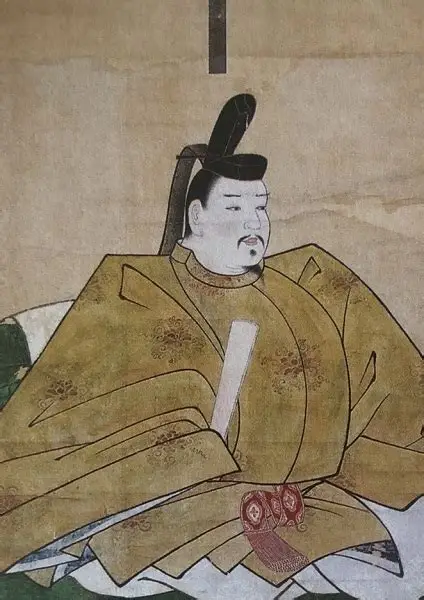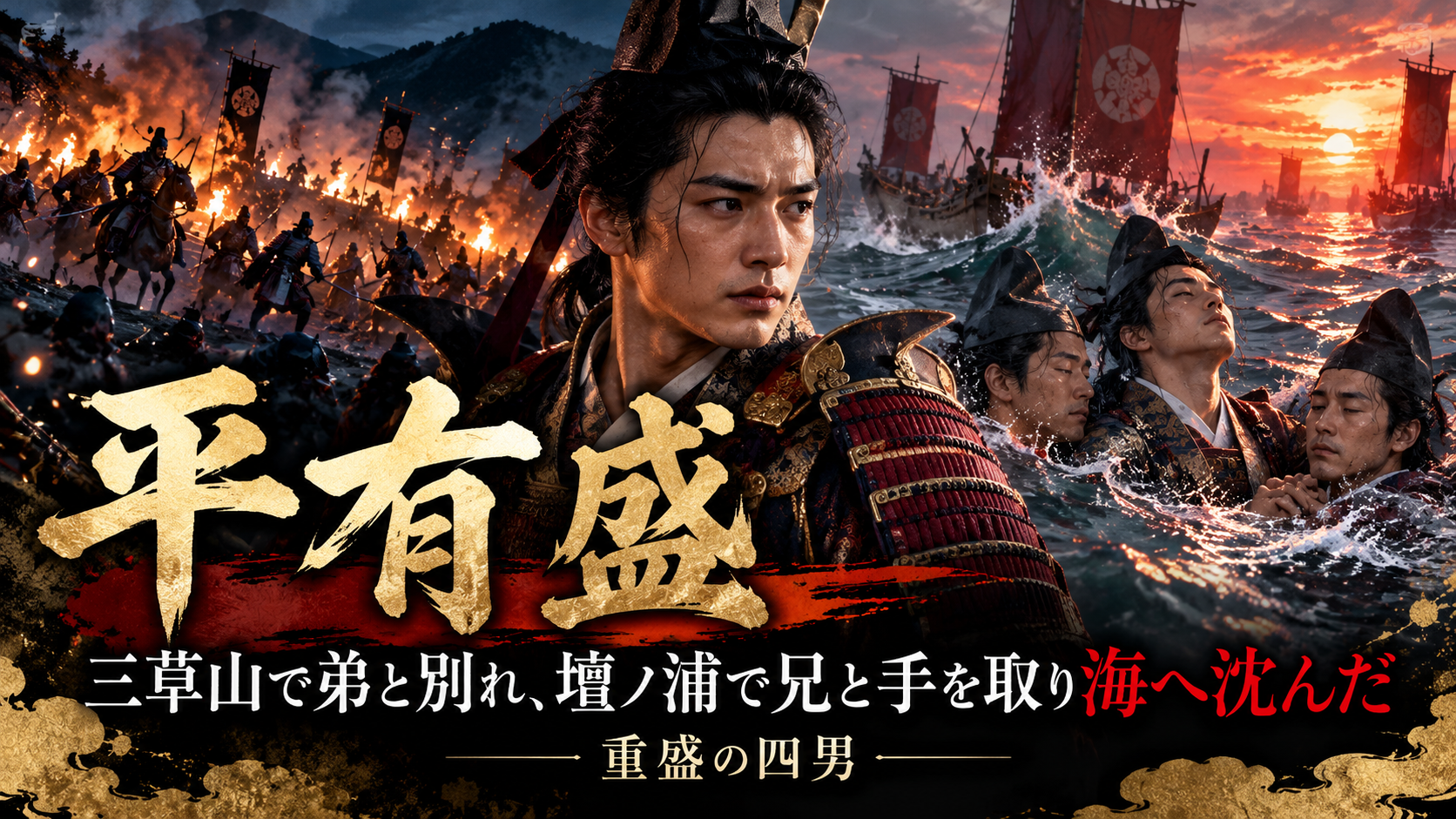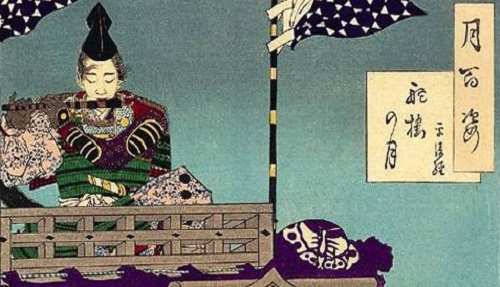
In the autumn of Juei 2 (1183), at Yanagigaura in Buzen Province.
The night was lit by the moon.
On the sea, a ship carrying members of the Taira clan floated.
Having left Kyoto in July, they had brought Emperor Antoku down to Kyushu, yet even at Dazaifu, they found no refuge.
Ogata Koreyoshi of Bungo Province was closing in with forces to pursue the Taira.
Ogata had once served as a warrior under Taira no Shigemori.
Shigemori’s third son was on the ship.
Taira no Kiyotsune.
A grandson of Taira no Kiyomori, he was a young noble who had served as a Provisional Middle Captain of the Left Guards.
According to the “Dazaifu Och” chapter of the The Tale of the Heike, Kiyotsune lamented the fate of his clan, with no place left to flee, and reportedly said:
“Like a fish caught in a net.”
Like a fish ensnared in a net, wherever they tried to escape, pursuers closed in.
In Kyoto, they were chased by the forces of Minamoto no Yoshinaka, and in Kyushu, they were driven out by Ogata Koreyoshi, a former retainer of his father.
Even upon reaching Yanagigaura, they could not build a palace for Emperor Antoku.
Furthermore, news arrived that enemies were approaching from Nagato Province, and the story tells that the clan once again fled to their ships.
That night, Kiyotsune stepped out from the cabin of the ship.
He took up a flute and adjusted its pitch.
Soon, he began to chant.
Having been raised at court and served in the Konoe Guards, Kiyotsune played the flute even on his final night.
After finishing his chant, he quietly recited sutras.
He chanted the nembutsu.
And then, as The Tale of the Heike records, he sank into the sea.
The people on the ship wept in sorrow.
The exact date of Kiyotsune’s drowning is unknown. Some research suggests it was in September of Juei 2, while a biographical dictionary suggests October.
No contemporary records directly documenting Kiyotsune’s inner thoughts remain.
However, it is traceable from the political situation of the time that the Taira were expelled from Dazaifu and lost their foothold in Kyushu.
Kiyotsune’s death is said to have occurred about a year and a half before the fall of the Taira clan.
Afterward, the clan defeated Genji forces at Mizushima and Muroyama, and counterattacked as far as the area around Fukuhara.
Kiyotsune is said to have sunk into the sea without witnessing these battles.
The Third Son of Taira no Shigemori—His Mother Was Fujiwara no Tsuneko, Wet Nurse to Emperor Takakura
Taira no Kiyotsune was born as the third son of Taira no Shigemori.
His grandfather was Taira no Kiyomori.
His father, Shigemori, was Kiyomori’s eldest son and rose to the rank of Minister of the Interior after participating in the Hogen Rebellion and the Heiji Rebellion.
There are various theories about Kiyotsune’s birth year, but it is commonly believed he was born in the first year of Chokan (1163).
In various versions of “The Tale of the Heike,” it is noted that he died at the age of 21.
His mother was Fujiwara no Tsuneko.
She was the daughter of Fujiwara no Ienari and Shigemori’s principal wife.
Ienari was a prominent courtier close to Emperor Toba and had strong ties with both Taira no Tadamori and Kiyomori.
Tsuneko was also considered an adopted daughter of the Minister of the Left, Fujiwara no Tsunemune.
In the first year of Nin’an (1166), she became the wet nurse to Prince Norihito upon his appointment as Crown Prince.
Prince Norihito later became Emperor Takakura.
After Emperor Takakura ascended the throne, Tsuneko became a court lady and held a high position in the court.
She was also known by titles such as Dainagon no Tsubone and Dainagon no Sanmi.
Kiyotsune had older brothers, Koremori and Sukemori.
However, they had different mothers.
Koremori, as Shigemori’s heir, was in line to inherit his father’s household, while Sukemori held positions such as Governor of Echizen and in the Imperial Guard.
On the other hand, Kiyotsune was the son born to Shigemori’s principal wife.
His younger brothers, Arimori, Morimori, and Tadafusa, are also considered to be children of Keiko.
Shigemori had multiple wives and children, but on Kiyotsune’s maternal side, there were influential court nobles dating back to the reign of Emperor Toba.
Furthermore, with Keiko serving as the wet nurse to Emperor Takakura, Kiyotsune’s family became deeply connected with the imperial family.
The reason Kiyotsune attained a high court rank from a young age was due to the presence of his mother, Keiko.
At Age Four, Promoted to Junior Fifth Rank—A Different Path from His Brothers
Nin’an 1 (1166).
Kiyotsune was appointed to the Junior Fifth Rank, Upper Grade.
Assuming he was born in Chokan 1, he would have been four years old at the time.
In the same year, his elder brother Sukemori was appointed to the Junior Fifth Rank, Lower Grade.
The younger Kiyotsune was given a higher court rank than his brother.
The following year, Nin’an 2 (1167), he advanced to the Senior Fifth Rank, Lower Grade.
It is believed that Keiko’s role as the wet nurse to Emperor Takakura played a part in Kiyotsune’s promotions.
Shigemori’s children each had different connections through their maternal lineages.
Koremori was in line to succeed the Shigemori family as the heir, while Sukemori was raised as a court noble familiar with poetry and music.
Kiyotsune also entered court service from a young age, steadily climbing the ranks.
In Shoan 4 (1174) December, he was appointed as the Provisional Minor Captain of the Left Guards.
The Konoe Guards were responsible for the protection of the emperor and court ceremonies, with the Minor Captain being one of its senior officers.
After attaining a high rank at a young age, Kiyotsune began to serve as a military officer in the Konoe Guards.
By Jisho 1 (1177), he had advanced to the Junior Fourth Rank, Lower Grade, and by the following Jisho 2 (1178) December, he reached the Junior Fourth Rank, Upper Grade.
His father, Shigemori, was an Inner Minister.
His grandfather, Kiyomori, had risen to the position of Grand Minister.
The Taira clan’s young nobles held court positions and participated in court events and ceremonies.
Kiyotsune grew up within this courtly life.
However, around this time, Kiyotsune’s maternal relatives became embroiled in the conflict between the Taira clan and Emperor Go-Shirakawa.
This was Fujiwara no Narichika.
Fujiwara no Narichika—Maternal Uncle and Father-in-Law
Fujiwara no Narichika served as a close retainer to Emperor Go-Shirakawa.
He was the son of Fujiwara no Ienari and rose to the position of Provisional Major Counselor.
Kiyotsune’s mother, Keiko, was Narichika’s sister.
Narichika was Kiyotsune’s maternal uncle.
Furthermore, it is said that Kiyotsune married Narichika’s daughter.
The genealogical record ‘Sonpi Bunmyaku’ notes that one of Narichika’s daughters became Kiyotsune’s wife.
Thus, Kiyotsune’s wife was also his maternal cousin.
The timing and specifics of the marriage are not clear.
Another of Narichika’s daughters became the wife of Kiyotsune’s brother, Koremori.
The families of Shigemori and Narichika were linked through multiple marriages.
Nariyuki enjoyed the trust of Emperor Go-Shirakawa and wielded considerable influence at court.
At the same time, he was related by marriage to Kiyomori and had strong ties with the Taira clan.
However, in 1177, Nariyuki was arrested for allegedly plotting to overthrow the Taira.
This was the Incident at Shishigatani.
The Incident at Shishigatani—The Downfall of Nariyuki
June 1177.
Close associates of Emperor Go-Shirakawa were arrested for their involvement in a plot to overthrow the Taira.
One of the central figures was Fujiwara no Nariyuki.
Kiyomori captured Nariyuki and executed Saiko.
Shunkan and others were exiled to Kikaigashima, and Nariyuki was banished to Bizen Province.
Subsequently, Nariyuki died in exile.
The “Heike Monogatari” recounts how Shigemori pleaded for Nariyuki’s life, making earnest appeals to Kiyomori.
For Shigemori, Nariyuki was his wife’s brother and also related through the marriages of their sons.
To Kiyotsune, he was an uncle on his mother’s side and also his father-in-law.
Nariyuki’s fate deeply affected Shigemori’s family.
There are no detailed records of how Kiyotsune personally reacted to the incident.
At the time, Kiyotsune was a young courtier serving in the Konoe Guards.
His mother, Keiko, was also active at court as a wet nurse to the emperor.
However, the conflict between the Taira and Emperor Go-Shirakawa extended even to Kiyotsune’s maternal family.
Two years later, his father Shigemori passed away.
1179—The Death of Shigemori and Changes in the Komatsu Family
July 29, 1179.
Taira no Shigemori passed away.
He was 42 years old.
Shigemori was Kiyomori’s eldest son and was seen as the heir to the Taira clan.
He had a close relationship with Emperor Go-Shirakawa and often acted as a mediator between Kiyomori and the emperor.
With Shigemori’s death, the dynamics within the clan began to shift.
His eldest son Koremori assumed the position of head of the family, while Sukemori and Kiyotsune continued to advance in court ranks.
However, the political center of the Taira clan as a whole shifted to Shigemori’s younger brother, Munemori.
Munemori was the son of Kiyomori’s principal wife, Taira no Tokiko, and the brother of Empress Tokuko, consort of Emperor Takakura.
He had strong ties to the imperial family and held high court rank.
In November of the same year, Kiyomori led his forces into Kyoto.
He ousted the regent Matsudono Motofusa and appointed Konoe Motomichi as the new regent.
Furthermore, he dismissed the close associates of the cloistered emperor and confined Emperor Go-Shirakawa to the Toba Palace.
This was the political upheaval of the third year of Jisho.
In February of the following year, Jisho 4 (1180), Emperor Antoku ascended to the throne.
He was the young emperor, grandson of Taira no Kiyomori, born to Tokuko.
The Taira clan continued to hold high positions.
However, in May of the same year, Prince Mochihito and Minamoto no Yorimasa raised an army.
The conflict between the Taira and anti-Taira forces began to spread across the country.
Kiyotsune’s name also started to emerge as a figure involved in military actions.
The Uprising of Prince Mochihito—Joining the Siege of Onjo-ji
May of Jisho 4.
Prince Mochihito, son of Emperor Go-Shirakawa, allied with Minamoto no Yorimasa to plot the overthrow of the Taira.
Prince Mochihito sent out orders to the Minamoto across the provinces, calling for an uprising.
However, the plan was discovered by the Taira side.
Prince Mochihito fled Kyoto and sought refuge at Onjo-ji in Omi Province.
This is the temple known today as Miidera, located in Otsu City, Shiga Prefecture.
The warrior monks of Onjo-ji accepted Prince Mochihito, prompting the Taira clan to dispatch a punitive force.
It is said that Kiyotsune also joined this force.
The “Dictionary of Japanese Names” introduces him as the commander who led the attack on Onjo-ji.
The “Tale of the Heike” also depicts the Taira clan’s generals, including Tomomori and Shigehira, setting out for the pursuit.
However, there are few detailed records of which unit Kiyotsune commanded or where exactly he fought.
Prince Mochihito and Yorimasa left Onjo-ji, attempting to head to Nanto.
However, they were caught by the Taira forces at the Uji River.
Minamoto no Yorimasa took his own life at Byodo-in, and Prince Mochihito was killed while heading towards Minami Yamashiro.
The Taira clan suppressed the uprising.
However, Prince Mochihito’s call to arms had already spread across the land.
By August, Minamoto no Yoritomo had risen in rebellion in Izu Province.
Anti-Taira movements were also expanding in Kai and Shinano, forcing the Taira to dispatch punitive forces to various regions.
At this time, Kiyotsune held the court rank of Sakinokami Shosho and also served as Iyo no Suke.
The young courtiers serving the imperial court found themselves involved in quelling the rebellion.
The First Year of Yowa—Plans for Pursuit in the Eastern Provinces and Dispatch to the Hokuriku Region
In the eighth month of the fourth year of the Jisho era, Minamoto no Yoritomo rose in rebellion in Izu.
Although Yoritomo was defeated at Ishibashiyama, he managed to escape to Awa Province and regain his strength.
With the addition of forces from Chiba Tsunetane and Kazusa Hirotsune, he entered Kamakura by October.
Kiyomori dispatched a punitive force to the eastern provinces.
The commander of this force was Kiyomori’s brother, Koremori.
However, the punitive force retreated at Fujikawa, failing to halt Yoritomo’s growing influence.
In the following year, Jisho 5 (1181), in the intercalary second month, Kiyomori passed away.
Munemori became the leader of the Taira clan, but anti-Taira movements persisted in the eastern provinces and Hokuriku.
Regarding Kiyotsune, a biographical dictionary notes that he served as a deputy commander for the Genji punitive expedition in the eastern provinces during the first year of Yowa.
Meanwhile, contemporary diaries record plans for his dispatch to Hokuriku.
Yowa 1, October 4.
According to the diary ‘Gyokuyo’ by Kujō Kanezane, there was information that Taira no Tomomori and Kiyotsune were scheduled to head to Echizen Province.
At that time in Echizen Province, the forces of Minamoto no Yoshinaka (Kiso Yoshinaka) were expanding, and the troops of Taira no Tsunemori were struggling.
The Taira clan was attempting to send reinforcements to stabilize the situation in Hokuriku.
However, by October 10, the composition of the punitive force had changed.
Tomomori’s dispatch was canceled, and other clan warriors were sent instead.
Kiyotsune’s name does not appear in the subsequent formations.
It remains unclear whether Kiyotsune proceeded to Echizen as initially planned.
The ‘Gyokuyo’ records only that Kiyotsune was intended as a reinforcement for Hokuriku.
To address the uprisings in various regions, the Taira clan sought to mobilize its warriors.
Kiyotsune was among them.
However, the composition of the forces was frequently altered, and the situation did not easily improve.
Then, in Juei 2 (1183), the Taira forces suffered a major defeat in Hokuriku.
Senior Fourth Rank, Lower Grade – Lieutenant General of the Left Guards: Kiyotsune on the Eve of the Fall of the Capital
After Jisho 4, Kiyotsune continued to rise in court rank.
By Juei 2 (1183), he had reached the position of Senior Fourth Rank, Lower Grade, and Lieutenant General of the Left Guards.
The ‘Heike Monogatari’ refers to Kiyotsune as “Lieutenant General of the Left,” based on this position.
The Lieutenant General of the Left Guards was a high-ranking position in the Imperial Guard, responsible for the emperor’s protection and court ceremonies.
If born in Chōkan 1, Kiyotsune would have been 21 by traditional count.
His brother Koremori had experience as the commander of the eastern punitive force, and Sukemori held positions such as Lieutenant General of the Right Guards and Chief of the Kurōdo-dokoro.
The sons of Shigemori continued to advance in the court even after their father’s death.
However, in May of the second year of Juei, the Taira clan suffered a major defeat in the Hokuriku region.
It was the Battle of Kurikara Pass.
The punitive force led by Taira no Koremori was defeated by the forces of Minamoto no Yoshinaka, and they also fled at Shinohara in Kaga Province.
Yoshinaka advanced from Echizen to Omi, threatening Kyoto.
Many warriors who had been loyal to the Taira began to defect.
By July, it became difficult to defend Kyoto.
Taira no Kiyotsune left the capital while still holding his official rank.
July 25, Juei 2 — Departing the Capital with Emperor Antoku
July of the second year of Juei.
The forces of Minamoto no Yoshinaka were closing in on Kyoto.
The Taira attempted to resist by deploying troops around Kyoto, but even Enryaku-ji refused to cooperate, worsening the situation.
From the night of July 24 to the early hours of the 25th, Emperor Go-Shirakawa fled Kyoto and moved to Mount Hiei.
Taira no Munemori abandoned the defense of the capital.
On July 25.
The Taira clan, taking Emperor Antoku and the Imperial Regalia with them, headed west.
Taira no Kiyotsune also left Kyoto with his brothers Koremori, Sukemori, and his younger brother Arimori.
Koremori left his wife and children in the capital.
The “Tale of the Heike” describes a scene where Sukemori and others come to bid farewell to Koremori, urging him to depart quickly.
Sukemori also parted with Kenreimon-in Ukyō no Daibu, with whom he had been close.
In Ukyō no Daibu’s poetry collection, it is recorded that Sukemori, sensing his own death, asked for prayers for his afterlife.
There are no detailed records of whom Taira no Kiyotsune spoke with or what words were exchanged when he left Kyoto.
It is also unclear where his wife, the daughter of Fujiwara no Narichika, was at that time.
In the later Noh play “Kiyotsune,” he is depicted as leaving his wife in Kyoto, promising to reunite as he heads west.
Taira no Kiyotsune, along with Munemori and others, escorted Emperor Antoku, passing through Fukuhara and entering the Seto Inland Sea.
Their destination was Kyushu.
Dazaifu — The Taira’s Attempt to Regroup in Kyushu
Having left Kyoto, the Taira clan set sail for Kyushu.
For many years, the Taira had utilized the sea routes of the Seto Inland Sea, establishing connections with western warriors and manors.
Taira no Kiyomori had developed the port at Fukuhara, placing importance on Ōwada no Tomari.
There were still warriors in Kyushu loyal to the Taira.
In Chikuzen Province, Harada Tanenao was active, and near the mouth of the Onga River, there were figures like Yamaga Hidechika.
The Taira entered Dazaifu, aiming to establish a new political base.
Dazaifu had long been an important site for administration, military, and diplomacy in Kyushu.
For the Taira clan, who supported Emperor Antoku, establishing an imperial residence in Kyushu was crucial for maintaining their political standing.
The court nobles discussed setting up the capital in Tsukushi and constructing an imperial palace there.
However, unexpected news arrived from Bungo Province.
Ogata Koreyoshi had raised the banner of rebellion.
Moreover, Ogata was a warrior who had once served Shigemori, the father of Kiyokiyo.
Ogata Koreyoshi—A Prominent Warrior of Bungo Who Served Shigemori
Ogata Koreyoshi was a powerful warrior based in Ogata Manor of Ono District, Bungo Province.
He is also recorded as Koreei and Korenō.
He was a descendant of the Ōgami clan and had deep connections with the local warriors of Bungo.
During the Taira clan’s expansion of control over Dazaifu, Ogata entered into a master-servant relationship with Taira no Shigemori.
In Shigemori’s lifetime, the Taira clan relied on the strength of such local warriors to maintain their dominance in the western provinces.
However, after Minamoto no Yoritomo’s uprising, Ogata shifted to an anti-Taira stance.
In Bungo Province, he expelled the deputy governor and allied with surrounding warriors like the Usuki and Nagano clans to expand his influence.
In the second year of Juei, he received imperial and provincial orders from the governor of Bungo, Fujiwara no Yorisuke, to attack the Taira clan and mobilized his forces.
For Ogata, who acted under the orders of Emperor Go-Shirakawa, the Taira clan, who had fled to Kyushu, became targets for pursuit.
The “Tale of the Heike,” Volume Eight, “The Fall of Dazaifu,” depicts the Taira clan’s shock and deliberation upon learning of Ogata’s defection.
Ogata was once a retainer of Shigemori.
Recalling that relationship might persuade him.
The Taira clan pinned their hopes on the former master-servant bond.
The Brother, Sukemori, Heads to Bungo—A Mission with Over 500 Horsemen
According to the “Tale of the Heike,” it was Taira no Tomomori who suggested persuading Ogata Koreyoshi.
Ogata was a former retainer of the late Shigemori.
If they sent one of Shigemori’s sons, he might reconsider.
Tomomori thought so.
Acting on this suggestion, Kiyokiyo’s brother, Sukemori, headed to Bungo Province.
The “Tale of the Heike” records that he set out with over 500 horsemen.
Sukemori met with Ogata and tried to persuade him by reminding him of the favors received from his father, Shigemori.
However, Ogata did not comply.
On the contrary, he reportedly told Sukemori that he could capture him on the spot.
However, even if they weren’t captured here, the Taira’s defeat seemed inevitable.
He urged them to return to Dazaifu quickly.
The story goes that Ogata said this and sent Sukemori back.
Kiyotsune’s brother traveled to Bungo to persuade their late father’s former retainers.
Yet, they could not restore the master-servant relationship.
The “Tale of the Heike” further describes a scene where Ogata’s son appears as a messenger at Dazaifu.
“The Past is the Past, Now is Now”—The Protest of Taira no Tokitada
Ogata Koreyoshi sent his second son, Nojiri Jiro Koremura, as a messenger to Dazaifu.
Koremura acknowledged that his father had once received great favor from the Taira.
He then conveyed that they had been ordered by Emperor Go-Shirakawa to drive the Taira out of Kyushu.
The one who appeared before the messenger was Taira no Tokitada, the Grand Counselor.
To Kiyotsune, he was the brother of Taira no Tokiko, the wife of his grandfather, Taira no Kiyomori.
Tokitada argued that Emperor Antoku was the legitimate emperor and that the Taira had quelled the Heiji Rebellion and the Hogen Rebellion.
He strongly condemned local warriors like Ogata for forgetting this debt and opposing the Taira.
When Koremura returned and relayed these words, Ogata was furious.
The “Tale of the Heike” briefly records his response.
“The past is the past, now is now.”
Following the Taira in the past and the current situation are different matters.
Ogata gathered his forces to drive the Taira out of Kyushu.
The Taira also attempted to counterattack.
According to the “Tale of the Heike,” Minamoto no Suketsuna and Settsu no Kami Morisumi went to battle at Takano Honjo in Chikugo Province.
However, Ogata’s forces were numerous, and the Taira retreated.
Soon, news came that Ogata’s army was advancing on Dazaifu.
The Taira clan, having only recently entered Kyushu, found themselves fleeing once more.
The Fall of Dazaifu—Fleeing with Emperor Antoku in the Rain
The “Tale of the Heike” records that Ogata led over thirty thousand horsemen.
While it’s difficult to take this number as literal, the Taira could no longer hold Dazaifu.
The clan, carrying Emperor Antoku, headed north.
The “Tale of the Heike” vividly describes this flight.
There were not enough people to carry the palanquin for Emperor Antoku, and the court ladies walked with their hakama hems lifted.
Munemori and the courtiers hurried along unfamiliar roads.
At that time, a heavy rain was falling.
The wind whipped up sand, and it is said that the people left Mizuki and headed toward the port of Hakozaki.
Back in Kyoto, many people accompanied Emperor Antoku on his visits.
The Taira nobles rode in ox-drawn carriages and attended court ceremonies.
Now, they were fleeing along the roads of Kyushu with Emperor Antoku.
The group bowed and prayed at shrines like Sumiyoshi, Hakozaki, Kashii, and Munakata, hoping that Emperor Antoku could return to Kyoto.
The Heike Monogatari describes how the feet of the court ladies bled as they walked the rough paths, staining the sand.
Kiyotsune was also part of this escape.
A young man who had risen to the rank of Senior Fourth Rank, Provisional Middle Captain of the Left, was moving with Emperor Antoku to evade pursuers.
During this journey, two warriors rushed to join the Taira.
They were Harada Tanenaga and Yamaga Hidetō.
Harada Tanenaga and Yamaga Hidetō—Discord Among Remaining Allies
Harada Tanenaga was a warrior with influence centered in Chikuzen Province.
On the other hand, Yamaga Hidetō was based near the mouth of the Onga River and followed the Taira.
The Heike Monogatari records that Tanenaga led over two thousand horsemen and Hidetō several thousand to welcome the Taira.
The actual number of troops is unknown, but there were still warriors in Kyushu supporting the Taira.
However, it is said that Tanenaga and Hidetō were not on good terms.
It was difficult for the two to cooperate in protecting the clan.
According to the Heike Monogatari, Tanenaga turned back midway.
This does not mean that Tanenaga defected to the Genji side at this point.
The inability of allied warriors to cooperate hindered the Taira’s defense.
The Taira had to rely on Yamaga Hidetō.
Yamaga was located around present-day Ashiya Town in Onga District, Fukuoka Prefecture.
It was situated at the mouth of the Onga River, a place accessible by sea routes.
Although they entered Yamaga’s castle under Hidetō’s guidance, news arrived that enemies were approaching there too.
The Taira decided to move once again.
According to the Heike Monogatari, the clan boarded small boats and sailed through the night toward Yanagigaura in Buzen Province.
It is at Yanagigaura that Kiyotsune’s end is recounted.
Yanagigaura in Buzen Province—Unable to Build a Palace
Upon reaching Yanagigaura, the Taira discussed building a palace for Emperor Antoku.
Emperor Antoku was still very young.
In Kyoto, Emperor Go-Toba had been enthroned, and the Imperial Regalia had been taken west with the Taira.
The Taira sought to maintain their political standing by supporting Emperor Antoku.
To do so, they needed facilities for the emperor to reside.
However, even at Yanagigaura, the construction of the palace did not materialize.
The ‘Tale of the Heike’ attributes the reason to “lack of resources.”
They were unable to gather the conditions and resources necessary to build the Imperial Palace.
Furthermore, news arrived that the Minamoto were advancing from Nagato Province.
The clan once again boarded small boats and fled to the sea, as the tale recounts.
After leaving Kyoto, the Taira sought to establish a new base in Kyushu.
At Dazaifu, they were pursued by Ogata Koreyoshi.
Enemies also closed in at Yamaga.
At Yanagigaura, they couldn’t even prepare a residence for Emperor Antoku.
The clan, with Emperor Antoku, had to spend the night aboard a ship.
Among those on one of the ships was Kiyotsune.
“Like Fish Caught in a Net”—The Fate of the Taira as Seen by Kiyotsune
The ‘Tale of the Heike’ describes Kiyotsune as a person who pondered deeply over matters.
It portrays a scene where Kiyotsune laments the future of the clan off the coast of Yanagigaura.
They were driven out of Kyoto by the Minamoto.
In Kyushu, they were expelled by Ogata Koreyoshi.
Even after fleeing to the sea, news of advancing enemies continued.
Kiyotsune compared their situation to fish caught in a net.
“Like fish caught in a net,”
Fish in a net cannot escape no matter how much they swim.
The Taira, too, were pursued by enemies wherever they went.
Kiyotsune further lamented, wondering where they could possibly escape to.
His father, Shigemori, had already passed away four years earlier.
His grandfather, Kiyomori, had also died two years prior.
When Shigemori was alive, Ogata Koreyoshi supported the Taira as one of his retainers.
But now, that same Ogata was leading forces in Kyushu, cornering Shigemori’s sons.
The ‘Tale of the Heike’ tells that Kiyotsune, in despair over this situation, chose death.
On the other hand, the Taira still had some strength left to counterattack in the western provinces.
In the Seto Inland Sea, they had naval forces loyal to them, and their ties with local warriors were not entirely severed.
The clan would later regroup around Yashima, achieving victories at Mizushima and Muroyama.
Kiyotsune’s reported drowning occurred before this counterattack began.
A Moonlit Night on the Ship—Flute, Recitation, and Prayers
Off the coast of Yanagigaura.
It was said to be a moonlit night.
Kiyotsune stepped out from the cabin of the ship.
He took up a flute and adjusted its tune.
The ‘Tale of the Heike’ records that Kiyotsune began to recite poetry.
Recitation was a courtly art of singing poems, often Chinese, with melody.
Kiyotsune had served at court from a young age, holding various positions in the Konoe Guards.
Kiyotsune played the flute on a moonlit night aboard a ship.
The Tale of the Heike depicts the final moments of this nobleman raised in the court in such a manner.
It is not recorded what piece Kiyotsune played or what he recited.
Soon, Kiyotsune quietly began to chant sutras.
He recited the nembutsu.
And then, he is said to have submerged himself into the sea.
“Though men and women wept in sorrow, there was nothing they could do.”
The people on the ship wept and grieved, but they were powerless to intervene.
In the Kakuichibon version of the Tale of the Heike, Kiyotsune’s end is recounted in a brief passage.
Who first noticed Kiyotsune’s plunge into the water?
How did his retainers react?
The detailed sequence of events is not recorded.
The scene of Kiyotsune playing the flute on a moonlit night, chanting the nembutsu, and sinking into the sea was passed down through military tales to later generations.
Juei 2, September or October?—Debates on the Timing of His Death
Kiyotsune’s death by drowning is known to have occurred in the autumn of Juei 2 (1183).
However, there are various theories regarding the exact date.
Some research suggests it was a moonlit night in September, while the Dictionary of Japanese Biographies states it was in October.
Even among the different versions of the Tale of the Heike, the order of the Taira clan’s actions in Kyushu and their pilgrimage to Usa Hachiman Shrine varies.
It is difficult to reconstruct a definitive timeline for the move to Yanagigaura and Kiyotsune’s death.
Regarding Kiyotsune’s age, if he was born in Chokan 1, he would have been 21 by the traditional Japanese count, but his birth year is not definitively known.
Furthermore, there are differences in how the meaning of his death is interpreted among the various texts.
In the Kakuichibon, the hardships of his flight and evaluations of Kiyotsune’s character are depicted as the backdrop to his death.
Other versions include stories involving Kiyotsune’s wife.
By the Muromachi period, Kiyotsune’s death had become a subject for Noh theater.
The young man’s end, playing the flute on a moonlit ship, gradually came to be accompanied by new scenes over time.
After Kiyotsune’s Death—Counterattacks at Mizushima and Muroyama
Even after Kiyotsune was said to have sunk into the sea, the Taira clan continued to fight.
They returned from Kyushu to the Seto Inland Sea, gathering forces centered around Yashima in Sanuki Province.
In the intercalary October of Juei 2,
the Taira defeated the forces of Minamoto no Yoshinaka at Mizushima in Bitchu Province.
In the following November, they also defeated the forces of Minamoto no Yukie at Muroyama in Harima Province.
These victories allowed the Taira to regain their power in the Seto Inland Sea.
By the following Juei 3 (1184) in January, they had advanced to the area around Fukuhara.
Kiyotsune’s brothers, Sukemori and Arimori, along with others, continued their activities as part of the clan’s forces.
However, on February 7th, at the Battle of Ichinotani, the Taira clan suffered a crushing defeat.
Taira no Tadanori, Taira no Atsumori, and Taira no Tsunemori were killed in action, and Taira no Shigehira was captured.
Kiyotsune’s younger brother, Morimori, also lost his life in this battle.
Furthermore, their elder brother Koremori is said to have left the clan and headed to Kumano.
There are accounts of Koremori’s end, suggesting either drowning at Nachi or dying of illness.
The following year, on March 24th, 1185 (Genryaku 2).
The Taira clan met their demise at Dan-no-ura.
It is said that Sukemori and Arimori, Kiyotsune’s brothers, also perished in this battle.
In “The Tale of the Heike,” it is depicted that the two clasped hands with their cousin Taira no Norimori and sank into the sea.
About a year and a half had passed since Kiyotsune’s death.
The children of Shigemori successively lost their lives amidst the turmoil of war.
Kenreimon-in Tokuko’s Recollection of “The Beginning of Sorrowful Times”
From “The Tale of the Heike,” Kanjo Volume “The Judgment of the Six Paths.”
Kenreimon-in Tokuko, who survived Dan-no-ura, was living in Ohara.
Having lost Emperor Antoku and having thrown herself into the sea, Tokuko was rescued by the Genji forces, took vows, and was returned to Kyoto.
There, she was visited by Emperor Go-Shirakawa.
Tokuko reflected on her past court life and the fall of the Taira clan.
As the daughter of Kiyomori, she entered the court of Emperor Takakura and later became the mother of Emperor Antoku.
In the court, she was surrounded by many ladies-in-waiting and nobles, leading a glamorous life.
However, the Taira clan was driven out of Kyoto and lost their foothold even in Kyushu.
While accompanying Emperor Antoku, they continued to travel by sea, spending nights aboard the ships.
Among these memories, the drowning of Kiyotsune emerges.
Driven out of the capital and later expelled from Kyushu by Ogata Koreyoshi.
Kiyotsune, despairing over the future of his clan, sank into the sea.
Tokuko later reflected on his death as “the beginning of sorrowful events.”
It was the start of a series of tragic events.
Subsequently, many of the clan perished in the Battle of Ichinotani.
They lost Yashima, and at Dan-no-ura, even Emperor Antoku sank into the sea.
The “Tale of the Heike” has Tokuko recount Kiyotsune’s death as her first great sorrow.
This conversation is depicted in later war tales and is not confirmed as Tokuko’s own words in contemporary records.
Kiyotsune’s drowning became a significant event in the narrative of the Taira clan’s downfall.
Kiyotsune’s Wife—Marriage Recorded in “Sonpi Bunmyaku”
Kiyotsune had a wife.
The “Sonpi Bunmyaku” records that Kiyotsune’s wife was the daughter of Fujiwara no Narichika.
Since Narichika was the brother of Kiyotsune’s mother, Tsuneko, his wife was also his maternal cousin.
Narichika’s daughters were married to several sons of the Shigemori family.
The wife of his elder brother Koremori is also said to be Narichika’s daughter.
The Shigemori and Narichika families were deeply connected through these marriages.
However, there are few contemporary records detailing where Kiyotsune’s wife lived during the fall of the capital or how she acted after her husband’s drowning.
On the other hand, various versions of the “Tale of the Heike” provide detailed accounts of Kiyotsune’s wife.
News of her husband’s descent to the western provinces and eventual drowning reaches her.
She receives a keepsake and continues to mourn Kiyotsune in her sorrow.
These traditions were later incorporated into the Noh play “Kiyotsune.”
The words and actions of the wife are preserved in war tales and Noh plays.
In the Muromachi period, Kiyotsune’s drowning became a new story.
Zeami’s Noh “Kiyotsune”—The Hair Relic Sent to His Wife
In the Muromachi period, the Noh play “Kiyotsune,” based on his final moments, was created.
The author is said to be Zeami.
The setting is the home of Kiyotsune’s wife, who remained in Kyoto.
The story begins with the visit of Kiyotsune’s retainer, Awazu Saburo.
Saburo has returned from the western provinces.
However, his master Kiyotsune is not with him.
It was to inform the wife that Kiyotsune had drowned at Yanagigaura in Buzen Province.
Saburo presents Kiyotsune’s hair as a keepsake.
The wife grieves deeply.
Kiyotsune had promised to return when he left the capital.
Yet, he took his own life.
His wife harbored resentment over the matter.
She felt her sorrow deepen each time she saw the lock of hair, and so she asked Saburo to return it to Usa Hachimangu Shrine.
As night fell, his wife cried herself to sleep.
In her dreams, the spirit of Kiyotsune appeared.
Kiyotsune reproached his wife for sending back his lock of hair.
Meanwhile, his wife resented Kiyotsune for taking his life and leaving her behind.
The two shared their feelings and shed tears together.
Eventually, Kiyotsune began to recount his flight from Kyoto.
He spoke of being pursued by Ogata Koreyoshi and finding no refuge even in Kyushu.
Despite praying at Usa Hachimangu Shrine, he could not find hope for his clan’s future.
He recounted playing the flute under the moonlit sky on a boat and chanting prayers before throwing himself into the sea.
Kiyotsune’s spirit also revealed the suffering he endured in the afterlife’s realm of war.
Yet, in the end, he was saved by the merit of the prayers he chanted as he entered the water, and then he vanished.
The Noh play ‘Kiyotsune’ places significant emphasis on the farewell and dream reunion with his wife.
This work intertwines the final moments of Kiyotsune, as told in ‘The Tale of the Heike,’ with themes of marital resentment, sorrow, and Buddhist salvation.
Kiyotsune’s wife mourned his self-inflicted death and blamed him for breaking their promise to reunite.
Conversely, Kiyotsune resented having his lock of hair returned.
On the Noh stage, the couple’s exchange of feelings unfolds, leading to the depiction of Kiyotsune’s drowning at Yanagigaura.
Where is Yanagigaura?—Legends in Moji and Usa
Multiple legends about Yanagigaura, where Kiyotsune is said to have drowned, still exist today.
One such place is Moji Ward in Kitakyushu City, Fukuoka Prefecture.
This area, near the Kanmon Straits, is associated with the legend of the Yanagi Palace, where the Taira clan, escorting Emperor Antoku, is said to have stayed.
The National Archives of Japan also equates Yanagiura in Buzen Province with the present-day Moji Ward in Kitakyushu City.
In ‘The Tale of the Heike,’ it is recounted that the Taira clan boarded a small boat from Yamaga and sailed through the night to Yanagigaura.
Yamaga corresponds to the area around present-day Ashiya Town in Onga District, and there are geographical reasons supporting the theory of a sea route towards Moji.
Meanwhile, in Yanagigaura, Usa City, Oita Prefecture, there are also legends related to Kiyotsune’s drowning.
In the Nagasu area of Usa City, a memorial tower for Kiyotsune stands, marking the place traditionally considered his final resting spot.
Usa is home to the Usa Hachimangu Shrine.
In the Noh play ‘Kiyotsune,’ there is a scene where his wife returns Kiyotsune’s lock of hair to Usa Hachimangu Shrine.
Additionally, various manuscripts of ‘The Tale of the Heike’ include articles about pilgrimages to Usa, though their arrangement and significance differ.
Furthermore, in Kanda Town, Kyoto District, Fukuoka Prefecture, there is a site believed to be Kiyotsune’s grave.
This is linked to the legend that Kiyotsune’s body washed ashore from the sea.
However, it is challenging to determine the exact location of his drowning or burial site based solely on the legends of memorial towers and graves in various places.
Kiyotsune’s death became widely known through ‘The Tale of the Heike,’ eventually inspiring the creation of the Noh play ‘Kiyotsune.’
As the story spread to different regions, the name Yanagigaura became associated with multiple locations.
The Final Days of Taira no Kiyotsune: The Flute that Vanished into the Moonlit Sea
Taira no Kiyotsune was born to Fujiwara no Tsunekiko, the wife of Taira no Shigemori.
His mother served as a wet nurse to Emperor Takakura and was a woman with deep connections at the court.
From a young age, Kiyotsune was granted official ranks, advancing to positions such as Lieutenant of the Left Imperial Guards and Provisional Middle Captain of the Left Imperial Guards.
However, in 1177, his maternal uncle and father-in-law, Fujiwara no Narichika, was punished in the Shishigatani Incident.
Two years later, his father Shigemori passed away.
Then, in 1181, his grandfather Kiyomori also died.
As the conflict with the Minamoto clan intensified, Kiyotsune’s name began to appear as a key figure in organizing the punitive forces.
In 1183, the Taira clan left Kyoto.
They escorted Emperor Antoku to Kyushu, aiming to regroup at Dazaifu.
However, Ogata Koreyoshi led forces to expel the Taira from Dazaifu.
Ogata was a warrior who had once served Shigemori.
Although Kiyotsune’s brother, Sukemori, attempted to negotiate, Ogata did not comply, as recounted in “The Tale of the Heike.”
The Taira moved to Yamaga, and then to Yanagigaura.
There, too, they were unable to build a palace for Emperor Antoku and once again took refuge on their ships.
Kiyotsune likened their situation to fish caught in a net.
Where could they escape to?
Even in distant Kyushu, far from Kyoto, their pursuers were closing in.
Then, on a moonlit night.
Kiyotsune stepped out from the cabin of the ship.
He played a flute and began to chant poetry.
Eventually, he recited sutras and chanted Buddhist prayers.
Afterward, he submerged himself into the sea, as recorded in “The Tale of the Heike.”
The people on the ship wept and mourned.
The Taira clan continued to fight, winning battles at Mizushima and Muroyama.
However, after Ichinotani and Yashima, they met their end at Dan-no-ura on March 24, 1185.
Kiyotsune’s brother, Sukemori, and his younger brother, Arimori, are also said to have perished there.
What Kiyotsune thought at Yanagigaura, and to whom he spoke his last words, remains unknown.
The “Yashirobon” version of “The Tale of the Heike” describes the scene of him playing the flute, finishing his chant, and reciting prayers before sinking into the sea on a moonlit night.
“Though men and women wept and mourned, it was to no avail.”
Thus concludes “The Tale of the Heike” on Kiyotsune’s final moments.