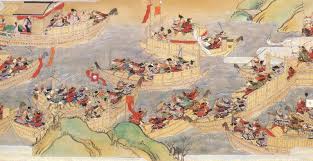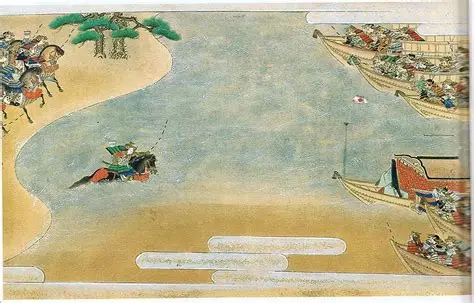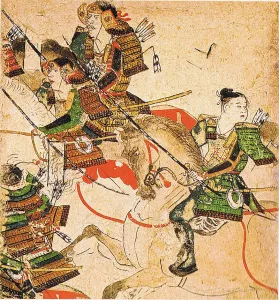
In November of 1183, during the second year of the Juei era, at Mount Muro in Harima Province.
Minamoto no Yukie led several hundred cavalrymen to confront the Taira forces, who were regaining strength in the western provinces.
It had only been about four months since the Taira had left Kyoto.
After their crushing defeat at the Battle of Kurikara Pass in May, the Taira had fled the capital in July, taking Emperor Antoku and the Imperial Regalia with them. However, once they retreated to the western provinces, they began to regroup their forces.
In the intercalary month of October, they defeated the forces of Minamoto no Yoshinaka (Kiso Yoshinaka) at the Battle of Mizushima.
Then in November, they moved to confront Minamoto no Yukie, who had advanced into Harima.
According to the diary “Gyokuyou” by Kujou Kanezane, Yukie’s forces numbered over 270 cavalrymen when they departed Kyoto.
The “Kikki” records the number as over 300 cavalrymen.
Meanwhile, the “Heike Monogatari” Kakuichibon version states that the Taira forces gathered at Mount Muro numbered over 20,000 cavalrymen, while Yukie’s forces were over 500.
The Taira divided this large army into five divisions.
The first division opened the way.
The second division also opened the way.
The third and fourth divisions allowed Yukie’s forces to pass.
It appeared as though Yukie was breaking through the enemy lines one after another.
Waiting ahead was the fifth division led by Taira no Tomomori.
As Yukie’s forces penetrated deep into the Taira army, the four divisions they had passed through suddenly reversed course.
In front was Tomomori.
Behind were the forces of Shigehira and others.
Minamoto no Yukie found himself surrounded in the midst of the Taira’s massive army.
The Crushing Defeat at Kurikara Pass—The Taira Leave Kyoto
In May of 1183, the second year of the Juei era, the Taira sent a large army into the Hokuriku region.
Standing in their way was Minamoto no Yoshinaka (Kiso Yoshinaka).
On May 11, at the Battle of Kurikara Pass, the Taira army suffered a devastating defeat. They were also defeated at the subsequent Battle of Shinohara, forcing them to retreat from the Hokuriku region back to Kyoto.
Yoshinaka’s forces then advanced towards Kyoto.
On July 25, the Taira clan, led by Taira no Munemori, left Kyoto, taking Emperor Antoku and the Imperial Regalia with them.
Emperor Go-Shirakawa did not accompany the Taira and remained in Kyoto.
On July 28, Minamoto no Yoshinaka and his forces entered the capital.
The Taira clan’s political and military foothold in Kyoto was lost, and military control shifted to Yoshinaka and his allies.
The Taira clan headed towards the western provinces.
For many years, the Taira had cultivated strong ties with the Seto Inland Sea region and wielded significant influence over maritime routes.
Using strategic bases like Yashima, they gathered forces in the Shikoku and Sanyo regions, aiming to restore their power through the Seto Inland Sea.
The battle that marked their counterattack was the Battle of Mizushima.
Battle of Mizushima—The Taira Counterattack
On the intercalary 10th month, 1st day of the 2nd year of Juei (1183), the Taira forces clashed with Minamoto no Yoshinaka’s troops near Mizushima in Bitchu Province.
The battle took place in the Seto Inland Sea.
Yoshinaka’s forces approached the Taira by ship but were defeated, with prominent warriors like Ashikaga Yoshikiyo falling in battle.
Having pursued the Taira from Kurikara Pass to Kyoto, Yoshinaka’s forces suffered a significant defeat in the western provinces.
Victorious at Mizushima, the Taira once again asserted their presence in the Sanyo region.
It was Minamoto no Yukie who moved westward to confront the Taira.
Minamoto no Yukie—The Man Who Also Fought the Taira at Sumiyoshi River
Minamoto no Yukie was a son of Minamoto no Tameyoshi and an uncle to Minamoto no Yoritomo.
In the 4th year of Jisho (1180), when Prince Mochihito issued a call to arms against the Taira, Yukie spread this message among the Minamoto across the land.
As Minamoto no Yoritomo and other Minamoto leaders raised armies, Yukie himself led forces against the Taira.
In the 1st year of Yowa (1181), in March, he clashed with the Taira forces at Sumiyoshi River, which flows between Owari and Mino Provinces.
This is the Battle of Sunomata River.
Yukiie’s forces launched a night attack, but were repelled by the Taira forces and defeated.
Despite this setback, Yukiie continued his anti-Taira campaign, moving from place to place. In the second year of Juei, he entered Kyoto alongside Minamoto no Yoshinaka.
However, their relationship soon deteriorated.
The “Gyokuyo” entry for the intercalary 10th month, 27th day, notes the discord between Yoshinaka and Yukiie.
This occurred shortly after the Taira forces defeated Yoshinaka’s side at Mizushima.
On November 8, Yukiie departed Kyoto to confront the Taira forces.
“Over 270 Horsemen” — Yukiie Heads West
Contemporary records provide details about the troops led by Yukiie.
The “Gyokuyo” entry for November 8 mentions,
“Over 270 horsemen”
were recorded.
It was over 270 horsemen.
Kanezane noted the small size, writing “It is very few, how come?”
The “Kikki” also states Yukiie’s forces numbered over 300 horsemen, indicating he left Kyoto with several hundred troops.
Yukiie advanced towards Harima.
Meanwhile, the Taira forces also deployed troops towards Harima.
The two armies clashed at Muroyama.
Near present-day Murotsu in Mitsu-cho, Tatsuno City, Hyogo Prefecture, there remains a site traditionally known as the Muroyama Battlefield.
The battle occurred about three weeks after Yukiie left Kyoto.
Taira no Tomomori and Taira no Shigehira — The Taira Await at Muroyama
In the “Heike Monogatari,” the central figures leading the Taira forces at Muroyama are New Middle Counselor Taira no Tomomori and Third Rank Lieutenant Taira no Shigehira.
Tomomori was the fourth son of Taira no Kiyomori.
He continued to be a core part of the Taira forces, ultimately accompanying the clan to their end at Dan-no-ura.
Shigehira was Kiyomori’s fifth son.
For Yukiie, they were adversaries he had faced before in the Battle of Sunomata River.
The “Heike Monogatari” records the Taira forces at Muroyama as numbering over 20,000 horsemen.
In contrast, Yukiie’s forces numbered over 500 horsemen.
The Taira clan did not consolidate their forces into one, but instead divided them into five camps to await Yukie.
Over 20,000 Taira Warriors, Arranged in Five Camps
The “Heike Monogatari” describes the Taira’s deployment as follows:
First Camp: Etchu Jirobei Moritsugu, over 2,000 horsemen
Second Camp: Iga Heinai Saemon Ienaga, over 2,000 horsemen
Third Camp: Kazusa Gorobei Tadamitsu and Aku Shichibei Kagekiyo, over 3,000 horsemen
Fourth Camp: Hon Sanmi Chujo Taira no Shigehira, over 3,000 horsemen
Fifth Camp: Shin Chunagon Taira no Tomomori, over 10,000 horsemen
Totaling over 20,000 horsemen.
Yukie’s forces numbered just over 500 horsemen.
Yukie launched an attack on the Taira forces.
The first to confront them was the First Camp led by Moritsugu.
The two armies clashed.
Soon, the First Camp split to the sides, opening a path in the center.
Yukie’s forces charged through the gap.
The Second Camp also opened up, allowing Yukie’s forces to pass through.
The Third Camp opened as well.
Shigehira of the Fourth Camp also let Yukie’s forces pass.
Beyond the four camps awaited the Fifth Camp, led by Tomomori, with over 10,000 horsemen.
By this point, Yukie’s forces had penetrated deep into the Taira army.
Then, the four camps that had allowed Yukie to pass began to move.
Tomomori in Front, Shigehira Behind—Yukie’s Forces Encircled
The forces from the First to the Fourth Camp turned around.
Yukie’s forces found their rear blocked.
In front was Tomomori’s Fifth Camp.
Behind were Shigehira and the four camps.
The “Heike Monogatari” describes this five-layered strategy as a battle that lured Yukie’s forces deep into the Taira army, surrounding them.
Yukie realized they had been drawn into a trap.
With their escape routes blocked, Yukie’s forces fought to break through the encirclement.
The “Heike Monogatari” recounts that Kiseimon, Kihachimon, and Kikuro from Tomomori’s side were killed.
Yukie himself fought without retreating.
However, as they were attacked from all sides by the Taira forces, Yukie’s army gradually lost its men.
The detailed developments of this encirclement battle are depicted in the “Heike Monogatari.”
Meanwhile, the fact that Yukie’s forces suffered a major defeat at Muroyama is also recorded in contemporary historical sources.
“Yukie’s Forces Suddenly Defeated”—News of Defeat Reaches Kyoto
December 2nd.
News of the battle at Muroyama reached Kujo Kanezane in Kyoto.
The “Gyokuyo” entry for December 2nd notes that a battle between the Taira and Yukie occurred on November 29th.
And regarding the outcome,
“Yukie’s forces were suddenly defeated.”
it states.
The army of Yukie was swiftly defeated.
Furthermore, it is noted that many of Yukie’s retainers were killed.
Yukie himself survived.
There are discrepancies in the historical records regarding the date of the battle; the ‘Gyokuyou’ records it as November 29, while the ‘Kikki’ states it occurred on November 28.
The Battle of Muroyama took place on November 28 or 29, 1183.
From Over 500 Horsemen to 30 — Yukie’s Escape from Muroyama
The ‘Tale of the Heike’ provides a detailed account of the retreat of Yukie’s surrounded forces.
The force of over 500 horsemen was gradually cut down during the battle.
In the end, only about 30 horsemen remained around Yukie.
Yukie, with his remaining men, charged into the enemy lines and broke through the Taira forces’ encirclement.
They retreated to Takasago in Harima Province and boarded a ship.
Crossing the sea, they escaped to Fukeno-ura in Izumi Province, then moved to Kawachi and entered Nagano Castle, as recounted in the ‘Tale of the Heike.’
At Muroyama, Yukie’s forces suffered a devastating defeat.
This victory further strengthened the Taira’s momentum in the western provinces.
Four Months After the Fall of the Capital — The Taira’s Movements
On July 25, the Taira left Kyoto.
By the end of November, they had defeated Minamoto no Yukie in Harima.
In just about four months, the tide of battle had shifted significantly.
In the intercalary October, they defeated Minamoto no Yoshinaka’s forces at the Battle of Mizushima, followed by their victory at Muroyama.
The ‘Gyokuyou’ entry for December 2 notes that the Taira were in Sumoto in Harima Province around this time.
The Taira clan, having been driven from Kyoto, reorganized their forces along the Seto Inland Sea coast and extended their influence to Harima.
This movement also affected the political situation in Kyoto.
Minamoto no Yoshinaka Seeks Peace with the Taira
Around the time of the Battle of Muroyama, Minamoto no Yoshinaka was also facing difficulties in Kyoto.
Deepening his conflict with Emperor Go-Shirakawa, Yoshinaka attacked the Hojuji Palace on November 19.
Although Yoshinaka emerged victorious in the Battle of Hojuji and gained control over Emperor Go-Shirakawa, he became increasingly politically isolated.
From the east, forces dispatched by Minamoto no Yoritomo were approaching.
In the west, the Taira were victorious at Mizushima and Muroyama.
The ‘Gyokuyou’ entry for December 2 also notes that Yoshinaka sent envoys to the Taira in Sumoto, Harima Province, seeking peace.
Yoshinaka, who had defeated the Taira at Kurikara Pass and driven them from Kyoto, was now exploring peace with them.
In just a few months, the dynamics surrounding the Minamoto and Taira clans had changed so drastically.
From Muroyama to Ichi-no-Tani
January, 1184.
Minamoto no Noriyori and Minamoto no Yoshitsune, leading the forces loyal to Yoritomo, advanced into Kyoto.
Minamoto no Yoshinaka (Kiso Yoshinaka) was defeated and on January 20th, he met his end at Awazu in Omi Province.
With Kyoto under their control, Yoritomo’s forces now faced the Taira clan, who had regrouped their strength in the western provinces.
The Taira deployed their troops around Fukuhara in Settsu Province, preparing to confront the Minamoto forces in the region centered around Ichinotani.
Taira no Tomomori and Taira no Shigehira, who had previously battled at Muroyama, were once again poised to face the Minamoto army.
February 7, 1184.
The attack led by Minamoto no Noriyori and Minamoto no Yoshitsune commenced.
This was the Battle of Ichinotani.
After suffering a major defeat at Kurikara Pass and withdrawing from Kyoto, the Taira had achieved victories at Mizushima and defeated Minamoto no Yukie at Muroyama.
The battle at Muroyama symbolized their counteroffensive in the western provinces.
The “Tale of the Heike” depicts a five-layered strategy.
They allowed the enemy to pass through, drawing them deeper into their ranks.
Then, they surrounded them from all sides.
Approximately two months after Minamoto no Yukie’s crushing defeat at Muroyama, the Taira were set to face the massive Minamoto army sent from the eastern provinces at Ichinotani.