Episode 145
February 19, 1185, Yashima in Sanuki Province.
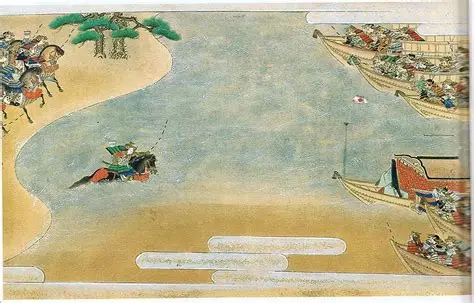
Arrows rained down from the Taira clan’s ships floating on the sea onto the mounted warriors of the Minamoto clan.
The palace at Yashima had already been set ablaze, and the Taira clan, with Emperor Antoku in their care, had retreated to their ships. However, the forces led by Yoshitsune were few in number. Knowing this, the Taira forces approached the shore once more, and fierce combat erupted on the coastline.
According to the “Tsunenobu’s Last Stand” chapter of the The Tale of the Heike, Taira no Noritsune, the governor of Noto, was targeting Minamoto no Yoshitsune from aboard the ship.
Noritsune, a nephew of Taira no Kiyomori, was a renowned warrior known for his skill with a powerful bow. He aimed his arrow to bring down the Minamoto commander.
In front of Yoshitsune, his retainers lined up their horses.
Sato Saburobei Tsugunobu from Oshu.
His younger brother, Sato Shirobei Tadanobu.
It is said that Eda Genzo, Kumai Taro, and Musashibo Benkei also stepped forward to protect Yoshitsune.
Noritsune shot arrows at them one after another.
One of these arrows pierced through Tsugunobu from his left shoulder to his right side.
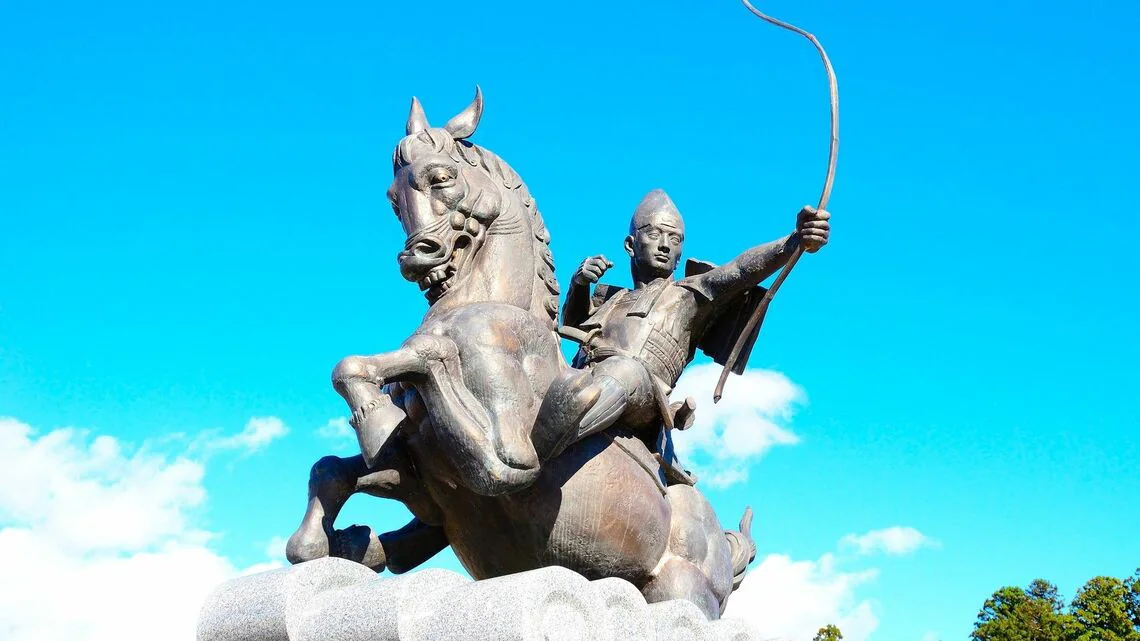
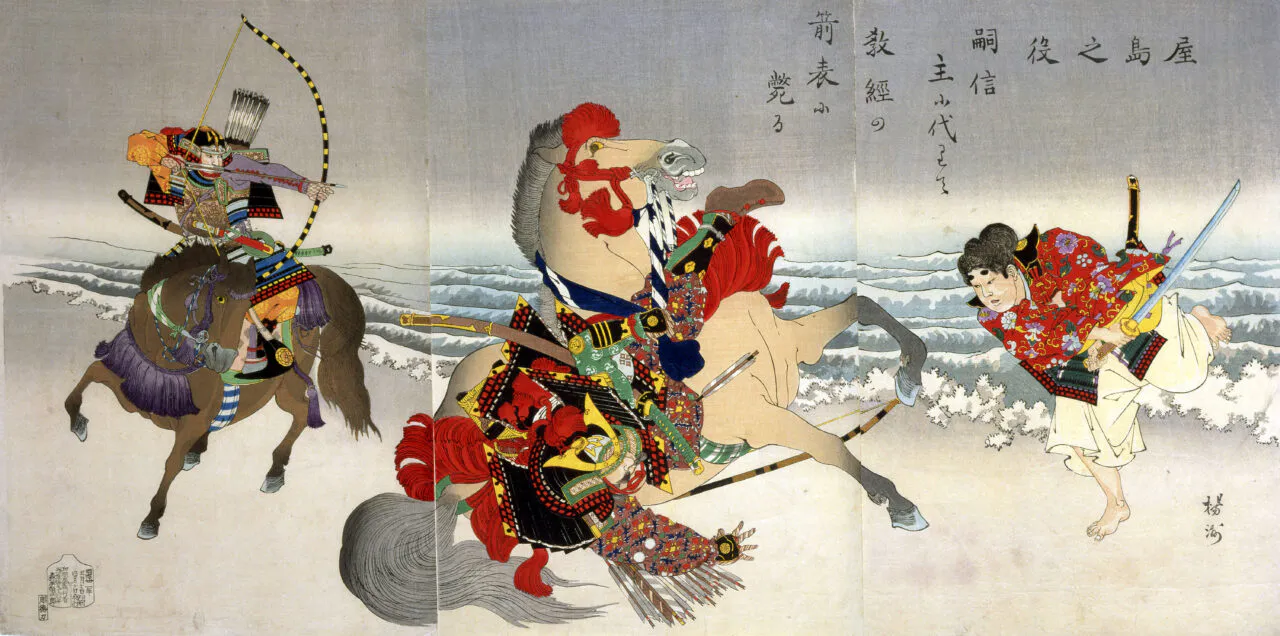
It is said that Tsugunobu fell from his horse upside down.
A young retainer of the Taira, Kikuomaru, rushed to take the fallen Tsugunobu’s head. However, Tadanobu, who was nearby, drew his bow and shot Kikuomaru, as The Tale of the Heike recounts.
It was the younger brother’s attempt to prevent his brother’s head from being taken.
The gravely wounded Tsugunobu was carried to the rear of the camp. It is said that Yoshitsune dismounted and took his hand.
“Do you have any regrets?”
When asked by Yoshitsune, Tsugunobu expressed his only regret was not being able to see his lord rise to prominence.
He then stated that if his sacrifice at Yashima in place of his lord’s life would be remembered by future generations, it would be the greatest honor for a warrior.
It is said that Yoshitsune’s armor sleeves were wet with tears.
Tsugunobu was a warrior who had followed Yoshitsune from the distant land of Mutsu Province.
His hometown was Shinobu Manor, which corresponds to the area around present-day Fukushima City in Fukushima Prefecture.
His father, Sato Motokazu, served the Oshu Fujiwara clan, and his brother Tadanobu also fought in various places as a retainer of Yoshitsune.
The month after Tsugunobu lost his life at Yashima, the Minamoto clan defeated the Taira at Dan-no-ura.
However, what awaited Yoshitsune afterward was conflict and flight from his brother Yoritomo.
The service to his lord that Tsugunobu could not fulfill at Yashima would continue to be carried on by his brother Tadanobu.
The Sato Clan of Shinobu Manor in Mutsu Province
Sato Tsugunobu was born into a family of warriors based in Shinobu Manor in Mutsu Province.
Shinobu Manor corresponds to the area around present-day Fukushima City in Fukushima Prefecture. In the late Heian period, the Shinobu Sato clan held significant power in this region.
The Sato clan is known as a prominent family serving as senior retainers to the Oshu Fujiwara clan.
The Northern Fujiwara clan expanded its influence over a wide area of Mutsu and Dewa, with Hiraizumi as its base. After the first leader, Fujiwara no Kiyohira, and the second leader, Motohira, the third leader, Hidehira, was in power during the time of Tsugunobu.
In Hiraizumi, temples like Chuson-ji and Motsu-ji were constructed, and products from the northern provinces, including gold and horses, were gathered there.
Maintaining relations with the Kyoto court and the Taira government, Hidehira was appointed as the Governor of Mutsu and the Commander of the Defense Office.
Supporting the rule of the Northern Fujiwara clan across various regions were numerous samurai.
The Sato clan of Shinobu was one such group.
The Sato clan managed the land as influential figures in the Shinobu district and forged a deep relationship with the Northern Fujiwara clan. It is said that there were also familial ties between the two clans.
Tsugunobu’s father was Sato Motokazu.
In the “Azuma Kagami,” he is also referred to as Sato Motoharu, known as Shinobu Sato Shoji or Yu Shoji.
His mother is said to be Otowa, and he had a younger brother named Tadanobu.
In later generations, the Sato brothers, known for their loyalty to Yoshitsune, were originally samurai from Shinobu who supported the Northern Fujiwara’s rule.
Father Sato Motokazu and Otori Castle
Sato Motokazu was a samurai who was active as a prominent figure in the Shinobu manor.
In present-day Iizaka Town, Fukushima City, the ruins of Otori Castle, said to be Motokazu’s residence, still remain.
The castle was built on a site known as Tatenoyama, utilizing the surrounding rivers and slopes as a mountain fortress. Remnants such as enclosures and dry moats still exist today, and the area has been developed into Tatenoyama Park.
There is a tradition that in the second year of Hogen (1157), Motokazu built the castle under the orders of Fujiwara no Hidehira.
It is also said that during the construction, a crane was buried to pray for the castle’s protection.
However, these are historical anecdotes passed down through later geographical records, and the detailed circumstances of the castle’s construction remain unclear.
Motokazu’s service to the Northern Fujiwara and his activities as a prominent samurai in the Shinobu district are also known from the “Azuma Kagami” articles on the Oshu War.
Tsugunobu and Tadanobu were raised as the sons of Motokazu.
There is a theory that Tsugunobu was born in the third year of Hogen (1158). However, the age at which he died in Yashima varies according to tradition, and his exact birth year is not confirmed.
What kind of life did the brothers lead in their childhood, and where did they learn archery and horseback riding?
No detailed records remain to tell us about those aspects.
Tsugunobu’s name clearly appears in history after he began serving Minamoto no Yoshitsune.
Minamoto no Yoshitsune Raised in Hiraizumi
Minamoto no Yoshitsune was the son of Minamoto no Yoshitomo and the half-brother of Minamoto no Yoritomo.
In the first year of Heiji (1159), when his father Yoshitomo was defeated in the Heiji Rebellion, the Minamoto clan was scattered across the land, and the young Yoshitsune fell under the control of the Taira clan.
He was later entrusted to Kurama Temple, according to tradition.
However, Yoshitsune eventually left Kyoto and headed to Oshu.
He sought the help of Fujiwara no Hidehira in Hiraizumi.
There is also a well-known story that Kanemochi Kichiji assisted him on his journey to Oshu, but the details largely rely on military tales like the ‘Heiji Monogatari.’
Hidehira protected Yoshitsune in Hiraizumi.
Yoshitsune spent his youth there and later, upon learning of Yoritomo’s uprising, decided to head to the eastern provinces.
Around the same time, the Sato family governed Shinobu Manor and served the Oshu Fujiwara clan.
It is unclear when Tsugunobu and Tadanobu became retainers of Yoshitsune.
Later biographies suggest that Tsugunobu was a wet nurse’s child to Yoshitsune. This tradition implies a close relationship with the young Yoshitsune, but there are few detailed records of their lives.
What is certain is that the Sato brothers later became Yoshitsune’s retainers and followed him to distant western battlefields.
Leaving Oshu with Yoshitsune
In the fourth year of Jisho (1180), Minamoto no Yoritomo raised an army in Izu Province.
Yoritomo’s uprising sparked movements against the Taira clan across the land.
Yoshitsune, who was in Oshu, also decided to join his brother.
The ‘Azuma Kagami’ records that in October of the same year, Yoshitsune met Yoritomo at Kisegawa in Suruga Province.
Subsequently, Yoshitsune joined Yoritomo’s forces and played a crucial role in the Genpei War.
It is said that around this time, Sato Tsugunobu and Tadanobu also left Oshu with Yoshitsune.
At Ioji Temple in Fukushima City, there is a tradition that their father, Motoharu, following Fujiwara no Hidehira’s orders, had his two sons accompany Yoshitsune.
The Sato family served Hidehira. The story of the brothers leaving Oshu with Yoshitsune has been passed down as a tale of the relationship between Hidehira and Yoshitsune.
However, the exact date of the brothers’ departure and the specific orders from their father remain unknown.
In later years, a legend emerged that their father saw them off and planted a staff at the place of their farewell.
This staff took root and became a cherry tree, known as the “Shoji Modoshi no Sakura” legend.
It is also unclear whether Tsugunobu and Tadanobu ever had the opportunity to reunite with their parents after leaving their hometown.
The two brothers joined Yoshitsune in the battles between the Minamoto and Taira clans.
Yoshitsune’s Forces Advance to Kyoto
In the second year of Juei (1183), the advance of Minamoto no Yoshinaka (Kiso Yoshinaka) forced the Taira clan to abandon Kyoto and retreat to the western provinces.
However, once in the capital, Yoshinaka soon came into conflict with the Retired Emperor Go-Shirakawa.
In January of the following Juei 3 (1184), Minamoto no Noriyori and Yoshitsune, acting on Yoritomo’s orders, advanced to Kyoto.
They defeated Yoshinaka’s forces at Uji River and Seta, leading to Yoshinaka’s death in battle at Awazu in Omi Province.
Afterward, Yoshitsune advanced to Settsu Province to pursue the Taira clan.
On February 7, the Battle of Ichinotani took place.
The Genji forces attacked the Taira positions from both east and west, resulting in the deaths of many commanders including Taira no Tadamasa, Taira no Atsumori, Taira no Tsunemasa, and Taira no Tomomori.
The Sato brothers are said to have followed Yoshitsune and participated in battles across various locations.
However, there are few detailed historical records about which unit Tsugunobu belonged to at Uji River and Ichinotani, or what military achievements he accomplished.
In later tales of Yoshitsune, the brothers appear as warriors active by Yoshitsune’s side from early on.
On the other hand, Tsugunobu’s actions are specifically recorded in the “Azuma Kagami” only in the following year’s Battle of Yashima.
From Ichinotani to Yashima
After their crushing defeat at Ichinotani, the Taira retreated by ship to Yashima in Sanuki Province.
Despite losing many of their commanders, the Taira still held Emperor Antoku and the Imperial Regalia.
A fleet remained in the Seto Inland Sea, and at Yashima, Taira no Munemori and others continued to support Emperor Antoku.
Meanwhile, Taira no Tomomori’s forces were active on Hikoshima in Nagato Province.
The Genji had achieved victories on land, but to pursue the Taira across the sea, they needed ships.
In September of the first year of Genryaku (1184), Noriyori led his forces to the western provinces.
He advanced along the Sanyo Road, battling the Taira at places like Fujito in Bizen Province, but the campaign dragged on. Supplies and ships were scarce, and some warriors even expressed a desire to return home.
While Noriyori was active in the Kyushu region, it was Yoshitsune who was tasked with heading to Yashima in Shikoku.
In February of the second year of Genryaku, Yoshitsune set sail from Settsu Province.
According to the “Azuma Kagami,” despite many ships being damaged by the storm, Yoshitsune decided to set sail.
On February 18, it is recorded that he crossed over to Awa Province with an advance party of five ships, leading over 150 horsemen ashore.
There is debate on how to interpret the number of ships and soldiers, but the fact that Yoshitsune crossed to Shikoku ahead of the main fleet is significant.
In Awa Province, Yoshitsune attacked the Taira stronghold and marched through the night towards Sanuki Province.
Keishin and Tadanobu were also part of this force.
February 19, the Imperial Residence at Yashima Burns
On the morning of February 19, 1185, Yoshitsune’s forces arrived at the opposite shore of Yashima.
At Yashima, Taira no Munemori and others were hosting Emperor Antoku, having established an imperial residence there.
Yoshitsune set fire to the houses in Mure and Takamatsu on the opposite shore.
Seeing the sudden blaze, the Taira forces believed a large Genji army was attacking.
Munemori and his men moved Emperor Antoku onto a ship and retreated to the sea.
During this time, Yoshitsune’s forces attacked the imperial residence at Yashima.
The “Azuma Kagami” entry for February 19, 1185, notes that the brothers Sato Keishin and Tadanobu, along with Goto Sanemoto and his adopted son Motokiyo, set fire to the imperial residence and Munemori’s resting place.
This record in the “Azuma Kagami” provides valuable insight into Keishin’s actions during the Battle of Yashima.
“Black smoke rose to the heavens, blocking the light of day.”
The black smoke from the imperial residence covered the sky, obscuring the daylight.
The palace at Yashima, where the Taira had hosted Emperor Antoku, was destroyed in this attack.
However, the Taira fleet remained at sea.
Realizing Yoshitsune’s forces were few, the Taira brought their ships back to shore and launched a counterattack.
Keishin met his end during this counterattack.
The Taira Forces Return to the Shore
According to the “Azuma Kagami,” Yoshitsune headed to the coast with Tashiro Nobutsuna, Kaneko Ietada, Kaneko Yoichi Chikanori, and Ise Saburo Yoshimori.
The Taira forces fired arrows from their ships, while the Genji forces returned fire from the shore.
Furthermore, it is recorded that Etchu Jirobei Moritsugu and Kazusa Gorobei Tadamitsu disembarked and formed ranks in front of the imperial residence.
Even after losing the imperial residence, the Taira did not simply flee.
They brought their ships to shore, landing their warriors to attack Yoshitsune’s forces.
The “Heike Monogatari” introduces Taira no Noritsune at this point.
Noto no Kami Taira no Noritsune, the son of Kiyomori’s brother Taira no Norimori, and the brother of Taira no Tomomori, who died in battle at Ichinotani.
The “Heike Monogatari” portrays Noritsune as a skilled archer, who at Yashima, shot down Genji warriors one after another.
Noritsune’s target was the Genji commander, Yoshitsune.
Keishin Stands in the Line of Fire for Yoshitsune
According to the “Tale of the Heike,” Yoshiie was surrounded by Tsuneshige and Tadanobu, along with Eda Genzo, Kumai Taro, and Musashibo Benkei.
They lined up their horses and advanced in front of Yoshiie.
Noritsune shot arrows at the warriors who were blocking his path to Yoshiie.
The “Tale of the Heike” recounts that more than ten armored horsemen were shot down by those arrows.
Then, Tsuneshige, who had advanced to the front line, was struck by an arrow.
From the shoulder of his bow arm to the side of his horse arm.
Tsuneshige, pierced through his body, fell upside down from his horse.
The arrow aimed at Yoshiie was taken by his retainer, Tsuneshige.
Tsuneshige’s final moments would be depicted repeatedly in later generations.
However, there is a historical issue with this scene.
The “Azuma Kagami” also records that Tsuneshige was shot and killed at Yashima, but it does not name the archer.
The “Tale of the Heike” portrays it as the work of Taira no Noritsune’s powerful bow.
Regarding Noritsune’s own fate, other historical sources provide different accounts.
Did Taira no Noritsune Die at Ichinotani?
Taira no Noritsune is known as a brave warrior of the Taira clan during the Genpei War.
In the “Tale of the Heike,” he is depicted as the one who shot down Tsuneshige at the Battle of Yashima and continued to target Yoshiie even at Dan-no-ura.
However, the “Azuma Kagami” tells a different story of Noritsune’s end.
It includes an account that in the third year of Juei (1184), during the Battle of Ichinotani, Noritsune was captured and executed.
If this record is followed, Noritsune would have died about a year before the Battle of Yashima.
On the other hand, in the diary “Gyokuyo” by Kujo Kanezane, there is information that Noritsune was still alive after the Battle of Ichinotani.
Moreover, the “Daigoji Zatsujiki” records that Noritsune committed suicide at Dan-no-ura.
There are records of him being captured at Ichinotani and others indicating he survived afterward.
Regarding Noritsune’s final moments, discrepancies remain among the historical sources.
It remains uncertain whether it was truly Taira no Noritsune who shot Minamoto no Tsugunobu at Yashima.
The fact that Tsugunobu died in battle at Yashima and the story of him protecting Minamoto no Yoshitsune from Noritsune’s arrow are supported by different historical sources.
However, the scene in the ‘Tale of the Heike’ where Noritsune targets Yoshitsune and Tsugunobu takes the arrow is what made the name of Sato Tsugunobu known to later generations.
Tadanobu Who Refused to Surrender His Brother’s Head
The ‘Tale of the Heike’ also recounts the events immediately following Tsugunobu’s fall.
It was Kikuomaru from the Taira side who rushed to Tsugunobu’s side.
Kikuomaru was a young retainer serving Noritsune, and it is said he originally served Noritsune’s brother, Taira no Tsunemori.
After Tsunemori fell at the Battle of Ichinotani, he began serving his younger brother, Noritsune.
He was said to be 18 years old at the time.
Kikuomaru drew his sword and attempted to take the head of the fallen Tsugunobu.
Seeing this, Tadanobu drew his bow.
He shot an arrow at Kikuomaru, determined not to let his brother’s head fall into enemy hands.
The arrow pierced through Kikuomaru’s grass skirt.
Kikuomaru was wounded and fell.
The ‘Tale of the Heike’ tells that Noritsune, still holding his bow, grabbed Kikuomaru and carried him onto a ship.
However, the wound was deep.
Kikuomaru died from his injuries, and Noritsune mourned his death deeply.
On the shores of Yashima, where both Tsugunobu and Kikuomaru fell.
On one side was Tadanobu, trying to protect his brother. On the other was Noritsune, who had lost a young retainer.
This account is conveyed through the ‘Tale of the Heike’, and there are no contemporary historical records detailing Tadanobu’s shooting of Kikuomaru.
Nevertheless, as the brother who witnessed his sibling’s death in battle, Tadanobu’s name became etched into the story of Tsugunobu’s final moments.
The Words Tsugunobu Left for Yoshitsune
Severely wounded, Tsugunobu was carried to the rear of the camp.
According to the ‘Tale of the Heike’, Yoshitsune leapt from his horse and took Tsugunobu’s hand.
“How do you feel?”
Yoshitsune asked about his condition.
Tsugunobu replied that he could not be saved.
When asked if he had any regrets, Tsugunobu mentioned one thing he lamented.
It was that he would not see Yoshitsune rise to prominence.
At Yashima, the Genji forces were nearing victory as they set fire to the Taira’s imperial palace.
However, the battle was not yet over.
Tsugunobu could not witness the outcome.
The ‘Tale of the Heike’ narrates that Tsugunobu had long been prepared for the possibility of dying from an enemy arrow on the battlefield, as was the fate of a warrior.
He expressed that if future generations would recount how he was struck down at Yashima in place of his lord, it would be the greatest honor.
“At the shore of Yashima in Sanuki Province, he was struck down in place of his lord.”
What Tsugunobu wished for, it is said, was for his name to be remembered by posterity.
The ‘Tale of the Heike’ records that upon hearing these words, Yoshitsune’s armor sleeves were wet with tears.
Of course, there are no contemporary records that directly transcribe the conversation between the two.
Tsugunobu’s final words have been passed down through military tales.
Nevertheless, the fact that he was shot and lost his life at Yashima is also recorded in the ‘Azuma Kagami.’
Yoshitsune, having lost Tsugunobu, ended up parting with a prized horse for his funeral.
The Prized Horse Yoshitsune Parted With: Taifu Kuro
Upon learning of Tsugunobu’s death, Yoshitsune was deeply saddened.
The ‘Azuma Kagami’ entry for February 19, Genryaku 2, notes that Yoshitsune invited a monk and had Tsugunobu buried at the base of a thousand-year-old pine.
He then gave the monk a horse.
It was Taifu Kuro.
Taifu Kuro was originally a horse from the stables of Emperor Go-Shirakawa.
It was given to Yoshitsune when he served the emperor and was the horse he rode into battle.
Yoshitsune gave this cherished horse to the monk for Tsugunobu’s memorial service.
The ‘Azuma Kagami’ praises this act as a demonstration of respect for a fallen retainer.
The ‘Tale of the Heike’ also recounts the story of a black prized horse given to the monk who mourned Tsugunobu.
The horse was adorned with a splendid saddle.
Seeing this, the retainers shed tears and declared they would not hesitate to give their lives for Yoshitsune.
What Tsugunobu’s final words were remains unknown.
However, the story of Yoshitsune mourning his death and giving Taifu Kuro for the funeral is recorded in the ‘Azuma Kagami.’
Tsugunobu’s death was a significant event for Yoshitsune.
The Victory at Dan-no-ura His Brother Could Not Witness
Even after losing Tsugunobu, Yoshitsune continued to pursue the Taira clan.
Though he burned the imperial palace at Yashima, he could not capture Emperor Antoku or Taira no Munemori.
The Taira clan maintained their fleet and retreated to the sea, heading towards Shido.
According to the ‘Azuma Kagami,’ on February 21, Yoshitsune led 80 horsemen to advance on Shido.
Subsequently, Taira no Tadaie’s retainer surrendered, and Kono Michinobu of Iyo Province joined Yoshitsune’s forces with 30 warships.
On the following day, February 22, the fleet of Kajiwara Kagetoki and others also arrived at Yashima.
The Genji forces gathered more ships and pursued the Taira westward.
On March 24, the final naval battle between the Genji and the Taira took place at Dan-no-ura in Nagato Province.
Yoshitsune was at the center of the Genji forces, and the Taira were defeated in this battle.
Emperor Antoku perished in the sea, and many Taira warriors lost their lives.
This occurred about a month after Tsugunobu was killed at Yashima.
In “The Tale of the Heike,” Tsugunobu laments that he will not see Yoshitsune rise to prominence.
Yoshitsune achieved great military success in defeating the Taira clan.
However, shortly after the victory at Dan-no-ura, his relationship with his brother Yoritomo began to deteriorate.
Tsugunobu’s brother, Tadanobu, remained by Yoshitsune’s side during this difficult time.
Tadanobu’s Struggle After Losing His Brother
After losing his brother at Yashima, Tadanobu continued to follow Yoshitsune.
Following the Taira’s downfall at Dan-no-ura, the relationship between Yoshitsune and Yoritomo gradually worsened.
Yoshitsune received an imperial order to pursue Yoritomo, but he could not gather enough troops.
At the end of the first year of Bunji (1185), Yoshitsune left Kyoto and headed for Mount Yoshino in Yamato Province.
Tadanobu accompanied him on this escape.
According to “The Tale of Yoshitsune,” Tadanobu claimed to be Yoshitsune to distract the pursuers, allowing his lord to escape.
It is said that he fought the pursuers at Mount Yoshino, enabling Yoshitsune to move on.
While the detailed account of this battle comes from later military tales, Tadanobu is certainly known as the samurai who aided Yoshitsune’s escape.
Tadanobu later returned to Kyoto.
However, his whereabouts became known to the pursuers.
In the second year of Bunji (1186), Tadanobu was surrounded in Kyoto and, after a battle, took his own life, as recorded in “The Azuma Kagami.”
This occurred the year after Tsugunobu lost his life at Yashima.
Tsugunobu died in battle while Yoshitsune was pursuing the Taira.
His brother Tadanobu continued to follow Yoshitsune even after he became a fugitive from Yoritomo.
The stories of their final moments are deeply intertwined with Yoshitsune’s life.
The Family Who Learned of the Brothers’ Deaths in Their Hometown
In their hometown of Shinobu Manor, Tsugunobu and Tadanobu’s family remained.
They were their father, Motoji, and mother, Otoha.
It is said that Tsugunobu had a wife named Wakazakura and Tadanobu had a wife named Kaede.
However, much of what is known about their wives’ names and lives is based on later traditions.
In Ioji Temple in Fukushima City, there is a story about the family who learned of the brothers’ deaths.
Their mother, Otoha, was deeply grieved by the loss of her two sons.
It was said that Wakazakura and Kaede, the wives of Tsugunobu and Tadanobu, could not bear to see her in such sorrow.
Both Wakazakura and Kaede had also lost their husbands.
Yet, in an effort to console their mother-in-law, they donned their late husbands’ armor.
Wakazakura is said to have carried a naginata, while Kaede held a bow and arrows.
They appeared before Otoha, dressed as brave warriors, as if Tsugunobu and Tadanobu had returned.
They wanted to show their mother the sight of her sons once more.
This story was incorporated into noh and joruri plays, becoming widely known.
There are no contemporary records confirming that the two wives actually wore armor.
However, the story of the Sato brothers also portrays the family left behind in their hometown, alongside the two who perished on the battlefield.
When Matsuo Basho later visited the land of Shinobu, he was particularly moved by the tales of these wives.
Father Sato Motoharu Also Fights at Ishinasaka
Even after the deaths of Tsugunobu and Tadanobu, their father, Motoharu, remained in Oshu.
After the fall of the Taira clan, Yoshitsune clashed with Yoritomo and fled back to Hiraizumi.
Fujiwara no Hidehira protected Yoshitsune, but he passed away in 1187.
His successor, Yasuhira, was pressured by Yoritomo to hand over Yoshitsune.
In the intercalary fourth month of 1189, Yasuhira attacked Yoshitsune’s residence.
Yoshitsune met his end at Koromogawa.
Nevertheless, Yoritomo decided to dispatch troops to Oshu, and in July of the same year, he led a large army north from Kamakura.
This marked the beginning of the Battle of Oshu.
At this time, Sato Motoharu also fought on behalf of the Oshu Fujiwara clan.
According to the Azuma Kagami entry for August 8, 1189, Sato Shoji, who served Fujiwara no Yasuhira, set up camp at Ishinasaka with his uncle Kawabe Takatsune and Igarame Takashige.
There, they constructed moats and fences to prepare for the advance of the Kamakura forces.
On the Kamakura side, Isa Tamemune, the son of Hitachi Nyudo Nensai, and others launched an attack.
The battle was fierce, and there were casualties on the Kamakura side as well.
However, in the end, the forces of the Sato clan were defeated.
The Azuma Kagami entry for August 8 records that the heads of Sato Shoji and 18 others were taken.
According to this record, Motoharu would have been killed in action at Ishinasaka.
However, the Azuma Kagami contains another record regarding Motoharu’s fate.
Sato Shoji Slain at Ishinasaka, Pardoned in October
October 2, 1189.
The Azuma Kagami reports that Sato Shoji, Natori Gunji, and Kumano Betto, who had been taken prisoner, were pardoned and returned to their original lands.
On August 8, it was recorded that Sato Shoji was slain.
Yet, about two months later, the same name appears as having been pardoned.
The two entries do not align as they stand.
While there is a tradition that Motoharu died in battle at Ishinasaka, there is also a view that he was captured and later pardoned.
Later geographical records also tell of Motoharu surviving and returning to Otori Castle.
Recent research emphasizes the pardon entry from October 2, suggesting that Motoharu was captured, pardoned, and returned to Shinobu Manor.
The precise details of Motoharu’s end still require further examination of the sources.
In any case, it is recorded in the Azuma Kagami that Motoharu served the Oshu Fujiwara clan and fought against Yoritomo’s forces.
His sons, Tsugunobu and Tadanobu, served Yoshitsune and lost their lives in succession.
Their father, Motoharu, served the Oshu Fujiwara clan, who had protected Yoshitsune, and faced Yoritomo’s forces.
The Sato family found themselves fighting in different locations throughout the conflicts from the Genpei War to the Battle of Oshu.
The Sato Clan’s Memorial Tower at Ioji Temple
In present-day Iizaka Town, Fukushima City, stands Ioji Temple.
This temple belongs to the Buzan sect of Shingon Buddhism and is known as the family temple of the Shinobu Sato clan.
In the inner sanctuary of the temple grounds, there remain stone towers said to be the graves of Sato Motoharu, his mother Otowa, and Keishin and Tadanobu.
These are recognized as a group of important cultural properties designated by Fukushima Prefecture, known as the “Stone Memorial Towers of Ioji Temple.”
Numerous stone towers, centered around the Oshu-style Itabi, are enshrined here, conveying the faith associated with the Sato clan.
According to the temple’s history, there was once a belief that scraping off and consuming the stone from Keishin and Tadanobu’s memorial towers could cure illnesses.
As a result, some parts of the towers show signs of having been scraped away.
However, Keishin met his end in Yashima, Sanuki Province.
The “Azuma Kagami” records that Yoshitsune had Keishin buried at the root of a thousand-year-old pine tree.
The stone towers at Ioji Temple have been passed down as memorial towers erected to honor his spirit in his hometown.
Additionally, within the temple grounds is a camellia known as “Otowa’s Camellia.”
It is said that the grief of Otowa, mourning her sons’ deaths, resides in the tree, causing its flowers to fall while still in bud, never fully blooming.
The tale of a mother’s sorrow over her sons’ deaths continues to be told at Ioji Temple to this day.
The Sato Clan’s Gravestones That Moved Matsuo Basho to Tears
In the second year of Genroku (1689), Matsuo Basho traveled through Oshu.
This was during his journey chronicled in “The Narrow Road to the Deep North.”
Basho entered the land of Shinobu and visited the old site of Sato Shoji.
After crossing the Tsukinowa Ferry and reaching Segami, he asked locals for directions and headed towards the village of Iizuka.
Eventually, he arrived at a place called Maruyama.
There, remnants of what was said to be Sato Shoji’s residence were preserved.
Seeing this site, Basho was moved to tears and proceeded to a nearby ancient temple.
The temple housed gravestones of the Sato clan.
Among them, Basho was particularly touched by the gravestones of two wives.
“The Narrow Road to the Deep North” records his feelings.
“Among them, the marks of the two wives are especially poignant.”
Basho deeply empathized with the fact that the names of the wives who had lost their husbands were preserved.
He was moved by their gallant reputation, left behind despite their status as women, and wrote that his sleeves were wet with tears.
About 500 years after the deaths of the Sato brothers.
The stories of not only Keishin and Tadanobu’s final moments but also of the wives left behind in their homeland had been passed down to Basho’s time.
“Decorate with Paper Streamers in May, Both Box and Sword”
Basho sought tea at the temple.
It is said that the temple preserved as treasures Yoshitsune’s sword and Benkei’s box.
The box is a container carried on the back, used for storing travel gear and other items.
Upon seeing these, Basho composed a haiku.
“Adorn the month of May with both the pack and the sword, and paper streamers.”
In the Boys’ Festival of May, I hope you will display Yoshitsune’s sword and Benkei’s pack alongside paper streamers.
This haiku by Basho was inspired by his visit to a place associated with the Sato brothers, where he saw items believed to be the sword of their lord, Minamoto no Yoshitsune, and the pack of Benkei.
Of course, it’s uncertain whether these sword and pack were truly used by Yoshitsune and Benkei.
What Basho saw were treasured artifacts passed down through a temple from the Edo period.
Today, a monument inscribed with this haiku remains at Ioji Temple.
Within the temple grounds stands a memorial tower for the Sato clan, and stories of their wives are also passed down.
The lives of Tsugunobu and Tadanobu became known to even more people through Basho’s travel writings.
The “Grave of Sato Tsuginobu” in Sanuki
In Sanuki Province, where Tsugunobu lost his life, there is a place believed to be his grave.
This is the grave of Sato Tsugunobu located in Mure Town, Takamatsu City, Kagawa Prefecture.
According to cultural heritage records of Takamatsu City, the grave was originally located behind the current site, at a place called Oomuka Pond.
In the second year of Shōhō (1645), it was moved to its current location when the pond was constructed.
A little earlier, in the 20th year of Kan’ei (1643), Matsudaira Yorishige, the first lord of the Takamatsu Domain, erected a new marker stone.
The stone is inscribed with the words:
“Grave of Sato Tsuginobu”
The characters used differ from the commonly used “Tsugunobu.”
In the “Tale of the Heike,” the name “Shinobu” is also used, indicating that multiple characters have been passed down for Tsugunobu’s name.
“Tsuginobu” is one of these variations.
In 1931, Sato Shinko, believed to be a descendant of Tsugunobu, undertook significant renovations of the grave site.
Monuments such as the Sato Family Ancestral Memorial were erected, shaping the site into its current form as a cemetery park.
Takamatsu City has registered this grave site as a city historical site.
The grave of Tsugunobu, who died in battle at Yashima, has been preserved by the lords of the Takamatsu Domain during the Edo period and by those believed to be his descendants in later generations.
Ichiotobatake and Suzaki Temple
In the area around Yashima, several sites are associated with the legend of Tsugunobu’s final moments.
One such site is Ichiotobatake in Mure Town, Takamatsu City.
It is said to be the place where Tsugunobu fell from his horse after being struck by a Taira no Noritsune’s arrow, as recounted in the “Tale of the Heike.”
In 1931, Sato Shinko, believed to be a descendant of Tsugunobu, erected a stone monument at this site.
Today, it is one of Takamatsu City’s registered historical sites.
Nearby is Suzaki Temple.
The temple holds a story that Tsugunobu, wounded, was carried there on a door plank.
It is said that weapons associated with Tsugunobu are also preserved there.
However, the exact location where Tsugunobu was struck by the arrow and the route he was taken remain unknown from contemporary records.
The legends of Ichiotobatake and Suzaki Temple are stories passed down by later generations, linking the land of Yashima with the depiction of Tsugunobu’s end in the “Tale of the Heike.”
Additionally, there is a place in Yashima believed to be the grave of Kikuwamaru.
Kikuomaru was a young retainer who appears in the Tale of the Heike, where he was shot by Tadanobu while trying to take the head of Tsugunobu.
On the Genji side was Tsugunobu, and on the Heike side was Kikuomaru.
At Yashima, sites remain to mourn the deaths of both men.
The Name of Sato Tsugunobu Remembered in Oshu and Sanuki
On February 19, 1185, Sato Tsugunobu lost his life in the Battle of Yashima.
Born into the Sato clan, who governed the Shinobu Manor in Mutsu Province, he served Minamoto no Yoshitsune alongside his younger brother Tadanobu.
Much about his early military achievements remains unknown.
However, the Azuma Kagami records that he participated in the attack on the Yashima palace and was killed in battle after being shot.
Yoshitsune was deeply grieved by Tsugunobu’s death and gave his beloved horse, Taifu-kuro, to a monk during the funeral.
In the Tale of the Heike, he is depicted as the warrior who protected Yoshitsune from Taira no Noritsune’s arrow.
The words Tsugunobu is said to have left at the end of his life became widely known to later generations.
His brother Tadanobu continued to follow Yoshitsune even after he was pursued by Yoritomo, and he died in Kyoto in 1186.
Their father, Motoji, later fought against the Kamakura forces in the Oshu War.
In the land of Shinobu, where the family lived, a memorial tower for the Sato clan still stands today.
Near Yashima, a grave was erected for Tsugunobu.
In 1643, Matsudaira Yorishige, the lord of the Takamatsu domain, erected a stone marker inscribed with “Grave of Sato Tsugunobu”.
In 1689, Matsuo Basho visited the old site of Sato Shoji in Oshu.
Basho shed tears upon seeing the monuments to the two wives and composed a poem inspired by Yoshitsune’s sword and Benkei’s backpack, which remain at the temple.
As Tsugunobu wished in the Tale of the Heike, his name has been passed down through the ages.
Sato Saburobei Tsugunobu of Oshu.
The warrior who was said to have been shot in place of his lord at Yashima is remembered in both the distant lands of Sanuki and Mutsu.