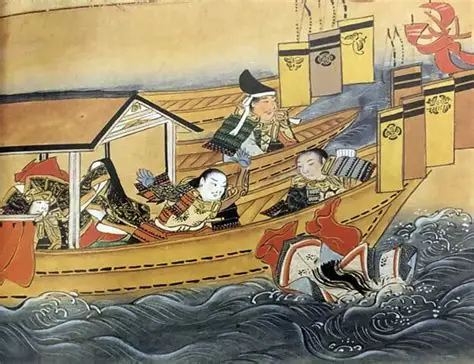
In July of 1183, the Taira clan departed Kyoto, heading westward.
With Minamoto no Yoshinaka’s forces closing in, the Taira found it increasingly difficult to defend the capital and decided to flee, taking Emperor Antoku and the Imperial Regalia with them.
During their retreat, one warrior made his way to Ninna-ji Temple.
That warrior was Taira no Tsunemasa.
The eldest son of Taira no Kiyomori’s brother, Taira no Tadamori, Tsunemasa was a Taira noble known for his skill in playing the biwa and composing waka poetry.
According to “The Tale of the Heike,” Tsunemasa served at Ninna-ji Temple as a child, where he became familiar with court music.
On the day of the capital’s fall, Tsunemasa brought with him a famous biwa named “Seizan,” which had been entrusted to him by Ninna-ji.
He placed the biwa, wrapped in a red brocade bag, before the temple’s abbot and bid farewell.
It would be a great loss to take such a precious instrument into the turmoil of the western provinces.
If by chance I can return to the capital, I would like to take it into my care once more.
The abbot accepted the biwa and composed a waka in return.
“Though we part too soon, I shall keep your memory as a memento for the future.”
Tsunemasa borrowed an inkstone and wrote a reply.
“Though the water in the bamboo pipe may change, my feelings for the palace remain unchanged.”
The water flowing through the bamboo pipe at Ninna-ji is ever-changing.
Yet, my feelings for the days spent at this palace are endless.
Leaving behind such a poem, Tsunemasa rejoined the Taira clan’s retreat.
More than half a year later.
On February 7, 1184, Tsunemasa fought and died in battle against the Minamoto forces at Ichinotani in Settsu Province.
His brothers, Taira no Tsunetaka and Atsumori, also perished on the same battlefield.
Tsunemasa was known both for his biwa studies at Ninna-ji and his service in various court positions, where he was active in the poetry circles alongside his father, Taira no Tadamori.
As the Genpei War erupted, he was dispatched to the Hokuriku region, where he engaged in battles against Minamoto no Yoshinaka’s forces.
Before the tale of returning the biwa “Seizan” to Ninna-ji, Tsunemasa had a long history of court service and battlefield experience in the north.
Born as the Eldest Son of Taira no Tadamori
Taira no Tsunemasa was born as the eldest son of Taira no Tadamori.
His father, Tadamori, was a son of Taira no Tadamasa, who led the Ise Taira clan.
Taira no Kiyomori was his half-brother, and he held various official positions in the imperial court.
For Tsunemasa, Kiyomori was an uncle, and Tadamori was a grandfather.
Tsunemasa’s exact birth year is unknown.
It is sometimes estimated that he was born around the Kyuan era (1145–1151), but no definitive records confirm this.
Details about his mother are also unclear.
His father, Taira no Tsunemori, had several children.
Among Tsunemasa’s known younger brothers are Taira no Tsunetoshi and Taira no Atsumori.
Tsunetoshi served as the governor of Wakasa and joined the Taira forces during the Genpei War.
Atsumori was known as the “Unranked Noble” and is depicted in the Tale of the Heike as a young warrior carrying a flute.
Other names such as Tsunekane, Tsunemitsu, and Chikamori also appear in genealogies.
However, many details about their birth years, their mother’s origins, and their early lives remain unknown.
Tsunemasa grew up during a time when the Taira clan was rising in status within the imperial court.
His grandfather, Tadamori, gained influence through the trust of Retired Emperor Toba, and Kiyomori continued this legacy.
Meanwhile, Tsunemasa’s father, Tsunemori, was active not only as an official but also had a keen interest in waka poetry.
Tsunemasa thus grew up in a household deeply connected to court culture.
Tsunemori, the Father Who Hosted Poetry Contests
His father, Tsunemori, served the court as Kiyomori’s brother.
He held positions such as governor of Wakasa and head of the Bureau of Imperial Storehouses, eventually rising to the rank of councilor.
He was a prominent official, conferred with the Senior Third Rank.
At the same time, Tsunemori was an avid student of waka poetry and mingled with court poets.
Within the Taira clan, his grandfather Tadamori also had a fondness for waka.
Tadamori participated in poetry gatherings during Emperor Sutoku’s reign and left behind his works.
Tsunemori continued this tradition, hosting poetry contests from the Nin’an to the Shōan eras.
A poetry contest involves participants dividing into two sides to present poems, with judges determining the winners.
Poems were composed on set themes such as spring flowers, autumn moons, and love.
Distinguished court poets gathered at Tsunemori’s poetry contests.
His interactions with poets like Fujiwara no Kiyosuke and Shun’e are also well-documented.
Kiyosuke was a poet from the Rokujō Fujiwara family, known for his contributions to the study of poetry and writing treatises on the subject.
Shun’e, the son of Minamoto no Toshiyori, continued his involvement in the world of waka even after becoming a monk.
Additionally, Tsunemori was long involved with the court of Fujiwara no Masako, consort of Emperor Nijō.
The roles at court and the activities in the poetry circles were deeply intertwined in Tsunemori’s life.
His eldest son, Tsunemasa, also participated in the poetry contests organized by his father and later began hosting his own poetry gatherings.
However, the place that had a significant influence on young Tsunemasa was not just his father’s residence.
It was Ninna-ji Temple in Kyoto.
Ninna-ji Temple in His Early Years
Ninna-ji is a Shingon Buddhist temple located in Omuro, Kyoto.
Construction began at the behest of Emperor Koko, and it was completed in the 4th year of Ninna (888) during Emperor Uda’s reign.
After abdicating, Emperor Uda took vows and resided at Ninna-ji.
Subsequently, Ninna-ji became a temple where monks of imperial lineage served as abbots, forging a deep connection with the court.
According to the “Tsunemasa’s Departure from the Capital” in the seventh volume of “The Tale of the Heike,” Tsunemasa entered the Omuro of Ninna-ji at the age of eight and served there until he came of age at thirteen.
It is said that during this time, Tsunemasa, in his childhood form, served closely to the Omuro.
He reportedly rarely left his side, except when he was ill.
In the Heian period, it was not uncommon for children of nobles and influential warriors to serve the imperial family or temples.
During this time, they might learn etiquette, academics, poetry, music, and more.
Tsunemasa is said to have become familiar with the biwa at Ninna-ji and was recognized for his musical talent.
However, the specific ages of eight to thirteen are based on “The Tale of the Heike.”
Since Tsunemasa’s birth year is unknown, the exact year he entered Ninna-ji cannot be determined.
Meanwhile, Tsunemasa’s relationship with the princes of Ninna-ji can also be gleaned from later poetry records.
Even after Tsunemasa grew up to become a warrior of the Taira clan, his interactions with Ninna-ji continued.
Prince Kakusho and Prince Shugaku
In considering Tsunemasa’s life at Ninna-ji, it is necessary to distinguish between two princes.
These are Prince Kakusho and Prince Shugaku.
Prince Kakusho was born in the 4th year of Daiji (1129).
He was the son of Emperor Toba and served as the abbot of Ninna-ji.
He was well-versed in Buddhist studies and rituals, and familiar with court culture.
He is known as the person who recognized Tsunemasa’s talent with the biwa during his childhood.
However, Prince Kakusho passed away in the 1st year of Kaho (1169).
By the time the Taira clan left Kyoto in the 2nd year of Juei (1183), fourteen years had already passed.
Prince Shugaku succeeded Prince Kakusho.
Prince Shugaku was born in the 6th year of Kyuan (1150).
He was the son of Emperor Go-Shirakawa and entered Ninna-ji, taking vows under Prince Kakusho.
When Prince Kakusho passed away in the 1st year of Kaho, Prince Shugaku succeeded him as the abbot of Ninna-ji.
Prince Shugaku was also knowledgeable in poetry and Buddhist rituals, and his works, such as poetry collections, have been passed down.
Tsunemasa continued his interactions with Prince Shugaku as well.
When Tsunemasa departed the capital, it is believed that he returned the biwa “Aoyama” to Prince Shugaku, based on the timeline.
The young Tokinaga served Prince Kakusho during his childhood, and later bid farewell to Prince Shokaku at Ninna-ji Temple in 1183.
Thus, Tokinaga was associated with two generations of the Omuro of Ninna-ji Temple.
The Biwa, Revered in Court Music
Tokinaga was particularly renowned for his exceptional skill in playing the biwa.
In the Heian period court, gagaku music, which had been imported from Tang China, was performed at ceremonies and banquets.
The biwa was one of the instruments used in these performances.
It is a string instrument with four strings, played by plucking with a plectrum.
In the court, both nobles and members of the imperial family studied music, and those who excelled were highly esteemed.
Furthermore, musical skills were often passed down through families and master-disciple relationships.
Certain pieces were treated as secret compositions, taught only to a select few.
According to the “Tale of the Heike,” Tokinaga honed his biwa skills at Ninna-ji Temple, engaging with such music.
His talent was such that he was entrusted with a special instrument by the Omuro of Ninna-ji Temple.
This instrument was known as “Seizan.”
“Seizan” is famed as a masterful biwa passed down at Ninna-ji Temple.
Rather than being freely owned by Tokinaga, it was a treasured item carefully entrusted to him by the temple.
The “Tale of the Heike” records a lengthy narrative about its origins.
The Tang Origins of the Biwa “Seizan”
“Seizan” is pronounced “Seizan.”
The seventh volume of the “Tale of the Heike,” titled “The Story of Seizan,” provides a detailed account of this biwa’s origins.
During the reign of Emperor Ninmyo, a man named Fujiwara no Sadatoshi traveled to Tang China.
Sadatoshi studied the biwa and was taught secret compositions by a biwa master in Tang.
Upon his return, he attempted to bring back three biwa.
These were “Genjo,” “Shishimaru,” and “Seizan.”
Genjo is also written as “Genjo.”
However, as the ship crossed the sea, fierce winds arose and the waves grew high.
The people believed that the dragon god coveted the precious instruments, so they cast one into the sea.
The one submerged was Shishimaru.
The remaining Genjo and Seizan were brought to Japan and became treasures of the emperor.
The “Tale of the Heike” further describes the appearance of “Seizan.”
The body was made of purple wisteria wood, and the area where the strings were plucked depicted the rising moon of Ariake between green mountains.
It is said to have been named “Seizan” after this image.
However, these are stories explaining the pedigree of the biwa as a renowned instrument.
It is difficult to verify the details of its transmission from Tang or the tale of the instrument being submerged as historical facts.
Instruments passed down in the court often had various stories added to highlight their value.
“Seizan” has been recounted as one such esteemed instrument.
The Biwa Master Who Appeared Before Emperor Murakami
The tale concerning “Seizan” does not end with the stories brought from Tang China to Japan.
During the era of Emperor Murakami, a mysterious event is said to have occurred.
Emperor Murakami reigned from the 9th year of Tenkei (946) to the 4th year of Koho (967).
According to the Kakuichibon version of “The Tale of the Heike,” one night, Emperor Murakami was playing the biwa “Genjo” in the Seiryo-den.
Then, a stranger appeared before him.
It was said to be the spirit of the master who taught the biwa to Sadatoshi in Tang China.
The master explained that he was supposed to teach Sadatoshi three pieces, but had left one untaught.
As a result, he was unable to escape his suffering even after death.
He wished to pass on the remaining secret piece to the Emperor.
The spirit of the master is said to have taken up “Seizan” and played the piece.
Similar musical tales are also found in “Kojidan” and “Jikkinsho.”
Additionally, depending on the version of “The Tale of the Heike,” there are variations in details, such as celestial beings appearing when the biwa was played.
It is thought that stories about the transmission of old instruments and secret pieces became associated with the tale of Tsunemasa.
“Seizan,” said to have been entrusted from Ninna-ji, is depicted as a revered instrument long cherished by the Imperial family and temples.
Tsunemasa became known to posterity as someone permitted to handle this biwa.
The Tale of Visiting Usa Hachimangu at Seventeen
“The Tale of the Heike” also contains a story about Tsunemasa being sent as an imperial envoy to Usa Hachimangu at the age of seventeen.
Usa Hachimangu is a prominent shrine in Buzen Province, now located in Usa City, Oita Prefecture.
As a shrine dedicated to the god Hachiman, it was deeply revered by the court and involved in important national prayers.
According to “The Tale of the Heike,” Tsunemasa was entrusted with “Seizan” and set out for Usa Hachimangu.
There, he played the secret piece of the biwa before the deity.
It is said that those who heard the performance were moved to tears by its sound.
Even those not familiar with the biwa, as well as those not knowledgeable about music, were deeply touched.
However, the exact year Tsunemasa went to Usa is unknown.
Since Tsunemasa’s birth year is unclear, it is difficult to determine the period from his age of seventeen.
Moreover, there are no detailed contemporary records about his dispatch as an envoy or the course of his performance.
This tale is passed down as a testament to Tsunemasa’s exceptional skill as a biwa player from a young age.
Meanwhile, records show that as an adult, Tsunemasa held various court positions.
From Governor of Awaji to Governor of Tajima
Tsunemasa was appointed to court positions from a young age.
In the intercalary 7th month of the 2nd year of Nin’an (1167), he became the Governor of Awaji.
Awaji Province corresponds to present-day Awaji Island in Hyogo Prefecture.
In the 2nd year of Jisho (1172), he became a courtier, and subsequently held positions such as Assistant Captain of the Left Guards and Provisional Head of the Left Horse Guards.
The position of Saheisuke was the assistant director of the Left Guard Office, responsible for security at the imperial court.
The Sama no Gon no Kami was an official role in charge of managing the imperial horses at the Sama Bureau.
In the second year of Angen (1176), he was promoted to Senior Fourth Rank, Upper Grade, and served as the Assistant Director of the Office of the Empress Dowager.
The Assistant Director of the Office of the Empress Dowager was the deputy head of that office.
His father, Taira no Tsunemori, was also long involved with the office of Fujiwara no Tashi, who was the consort of Emperor Nijō.
The careers of father and son show their activities in the same areas of the court.
In the second year of Jishō (1178), he also served as Governor of Tango, and the following year, he was promoted to Senior Fourth Rank, Lower Grade.
In November of the same year, he also took on the role of Governor of Tajima.
Tango Province corresponds to the northern part of present-day Kyoto Prefecture, and Tajima Province to the northern part of Hyogo Prefecture.
He was sometimes referred to as “Assistant Director of the Office of the Empress Dowager Taira no Tsunemasa” or “Governor of Tajima Taira no Tsunemasa.”
However, when appointed to these provincial governorships, there is little detailed record of whether he actually went to these provinces to manage their administration.
Many members of the Taira clan were appointed as provincial governors but continued their activities in Kyoto, and Taira no Tsunemasa also continued his official life at court.
In this life, waka poetry held an important place.
Participating in Poetry Contests with His Father
Taira no Tsunemasa was enthusiastic about waka poetry as well as the biwa.
His activities were closely tied to those of his father, Taira no Tsunemori.
Taira no Tsunemori hosted poetry contests from the Ninna to the Shōan eras, interacting with court poets.
Taira no Tsunemasa also participated in his father’s poetry contests.
He also composed poems for contests held at the residence of Minamoto no Michichika, and for offerings at Sumiyoshi Shrine, Hirota Shrine, and Kamigamo Shrine.
Kamigamo Shrine is the present-day location of Betsurai Shrine.
These poetry contests were attended by nobles, monks, and female court poets.
Participants composed poems on the same theme, competing in expression and technique.
Taira no Tsunemasa presented his works in these settings and received evaluations.
In the third year of Shōan (1173), he is known to have hosted his own poetry contest.
Hosting a poetry contest required gathering participants, setting themes, and inviting judges.
Taira no Tsunemasa was not only a poet but also someone who brought poets together.
Furthermore, he was known as a member of the Karyūen assembly.
Karyūen was a gathering of poets centered around Fujiwara no Kiyosuke and others.
Taira no Tsunemasa interacted with Kiyosuke and the monk Tōren.
Along with his father, Taira no Tsunemori, he was a figure supporting the Taira clan’s poetry circle.
Presenting a Hundred-Poem Sequence to Fujiwara no Shunzei
Taira no Tsunemasa also studied waka poetry under Fujiwara no Shunzei.
Shunzei was a leading figure in the poetry world of the time and would later compile the “Senzai Wakashū.”
Taira no Tsunemasa is known to have shown a hundred-poem sequence to Shunzei, seeking critique and guidance.
A hundred-poem sequence involves composing one hundred waka poems on themes like the four seasons and love.
Compiling many poems at once was also a way to demonstrate one’s prowess as a poet.
From a young age, Tsunemasa participated in poetry contests and even hosted some himself.
Showing a hundred poems to Shunzei was one of his many activities.
Within the Taira clan, Tsunemasa’s uncle, Tadamori, also studied poetry under Shunzei.
The Heike Monogatari recounts that Tadamori entrusted a scroll of his own poems to Shunzei when he fled the capital.
Meanwhile, on the day Tsunemasa left the capital, he returned the biwa named “Seizan” to Ninna-ji Temple.
These two warriors, active in the same poetic circles, are depicted parting with the capital in different ways.
Tsunemasa’s works were later compiled into a collection known as the Tsunemasa-shu.
Manuscripts of this collection still exist today.
A Poem on the Moon Composed During a Journey to Itsukushima
Tsunemasa’s collection includes poems composed during his travels.
One such poem is said to have been composed in Tomo, Bingo Province, on his way to visit Itsukushima.
“Alone I gaze at the moon on this precious night, resting my head on unexpected shores.”
The poem captures the scene of unexpectedly stopping by the seaside, gazing at the beautiful moon alone.
It describes spending the night listening to the sound of the waves.
The preface notes that the poem was composed on the night of the thirteenth of September, during his pilgrimage to Itsukushima, in Tomo.
Tomo is a port town in present-day Fukuyama City, Hiroshima Prefecture, known as a crucial point for Seto Inland Sea traffic.
Itsukushima was a place of deep faith for the Taira clan.
Kiyomori devoted efforts to maintaining the Itsukushima Shrine buildings, praying for the prosperity of his clan.
It is said that Tsunemasa composed poems during his journey to this sacred place.
However, there is some debate about the authorship of this poem.
While it is included in the Tsunemasa-shu, it is also attributed to Fujiwara no Kimikage in the Fuga Wakashu.
Therefore, it cannot be definitively confirmed as a poem by Tsunemasa.
Tsunemasa’s collection also contains other works themed around the sea and travel.
In addition to his activities as a court poet, his travels around the Seto Inland Sea are also evident.
Sending Off Autumn by the Shores of Fukuhara
In 1180, Taira no Kiyomori relocated Emperor Antoku and others to Fukuhara.
Fukuhara corresponds to the area around present-day Hyogo Ward, Kobe City.
Kiyomori developed this area as a base and focused on maritime traffic through Owada no Tomari.
Tsunemasa also spent time in Fukuhara.
A poem he is said to have composed during this time is preserved in later imperial anthologies.
“Watching the setting sun over Wada’s bay, today I send off autumn on the waves.”
It is a poem about watching the sun set into the sea, marking the end of autumn.
The preface notes that during a stay in Fukuhara, on the last day of September, a poem was composed by the sea with companions.
The term “misoka” refers to the last day of the month.
The end of the ninth month in the old calendar also marked the last day of autumn.
“Wada no Hara” is a phrase meaning a vast sea, and it also connects to the large bay of Owada in Fukuhara.
This poem was later included in the “Shinshūi Wakashū.”
Additionally, the “Kyonoshō” contains a poem about listening to the sound of waves at night by the sea.
“In various thoughts, I awaken to the sound of the same waves in the wind of the bay.”
On a night away from home, I awaken and ponder many things.
All the while, the sound of the waves, carried by the bay wind, continues to resonate unchanged.
These poems suggest that Kyonoshō had a fondness for using seaside scenery as a theme.
During the time these poems were composed in Fukuhara, the Taira clan still held significant power at the court.
However, in the same year, the Genji began their uprising, and Kyonoshō himself became involved in military actions across various regions.
The Genji Uprising and Turmoil in the Hokuriku Region
In the fourth year of Jishō (1180), resistance against the Taira clan began to emerge in various places.
In May, Prince Mochihito and Minamoto no Yorimasa raised an army.
Both were defeated by the Taira forces near the Uji River, and Yorimasa took his own life at Byodoin.
Prince Mochihito was also killed while on his way to Nara.
However, the anti-Taira movement did not subside.
In August, Minamoto no Yoritomo raised an army in Izu Province.
In Shinano Province, Minamoto no Yoshinaka (Kiso Yoshinaka) expanded his influence, and the anti-Taira movement spread to the Hokuriku region.
Kyonoshō’s father, Kyonoshō, had deep ties with Wakasa Province.
Wakasa Province corresponds to the southern part of present-day Fukui Prefecture and is a crucial transportation hub connecting Kyoto and the Japan Sea coast.
However, even in Wakasa, warriors who refused to follow the Taira began to emerge.
On November 28, 1180, the “Gyokuyō” records that influential local officials in Wakasa Province, which was under Kyonoshō’s administration, sided with the Genji forces in Omi.
Supplies transported from the Hokuriku region to Kyoto were also being obstructed by the rebel forces.
The Taira were compelled to send troops to maintain control over the Hokuriku region.
The following year, 1181, Kyonoshō joined the punitive expedition.
In 1181, Tadamori Sets Out for the North One Day Earlier
On the intercalary 2nd month, 4th day of Jisho 5 (1181), Taira no Kiyomori passed away.
The central figure of the Taira clan became Kiyomori’s son, Taira no Munemori.
However, the conflict with the Minamoto clan continued.
In the Hokuriku region, local warriors in Etchu and Kaga intensified their anti-Taira activities, and this influence extended to Echizen as well.
On August 14th of the first year of Yowa, the court ordered the suppression of the rebellious forces in the Hokuriku region.
The following day, Taira no Tsunemasa set out.
This is recorded in the “Azuma Kagami.”
Furthermore, on the 16th, Taira no Tomomori also advanced.
Tomomori was Tsunemasa’s cousin and the eldest son of Taira no Norimori.
He had experience serving as the governor of Echizen and was a general deeply involved in the control of the Hokuriku region.
Tsunemasa and Tomomori headed to the Hokuriku region in succession.
However, anti-Taira forces were already strengthening their activities in Echizen.
On August 23rd, it is reported that warriors attacking from the Kaga area burned down Ono and Sakahoku districts in Echizen.
Tomomori entered the Echizen provincial headquarters, attempting to halt the enemy’s advance.
Meanwhile, Tsunemasa was operating in the Wakasa area.
There are few records detailing exactly where Tsunemasa set up his camp or the size of his forces.
However, it is confirmed that when Tomomori’s forces were defeated in Echizen, reinforcements from Tsunemasa in Wakasa became a concern.
Tomomori Awaits Tsunemasa’s Reinforcements in Tsuruga
In September of the first year of Yowa, Tomomori’s forces were defeated in Echizen.
Local warriors and religious factions were defecting one after another, making it difficult to continue defending the Echizen provincial headquarters.
Tomomori retreated south, also engaging the enemy in the Suizu area.
Suizu corresponds to the vicinity of Sugitsu in present-day Tsuruga City, Fukui Prefecture.
It was a strategic location controlling the traffic of the Hokuriku Road, wedged between mountains and the sea.
Tomomori further retreated to Tsuruga.
Around September 10th, it is recorded that he fortified himself in the castle at Tsuruga, seeking reinforcements.
At this time, Tomomori was hoping for reinforcements from Tsunemasa’s forces.
The “Gyokuyo” entry for September 12th notes rumors that Tomomori was waiting for reinforcements from Tsunemasa in Wakasa, but they did not arrive.
As a result, news reached Kyoto that Tomomori was planning to abandon the castle at Tsuruga and escape into the mountains.
However, these were merely rumors that reached Kyoto, and we must carefully consider how accurate this information actually was.
Additionally, there are no detailed records explaining why Tsunemasa was unable to send reinforcements.
It is possible that he was dealing with another enemy in the Wakasa area, or that he was unable to move because the routes were blocked.
In any case, the Taira clan’s punitive forces in the Hokuriku region failed to coordinate effectively, resulting in a significant defeat in Echizen.
Even after this, the situation in Hokuriku did not improve, and Tsunemori had to return to Kyoto.
Meanwhile, Tsunemasa remained in Wakasa.
Tsunemasa Remains in Wakasa
On November 21, 1181, the Azuma Kagami records that Tsunemori and others who had been dispatched to Hokuriku returned to the capital.
The Gikki notes this event as occurring on the previous day, the 20th.
However, Tsunemasa still remained in Wakasa.
Wakasa was land governed by his father, Tsunemori, and was a region the Taira clan wanted to maintain control over.
With anti-Taira forces expanding in Echizen, it was likely necessary to station troops in the Wakasa area as well.
However, the details of when Tsunemasa left Wakasa are unclear.
There are also limited records regarding the enemies he faced and the size of the forces he commanded.
Nevertheless, the 1181 expedition to Hokuriku is an important event that demonstrates Tsunemasa’s activities as a military commander.
Tsunemasa, who composed poetry at court and studied the biwa at Ninna-ji Temple, led troops to Wakasa when the Genpei War began.
However, this expedition failed to restore Taira control over Hokuriku.
Minamoto no Yoshinaka further expanded his influence, and in the following year, Juei 2 (1183), large-scale battles with the Taira began.
Tsunemasa was once again dispatched to Hokuriku.
Juei 2: Pursuing Minamoto no Yoshinaka Again
In Juei 2 (1183), the Taira clan sent a large army to Hokuriku to defeat Minamoto no Yoshinaka.
The main force was led by Taira no Korehira.
Tsunemori, who had experienced defeat in Hokuriku the previous year, also participated, leading his troops.
According to the Heike Monogatari, Tsunemasa joined the expedition as one of the deputy generals.
The Taira forces advanced from Omi Province along the Hokuriku Road, aiming to defeat anti-Taira forces in the Echizen and Kaga regions.
However, Yoshinaka was gathering local warriors in Hokuriku, preparing to confront the Taira army.
The Heike Monogatari Volume Seven “Chikubushima Mairi” recounts an anecdote of Tsunemasa visiting an island on Lake Biwa during this expedition.
While the main generals, Korehira and Tsunemori, advanced to Hokuriku, Tsunemasa and Tadanori remained near Shiotsu and Kaizu in Omi Province.
Shiotsu and Kaizu are located in the northern part of Lake Biwa, areas connected to the Hokuriku Road.
It is said that Tsunemasa gazed at an island floating in the lake’s waters.
Crossing to Chikubushima
According to the Heike Monogatari, on April 18, Juei 2, Tsunemasa was near the northern shore of Lake Biwa.
He pointed to an island visible across the lake and asked his retainer, Fuji no Hyōe no Jō Arinori, about it.
What is the name of that island?
Yukyo answered that it was the renowned Chikubushima.
It is said that Tsunemasa decided to make a pilgrimage to the island, boarding a small boat with five or six attendants.
Chikubushima belongs to present-day Nagahama City in Shiga Prefecture.
The island floats in the northern part of Lake Biwa and has long been a center of worship for gods and Buddhas.
It is especially known as a place dedicated to Benzaiten.
Benzaiten is a deity deeply connected with music and the arts.
Upon landing on the island, Tsunemasa proceeded to the shrine precincts.
The “Tale of the Heike” vividly describes the scenery of the island.
The season was late spring.
Young leaves spread on the trees, and birdsong could be heard in the valleys.
The sight of the mountain rising from the lake was likened to Mount Penglai from ancient Chinese legend.
Tsunemasa is said to have prayed before Benzaiten for victory in the northern expedition.
He wished for his forces to defeat the enemy and for the Taira clan to achieve victory.
This pilgrimage is detailed in the “Tale of the Heike,” and it became widely known as an anecdote linking Tsunemasa’s talent with the biwa and his devotion to Benzaiten.
As dusk began to fall, it is said that the monks of the island offered a biwa to Tsunemasa.
The Secret Melody Played on Chikubushima
According to the “Tale of the Heike,” by the time Tsunemasa finished his pilgrimage, night had fallen.
The moon soon rose, beginning to illuminate the surface of the lake.
At that moment, the monks brought a biwa to Tsunemasa.
Having heard of his skill as a musician, they requested a performance.
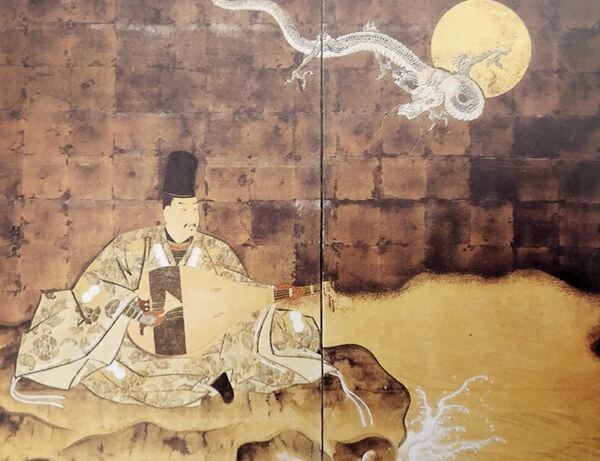
Tsunemasa accepted the biwa and is said to have played a secret melody.
The pieces were called “Jogen” and “Ishigami.”
Some manuscripts record it as “Uehara.”
The sound of the biwa resonated throughout the precincts, captivating those present.
Then, a mysterious event occurred.
A white dragon is said to have appeared on Tsunemasa’s sleeve.
The “Tale of the Heike” describes Benzaiten, moved by Tsunemasa’s performance, appearing in the form of a dragon.
Tsunemasa was overjoyed and, shedding tears, composed a waka poem.
“Could it be that my prayers to the mighty gods have been answered, for the sign has appeared so clearly?”
It was a poem expressing the belief that his prayers to the gods had been fulfilled.
The sign had manifested in such a visible form.
With this, Tsunemasa rejoiced, believing that the northern expedition would succeed, and once again boarded the small boat to leave the island.
The appearance of the white dragon is a tale from military chronicles conveying the miraculous power of the gods and Buddhas.
The “Tale of the Heike” portrays Tsunemasa linking music to prayer to the divine in this scene.
However, the subsequent northern expedition resulted in an outcome contrary to Tsunemasa’s expectations.
The Great Defeat at Kurikara Pass
In May of the second year of Juei, the main forces of the Taira clan advanced from Kaga Province towards Etchu Province.
Minamoto no Yoshinaka was gathering local warriors from the Hokuriku region, preparing to intercept them.
On May 11, the two armies clashed near Kurikara Pass.
The Taira forces suffered a crushing defeat under the assault from Yoshinaka’s troops.
The Tale of the Heike describes how Yoshinaka divided his forces to encircle the Taira army, driving them into a steep valley.
The story of the “fire oxen,” where torches were tied to the horns of oxen and driven into the enemy camp, is also well-known.
While many details about the battle’s progress and the number of troops remain unclear, it is certain that the Taira’s northern expedition ended in a major failure.
It is not clear which unit Tsunemasa commanded at the main battlefield of Kurikara Pass.
According to the Tale of the Heike, Tsunemasa stayed at a different location with Koremori and Tomomori.
There are no detailed records of how he rejoined the forces after visiting Chikubushima.
Subsequently, the Taira forces were pursued by Yoshinaka’s troops again at Shinohara in Kaga Province.
The expedition, which had deployed a large army, failed, and the Taira retreated to Kyoto.
This defeat opened the way for Yoshinaka to advance to Kyoto, forcing the Taira clan to abandon the capital.
July of the Second Year of Juei: The Taira Abandon the Capital
In July of the second year of Juei, Minamoto no Yoshinaka’s forces approached Kyoto.
The Taira, having lost much of their main army in the Hokuriku region, found it difficult to defend the capital.
Between July 24 and 25, Emperor Go-Shirakawa secretly left the capital and moved to Mount Hiei.
Unable to secure the emperor, the Taira decided to head west with Emperor Antoku and the Imperial Regalia.
On July 25, the Taira clan left Kyoto.
Their residences at Rokuhara and Nishihachijo were set ablaze, and the places they had lived for many years were lost.
Tsunemasa also left the capital with his father, Kiyomori, and his brothers.
Holding court positions, participating in poetry contests with his father, and studying the biwa at Ninna-ji, Tsunemasa had a life in Kyoto.
There were people in Kyoto who had supported his life until then.
However, heading west meant uncertainty about when they could return to the capital.
While the Taira were trying to regroup their forces, anti-Taira warriors were becoming more active across the land.
According to the Tale of the Heike, Tsunemasa visited Ninna-ji during this retreat from the capital.
His purpose was to return the biwa “Seizan” that he had been entrusted with.
Heading to Ninna-ji in Armor
The seventh volume of the Tale of the Heike, “Tsunemasa’s Departure from the Capital,” provides a detailed account of Tsunemasa’s visit to Ninna-ji.
It is said that Tsunemasa, accompanied by five or six mounted retainers, headed to Ninna-ji.
Upon arriving at the temple, he dismounted and requested an audience with the abbot.
The Taira clan had already left the capital.
What fate awaited them in the west was unknown.
However, he wished to bid a final farewell to the abbot, whom he had served since childhood.
The Tale of the Heike records that Tsunemasa conveyed this sentiment.
At this time, Tsunemasa was wearing armor.
He was dressed in a purple brocade hitatare with armor of a fresh green hue.
It is said he appeared as a warrior, equipped with a sword and bow and arrows.
Tsunemasa hesitated to appear before the Omuro while still in his armor.
However, it is said that the Omuro commanded him to come as he was.
Tsunemasa removed his helmet and respectfully stepped onto the white sand of the garden.
Soon, he was summoned before the Omuro.
There, Tsunemasa called for his attendant, Fujihei no Jo Arinori.
Arinori brought with him a red brocade bag.
Inside was the famed biwa, “Seizan.”
Returning the Biwa “Seizan” to the Omuro
Tsunemasa placed the biwa before the Omuro.
According to the “Heike Monogatari,” Tsunemasa explained why he was returning the treasured instrument.
He had long been entrusted with the biwa, and parting with it was bittersweet.
However, he could not bear the thought of taking such a precious instrument into the turmoil of the western provinces and potentially losing it.
Thus, he decided to return it to Ninna-ji Temple.
Tsunemasa further expressed that if the Taira clan’s fortunes improved and he could return to the capital, he hoped to be entrusted with it once more.
“Seizan” was a cherished instrument of Ninna-ji Temple.
Tsunemasa was recognized for his talent with the biwa and had been entrusted with this renowned instrument.
His intention to return it during his departure from the capital reflected his relationship with Ninna-ji.
In the “Heike Monogatari,” it is depicted that the Omuro was deeply moved by Tsunemasa’s offer.
It is said that he composed a waka poem to express his sorrow at their parting.
The poem conveyed the sentiment that the returned biwa would serve as a memento of their farewell.
“Parting Without Satisfaction”
It is said that the Omuro sent Tsunemasa a waka poem.
“Parting without satisfaction, I will keep this memento of you as a cherished keepsake.”
Tsunemasa, leaving without having spoken enough.
I will carefully wrap this memento of our parting.
Such was the meaning of the poem.
“Wrap” also implied enclosing the returned biwa in its bag.
The renowned instrument “Seizan” was poetically marked as a keepsake of their farewell.
Tsunemasa also borrowed an inkstone and wrote a reply poem.
“Though the water in the bamboo pipe may change, my feelings for the palace remain unchanged.”
A bamboo pipe is a conduit used to draw water.
The water flowing through it is constantly renewed.
However, my memories of the days spent at Ninna-ji are endless.
“Sumi” plays on the dual meanings of clear water and residing in a place.
In response to the phrase “akazushite” in the poem from Omuro, Tsunemasa replied with “sumiakanu.”
This was an exchange of waka poetry, where one receives the words of another and returns with their own thoughts.
Tsunemasa spent his childhood at Ninna-ji Temple.
Their lives there and interactions with the Prince Priest are reflected in their poems.
This scene, conveyed through “The Tale of the Heike,” shows Tsunemasa bidding farewell through the biwa and waka, a tradition that would be carried on in later performing arts.
Gyokei Accompanies Him to the Katsura River
After saying farewell to Omuro, Tsunemasa prepared to leave Ninna-ji Temple.
According to “The Tale of the Heike,” children, monks, and temple officials gathered to lament his departure.
It is said that some clung to his sleeves, shedding tears.
Among them, Tsunemasa had a particularly close relationship with the Great Counselor and Dharma Seal, Gyokei.
Gyokei, the son of Fujiwara no Mitsuyori, the Great Counselor of Hamuro, was a monk at Ninna-ji Temple.
He appears in “The Tale of the Heike” as someone who taught Tsunemasa in his youth.
Gyokei found it hard to part with Tsunemasa at the temple gate and accompanied him to the banks of the Katsura River.
There, they finally parted ways.
It is said that Gyokei composed a poem.
“Ah, the old trees and young trees, the mountain cherry blossoms, none will remain.”
Just as old and young trees alike shed their blossoms,
So too do we not know who will leave this life first.
This was the sentiment expressed in the poem.
Tsunemasa also sent a reply in verse.
“On my journey, night after night, I shall lay my sleeves alone, thinking of how far I must go.”
This poem captured Tsunemasa’s feelings as he set out for the western provinces.
After bidding farewell to Gyokei, Tsunemasa mounted his horse once more.
Raising the Red Banner to the West
According to “The Tale of the Heike,” after returning from Ninna-ji, Tsunemasa unfurled the red banner of the Taira clan that he had carried.
Seeing this, his retainers, who had been waiting nearby, rode their horses to gather around him.
Their number is said to have reached about a hundred horsemen.
Tsunemasa led his forces in pursuit of Emperor Antoku and the Taira clan.
At Ninna-ji, he returned the biwa and exchanged waka with Omuro and Gyokei, lamenting their parting.
However, once he left the temple, Tsunemasa was a commander of the Taira forces.
He had to catch up with his clan heading west and prepare for battle once more.
This scene is well-known alongside Taira no Tadanori’s flight from the capital in the same volume.
It is said that Tadanori entrusted over a hundred poems to Fujiwara no Shunzei.
It is also recounted that Tsunemasa returned the biwa “Aoyama” to Ninna-ji Temple.
Despite being Heike warriors familiar with court culture, both men left the capital to follow the battle against the Genji.
The following year, they would both lose their lives at the same Ichinotani.
Rebuilding in the West and the Advance to Fukuhara
After leaving Kyoto, the Heike attempted to regroup their forces in the western provinces.
However, in Kyushu, they faced resistance from figures like Ogata Koreie of Bungo Province, preventing them from establishing a stable base.
Subsequently, the clan moved to Yashima in Sanuki Province.
Yashima, facing the Seto Inland Sea, was a crucial location for utilizing maritime transport.
Tsunemasa, along with his father Tsunemori and his brothers, followed the clan there.
According to “The Tale of the Heike,” even after moving to the west, Tsunemori and Tsunemasa were depicted gazing at the moon and composing waka poetry.
It is said that the practice of composing poems continued even after being driven from the capital.
Meanwhile, the Heike reorganized their forces and began their counterattack.
In the intercalary tenth month of the second year of Juei, they defeated the forces of Minamoto no Yoshinaka at Mizushima in Bitchu Province.
Furthermore, in November, they defeated the forces of Minamoto no Yukie at Muroyama in Harima Province.
These victories enabled the Heike to advance once again from Harima towards Settsu.
There are few detailed records of Tsunemasa’s specific military actions at Mizushima or Muroyama.
However, he continued to operate in the western provinces with the clan’s forces.
At that time in Kyoto, relations between Minamoto no Yoshinaka and Emperor Go-Shirakawa were deteriorating.
Minamoto no Yoritomo dispatched his brothers Noriyori and Yoshitsune to defeat Yoshinaka.
On January 20, 1184, Yoshinaka was killed in battle at Awazu in Omi Province.
Having secured Kyoto, the Genji forces then turned their attention to pursuing the Heike.
Tsunemasa and his companions would face their attack in the vicinity of Fukuhara.
The Genji Army Approaches Ichinotani
In February of the third year of Juei, the Heike had positioned their forces from Fukuhara in Settsu Province to Ichinotani.
Fukuhara was once a base for Kiyomori.
In the fourth year of Jisho, Emperor Antoku and others moved there, making it a political center for a brief period.
Tsunemasa is said to have composed waka poetry at Fukuhara as well.
However, in the third year of Juei, Fukuhara had become a battlefield to confront the Genji army.
The Heike established a defensive line from the eastern Ikuta Forest to the western Ichinotani.
To the north, mountains loomed, while to the south lay the Seto Inland Sea.
The Heike intended to use this terrain to fend off the enemy and also to utilize their naval fleet.
Meanwhile, on the Genji side, Noriyori advanced from the east, while Yoshitsune moved along the mountain paths.
Between February 4th and 5th, Minamoto no Yoshitsune’s forces launched a night attack on the troops of Taira no Sukemori and Taira no Arimori at Mikusayama, defeating them.
The defensive line on the mountain side collapsed, and the Minamoto forces advanced towards Ichinotani.
There are no detailed records about which specific position Tsunemasa was defending.
However, he joined the Taira forces alongside his father and brothers, ready for the decisive battle.
Then, on February 7th, the Minamoto forces launched their attack.
The Battle of Ichinotani—Tsunemasa’s Death
On February 7th, 1184, the Battle of Ichinotani commenced.
In the east at the Ikuta Forest, Noriyori’s forces engaged in combat with Taira no Tomomori and Taira no Shigehira.
At the western entrance of Ichinotani, it is said that Kumagai Naozane and Hirayama Sueshige competed to be the first to attack.
Additionally, the Minamoto forces advanced from the mountain side.
The ‘Heike Monogatari’ recounts how Yoshitsune charged down a steep slope, breaking into the Taira positions.
This scene is later known as the “descent of Hiyodorigoe.”
Meanwhile, Kujō Kanezane’s diary ‘Gyokuyō’ records that Tada Yukitsuna broke through the mountain-side positions.
The actual routes of attack and the roles of each commander vary among historical sources.
Under the assault from the Minamoto forces, the Taira defensive lines crumbled in various places.
The warriors retreated to the coast, aiming for the ships anchored offshore.
However, not everyone managed to escape to the ships.
Tsunemasa also lost his life in this battle.
The ‘Azuma Kagami’ mentions Tsunemasa as one of the Taira commanders who died at Ichinotani.
The entry for February 15th includes a report on the battle achievements, noting Tsunemasa’s death as the accomplishment of Yasuda Yoshisada.
Yoshisada was a commander of the Kai Genji and held the position of Governor of Tōtōmi at the time.
The same report also mentions the names of Taira no Morimori and Taira no Noritsune.
However, regarding Noritsune, the ‘Heike Monogatari’ depicts him as surviving until the Battle of Dan-no-ura, indicating significant discrepancies among sources.
As for Tsunemasa himself, the details of who exactly took his head and where he was killed remain unclear.
The ‘Azuma Kagami’ provides the only confirmed record of Tsunemasa’s death being credited to Yasuda Yoshisada’s military achievement.
Since Tsunemasa’s birth year is unknown, his age at the time of death cannot be determined.
On February 7, 1184, just over six months after fleeing the capital, Tsunemasa met his end at Ichinotani.
His Brothers Tsunetoshi and Atsumori Also Fell in Battle
At Ichinotani, not only Tsunemasa but also his brothers Tsunetoshi and Atsumori were killed in action.
Tsunetoshi served as the governor of Wakasa and was part of the Taira forces.
However, there are limited records detailing Tsunetoshi’s military exploits.
The specifics of how he fought at Ichinotani and who killed him remain unclear.
On the other hand, the youngest brother Atsumori is remembered in a famous tale from the “Heike Monogatari.”
While attempting to escape to the sea during the retreat, Atsumori was called back by Kumagai Naozane.
It is said that he grappled with Naozane and was beheaded.
Atsumori was young and was carrying a flute.
As a result, he came to be remembered as a master of the flute in later generations.
Tsunemasa played the biwa, while Atsumori played the flute.
Though both were sons of Kiyomori, they left behind stories of different instruments.
Tsunemasa served as the governor of Awaji, Tango, and Tajima, and was active in the court’s poetry circles.
In contrast, Atsumori was still young and had not yet attained the official positions that Tsunemasa had.
It is said that at Ichinotani, the three brothers Tsunemasa, Tsunetoshi, and Atsumori lost their lives on the same day.
Their father, Kiyomori, survived this battle.
However, his sons perished on the battlefield stretching from Fukuhara to Ichinotani.
The Heads Sent to Kyoto’s Hachijo Riverbed
After their victory at Ichinotani, the Genji forces sent the heads of the fallen Taira commanders to Kyoto.
According to the “Azuma Kagami,” there was a debate at the court about whether to display these heads in the city.
The Taira commanders had long served the court and held high ranks.
There were cautious opinions about displaying their heads.
However, at the request of Noriyori and Yoshitsune, it was ultimately decided to display the heads.
On February 13, the heads of the Taira clan’s war dead were reportedly brought to Kyoto’s Hachijo Riverbed.
Tsunemasa’s name was among them.
Additionally, the names of Taira no Tadamori, Taira no Tsunemori, Taira no Atsumori, Taira no Morimasa, Taira no Tomonaga, and Taira no Kiyotsune are recorded.
It is said that during his escape from the capital, Tsunemori returned the biwa “Seizan” to Ninna-ji Temple.
Just over six months later, news of Tsunemori’s death in battle reached Kyoto, and his head was brought to the Hachijo Riverbank.
Meanwhile, his father, Taira no Tsunemori, escaped from Ichinotani and retreated towards Yashima with Emperor Antoku and Taira no Munemori.
The conflict between the Taira and Minamoto clans continued unabated.
Tsunemori’s Father Heads to Dan-no-ura
Having lost many commanders at Ichinotani, the Taira clan continued their resistance from their base at Yashima.
Emperor Antoku and the Imperial Regalia remained in their possession.
Tsunemori’s father, Taira no Tsunemori, stayed with the Taira forces.
In the second month of the second year of Genryaku (1185), Yoshitsune’s forces launched a surprise attack on Yashima.
The Taira clan abandoned Yashima and retreated further west.
On March 24, the final battle took place at Dan-no-ura in Nagato Province.
The Taira forces were defeated by the Minamoto, and Emperor Antoku drowned in the sea.
Taira no Tomomori also drowned, while Munemori was captured.
It is said that Tsunemori’s father, Taira no Tsunemori, also perished in this battle.
According to the “Tale of the Heike,” Tsunemori, along with his brother Taira no Norimori, tied anchors to their armor and leapt into the sea, hand in hand.
Although historical accounts differ on the exact circumstances of their end, it is known that Tsunemori died at Dan-no-ura.
This occurred about a year after Tsunemori’s death in battle at Ichinotani.
Tsunemori held various court positions, was fond of waka poetry, and organized poetry gatherings.
Tsunemori’s son continued these activities, interacting with poets like Fujiwara no Kiyosuke and Shunzei.
The waka poems left by the father and son were preserved in anthologies even after the fall of the Taira clan.
Tsunemori’s Poems in Imperial Anthologies
Tsunemori’s poetry was not limited to the gatherings held during his lifetime.
His works were compiled into a personal anthology and later included in imperial anthologies.
His first appearance in an imperial anthology is said to be in the “Senzai Wakashu.”
However, in the “Senzai Wakashu,” the author is listed as “unknown.”
Through comparison with works passed down in Tsunemasa’s family collection, it is believed that these poems are attributed to Tsunemasa.
The “Senzai Wakashu” is an imperial anthology of waka poetry compiled by Fujiwara no Shunzei at the behest of Emperor Go-Shirakawa.
Tsunemasa’s uncle, Taira no Tadamori, is also known for leaving behind poems in the same anthology under anonymity.
However, Shunzei himself did not record the detailed circumstances under which Tsunemasa’s poems were labeled as “author unknown.”
It has been suggested that this may be related to his role as a military commander of the Taira clan, who were enemies of the court, but the transmission of individual works is also being examined.
Later, Tsunemasa’s poems were also included in collections such as the “Shinshūi Wakashu.”
There is an organization of his poems into a total of eight pieces included in imperial anthologies.
Additionally, Tsunemasa was selected as a poet in the “Jisho Sanjurokunin Utaawase.”
His activities in the court poetry circles became known through his works even after the Genpei War had ended.
An important source that conveys his poems is the “Tsunemasa Ason Shu.”
Works Preserved in the “Tsunemasa Ason Shu”
The “Tsunemasa Ason Shu” is a private collection compiling Tsunemasa’s waka poetry.
Currently, a copy transcribed in the early Edo period is preserved in the Library of the Imperial Household Agency’s Shoryobu.
The bibliographic record states “Poems by Taira no Tsunemasa.”
This manuscript is an important resource for understanding Tsunemasa’s poetry from the late Heian period.
The “Tsunemasa Shu” includes poems composed during travels and exchanges with court figures.
Conversely, some poems are attributed to other authors in different collections.
One example is the poem “Atara yo no tsuki wo hitori zo nagametsuru,” composed while traveling to Itsukushima.
Differences in authorship and prefaces among various manuscripts are being studied.
Furthermore, Tsunemasa’s organization of a poetry contest in the third year of Jisho and his presentation of a hundred-poem sequence to Fujiwara no Shunzei provide insights into his activities in the court poetry circles.
Tsunemasa is often remembered as a master of the biwa.
However, he was also a poet who actively participated in the world of waka, leaving behind his own compositions.
His works continued to be read among poets even after the fall of the Taira clan.
The Noh Play “Tsunemasa”—The Spirit of Tsunemasa Appears at Ninna-ji
The story of Tsunemasa’s departure from the capital was also featured in a Noh play during the Muromachi period.
The play is titled “Tsunemasa.”
Depending on the school, it may be written as “Tsunemasa.”
The author is not known.
The setting of the story is Ninna-ji in Kyoto.
After Tsunemasa’s death in battle at Ichinotani, Ninna-ji was tasked with holding memorial services for his soul.
A monk named Gyokei, under orders from the Omuro, holds a music and dance service for Tsunemasa.
The music and dance service is a Buddhist ritual where music is performed to honor the deceased.
It was during this time that the biwa named “Seizan,” which Tsunemasa returned when he fled the capital, came into play.
As Gyokei and others played music, the spirit of Tsunemasa appeared.
The ghost reminisced about his days at Ninna-ji Temple and spoke of how the sound of the court music moved his heart.
Eventually, the spirit took up the biwa and began to play.
However, as the music comforted the spirit, memories of the battlefield gradually resurfaced.
The torment of a warrior fallen into the realm of Ashura emerged, revealing a fierce battle scene.
Finally, as dawn approached, the spirit of Tsunemasa faded away.
The Noh play “Tsunemasa” is based on the “Tsunemasa’s Flight from the Capital” chapter of the “Tale of the Heike.”
It depicts Tsunemasa, who was fond of music at Ninna-ji, and Tsunemasa, the warrior who perished at Ichinotani, on the same stage.
Through this Noh play, the biwa “Seizan,” returned during his flight from the capital, plays an important role in the story after Tsunemasa’s death.
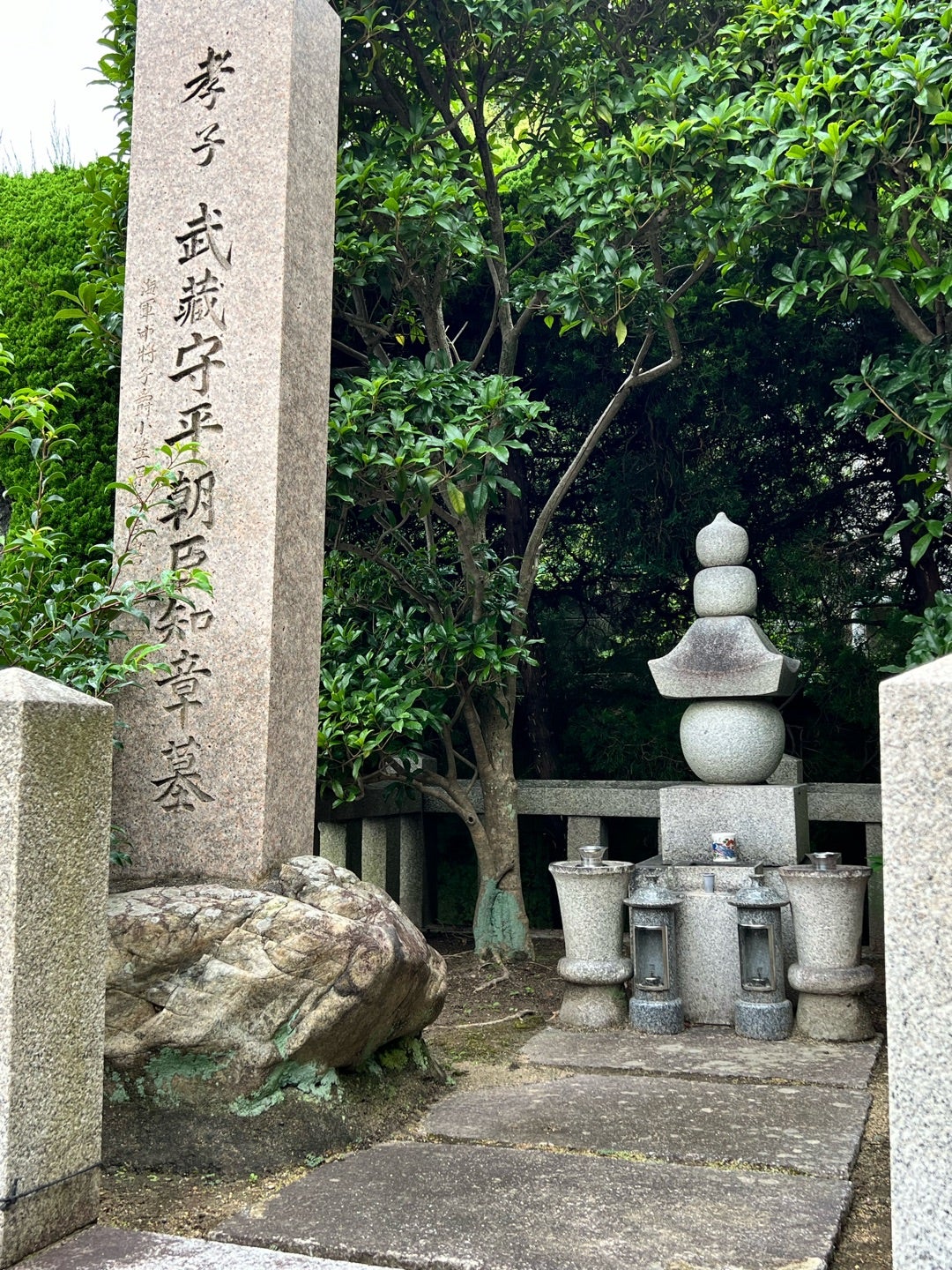
The Biwa Mound in Kobe
In the present-day Kiridocho area of Hyogo Ward, Kobe City, there remains a stone monument known as the “Biwa Mound.”
Nearby, there is a stone thirteen-story pagoda called Kiyomori-zuka and a statue of Taira no Kiyomori.
The Biwa Mound has been associated with Tsunemasa, known as a master of the biwa.
It is said that there was once a mound near Kiyomori-zuka that resembled the shape of a biwa.
Due to its shape, it came to be called the Biwa Mound, and it was thought to be the place where Tsunemasa’s grave or biwa was buried.
In 1902, a stone monument was erected as a place associated with Tsunemasa.
Later, due to road expansion work, it was moved to its current location along with Kiyomori-zuka.
However, there is no definitive record indicating that Tsunemasa was actually buried at this site.
In the “Tale of the Heike,” it is depicted that Tsunemasa returned the famous instrument “Seizan” to Ninna-ji when he fled the capital.
On the other hand, there is a local legend that the Biwa Mound is where Tsunemasa’s biwa was buried.
The two accounts differ, and there is no conclusive evidence that the famous “Seizan” itself was buried at the Biwa Mound.
The Biwa Mound indicates that Tsunemasa’s name has been passed down in the lands near Fukuhara and Ichinotani.
The seaside of Fukuhara, where Tsunemasa composed poems, later became a battlefield with the Genji forces.
There, Tsunemasa’s name, passed down along with the biwa, remains as a historical site.
The Story of the Biwa “Seizan” Left at Ninna-ji
After Tsunemasa perished at Ichinotani, his younger brother Tsunetoshi and Atsumori were also recorded as casualties of the same battle.
In March of the following year, 1185, their father Tsunemori also lost his life at Dan-no-ura.
Meanwhile, the waka poems composed by Tsunemasa during his lifetime were passed down through collections of family poetry and imperial anthologies.
The “Tsunemasa Ason Collection” includes poems about his travels to Itsukushima and the seaside of Fukuhara.
Furthermore, in the seventh volume of the ‘Tale of the Heike’, titled “Tsunezane’s Departure from the Capital”, the farewell at Ninna-ji Temple is vividly depicted.
It is said that Tsunezane returned the biwa named “Seizan” to Omuro, exchanged waka poems, and then set off for the western provinces.
Gyokei accompanied him as far as the Katsura River, and it is told that Tsunezane followed the Taira clan, raising a red flag.
Later, in the Muromachi period, the Noh play ‘Tsunezane’ was created.
On the Noh stage, monks from Ninna-ji Temple hold a musical gathering using the biwa “Seizan” to console Tsunezane’s spirit.
Additionally, a legend persists on Chikubushima in Lake Biwa that Tsunezane played the biwa to pray for victory in battle, and the name Biwazuka remains in Hyogo Ward, Kobe City, near Fukuhara.
The Imperial Household Agency’s Archives and Mausolea Department preserves a manuscript of the ‘Tsunezane Collection’, which conveys the poems Tsunezane composed at the court poetry gatherings to this day.
In July of the second year of Juei (1183), Tsunezane returned the biwa “Seizan” to Ninna-ji, expressing his wish to take custody of it again should he return to the capital.
However, on February 7, 1184, he lost his life at the Battle of Ichi-no-Tani.
The renowned instrument “Seizan”, which Tsunezane is said to have returned to Ninna-ji, was later used in the Noh play ‘Tsunezane’ for his memorial service, where his spirit, now a ghost, is portrayed playing the biwa once more.