On February 7, 1184, during the Battle of Ichi-no-Tani in Settsu Province, the Taira forces suffered a defeat.
As the Genji warriors advanced along the coast, members of the Taira clan attempted to escape to ships floating offshore.
Among them was a young warrior.
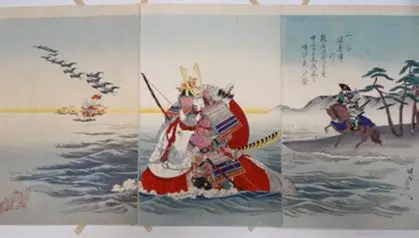
He wore a hitatare embroidered with crane patterns and armor of greenish hue. His helmet was adorned with a kuwagata crest, and he rode a dappled gray horse.
The young warrior urged his horse into the sea, aiming for the ships offshore.
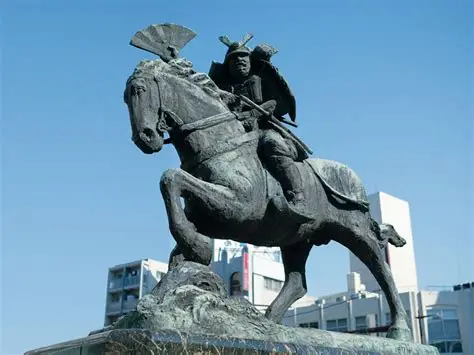
However, Kumagai Naozane of the Genji side spotted him, raised his fan, and called out loudly to stop him.
According to the ‘Tale of the Heike,’ the young warrior responded to Naozane’s call, turned back, and engaged in combat on the shore.
Naozane pulled his opponent from his horse and attempted to take his head.
But when he pushed up the helmet, he saw a boy the same age as his own son.
Naozane hesitated to strike him down, but his allies were closing in from behind.
Eventually, the boy was beheaded.
It is said that a flute in a brocade bag was tucked into his waist.
The young warrior’s name was Taira no Atsumori.
Taira no Kiyomori‘s younger brother, Taira no Tsunemori, was his father.
Born in the first year of Kaō (1169), Atsumori was 16 years old by traditional Japanese count when he died at Ichi-no-Tani. However, the ‘Tale of the Heike’ in its Kakuichi-bon version records him as 17.
Raised in Kyoto as a noble of the Taira clan, Atsumori fled the capital with his father and brothers, only to meet his end at Ichi-no-Tani.
His tragic end is intertwined with the story of Kumagai Naozane’s decision to become a monk, and it has been passed down through Noh, Kōwakamai, and Kabuki theater for centuries.
Born as the youngest son of Taira no Tsunemori, brother of Taira no Kiyomori
Taira no Atsumori is believed to have been born in the first year of Kaō (1169) as a son of Taira no Tsunemori.
His father, Tsunemori, was a son of Taira no Tadamori and a half-brother of Taira no Kiyomori.
Kiyomori was Atsumori’s uncle, and Tadamori was his grandfather.
Atsumori had two older brothers, Taira no Tsunemasa and Taira no Tsunetaka.
Tsunemasa was known as a master of the biwa and served the Prince of Ninna-ji.
Tsunehito also served the imperial court, holding positions such as Governor of Wakasa.
On the other hand, there are few reliable records about Atsumori’s mother, and her origins remain unclear.
By the first year of Kōō, when Atsumori was born, the Taira clan had already established significant power in Kyoto.
Taira no Kiyomori contributed to the victory of Emperor Go-Shirakawa’s faction in the Hogen Rebellion in the first year of Hogen (1156), and in the Heiji Rebellion of the first year of Heiji (1159), he defeated the forces of Minamoto no Yoshitomo and others.
Yoshitomo was killed after fleeing, and his son Yoritomo was exiled to Izu Province.
Afterward, Kiyomori continued to rise in the court, becoming Chancellor of the Realm in the second year of Nin’an (1167).
The Taira clan, as a warrior family, gained court positions and estates through their military power.
Kiyomori’s sons and brothers also attained high positions and became deeply involved in Kyoto’s court society.
Atsumori’s father, Tsunemori, was one of them.
Tsunemori held various court positions, eventually serving as Director of Repairs.
He was also known for his appreciation of poetry and music, with records indicating a connection to Ninna-ji Temple.
Atsumori was born into such a family.
However, there are very few detailed records of his childhood.
Where he grew up, who taught him martial arts and music, and what kind of life he led with his mother and brothers remain unknown.
The image of Atsumori that spread in later generations is mainly shaped by his final moments at the Battle of Ichinotani as depicted in the ‘Tale of the Heike.’
The House of Tsunemori Deeply Connected with Ninna-ji
There are traditions related to court music concerning Atsumori’s father, Tsunemori, and his brother, Tsunemasa.
In the aristocratic society of the Heian period, poetry and music were important cultural accomplishments.
Instruments like the biwa and flute were used in court ceremonies and banquets, and musical skill was highly valued in court society.
As the Taira clan rose in court ranks, they became familiar with such cultural pursuits.
Tsunemori is said to have composed poetry and participated in poetry gatherings hosted by the Ninna-ji Temple.
His son, Tsunemasa, was particularly known for his skill with the biwa.
According to the ‘Tale of the Heike,’ Tsunemasa served at the Ninna-ji Temple from a young age.
It is believed that Tsunemasa served under Prince Kakusho during his childhood.
Prince Kakusho was a son of Emperor Toba and served as the head of Ninna-ji Temple.
After Kakusho’s death, it was Prince Shokaku who became the head of Ninna-ji Temple.
It is believed that later, when Tsunemasa was leaving the capital, the person he bid farewell to was this very Prince Shokaku.
Tsunemasa is said to have been entrusted with the famous biwa lute “Seizan” at Ninna-ji Temple.
Meanwhile, his younger brother Atsumori became renowned in later generations as a master of the flute.
According to the “Tale of the Heike,” the flute Atsumori possessed was passed down from his grandfather Tadamori to his father Tsunemori.
However, it is unclear what kind of musical education Atsumori actually received from a young age.
Later war tales depict the house of Tsunemori as being familiar with court music through Tsunemasa’s biwa and Atsumori’s flute.
Atsumori, Known as “Mukan Taifu”
Atsumori is also known by the name “Mukan Taifu.”
The title “Taifu” was used for individuals holding the rank of the fifth grade.
Although Atsumori was appointed to the lower fifth rank, it is said he did not hold any specific office.
Therefore, he was called “Mukan Taifu.”
In the Taira clan, many were granted ranks from a young age and advanced in the court.
For example, Taira no Kiyomori’s son, Taira no Shigehira, was appointed to the lower fifth rank at the age of six and later held positions such as Chamberlain of the Empress, Chamberlain of the Crown Prince, Head of the Kurando-dokoro, and Provisional Middle Captain of the Left Guards.
In contrast, the details of when Atsumori was appointed to the lower fifth rank and his official career remain unclear.
Atsumori, who lost his life in his mid-teens, had no opportunity to serve long as an official of the court.
Nevertheless, he remained a member of the Taira clan, growing up in the court society as a noble youth.
The “Tale of the Heike” depicts him as a young warrior adorned with splendid armor and sword, his face lightly made up.
Born into a warrior family yet familiar with the culture of the aristocratic society, he was a noble youth of the Taira clan.
Atsumori grew up as one of the young members of such a distinguished family.
The Death of His Uncle Kiyomori and the Genji Uprising
In the fourth year of the Jisho era (1180), resistance against the Taira clan began to emerge across the country.
In May, Prince Mochihito, son of Emperor Go-Shirakawa, and Prince Mochihito and Minamoto no Yorimasa raised an army to overthrow the Taira.
The Taira forces suppressed the uprising near the Uji River, and Yorimasa took his own life at Byodoin. Prince Mochihito was also killed on his way to Nara.
However, this uprising sparked wider anti-Taira movements.
In August, Minamoto no Yoritomo raised an army in Izu Province.
In Shinano Province, Minamoto no Yoshinaka expanded his influence, and resistance against the Taira continued in the eastern provinces and Hokuriku.
In December of the same year, forces led by Taira no Shigehira marched on Nanto, resulting in the destruction of major halls and towers at Todai-ji and Kofuku-ji.
The conflict between the Taira and the temple-shrine forces intensified.
On the intercalary 4th day of the 2nd month of the following Jisho 5 (1181), Kiyomori passed away.
With the death of Kiyomori, who had led the Taira clan, the political and military leadership shifted to his son, Taira no Munemori.
Atsumori’s father, Taira no Tsunemori, also supported the Taira alongside Munemori and others.
Around this time, Atsumori was about 13 years old by traditional Japanese counting.
Although battles continued across the land, there are no definitive records of Atsumori participating in military actions.
We do not know what kind of life he led or what he heard from his father and brothers about the war situation.
Eventually, as Minamoto no Yoshinaka’s forces expanded their influence in Hokuriku, the Taira were forced to leave Kyoto.
The Great Defeat at Kurikara Pass—Leaving the Capital with the Taira
In May of Juei 2 (1183), the Taira forces suffered a major defeat in Hokuriku.
This was the Battle of Kurikara Pass.
The forces led by Taira no Koremori suffered significant losses due to Minamoto no Yoshinaka’s attacks and struggled in the subsequent Battle of Shinohara.
The Taira lost control over the Hokuriku region and could no longer prevent Yoshinaka’s advance towards Kyoto.
On July 25th, Taira no Munemori and others left the capital, taking Emperor Antoku and the Imperial Regalia with them.
Atsumori is believed to have headed west with his father Tsunemori and his brothers.
If he was born in the first year of Kaō, he would have been 15 years old by traditional Japanese counting at this time.
The Taira clan left Kyoto, passing through Fukuhara, where Kiyomori had once attempted to relocate the capital, and headed towards the Seto Inland Sea.
They had to leave behind their long-lived residences and court life to regroup their forces in the western provinces.
The “Tale of the Heike” vividly depicts this departure from the capital through numerous farewell scenes.
Taira no Kiyomori’s brother, Taira no Tadamasa, visited his poetry teacher, Fujiwara no Shunzei, entrusting him with his own poems.
Additionally, Atsumori’s brother, Taira no Tsunemasa, is said to have returned a biwa lute he had been safeguarding to Ninna-ji Temple.
This is a well-known anecdote depicting the people leaving Kyoto amidst the chaos of war.
The Biwa “Seizan” Returned to Ninna-ji by Tsunemasa
In the seventh volume of the “Tale of the Heike,” titled “Tsunemasa’s Departure from the Capital,” there is a scene where Taira no Tsunemasa visits Ninna-ji before leaving the capital.
Tsunemasa had served at Ninna-ji’s Omuro since childhood and was familiar with playing the biwa.
Through this connection, he had been entrusted with a famous instrument known as “Seizan.”
When the decision to leave the capital was made, Tsunemasa took the biwa and headed for Ninna-ji.
With ongoing battles in the western provinces, it was uncertain when he might return to Kyoto.
Fearing the loss of the precious biwa amidst the turmoil, he decided to return it, as recounted in the “Tale of the Heike.”
Tsunemasa is said to have visited Ninna-ji with his attendants and met with Prince Shukaku.
There, he reflected on the days he had served the palace since childhood and expressed his farewell sentiments.
The “Tale of the Heike” also depicts a scene where Tsunemasa composes a poem and plays the biwa.
The renowned instrument “Seizan” was returned to Ninna-ji.
However, the detailed conversation between Tsunemasa and Shukaku, as well as the specifics of the performance, cannot be confirmed as historical fact.
The relationship between Tsunemasa and Prince Kakusho, whom he once served, and Prince Shukaku, who was the Omuro at the time of his departure, is portrayed differently in various texts.
Nonetheless, Tsunemasa’s connection with Ninna-ji is examined through related historical sources.
Tsunemasa left the biwa “Seizan” in Kyoto and headed for the western provinces.
His younger brother Atsumori is later said to have carried a single flute to the battlefield.
Life in the Western Provinces—Atsumori’s Movements Are Poorly Recorded
The Heike, having left the capital, first attempted to reestablish their power in Kyushu.
However, they faced resistance from local forces such as Ogata Koreie in Bungo Province and were unable to establish a stable base.
Subsequently, the clan moved to Yashima in Sanuki Province.
Yashima, facing the Seto Inland Sea, was a strategic military location crucial for gathering warriors from Shikoku and the Chugoku region.
The Heike utilized ships to transport troops and supplies, aiming to recover their lost influence.
In the intercalary tenth month of the second year of Juei, the Heike forces defeated the army dispatched by Minamoto no Yoshinaka (Kiso Yoshinaka) at Mizushima in Bitchu Province.
Furthermore, in November, they defeated the forces of Minamoto no Yukie at Muroyama in Harima Province.
These victories at Mizushima and Muroyama provided the Heike with an opportunity to advance eastward once more.
However, specific records of Atsumori during this period are scarce.
There are no reliable historical records indicating that Atsumori himself participated in the Battle of Muroyama.
It is believed he was with his father, Taira no Tsunemori, and his brothers, but how he spent his time in Kyushu or Yashima remains unknown.
The Taira forces then retreated to the vicinity of Fukuhara in Settsu Province.
This was once the stronghold of Taira no Kiyomori.
The Taira gathered their forces, aiming to return to Kyoto and preparing to confront the Minamoto army.
However, the situation in Kyoto had changed significantly.
On January 20, 1184, Minamoto no Noriyori and Minamoto no Yoshitsune defeated Minamoto no Yoshinaka (Kiso Yoshinaka), who was killed in action at Awazu in Omi Province.
With Kyoto secured, Yoritomo’s forces moved to pursue the Taira.
The Taira, gathered at Fukuhara, were once again poised for a decisive battle with the Minamoto.
The Defense Line at Ichinotani—Where Was Atsumori?
In February 1184, the Taira army established a defensive line around Fukuhara.
The strategic point to the east was the Ikuta Forest.
To the west lay Ichinotani, with mountains to the north and the Seto Inland Sea to the south.
The Taira sought to use this terrain to block the advance of the Minamoto forces.
The Ikuta Forest was defended by Taira no Tomomori and Taira no Shigehira and others.
On the western side at Ichinotani, Taira no Tadanori and others were stationed, while Taira no Michimori and Taira no Moritoshi were reportedly involved in the mountain defenses.
It is unclear exactly where Atsumori was positioned or under whose command he was supposed to fight.
However, it is recorded in the Azuma Kagami that Atsumori was killed in action at the Battle of Ichinotani.
It is certain that he was present at the site on the day of the decisive battle as part of the Taira forces.
The Minamoto army advanced in two groups.
Noriyori led the main force, approaching Fukuhara from the east.
Meanwhile, Yoshitsune took a flanking route through the mountain paths of Tanba, advancing to the west of Ichinotani.
From February 4 to 5, Yoshitsune’s forces launched a night attack on the troops of Taira no Sukemori and Taira no Arimori at Mikusayama, defeating them.
The Taira lost their forces guarding the mountain routes, allowing Yoshitsune’s army to advance.
On February 7, the Minamoto and Taira armies clashed at Ichinotani.
February 7—Taira Warriors Flee to the Coast
In the Battle of Ichinotani, the Genji forces launched attacks on the Heike positions from multiple directions.
In the east, at the Ikuta Forest, Noriyori’s forces clashed with Taira no Tomomori and Taira no Shigehira, while on the western side at the Ichinotani entrance, Kumagai Naozane and Hirayama Sueshige competed to lead the charge.
Additionally, Genji troops advanced from the mountainside.
The “Heike Monogatari” describes how Yoshitsune galloped down a steep slope with mounted warriors, launching a surprise attack on the Heike camp.
This scene is later known as the “Sakaotoshi of Hiyodorigoe.”
However, the “Gyokuyo” records that Tada Yukitsuna was the first to break through the mountainside position, leading to debates about the actual route of advance and the roles of the various commanders.
The Heike defensive lines crumbled in several places, and the commanders headed for the coast.
To the south lay the Seto Inland Sea, with Heike ships floating offshore.
The “Heike Monogatari” depicts the defeated Heike warriors seeking rescue boats, riding their horses into the sea or rushing towards the ships.
However, not everyone managed to escape by ship.
On the coast, Genji warriors continued their pursuit.
Atsumori was also caught up in this chaos.
The “Heike Monogatari,” Volume Nine, “Atsumori’s End,” provides a detailed account of Atsumori’s last moments from the perspective of Kumagai Naozane.
The Young Warrior Found by Kumagai Naozane
Kumagai Naozane was a warrior based in Kumagaya-go, Musashi Province.
In the Battle of Ishibashiyama in 1180, he had sided with Oba Kagechika, but later joined Minamoto no Yoritomo.
He distinguished himself in campaigns such as the pursuit of the Satake clan and was part of Yoshitsune’s forces at Ichinotani.
According to the “Heike Monogatari,” Naozane watched the Heike army’s retreat, looking for an opportunity to take down a prominent commander.
He believed the Heike nobility would be fleeing to the ships offshore and proceeded along the coast.
There, he spotted a young warrior adorned in splendid armor.
The warrior wore a hitatare embroidered with a crane design and armor of deep green hue.
He donned a helmet with a kuwagata crest and carried a sword with gold decorations.
The horse was a dappled gray with a saddle embellished with gold.
The “Heike Monogatari” meticulously describes this attire.
Naozane assumed the young warrior was a high-ranking Heike commander.
The young warrior had already entered the sea on his horse, aiming for the ships offshore.
According to the “Heike Monogatari,” the horse swam five or six lengths into the sea.
Seeing this, Naozane raised his fan and called out loudly.
“That must be a great general!”
It was a call that acknowledged him as a distinguished general.
Naomitsu taunted him, questioning if he would flee with his back to the enemy, and urged him to return and fight.
In response, the young warrior turned his horse around and returned to the shore.
Why did Atsumori turn back from heading toward the ship offshore?
The “Heike Monogatari” records this action but does not delve into Atsumori’s inner thoughts.
Did he respond to Naomitsu’s provocation as a samurai, or was there another reason?
No historical records remain to confirm the reason.
The young warrior returned to the shore and engaged in combat with Naomitsu.
The Boy Revealed Under the Helmet
As the young warrior returned to the shore, Naomitsu lined up his horse alongside him.
According to the “Heike Monogatari,” Naomitsu grappled with his opponent, pulling him from his horse and pinning him down.
He then pushed up the helmet to take the head.
However, upon seeing the face, Naomitsu paused.
Before him was a boy of about 16 or 17 years old.
He wore light makeup and had blackened teeth.
The “Heike Monogatari” describes his appearance as exceptionally beautiful.
The light makeup and blackened teeth were related to the grooming standards of the aristocratic society at the time, and the story emphasizes the young warrior’s high status.
Naomitsu had a son named Kojirō Naie.
It is said that Naie also participated in the Battle of Ichinotani and was injured.
The young warrior before him was about the same age as his son.
Naomitsu hesitated to kill him and asked for his name.
However, the young warrior did not give his name and instead asked who Naomitsu was.
Naomitsu replied that he was Kumagai Jirō Naomitsu from Musashi Province.
The young warrior then said there was no need to give his name; if Naomitsu took his head and asked others, they would know.
The “Heike Monogatari” uses this exchange to depict the young warrior’s status and his demeanor in the face of death.
No contemporary records confirm that such a conversation took place.
However, this scene has become the most well-known account of Atsumori’s end.
Naomitsu’s Attempt to Let the Young Warrior Escape
According to the “Heike Monogatari,” Naomitsu wanted to save the young warrior.
If he was worried about his own son being slightly injured, how much more sorrow would this boy’s father feel upon learning of his son’s death?
Naomitsu thought so and tried to let him escape.
However, when he looked back, he saw the Genji forces approaching.
The Tale of the Heike recounts that there were about 50 horsemen led by Doi Sanehira and Kajiwara Kagetoki.
With so many allies closing in, even if the young warrior were to escape, he might be cut down by another samurai.
Naozane gave up on saving him.
He decided that rather than let someone else take the young warrior’s head, he would do it himself and later hold a memorial service.
When Naozane conveyed his thoughts, the young warrior urged him to take his head quickly, according to the tale.
Naozane, with tears streaming down his face, swung his sword.
The young warrior perished on the spot.
In the Tale of the Heike, it is depicted that Naozane regretted being born a samurai and continued to cry with his sleeves pressed against his face.
On the other hand, while the Azuma Kagami also records Atsumori’s death at Ichinotani, it does not detail the duel with Naozane.
The story of Kumagai Naozane slaying Atsumori has been passed down through the ages, but the reasons for turning back from the sea, their final conversation, and Naozane’s feelings rely on the depiction in the Tale of the Heike.
The Flute “Koeda” at His Waist
After Naozane had slain the young warrior, he reached for his armor to wrap the head.
It was then that he noticed something at the warrior’s waist.
It was a flute in a brocade bag.
According to the Tale of the Heike, seeing the flute reminded Naozane of the events before dawn.
That morning, the sound of music had drifted from the Taira camp.
Naozane wondered if it was the young warriors before him who had played that music.
Among the Genji warriors gathered from the eastern provinces, how many would bring a flute to the battlefield?
The Tale of the Heike tells that Naozane was moved by the conduct of the Taira nobility.
Naozane took the flute to Yoshitsune.
Yoshitsune and the others present were moved to tears upon seeing the flute.
Soon, the young warrior’s identity was revealed.
He was Atsumori, the son of Taira no Tsunemori, the Master of Repairs.
The Tale of the Heike (Kakuichibon version) also details the flute’s origins.
His grandfather, Taira no Tadamori, was a master of the flute and had received it from Emperor Toba.
It was passed down to his son Tsunemori, and because Atsumori was skilled in playing, it was entrusted to him.
The flute was named “Koeda.”
This origin story is a tradition recorded in the Tale of the Heike.
There are no definitive records confirming whether Tadamori received the flute from Emperor Toba or if it was passed down to Atsumori through Tsunemori.
Additionally, there are variations in the type and name of the flute among different versions of the Tale of the Heike.
Nevertheless, the flute became a symbol of Atsumori’s final moments.
The eastern warrior who slew a youth on the battlefield and the Taira noble who carried a flute.
The contrasting figures of both sides became widely known through ‘The Tale of the Heike.’
Was Atsumori 16 or 17?
There are discrepancies in the records regarding Atsumori’s age at death.
It is generally accepted that Atsumori was born in 1169 (Kao 1) and died in 1184 (Juei 3).
Calculating these dates by traditional Japanese age reckoning, he would have been 16 when he died in battle.
This birth and death year is adopted by the Hyogo Prefectural Museum of History and various biographical dictionaries.
On the other hand, the “Atsumori’s Last Moments” section of the Kakuichi-bon version of ‘The Tale of the Heike’ states he was “17 years old.”
The spread of the notion that Atsumori was 17 is due to this account in the war tale.
However, the calculation of being born in 1169 and being 17 years old does not align.
Due to the lack of contemporary records that directly confirm Atsumori’s birth year, it is difficult to definitively assert one age over the other.
Moreover, ‘The Tale of the Heike’ describes how, when Naozane lifted the helmet, the opponent appeared to be a youth of about 16 or 17.
In this scene, the fact that the young warrior was as young as Naozane’s own son holds significant meaning.
Atsumori participated in the Battle of Ichinotani in his mid-teens and lost his life.
According to sources that list his birth and death as 1169–1184, he was 16 by traditional reckoning. The Kakuichi-bon of ‘The Tale of the Heike’ reports he was 17.
Brothers Tsunemasa and Tsunetoshi Also Fell at Ichinotani
Atsumori was not the only one who perished in the Battle of Ichinotani.
Their father, Tsunemori, lost his sons one after another in this battle.
His brother Taira no Tsunemasa also fell at Ichinotani.
Tsunemasa is known for returning the biwa “Seizan” to Ninna-ji Temple during the fall of the capital.
Though skilled in court music, he participated in Ichinotani as a warrior of the Taira clan.
According to the ‘Azuma Kagami,’ Tsunemasa was killed by the forces of Yasuda Yoshisada.
Yoshisada was a member of the Kai Genji clan and a warrior allied with Yoshitsune.
Another brother, Tsunetoshi, also lost his life in this battle.
Tsunetoshi served as the governor of Wakasa and is mentioned in the ‘Azuma Kagami’ among the fallen.
Atsumori, Tsunemasa, Tsunetoshi.
Tsunemori’s sons fell one after another on the same battlefield at Ichinotani.
Meanwhile, their father Tsunemori survived Ichinotani and retreated west with the remaining Taira forces.
The Taira fled to Yashima with Emperor Antoku and the Imperial Regalia, continuing their resistance in the Seto Inland Sea.
Tsunehira also stayed with Munemori and others, surviving until the following year at Dan-no-ura.
Heads Sent to Kyoto’s Hachijo Riverbed
After their victory at Ichinotani, the Genji forces sent the heads of the defeated Taira commanders to Kyoto.
According to the Azuma Kagami entry for February 11, the court debated whether to display the heads of the Taira clan in the city.
The Taira commanders had long served the court and held high ranks.
There were cautious opinions about displaying their heads in the same manner as ordinary warriors.
However, at the request of Noriyori and Yoshitsune, it was ultimately decided to display the heads.
On February 13, the heads of the Taira commanders were taken to Kyoto’s Hachijo Riverbed.
The Azuma Kagami lists names such as Taira no Michimori, Taira no Tadanori, Taira no Tsunemasa, Taira no Atsumori, Taira no Tsunetoshi, Taira no Morimori, and Taira no Tomonaga.
Each head had a tag with the name attached and was displayed at the execution ground.
However, this list includes individuals like Taira no Noritsune, who other sources suggest survived.
There may have been cases of mistaken identity or misinformation in the battle reports.
Atsumori is mentioned in multiple records as having died at Ichinotani.
On the other hand, there are no definitive records of where his body was actually buried.
In present-day Suma, there are sites believed to be Atsumori’s grave or memorial towers, but these are also linked to later traditions.
Father Tsunehira Drowned at Dan-no-ura
Even after Atsumori lost his life at Ichinotani, the battle between the Taira and Genji continued.
Munemori and Tomomori retreated to Yashima, holding onto Emperor Antoku and the Imperial Regalia.
Atsumori’s father, Tsunehira, was also part of that force.
In the second month of the second year of Genryaku (1185), Yoshitsune’s forces launched a surprise attack on Yashima.
The Taira lost Yashima and retreated further west.
Then, on March 24, the final battle between the Taira and Genji took place at Dan-no-ura in Nagato Province.
The battle ended in a Genji victory, and Emperor Antoku perished in the sea.
Taira no Tomomori also drowned, and Munemori was captured.
According to the Heike Monogatari, Atsumori’s father, Tsunehira, threw himself into the sea with his brother Taira no Noritsune.
The two are depicted as wearing armor and carrying anchors, holding hands as they entered the water.
On the other hand, the Azuma Kagami records that Tsunehira once came ashore to become a monk before returning to the sea, showing differences in the accounts of his final moments.
In any case, all records agree that Tsunehira lost his life at Dan-no-ura.
After losing his sons at Ichinotani, Tsunehira met his end about a year later at Dan-no-ura.
As Kiyomori’s brother, Tsunehira had supported the Taira clan, but the Genpei War led to the loss of many family members.
Did Kumagai Naozane Become a Monk Because He Killed Atsumori?
The “Atsumori’s Last Moments” chapter of the Heike Monogatari links Kumagai Naozane’s decision to become a monk with his experience of killing Atsumori.
Having killed a boy the same age as his own son, Naozane regretted living as a warrior and felt a stronger pull towards the Buddhist path.
The flute that Atsumori carried at his waist is depicted as something that deeply moved Naozane’s heart.
However, there are other historical sources regarding Naozane’s decision to take religious vows.
An entry in the ‘Azuma Kagami’ from the year Kenkyu 3 (1192) tells a story of Naozane becoming a monk due to a dispute over his land holdings.
Naozane was in conflict with Kuge Naomitsu over land in Kumagai Township in Musashi Province.
During the hearing of the dispute before Yoritomo, it is said that Naozane, dissatisfied with the recognition of his claims, angrily cut his hair.
However, documents passed down in the Kumagai family indicate that by March of Kenkyu 2 (1191), Naozane was already using the name “Rensei.”
Therefore, the view that he took religious vows before the year 1192, as reported in the ‘Azuma Kagami,’ has gained traction.
Subsequently, Naozane became a disciple of Honen, the founder of the Jodo sect, and deeply devoted himself to the practice of exclusive nembutsu.
After becoming a monk, Naozane was known as Horikubo Rensei.
It is unclear to what extent the slaying of Atsumori influenced Naozane’s faith.
Various factors, such as the land dispute, his relationship with Yoritomo, and his encounter with Honen, are believed to have played a role in Naozane’s decision to take religious vows.
On the other hand, the ‘Tale of the Heike’ narrates a story where Naozane turns to Buddhism out of remorse for killing Atsumori.
This storyline was later inherited by Noh and Kōwaka dance.
Noh ‘Atsumori’ — The Young Warrior Appears as a Ghost
Atsumori’s final moments were also featured in medieval performing arts.
The most notable example is the Noh play ‘Atsumori,’ attributed to Zeami.
The story is set in Suma, after the Battle of Ichinotani.
Kumagai Naozane has already taken religious vows and is living as Rensei, walking the path of Buddhism.
Rensei visits the old battlefield of Ichinotani to pray for the soul of Atsumori, whom he once defeated.
There, he encounters young men cutting grass.
One of them plays a flute, and Rensei is captivated by its sound.
The young man reveals himself to be connected to Atsumori and then vanishes.
That night, as Rensei continues his prayers for Atsumori, the ghost of a young warrior in armor appears.
It is Atsumori.
The ghost of Atsumori recounts the days when the Taira clan enjoyed music and dance in Fukuhara, and the moments of their defeat at Ichinotani.
Facing Rensei, who once struck him down, Atsumori recalls the battle.
At one point, he attempts to attack Rensei, but eventually accepts the prayers of his former enemy and vanishes, hoping for salvation through the Buddha.
While the ‘Tale of the Heike’ details Naozane’s anguish, in the Noh play ‘Atsumori,’ it is Atsumori himself who appears on stage as a ghost.
He confronts the person who defeated him once more, seeking redemption through his prayers.
Noh, which developed as a performing art during the Muromachi period, includes this imaginative reunion with the ghost.
Nevertheless, Atsumori is portrayed in Noh theater as a figure deeply connected with the flute and court music.
The Kōwakamai ‘Atsumori’ and Oda Nobunaga
The story of Atsumori was also featured in Kōwakamai.
Kōwakamai is a medieval performing art that narrates and dances the tales of warriors and other stories.
It spread from the Muromachi period to the Sengoku period and was popular among the samurai class.
One of its performances was ‘Atsumori.’
The work depicts Kumagai Naozane, who killed Atsumori at the Battle of Ichinotani, feeling the impermanence of the world and aspiring to become a monk.
It includes a passage that later became widely associated with Oda Nobunaga.
“A human life lasts fifty years; compared to the life in the heavens, it is but a fleeting dream or illusion.”
The phrase suggests that a fifty-year human life is short, like a dream or illusion, when compared to the long time in the celestial realm.
According to the ‘Shinchōkōki,’ in 1560, as Imagawa Yoshimoto’s forces advanced on Owari, Nobunaga danced the Kōwakamai ‘Atsumori’ before heading into battle.
This was just before the Battle of Okehazama.
It should be noted that while the Kōwakamai lyrics use “katen,” the ‘Shinchōkōki’ records it as “geten.”
This difference is due to variations in the original texts.
There are also introductions that attribute this phrase to Taira no Atsumori’s death poem, but in reality, it is from the Kōwakamai lyrics and was not composed by Atsumori himself.
About 370 years after Atsumori lost his life at Ichinotani,
the dance bearing his name was still performed in Nobunaga’s era.
‘Ichinotani Futaba Gunki’—Naozane Sacrifices His Son to Save Atsumori
In the Edo period, the story of Atsumori and Naozane was also featured in puppet theater and Kabuki.
The representative work is ‘Ichinotani Futaba Gunki.’
Premiered in 1751 at the Toyotakeza in Osaka, this puppet play was created with contributions from Namiki Sōsuke and Asada Ichō, among others.
In this work, the fate of Atsumori at Ichinotani is significantly altered.
In ‘The Tale of the Heike,’ Kumagai Naozane kills Atsumori.
However, in ‘Ichinotani Futaba Gunki’s “Kumagai Jinya,” Naozane saves Atsumori by sacrificing his own son, Kojirō.
In the play, Atsumori is depicted as an illegitimate son of Emperor Go-Shirakawa, and Yoshitsune seeks to save his life.
Naozane understands Yoshitsune’s intentions and sacrifices his son in place of Atsumori.
During the head inspection, they pretend that the head is Atsumori’s, allowing the real Atsumori to escape.
This plot is a creation of Edo period authors and does not convey historical facts.
In ‘The Tale of the Heike,’ Naozane wishes to save Atsumori but ultimately kills him with his own hands.
In contrast, ‘Ichinotani Futaba Gunki’ develops this sentiment further, transforming it into a story where Naozane sacrifices his son to save Atsumori.
Though Atsumori lost his life at Ichinotani, on later stages, he is depicted as a character whose life is spared.
“Koeda” and the “Aoba no Fue” at Suma Temple
Atsumori’s flute is now widely known by the name “Aoba no Fue.”
At Suma-dera Temple in Suma Ward, Kobe City, there is a flute said to have been cherished by Atsumori, preserved as a temple treasure.
Suma-dera is located near the old battlefield of Ichinotani and has long been a repository of tales related to the Genpei War.
The temple refers to Atsumori’s flute as the “Koeda no Fue,” commonly known as the “Aoba no Fue.”
However, the name recorded in the Kakuichi-bon version of “The Tale of the Heike” is “Koeda,” and further investigation is needed to understand how the name “Aoba” became widespread.
There is also a tradition that the flute at Suma-dera was offered to the temple by Minamoto no Yoshitsune as a relic of Atsumori.
Additionally, later temple chronicles include stories attributing the flute to Kobo Daishi.
The legends surrounding the flute have evolved over time, spreading in various forms.
There are no contemporary records confirming that the current temple treasure was indeed Atsumori’s possession.
On the other hand, records indicate that a flute associated with Atsumori has been passed down at Suma-dera since ancient times.
During the Muromachi period, there are descriptions of a flute named “Koeda,” and by the Edo period, the “Aoba no Fue” had become widely known as a temple specialty.
Suma-dera has a literary tradition involving figures like Matsuo Basho, Yosa Buson, and Masaoka Shiki, and Atsumori’s flute has been one of the reasons many people visit.
The single flute depicted in “The Tale of the Heike” has been passed down through the ages, intertwined with the treasures of the temple in Suma.
Atsumori’s Mound and Head Mound Left in Suma
In the area around present-day Suma Ward in Kobe City, there are historical sites associated with Atsumori.
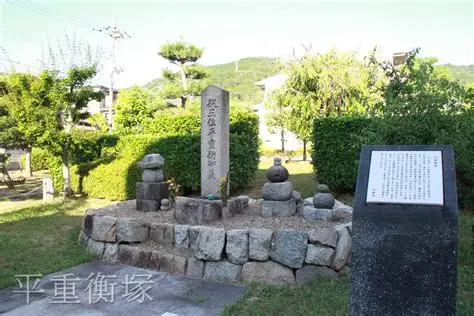
One such site is Atsumori-zuka, located on the west side of Sumaura Park.
It is a large five-tiered pagoda along National Route 2, with a total height of about 3.95 meters.
It is designated as a tangible cultural property by Kobe City.
It has long been known as a memorial tower for Atsumori, with a tradition that it is the place where his torso was buried.
There is also a tradition that Hojo Sadatoki, a regent of the Kamakura shogunate, erected it during the Koan era to memorialize the Taira clan.
However, the Kobe City Archaeological Center guides that the existing stone five-tiered pagoda dates from the late Muromachi to the Momoyama period.
Therefore, the tradition of its establishment in the Kamakura period cannot be confirmed with the current stone pagoda’s determined age.
No definitive records remain that Atsumori’s remains were actually buried at this site.
Meanwhile, within the grounds of Suma-dera, there is a five-tiered pagoda believed to be Atsumori’s head mound.
The temple has cherished it as a place to mourn Atsumori’s soul.
The grounds also feature the “Genpei Garden,” depicting the combat between Kumagai Naozane and Atsumori.
The Battle of Ichinotani makes it difficult to precisely determine the location where Atsumori fell or where his remains were buried.
However, Suma has long had historical sites for memorializing Atsumori, and traditions linked to military tales have been passed down.
At the present-day Suma-dera Temple, memorial services are held for those who lost their lives in the Battle of Ichinotani.
Visitors come to the temple grounds to pay respects at the “Kubi-zuka” mound, dedicated to Atsumori’s spirit, and the treasure hall preserves a flute known as the “Aoba no Fue.”
Taira no Atsumori perished at Ichinotani on February 7, 1184.
Afterwards, his father Taira no Tsunemori drowned himself at Dan-no-ura, and his brothers never returned from Ichinotani.
Meanwhile, Kumagai Naozane later became a monk, taking the name Renshō, and in the Noh play ‘Atsumori,’ he is depicted as a man who mourns the young warrior he once defeated at Suma.
Even today, Suma-dera continues to hold memorials for Atsumori, and the legend of the flute mentioned in ‘The Tale of the Heike’ endures.