On June 23, 1185, a warrior was brought to the banks of the Kizu River in Yamashiro Province.
This was Taira no Shigemori, the fifth son of Taira no Kiyomori.
According to the “Tale of the Heike,” Shigemori, facing execution, expressed a desire to worship an image of Amida Buddha.
When a former retainer hurried to bring a statue, Shigemori grasped the cord extending from the statue’s hand and chanted a Buddhist prayer.
Once, Shigemori led the Taira forces in an assault on Nara.
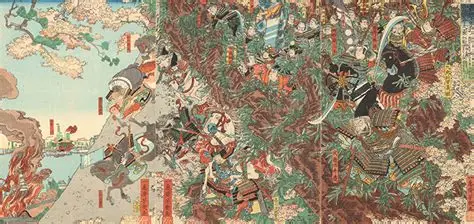
On December 28, 1180, the forces under Shigemori’s command clashed with the temple forces of Nanto, resulting in the destruction of the main halls of Todai-ji and Kofuku-ji.
The Great Buddha Hall was engulfed in flames, and the Great Buddha of Nara, dating back to the Nara period, was severely damaged.
At the age of 24, Shigemori achieved military success as a prominent Taira general through this battle, but also incurred the intense hatred of the monks of Nanto.
Subsequently, Shigemori continued to fight the Minamoto forces at Sumiyoshi River and Muroyama, supporting the military actions of the Taira clan.
However, on February 7, 1184, during the Battle of Ichi-no-Tani, he was captured and sent to Minamoto no Yoritomo.
In Kamakura, he formed a connection with a woman named Senjumae, and it is said that he had a final meeting with his wife on the way to the execution ground.
As Kiyomori’s son, Shigemori rose to high court rank and led the Taira forces in battles across the land.
His life spanned the period when the Taira clan’s power reached its zenith and then fell into ruin.
Born as the fifth son of Taira no Kiyomori
Taira no Shigemori was born in 1157, the second year of the Hogen era, as the fifth son of Taira no Kiyomori.
His mother was Taira no Tokiko, the daughter of Taira no Tokiie, who became Kiyomori’s principal wife.
His full brothers included Taira no Munemori and Taira no Tomomori, and he had a sister, Taira no Tokuko.
Tokuko later became the consort of Emperor Takakura and gave birth to Emperor Antoku. For Shigemori, Emperor Antoku was a nephew.
His half-brothers included Taira no Shigemori and Taira no Koremori.
Particularly, Shigemori, as Kiyomori’s legitimate son, held key positions in the imperial court and became a central figure supporting the Taira clan.
The year before Shigehira was born, in the first year of Hogen (1156), the Hogen Rebellion broke out in Kyoto.
The conflict arose from the rivalry between Emperor Go-Shirakawa and the retired Emperor Sutoku, with Kiyomori contributing to the victory on Emperor Go-Shirakawa’s side.
Minamoto no Yoshitomo also joined the same faction, defeating the forces of the retired Emperor Sutoku, including Minamoto no Tameyoshi.
In the first year of Heiji (1159), the Heiji Rebellion erupted.
Kiyomori defeated the forces of Fujiwara no Nobuyori and Minamoto no Yoshitomo, thereby enhancing his military standing in Kyoto.
Yoshitomo fled but was eventually killed, and his son Yoritomo was exiled to Izu.
During Shigehira’s early years, his father Kiyomori rapidly expanded his influence within the court through these internal conflicts.
In the second year of Nin’an (1167), he was appointed as the Grand Minister of State.
High ranks were also granted to the children of the Taira clan, with Kiyomori’s relatives occupying important positions in the court.
Shigehira grew up during a time when the Taira clan’s power was expanding.
However, there are no detailed records of his early education or under whom he learned martial arts and scholarship.
His later official career suggests that, as Kiyomori’s son, he was granted a position within the court from a young age.
At the Age of Six: Promotion to Junior Fifth Rank, Lower Grade
On December 23, in the second year of Oho (1162), Shigehira was promoted to Junior Fifth Rank, Lower Grade.
He was about six years old at the time.
In the following year, the first year of Chokan (1163), he became the Governor of Owari.
His promotions continued, and in December of the first year of Nin’an (1166), he was appointed as the Head of the Left Horse Bureau.
The Head of the Left Horse Bureau was the chief officer in charge of managing the imperial court’s horses.
It is unlikely that the young Shigemori himself managed the administration or horse management of Owari Province. These official positions indicate that he was given status within the court as a son of Kiyomori.
In the third year of Nin’an (1168), he was promoted to Junior Fourth Rank, Lower Grade, and in the third year of Kaō (1171), he advanced to Junior Fourth Rank, Upper Grade.
Furthermore, in the second month of the second year of Jōan (1172), he was appointed as the Assistant Master of the Empress’s Household.
At that time, the Empress was Shigemori’s sister, Tokuko.
Tokuko entered the court as the Empress of Emperor Takakura, strengthening Kiyomori’s ties with the imperial family.
Shigemori’s role as Assistant Master of the Empress’s Household was also rooted in the relationship between the Taira clan and the imperial family.
In the eleventh month of the second year of Jishō (1178), Tokuko gave birth to Prince Tokihito.
He would later become Emperor Antoku.
In the following December, Shigemori transitioned to serve as Assistant Master of the Crown Prince’s Household for Prince Tokihito, who had become the Crown Prince.
In the first month of the third year of Jishō (1179), he was appointed to the position of Provisional Middle Captain of the Left Imperial Guards.
The Left Imperial Guards were responsible for the emperor’s protection and court ceremonies, and the Middle Captain was a high-ranking official within this organization.
Although he resigned from the position of Middle Captain in December of the same year, he became the Head of the Kurōdo in the following first month of the fourth year of Jishō.
The Head of the Kurōdo was an important role involving political affairs as a close aide to the emperor, and Shigemori assumed this position at the age of 24.
In February, Prince Tokihito ascended the throne as Emperor Antoku, and Shigemori served as the Head of the Kurōdo for the new emperor.
Born as Kiyomori’s son, Shigemori had risen to a position close to the center of the court by his early twenties.
As the war with the Minamoto clan began, he would not only serve as a court official but also take on the role of a military commander leading troops.
Shigemori’s Wife, the Lady of the Senior Counselor’s Office
Known as Shigemori’s wife is the Lady of the Senior Counselor’s Office.
Also referred to as Fujiwara no Sukeko, she appears in “The Tale of the Heike” under names such as “Lady of the Senior Counselor’s Office.”
According to the same book, her father was Toriyae no Nakanoin Korezane.
She became the adopted daughter of Senior Counselor Fujiwara no Kunitaka and is said to have served as a wet nurse to Emperor Antoku.
Kunitaka was a court noble with close ties to Taira no Kiyomori and was one of the figures who supported the Taira regime.
With Kiyomori’s daughter Tokuko becoming the Empress of Emperor Takakura and giving birth to Emperor Antoku, court nobles closely associated with the Taira clan also came to hold important positions within the court.
Shigemori’s wife was also a woman belonging to this court society.
The exact details of when the two married are unclear.
Additionally, there are issues with historical records regarding their children.
In “The Tale of the Heike,” when Shigemori requests a final meeting with his wife before his execution, he states that he has no children.
On the other hand, genealogies also record names of individuals said to be Shigemori’s children, making it difficult to definitively establish family relationships.
At the very least, “The Tale of the Heike” portrays the final farewell between Shigemori and the Lady of the Senior Counselor’s Office as if they had no children.
This wife reappears in Shigemori’s life after he was captured at the Battle of Ichinotani.
The Political Upheaval of 1179—The Taira Clan’s Ascendancy
In 1179, tensions between Taira no Kiyomori and the retired Emperor Go-Shirakawa reached a critical point.
In June, Kiyomori’s daughter, Taira no Moriko, passed away.
Moriko was the widow of the regent Konoe Motozane, and after his death, she managed much of the regency family’s estates.
Her death led to disputes over the management of these lands, further souring relations between Kiyomori and the retired emperor.
On July 29, Kiyomori’s heir, Taira no Shigemori, also died of illness.
Shigemori was a key figure mediating between Kiyomori and the imperial court, and his death had a profound impact on the Taira clan.
In November, Kiyomori led his forces from Fukuhara to Kyoto.
He dismissed the Chancellor, Matsudono Motofusa, and appointed Konoe Motomichi as the new Chancellor, significantly influencing court appointments.
Furthermore, he relocated the retired Emperor Go-Shirakawa to the Toba Palace, effectively halting the cloistered government.
This was the political upheaval of 1179.
At this time, Taira no Shigehira served as the Provisional Middle Captain of the Left Guards, securing a prominent position within the court as a leading member of the Taira clan.
However, detailed records of Shigehira’s actions on the day of the upheaval are not available.
Kiyomori’s political control strengthened, but opposition also grew.
Particularly, relations with religious institutions deteriorated, and resistance against the Taira continued around Kyoto.
The following year, in 1180, the retired Emperor Go-Shirakawa’s son, Prince Mochihito, and Minamoto no Yorimasa rose in rebellion against the Taira.
At this time, Shigehira also took on the role of leading troops.
Prince Mochihito and Minamoto no Yorimasa‘s Uprising Suppressed
In May of the fourth year of the Jisho era, Prince Mochihito and Minamoto no Yorimasa raised an army with the aim of overthrowing the Taira clan.
Prince Mochihito fled to Onjoji Temple, where Yorimasa joined him.
The two sought support from Enryakuji Temple on Mount Hiei and Kofukuji Temple in Nara, but they were unable to secure sufficient backing.
Subsequently, Prince Mochihito and his followers headed towards Nara.
The Taira forces pursued them.
The diary “Gyokuyo” by Kujo Kanezane notes that Taira no Tomomori, Taira no Koremori, and Taira no Shigehira were appointed as commanders of the pursuing forces.
On May 26, the Taira army clashed with the forces of Prince Mochihito and Yorimasa near the Uji River.
The Minamoto forces attempted to defend by removing the planks of the Uji Bridge, but the Taira army crossed the river and continued their assault.
The battle concluded with a Taira victory.
Yorimasa took his own life at Byodoin, and Prince Mochihito was killed on his way to Nara.
Shigehira, along with his brother Tomomori, was involved in this pursuit.
However, it remains unclear exactly where along the Uji River Shigemori commanded his forces or what his specific actions were.
Although Prince Mochihito’s uprising was suppressed, resistance against the Taira clan spread across the country.
In Izu, Minamoto no Yoritomo began to expand his influence, while in Shinano, Minamoto no Yoshinaka (Kiso Yoshinaka) was rising in power.
Meanwhile, the monks centered around Kofuku-ji in Nanto continued their resistance against the Taira.
At the end of that year, Kiyomori dispatched forces to subdue Nanto.
The commander chosen for this task was Shigemori.
The Burning of Nanto—The Forces that Set Fire to Todai-ji and Kofuku-ji
On December 28, 1180, the Taira forces led by Shigemori advanced on Nanto.
The temple forces centered around Kofuku-ji in Nara had been involved in Prince Mochihito’s uprising and continued their resistance against the Taira regime.
The Nanto side constructed defensive facilities near Narazaka and Hannya-ji to confront the Taira forces.
According to the “Heike Monogatari,” they dug trenches across the roads and set up fences and shields, with warrior monks guarding the paths.
Shigemori’s army launched an attack on this defensive line.
The battle continued until evening, eventually setting the town of Nara ablaze.
The “Heike Monogatari” Kakuichibon describes how fires were set to homes to provide light for night combat, and the flames, carried by the wind, spread to the temples.
Meanwhile, other texts and related historical records suggest a more deliberate arson.
It is unclear from the sources who ordered the arson or whether Shigemori intended from the start to burn the main temple buildings.
However, it is certain that the attack by Shigemori’s forces caused extensive damage to Nanto.
At Kofuku-ji, the Central Golden Hall, Lecture Hall, and the Five-Story Pagoda were among the structures destroyed by fire.
At Todai-ji, the Great Buddha Hall and other major buildings were engulfed in flames, severely damaging the head and left hand of the Great Buddha.
Many people sought refuge in the Great Buddha Hall to escape the flames, resulting in numerous casualties.
The great temples, which had stood since the Nara period, suffered devastating damage in a single night.
As the commander of the forces sent to subdue Nanto, Shigemori bore responsibility for these damages.
At the time, he was 24 years old by traditional Japanese count.
Leading the forces and executing the orders of the Taira regime, Shigemori became the target of intense hatred from the monks of Nanto.
This event continued to affect Shigemori’s fate, even after he was captured at Ichinotani.
The Death of Kiyomori and the Evaluation of Shigehira
About two months after the Burning of Nara, Kiyomori, who had been the pillar of the Taira clan, passed away.
This occurred on the intercalary 2nd month, 4th day of Jisho 5 (1181).
The “Heike Monogatari” recounts that Kiyomori suffered from a severe fever, his body burning as if on fire.
His end is depicted as retribution for setting fire to the great temples of Nara.
However, the exact details of Kiyomori’s illness and cause of death remain unclear.
After his father’s death, the central figure of the Taira clan became Taira no Munemori.
Kiyomori’s heir, Shigemori, had already passed away, leaving Munemori, Tomomori, and Shigehira to support the clan.
Regarding Shigehira at this time, there is an intriguing entry in the diary “Gyokuyo” by Kujo Kanezane.
In the entry for the intercalary 2nd month, 15th day of Jisho 5, Kanezane wrote of Shigehira, “He has the capacity for martial prowess.”
This indicates that Shigehira was recognized as a person capable of leading troops.
Although Shigehira was branded an enemy of Buddhism due to the Burning of Nara, he was acknowledged for his abilities as a commander of the Taira forces.
And in the same year, in March, Shigehira would once again face the Genji forces in battle.
The Battle of Sunomata River—Defeating Minamoto no Yukie and Gien
In March of Jisho 5, the Genji and Taira forces clashed near the Sunomata River, close to the border between Owari and Mino provinces.
This was the Battle of Sunomata River.
The Genji side was led by Minamoto no Yukie.
Yukie was the son of Minamoto no Tameyoshi and the uncle of Yoritomo and Yoshitsune.
He was also the figure who conveyed Prince Mochihito’s call to arms to the Minamoto clan across the land, urging them to overthrow the Taira.
Minamoto no Yoshikata, Yoritomo’s half-brother, was among those who joined Yukie’s forces.
In response, the Taira dispatched a force led by Shigehira.
The “Gyokuyo” entry for the intercalary 2nd month, 15th day, notes that Shigehira was sent as the general with over ten thousand cavalry.
Meanwhile, different versions of “The Tale of the Heike” mention varying troop numbers, leaving the actual size of the forces unclear.
According to the “Azuma Kagami” entry for the 10th day of the 3rd month of the 5th year of Jisho, Yukie’s army attempted a night raid across the Suminokawa River on the Taira camp.
However, a retainer of Shigehira discovered the Genji movements while washing horses by the river.
Upon receiving this news, the Taira forces prepared for an attack and countered before Yukie’s side could fully mobilize.
The battle ended in a victory for the Taira.
Yukie’s forces suffered heavy losses, and Yoshikata was killed in action.
The “Azuma Kagami” records that Yoshikata was slain by Taira’s Takahashi Moritsuna.
On the other hand, “The Tale of the Heike” depicts Yoshikata as leading the charge across the river to attack the Taira forces.
Despite differences in the detailed accounts of the battle, it is agreed that Yukie’s side was defeated and Yoshikata lost his life.
For Shigehira, this victory became a significant military achievement following the burning of Nanto.
On May 26 of the same year, Shigehira was promoted to Junior Third Rank and reinstated as Provisional Middle Captain of the Left Guards.
Achieving the Third Rank elevated him to the rank of court noble, granting him high status not only in military but also in court affairs.
In the following year, Yowa 2 (1182), he also served as Provisional Governor of Tajima, and on January 7 of Juei 2 (1183), he advanced to Senior Third Rank.
Later known as “Hon Sanmi Chujo,” Shigehira continued to rise in rank while supporting the Taira clan’s military actions.
The Great Defeat at Kurikara Pass—Leaving the Capital with the Taira
In Juei 2 (1183), Minamoto no Yoshinaka’s forces rapidly expanded their influence along the Hokuriku Road.
The Taira dispatched an army led by Taira no Korehira to the Hokuriku region, but they suffered a crushing defeat in the Battle of Kurikara Pass in May.
In the Battle of Shinohara that followed, the Taira forces struggled and could not stop Yoshinaka’s army from advancing on Kyoto.
In July, Taira no Munemori and others left Kyoto with Emperor Antoku and the Imperial Regalia.
Shigemori also headed west with the Taira clan.
Having been granted official ranks from a young age and having served at the court as Kiyomori’s son, Shigemori found himself in the position of being driven out of the capital.
On August 6, Shigemori’s removal from office due to his departure to the western seas was recorded in the ‘Kugyō Bunin’.
The official status he had built as a member of the Taira nobility was lost with the fall from the capital.
Although the Taira attempted to regroup their forces in Kyushu, they faced resistance from local powers like Ōgata Koreie in Bungo Province and were unable to establish a stable base.
Subsequently, the clan moved to Yashima in Sanuki Province.
Yashima, facing the Seto Inland Sea, was a strategic military location crucial for gathering warriors from Shikoku and the Chugoku region.
The Taira reorganized their forces using maritime routes and worked to restore their power in the west.
Meanwhile, in Kyoto, tensions between Yoshinaka and Emperor Go-Shirakawa were escalating.
As internal conflicts within the Minamoto clan intensified, the Taira found an opportunity to advance eastward once more.
Battle of Mizushima—Counterattack in the Seto Inland Sea
On the intercalary 10th month, 1st day of Juei 2, the Genpei forces clashed near Mizushima in Bitchu Province.
This was the Battle of Mizushima.
The Genji forces were led by Ashikaga Yoshikiyo and Unno Yukihiro, dispatched by Minamoto no Yoshinaka.
In response, the Taira forces utilized their fleet in the Seto Inland Sea to confront them.
The ‘Heike Monogatari’ depicts Taira no Tomomori and Taira no Noritsune commanding their forces from the ships, attacking the Genji.
Shigemori is also said to have been involved in military actions as a prominent Taira commander during this period, but detailed records of which unit he commanded at Mizushima are scarce.
The ‘Heike Monogatari’ also recounts how the Taira tied their ships together with ropes and laid planks across them to secure a foothold.
Accustomed to naval combat, the Taira forces defeated the Genji, resulting in the death of Ashikaga Yoshikiyo and others.
This victory allowed the Taira to regain military dominance in the Seto Inland Sea.
Several months after their fall from the capital,
the Taira utilized western maritime routes to regroup their forces and moved once again towards the Harima region.
The Battle of Muroyama――Shigemori Leading the Fourth of Five Formations
In November of the second year of Juei, the forces of the Taira clan clashed with the army of Minamoto no Yukie at Muroyama in Harima Province.
This was the Battle of Muroyama.
Yukie departed from Kyoto on November 8, heading to Harima to attack the Taira forces.
According to the “Gyokuyo,” Yukie’s army numbered over 270 horsemen at the time of departure.
The “Kikki” also records over 300 horsemen.
On the other hand, the “Heike Monogatari” mentions that the Taira army gathered at Muroyama numbered over 20,000 horsemen, while Yukie’s forces were over 500.
There are discrepancies in the numbers of troops depending on the source.
The central figures of the Taira army were Tomomori and Shigemori.
The “Heike Monogatari” describes the Taira army forming five lines to confront Yukie’s forces.
The first line was led by Echizen Jirobei Moritsugu.
The second line was led by Iga Heinaizaemon Ienaga.
The third line was led by Kazusa Gorobei Tadamitsu and Akushichibyoe Kagekiyo.
And it was Shigemori who led the fourth line.
Tomomori was stationed with the fifth line.
As Yukie’s forces advanced, the first line split to the sides, opening a path in the center.
The second and third lines similarly opened paths, allowing Yukie’s forces to pass through.
It is said that Shigemori’s fourth line also opened in the center.
It seemed as though Yukie was breaking through the enemy lines one after another.
However, ahead lay the fifth line led by Tomomori, waiting in ambush.
When Yukie’s forces had penetrated deeply, the four lines that had opened paths suddenly turned around.
In front was Tomomori.
Behind were the forces of Shigemori and others.
The “Heike Monogatari” depicts Yukie’s army being surrounded by the large Taira forces and subjected to fierce attacks.
This five-layered strategy cannot be confirmed in detail from contemporary records.
However, it is recorded in the “Gyokuyo” that Yukie’s army suffered a major defeat at Muroyama.
According to the entry for December 2, the battle on November 29 resulted in Yukie’s army being swiftly defeated, with many of his retainers killed.
For Shigemori, this was another victory following the battle at Sumitagawa, where he defeated Yukie’s forces.
Nanto, Sunomata River, Muroyama.
As a commander of the Taira forces, Shigemori was involved in battles across various regions, supporting his clan militarily.
Return to Fukuhara—Facing the Genji Forces at Ichinotani
After their victory at the Battle of Muroyama, the Taira clan extended their influence further eastward.
Eventually, the clan returned to the vicinity of Fukuhara, eyeing a re-entry into Kyoto.
Fukuhara was once the site where Kiyomori attempted to relocate the capital, serving as a crucial base with access to maritime routes in the Seto Inland Sea.
Meanwhile, tensions between Minamoto no Yoshinaka (Kiso Yoshinaka) and Emperor Go-Shirakawa were escalating in Kyoto.
On November 19, 1183, Yoshinaka attacked the Hojuji Palace, subduing the Emperor by force.
In response, Yoritomo dispatched his brothers Noriyori and Yoshitsune.
On January 20, 1184, Yoshinaka’s forces were defeated at Uji and Seta, and Yoshinaka himself was killed at Awazu in Omi Province.
Kyoto fell under the control of Yoritomo’s forces.
Noriyori and Yoshitsune wasted no time in pursuing the Taira clan.
The Taira, anticipating the Genji army’s approach, established defensive lines around Fukuhara.
In the east, at Ikuta Forest, Taira no Tomomori and Shigemori took up positions.
In the west, at Ichinotani, Taira no Tadanori and others were stationed, with Taira no Michimori and Taira no Moritoshi positioned on the mountain side.
According to the ‘Tale of the Heike’, Shigemori appears as the vice-commander at Ikuta Forest.
Alongside his brother Tomomori, he was tasked with confronting Noriyori’s forces advancing from the east.
On February 7, 1184, the Genji and Taira forces clashed at Ichinotani.
The Battle of Ichinotani—The Collapse of the Taira Defense Line
During the Battle of Ichinotani, the Genji forces launched attacks on the Taira positions from multiple directions.
Noriyori’s forces were at Ikuta Forest in the east.
At the western entrance of Ichinotani, Kumagai Naozane and Hirayama Sueshige vied to be the first to attack.
Meanwhile, Yoshitsune’s troops advanced from the mountain side.
The ‘Tale of the Heike’ describes Yoshitsune charging down a steep slope to launch a surprise attack on the Taira camp.
This scene later became famous as the “Descent of Hiyodori Pass.”
However, the ‘Gyokuyo’ records that Tada Yukitsuna was the first to break through the mountain-side defenses, leading to debates about the roles of Yoshitsune and Yukitsuna and the actual points of attack.
The Genji forces launched attacks from all directions, causing the Heike’s defensive lines to crumble.
Tomomori and Shigehira, who were fighting in the Ikuta Forest, were also forced to retreat.
Many of the Heike troops headed towards the coast, attempting to escape by ship.
However, not all warriors managed to reach the ships.
In this battle, Taira no Tadanori, Taira no Michimori, Taira no Atsumori, and Taira no Morimori were among those who fell in combat.
Though Tomomori escaped by sea, Shigehira was eventually caught by the Genji forces.
Kajiwara Kageki’s Arrow—The Capture of Shigehira
The “Heike Monogatari” vividly describes Shigehira’s retreat in the section “Shigehira’s Capture.”
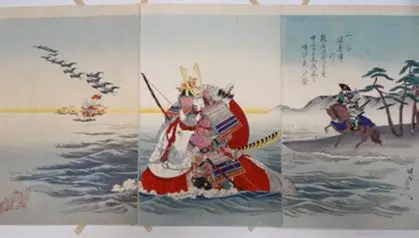
It is said that Shigehira fled westward with his wet nurse’s son, Goto Heiemon Morinaga, on two horses.
They rode a famous horse known as “Doji Kage.”
Relying on the swift horse to evade the pursuing Genji forces, they were nonetheless chased by Kajiwara Kageki and others.
Kageki, realizing he couldn’t catch up to Shigehira’s horse, shot an arrow from a distance.
The arrow reportedly struck the horse, causing it to lose its ability to run.
Shigehira asked Morinaga to lend him his horse.
However, Morinaga refused and fled, leaving Shigehira behind.
Left alone, Shigehira was overtaken by the Genji warriors.
He attempted to take his own life but was restrained by Shojiro Takaie, as recounted in the “Heike Monogatari.”
On the other hand, sources like the “Azuma Kagami” differ in their accounts of the capture’s location and the capturing warrior, making it difficult to ascertain the precise details.
The actions of the wet nurse’s son and the scene of the horse being shot should be considered as part of the war tale’s narrative.
Nevertheless, it is certain that Shigehira was captured alive at the Battle of Ichi-no-Tani.
Despite losing many commanders, the Heike clan, including Munemori and Tomomori, managed to escape by sea.
Shigehira, however, remained a prisoner in the hands of the Genji forces.
Returning to Kyoto as a Prisoner
Captured at Ichi-no-Tani, Shigehira was sent to Kyoto.
According to the “Heike Monogatari” in the section “The Imperial Palace Ladies,” Shigehira was paraded through the city in a cart along Rokujo Avenue, visible to the people of the capital.
He was escorted by Doi Sanehira and others, who managed his custody.
Once a child of Kiyomori who served the court and held many ranks, Shigehira’s presence drew crowds eager to see him, as the tale describes.
Shigehira was later placed in a temple near Hachijo Horikawa.
The “Heike Monogatari” recounts a scene where Shigehira, reflecting on his life in the capital, sends a letter to a woman he was once close to.
The letter was entrusted to Mokuryo Uma no Jo Tomotoki, who had served Shigehira for some time.
Tomotoki was the person who acted as an intermediary when Shigehira interacted with a lady serving in the imperial court.
Shigehira wished to meet this woman once more.
According to the Tale of the Heike, the woman was also concerned for Shigehira’s well-being and shed tears upon receiving his letter.
Eventually, they were granted a meeting, and it is said that they parted with regret.
The details of this woman’s life remain unclear, and it is uncertain how much of their interaction reflects historical fact.
Nevertheless, the Tale of the Heike portrays Shigehira as a person familiar with court culture, revealing a side of him not evident from his battlefield exploits alone.
Meanwhile, at the Kyoto court, there was an attempt to use the captive Shigehira as leverage in negotiations with the Taira clan.
Exchanging Shigehira for the Imperial Regalia
The Genji forces achieved a great victory at Ichi-no-Tani, but they failed to recover Emperor Antoku and the Imperial Regalia.
Taira no Munemori and others fled by ship to Yashima, taking Emperor Antoku and the regalia with them.
Emperor Go-Shirakawa then sought their return from the Taira.
The Tale of the Heike describes negotiations in the “Yashima Imperial Edict” and “Petition” sections, where Shigehira’s return was requested in exchange for the regalia’s return to the court.
Shigehira himself is said to have sent letters to his brother Munemori and others, conveying the emperor’s demands.
However, the Taira clan did not comply.
In the Tale of the Heike, Tomomori argues that there was no guarantee Shigehira would be returned, opposing the regalia’s return.
It is also conveyed that they judged it unacceptable to relinquish Emperor Antoku and the regalia to save just one life, Shigehira’s.
The detailed conversations of these negotiations and Shigehira’s feelings are largely derived from the Tale of the Heike‘s depiction.
Nonetheless, it is clear that Shigehira, captured at Ichi-no-Tani, became a significant figure in the negotiations between the Taira and the court.
The negotiations failed, and Shigehira could not return to the Taira clan.
Consequently, he was sent to the eastern provinces where Yoritomo was.
Meeting with Honen—Questioning the Guilt of the Burning of Nanto
The “Admonition” section of the Tale of the Heike includes a scene where Shigehira wishes to become a monk.
Shigehira, who burned Todai-ji and Kofuku-ji during the Burning of Nanto, is depicted as being deeply aware of the sins he committed.
Shigehira requested to take vows from Doi Sanehira.
Sanehira conveyed this to Yoshitsune, who in turn reported it to Emperor Go-Shirakawa.
However, it was decided that he could not be permitted to become a monk before being handed over to Yoritomo.
Thus, Shigehira expressed a desire to receive teachings on Buddhism from a high priest.
It is here that Honen appears as the figure to provide such teachings.
Honen was a monk who spread the practice of exclusive nembutsu and later became known as the founder of the Jodo sect.
According to the “Tale of the Heike,” Shigehira spoke of the sin of burning down the great temples of Nanto and asked whether even someone like him could be saved by Buddha.
Honen explained the original vow of Amida Buddha, teaching that even those burdened with deep sins could aspire to rebirth through nembutsu.
It is said that Shigehira was grateful for this teaching and received the precepts.
There is also a story that he gifted Honen an inkstone inherited from his father, Kiyomori.
However, there is scholarly debate about whether the meeting between Honen and Shigehira actually took place.
Shigehira was held as a prisoner and was not in a position to meet freely.
Although Honen’s biography depicts interactions with Shigehira, the timing and content of these accounts need to be examined.
The “Tale of the Heike” portrays Shigehira as a man who acknowledges his sins and seeks salvation.
This meeting with Honen connects to the image of Shigehira before his execution.
Meeting Minamoto no Yoritomo in Izu
On March 10, 1184, Shigehira departed from Kyoto.
Kajiwara Kagetoki was in charge of escorting him.
According to the “Azuma Kagami,” Shigehira arrived at the provincial headquarters in Izu on March 27.
At that time, Yoritomo was staying in the Hojo area of Izu.
When Kagetoki reported Shigehira’s arrival, Yoritomo indicated he would meet him the following day, the 28th.
On March 28, Shigehira was brought before Yoritomo.
Their first meeting took place not in Kamakura, but in Izu.
Yoritomo himself had once been exiled to Izu by Kiyomori.
Now, it was Kiyomori’s son, Shigehira, who appeared as a prisoner before Yoritomo.
The “Azuma Kagami” records that Yoritomo addressed Shigehira with courteous words.
Shigehira is said to have responded calmly.
In his words, Shigehira reflected on how both the Minamoto and Taira clans had protected the imperial court, and he looked back on the Taira’s 20 years of prosperity.
He also expressed that, as a prisoner of the enemy, he was prepared to accept whatever fate awaited him.
The “Azuma Kagami” notes that those present were impressed by his demeanor.
However, the conversation at the meeting is based on the “Azuma Kagami,” compiled in later years, and may not accurately reproduce the actual words spoken.
Yoritomo did not immediately execute Shigehira but entrusted him to Kano no Suke Munemochi in Izu Province.
On April 8, Shigehira entered Kamakura.
Nearly two months had passed since he was captured at Ichinotani.
A Banquet with Senjumae—Shigehira’s Flute Performance
Senjumae is known as the woman sent to Shigehira in Kamakura.
The “Azuma Kagami” entry for April 20, 1184, records a banquet held for Shigehira.
On this day, Shigehira was granted permission by Yoritomo to take a bath.
In the evening, Yoritomo sent Fujiwara no Kunimichi, Kudo Suketsune, and Senjumae to comfort Shigehira.
Wine and delicacies were delivered, and a banquet was held under Shigehira’s auspices.
Kudō Suketsune was a warrior from Izu Province who had once served Taira no Shigemori and was said to have been acquainted with Shigehira.
Senju-mae was a woman believed to be from Tegoshi in Suruga Province.
According to the Azuma Kagami, Suketsune played the drum and sang popular songs, Senju-mae played the biwa, and Shigehira joined in with the flute.
The Tale of the Heike also contains detailed descriptions of this banquet.
It is said that Shigehira likened the name of a musical piece to the afterlife, uttering words that seemed to reflect on his impending end.
He is also said to have recited a Chinese poem inspired by the story of Xiang Yu of Chu being cornered by Liu Bang of Han.
This portrayal draws a parallel between Xiang Yu’s situation of being surrounded on all sides and Shigehira’s own plight as a captive.
The specific conversations and songs performed at the banquet vary among different versions of the Tale of the Heike.
However, the fact that a banquet was held to console Shigehira, with Senju-mae’s involvement, is recorded in the Azuma Kagami as well.
Shigehira had accumulated court ranks and lived as a noble of the Taira clan.
His familiarity with musical instruments and poetry reflects a figure who was raised within the culture of the court, even as a warrior.
There are records of Senju-mae’s later life as well.
The Azuma Kagami notes that on April 25, 1188, Senju-mae passed away at the age of 24 by traditional reckoning.
The same text records rumors that her lingering affection for Shigehira might have been the cause of her illness.
The Tale of the Heike portrays the relationship between Shigehira and Senju-mae with emotional depth.
However, the exact nature of their relationship remains unclear.
After staying in Kamakura, Shigehira continued to be held under the control of Yoritomo’s forces.
Life as a Captive in Izu
According to the Tale of the Heike, “Shigehira’s Execution,” Shigehira was entrusted to Kanō no Suke Munemochi and lived in Izu Province.
Munemochi was a warrior from Izu who managed Shigehira’s custody under orders from Yoritomo’s faction.
There are few detailed records of how Shigehira spent his days in Izu.
However, he was not executed immediately after being escorted to Kamakura, and he lived for over a year thereafter.
As the battles with the Taira continued, Shigehira, being Kiyomori’s son, was treated as an important captive.
In the west, Munemori and Tomomori held onto Emperor Antoku and the Imperial Regalia, resisting the Genji forces.
In February 1185, Minamoto no Yoshitsune launched a surprise attack on Yashima.
The Taira lost Yashima and retreated further west.
Then, on March 24, the final battle between the Genji and the Taira took place at Dan-no-ura in Nagato Province.
The Taira forces were defeated, and Tomomori threw himself into the sea.
It is said that Shigehira’s mother, Tokiko, also drowned herself while holding Emperor Antoku.
Emperor Antoku lost his life, and his brother Munemori was captured by the Genji forces.
During Shigehira’s time in the eastern provinces, the Taira clan lost their military and political power.
However, there is no definitive record of when or how Shigehira learned of the defeat at Dan-no-ura.
Captured at Ichi-no-Tani, Shigehira witnessed the fall of the Taira clan from a different place than Tomomori and others who fought to the end at Dan-no-ura.
As a result of this defeat, Shigehira’s fate was also altered.
The Demand for Shigehira’s Surrender by the Nanto Monks
After the fall of the Taira clan, the monks of Nanto demanded the surrender of Shigehira.
Nearly four and a half years had passed since the Burning of Nanto in the fourth year of Jisho.
However, the damage left at Todai-ji and Kofuku-ji was significant.
At Todai-ji, Shunjobo Chogen took charge as the chief administrator, gathering donations and materials from various provinces to advance the reconstruction.
Chogen began serving as the chief administrator in the first year of Yowa (1181), progressing with the restoration of the Great Buddha with support from Emperor Go-Shirakawa and Yoritomo.
With the cooperation of the Song dynasty metal caster Chen Heqing and others, the restoration of the Great Buddha’s head and left hand was also underway.
However, the reconstruction of the Great Buddha Hall and other temple buildings still required a long time.
The monks of Nanto continued to demand punishment for Shigehira, the commander of the forces that burned the temples.
According to the “Tale of the Heike,” Yoritomo decided to hand over Shigehira in response to the demands from Nanto.
After the fall of the Taira clan, the political significance of holding Shigehira as a captive had diminished.
On June 9, 1185, Shigehira left the eastern provinces and headed for Nanto.
The person entrusted with escorting him was Izu Kurando no Daibu Yorikane.
According to the “Tale of the Heike,” Yorikane was a grandson of Minamoto no Yorimasa.
Yorimasa had fought against the Taira forces during the Rebellion of Prince Mochihito in the fourth year of Jisho and had taken his own life at Uji.
Thus, it was Yorimasa’s family, who had once opposed the Taira and perished, that was now tasked with escorting Shigehira to his final destination.
The Final Meeting at Hino—The Hair and Robe Given to His Wife
The group escorting Shigehira proceeded westward along the Tokaido.
According to the “Tale of the Heike,” they were not allowed to enter the city of Kyoto this time, and instead traveled from Otsu through Yamashina and along the Daigo Road towards Nara.
Along the way was Hino in Yamashiro Province.
This area corresponds to present-day Hino in Fushimi Ward, Kyoto City.
It is said that here, Taira no Shigehira’s wife, known as the Great Counselor Sano Tsubone, sought refuge.
According to the Tale of the Heike, after Shigehira was captured at the Battle of Ichi-no-Tani, his wife followed Emperor Antoku to the western provinces.
At Dan-no-ura, she attempted to throw herself into the sea but was saved by a Genji warrior and returned to the Kyoto area.
Afterward, she lived relying on her elder sister, Dainagon no Sanmi, who resided in Hino.
During his transport, Shigehira learned that his wife was in Hino.
He then requested the guards to allow him a final meeting with his wife.
In the Tale of the Heike, Shigehira expressed that he had few worldly attachments since he had no children, but he wished to see his long-time companion once more to discuss posthumous rites.
The guards granted his request.
Shigehira went to Hino and reunited with his wife.
The Tale of the Heike describes this scene in detail in the section “Shigehira’s Execution.”
Shigehira wore an indigo-dyed hunting robe and a folded eboshi cap, appearing thinner than before.
Upon seeing Shigehira, his wife hurriedly ran to him.
It is said that the two wept as they recounted the events since their separation.
Shigehira spoke of leaving the capital, being captured at Ichi-no-Tani, and living as a prisoner in Kyoto and Kamakura.
He then revealed that he would be handed over to Nanto for execution.
His wife also recounted how she had lost Emperor Antoku and the Taira clan at Dan-no-ura and returned to Kyoto.
The Tale of the Heike depicts Shigehira’s wish to become a monk and leave a lock of hair as a memento, but he was not permitted to do so.
Instead, he bit off a small piece of hair from his forehead and gave it to his wife.
His wife prepared new clothes for Shigehira.
Shigehira changed into them and left the clothes he had been wearing with his wife.
The Tale of the Heike also includes a scene where the couple exchanged poems at their farewell.
“Unable to hold back, tears soak my Tang robe, which I now change as a memento.”
This was the poem Shigehira left for his wife.
His wife also expressed her sorrow in a poem, accepting the robe as a keepsake.
“What use is changing clothes now, when I think of them as a memento of this final day?”
It is impossible to verify all these poems and detailed conversations as historical facts.
However, the tradition that Shigehira met his wife before his execution is supported by related descriptions in the Gukansho, indicating that it was a story told early on.
In the Tale of the Heike, Shigehira, having bid farewell, mounted his horse and left Hino, listening to his wife’s cries.
Though he wished to look back once more, he continued on to Nara.
Shigehira parted from his wife and headed to the execution grounds by the Kizu River.
By the Kizu River—The Amida Buddha Statue Delivered by His Former Retainer, Tomotoki
On June 23, 1185, Shigehira was beheaded by the banks of the Kizu River in Yamashiro Province.
He was 29 by traditional age reckoning.
The “Heike Monogatari” vividly details the final moments of Taira no Shigehira in the section “Shigehira’s Execution.”
At the execution site, monks and warriors from Nanto gathered, and many people came to witness Shigehira’s last moments.
Then, a lone warrior hurried to the scene.
It was Mokuryo Uma no Jo Tomotoki.
Tomotoki had once served Shigehira and continued to visit him even after he was captured in Kyoto.
According to the “Heike Monogatari,” Tomotoki rushed to the execution site to witness Shigehira’s final moments.
Shigehira spotted Tomotoki and expressed gratitude for his loyalty.
He wished to worship an image of Amida Buddha one last time.
Tomotoki arranged for a statue of the Buddha to be brought from nearby.
The statue of Amida Buddha was placed on the sand of the riverbank, with a cord tied to its hands.
It is said that Shigehira grasped the cord and recited prayers towards the statue.
The “Heike Monogatari” depicts Shigehira speaking about the burning of Nanto at this moment.
He explained that the attack on Nanto was carried out under orders from the court and his father, and it was not his own desire to see the temples destroyed.
However, as the commander of the forces, he also acknowledged his own responsibility.
Whether Shigehira actually spoke these words cannot be confirmed.
The “Heike Monogatari” portrays a warrior who burned temples, seeking salvation through prayer as he faced death.
It is said that Shigehira offered his neck while chanting prayers towards Amida Buddha.
On the banks of the Kizu River, the fifth son of Kiyomori met his end.
The Head Displayed at Hannya Temple and the Wife’s Memorial Service
After Shigehira’s execution, his head was taken to Nara.
According to the “Heike Monogatari,” monks from Nanto displayed his head in front of the grand torii gate of Hannya Temple.
Hannya Temple is located in the area attacked by the Heike forces during the burning of Nanto in the fourth year of the Jisho era.
It is said that his head was taken to the land where he once led his troops as a commander.
Meanwhile, his body was reportedly handed over to his wife.
The “Heike Monogatari” records that Dainagon Sakyoku had Shigehira’s remains transported to Hino, where a memorial service was held at Hokkai-ji Temple.
Later, through the arrangements of Chogen, who was overseeing the reconstruction of Todai-ji, the head was also returned, and his wife cremated it and enshrined the ashes.
It is also said that some of the ashes were sent to Mount Koya.
However, the handling of the remains and the location of the ashes after the execution include later traditions and should be considered with caution.
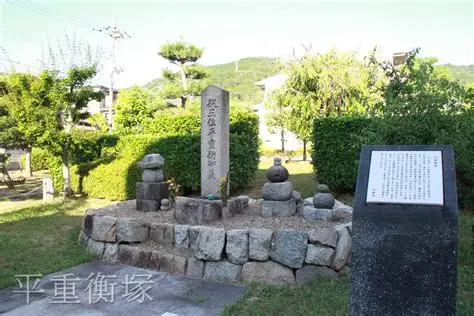
In the Fushimi Ward of Kyoto City, there remains a site believed to be the grave of Taira no Shigemori.
Nearby, Hokaiji Temple is known as the place where Shigemori’s wife held memorial services for him.
According to the “Tale of the Heike,” his wife later became a nun and prayed for Shigemori’s soul.
Additionally, Senju-mae, who comforted Shigemori in Kamakura, passed away young in April of the fourth year of Bunji (1188).
The “Azuma Kagami” records rumors that her death might have been related to her longing for Shigemori.
The stories of the women surrounding Shigemori continued to be told in later military tales and legends.
The Continued Reconstruction of Todaiji After Shigemori’s Death
When Shigemori was executed at the Kizu River, reconstruction efforts at Todaiji were ongoing.
Although the restoration of the Great Buddha was progressing, the reconstruction of the Great Buddha Hall and other temple buildings was not yet complete.
Chogen traveled across the provinces to solicit donations and, with the help of craftsmen from Song China, including Chen Heqing, advanced the restoration of the Great Buddha.
About two months after Shigemori’s execution, on August 28th of the first year of Bunji (1185), the eye-opening ceremony of the Great Buddha was held at Todaiji.
It is recorded that Retired Emperor Go-Shirakawa attended and personally performed the eye-opening ceremony with a brush.
However, the reconstruction of the Great Buddha Hall, which housed the Great Buddha, would take many more years.
In the sixth year of Kenkyu (1195), the dedication ceremony for the completed Great Buddha Hall was held.
It was 15 years after the Burning of Nanto.
Todaiji, which had been destroyed by the forces led by Shigemori, continued its reconstruction with the support of many people even after his death.
Meanwhile, Shigemori’s wife is said to have prayed for her husband’s soul in Hino.
In December of the fourth year of Jisho, Shigemori, at the age of 24 by traditional count, advanced on Nanto, and on June 23rd of the second year of Genryaku, at the age of 29, he was beheaded on the banks of the Kizu River.
The “Tale of the Heike” notes that his head was taken to Hannya Temple, and his body was returned to his wife.
Then, ten years after Shigemori’s execution, in the sixth year of Kenkyu, the dedication ceremony for the rebuilt Great Buddha Hall was held at Todaiji.
The Great Buddha Hall, once destroyed by Shigemori’s forces, reappeared on the land of Nara.