Father: Minamoto no Tsunemoto. The Era When Mitsunaka Was Born
Minamoto no Mitsunaka is believed to have been born on April 10, 912.
His father was Minamoto no Tsunemoto.
He was a descendant of Emperor Seiwa’s son, Prince Sadazumi, and became one of the Seiwa Genji after being demoted to a commoner status.
Mitsunaka was born as the child of Tsunemoto.
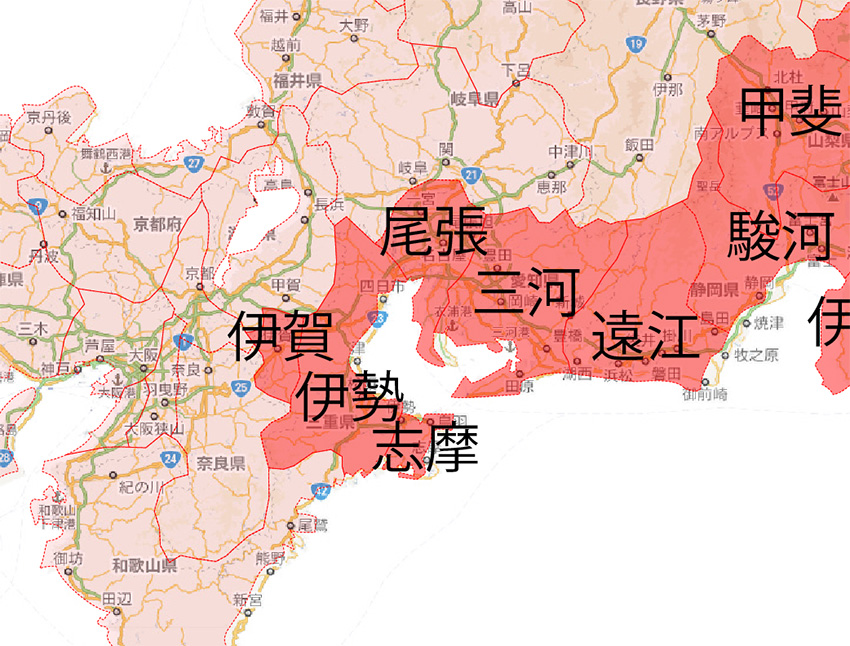
During this era, the Fujiwara clan dominated the political scene at the Kyoto court, while conflicts between provincial governors and local powers intensified in the regions.
The rebellion of Taira no Masakado occurred when Mitsunaka was around 28 years old, during the Shōhei 5 to Tengyō 3 years (935–940).

The rebellion of Fujiwara no Sumitomo also took place from 939 to 941.
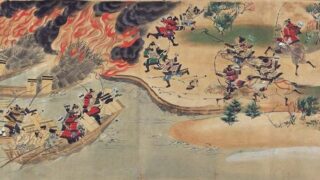
Mitsunaka was born and raised precisely at a time when the court began to rely on regional military power.
For the Minamoto clan, this era’s developments were of great significance.
The Minamoto, with imperial blood, secured court positions while gaining control over regional military forces.
One of the key figures who advanced this structure was Mitsunaka.
Young Mitsunaka—Becoming a Court Official Before a Warrior
To label Mitsunaka as a “warrior” from the start is to misunderstand his character.
Mitsunaka’s starting point was as a court official serving the imperial court.
He served as a provincial governor, taking assignments in various regions.
Historical records indicate he held positions such as governor of Echizen, Musashi, Iyo, Mino, Shimotsuke, and Mutsu, as well as deputy governor of Kazusa and Hitachi.
He also took on military-related roles like Left Horse Guard Captain and Commander of the Defense Headquarters.
A provincial governor was not merely a local administrative officer.
They collected taxes, maintained domestic order, and executed the court’s commands.
And since they operated in the provinces, building relationships with local influential figures and those with military power was crucial.
While rising as a court official in Kyoto, Mitsunaka expanded his connections with the provinces.
This is a crucial point that connects to the future of the Minamoto clan.
Imperial court positions and regional military power.
Manchika began to unify these two elements within a single family.
To Settsu and Tada—Manchika Establishes His “Base”
There is a land that is always mentioned alongside Manchika’s name.
Tada in Settsu Province.
This area corresponds to present-day Kawanishi City in Hyogo Prefecture.
Manchika expanded into Settsu and developed the entire Tada Basin.
He led his family and retainers to establish Tada as a base, forming a power grounded in land ownership.
For samurai, land directly translates to military power.
Income is derived from the land. That income supports the retainers. The retainers, in turn, fight for their lord.
These relationships accumulate to form a samurai band.
For Manchika, Tada became an essential location for this purpose.
However, it is important to be cautious when applying the later term “Tada Genji” directly to Manchika’s era.
The lineage that claimed “Tada” as their name became clear during the time of Manchika’s great-grandson, Minamoto no Yoritsuna.
The Year 969—The “Anna Incident” That Changed Manchika’s Life
Manchika emerged onto the historical stage in Anna 2 (969).
At this time, Manchika was serving as Assistant Master of the Left Horse.
In March, information surfaced about a plot to rebel against the court.
Manchika was involved in this incident and is recorded as the person who reported the plot to Fujiwara no Morosuke and others.
Those accused included Minamoto no Tsuranaga, Tachibana no Shigenobu, and Fujiwara no Chiharu.
The court acted swiftly.
They fortified checkpoints, secured the palace, and detained those involved.
The investigation even reached the Left Minister, Minamoto no Takaaki.
Takaaki, a son of Emperor Daigo and a prominent figure who rose to Left Minister, was demoted to Deputy Governor of Dazaifu.
This was the Anna Incident.
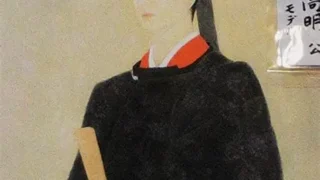
For his role in this incident, Manchika was recognized for his achievements and promoted to Senior Fifth Rank, Lower Grade.
A single accusation significantly altered the court’s personnel decisions, and Manchika’s own status rose as a result.
From this point, Mitsunaka further strengthened his ties with the Fujiwara regency family.
Why Did Mitsunaka Oust Takaaki?
When discussing the Anna Incident, one should not simply conclude that “Mitsunaka disliked Takaaki.”
This event was rooted in the power struggles within the imperial court.
Minamoto no Takaaki was a Left Minister of imperial lineage, and his daughter Akiko was married to Prince Tamahira.
Prince Tamahira was the son of Emperor Reizei.
In the context of the imperial succession at the time, Takaaki’s presence held significant political weight.
Meanwhile, Mitsunaka was deepening his connections with the Northern Fujiwara, particularly the regency family.
For Mitsunaka, who he allied with in the court directly impacted his future.
The role Mitsunaka played in the Anna Incident was crucial for the later expansion of the Minamoto clan’s influence in court politics.
Mitsunaka did not rise to power through military might alone.
He wielded information, maneuvered in political situations, and built relationships with influential figures in the court.
This political acumen was a defining characteristic of Mitsunaka.
The Bandits Who Attacked Mitsunaka’s Home—A Warrior with a Bow
Mitsunaka is also remembered for a striking episode befitting a warrior.
According to stories recorded in works like the “Kojidan,” during the Tentoku era (957–961), bandits broke into Mitsunaka’s residence at night and stole valuables.
Mitsunaka himself took up a bow and shot one of the bandits, Kurahashi no Hiroshige, capturing him.
The court investigated to uncover the names of the remaining bandits.
However, the bandits attacked Mitsunaka’s residence again.
This time, they surrounded the house and even set it on fire.
According to tradition, the fire raged fiercely, reportedly spreading to over 300 houses.
Miyaji no Hiroshi, who came to the rescue, was struck down by enemy arrows.
Yet, Mitsunaka is said to have repelled the bandits.
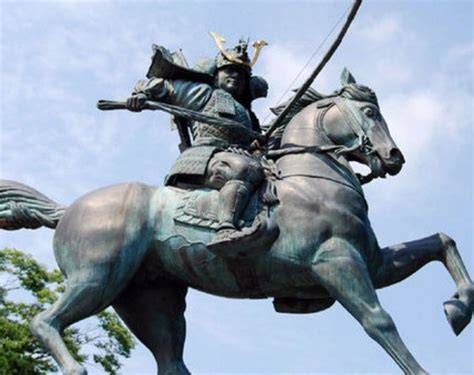
Mitsunaka was perceived by later generations as a **”warrior who took up a bow and led his retainers into battle.”**
Mitsunaka as a Heian noble and Mitsunaka as a warrior defending his residence with a bow.
These two aspects define the dual nature of Minamoto no Mitsunaka.
The Year 986—Mitsunaka Reappears in a Court Upheaval
Another pivotal moment in Mitsunaka’s life, alongside the Anna Incident, was **Kanna 2 (986)**.
In this year, an incident occurred where Emperor Kazan abdicated to become a monk.
In June of Kanna 2, Emperor Kazan went to Gankei-ji Temple to take monastic vows.
At this time, it was Mitsunaka who was aligned with the movements of Fujiwara no Kaneie and Michikane.
Mitsunaka led his retainers to guard the path that Emperor Kazan was to take.
The aim was to ensure that no one would appear to disrupt the proceedings along the way.
Even in the major political upheaval of the Emperor’s abdication, Mitsunaka played a role in providing military support.
The Anna Incident of 969.
The abdication of Emperor Kazan in 986.
When these two events are compared, Mitsunaka’s position becomes clear.
Mitsunaka was a figure involved in court politics, providing the necessary military force when required.
Mitsunaka Becomes a Monk
Even for Mitsunaka, who lived in the world of politics and military power, old age eventually came.
In Kanwa 2 (986), Mitsunaka took monastic vows.
He took the Dharma name Mankei and was known as Tada Shinpotsu.
An anecdote characteristic of Mitsunaka is associated with his ordination.
According to the ‘Konjaku Monogatari-shu’, it is said that Mitsunaka released the hawks he owned and burned his hunting nets and tools to avoid taking life.
Furthermore, many of his retainers also followed Mitsunaka into monastic life.
Tradition holds that the number was as many as 60 people.
A man who had defended his house with bow and arrow, in his later years, turned to the Buddhist path that renounces killing.
This transformation is fascinating when considering the lives of warriors in the Heian period.
Mitsunaka’s ordination certainly left a strong impression on people.
Tada-in Temple—The Base Left by Mitsunaka for His Clan
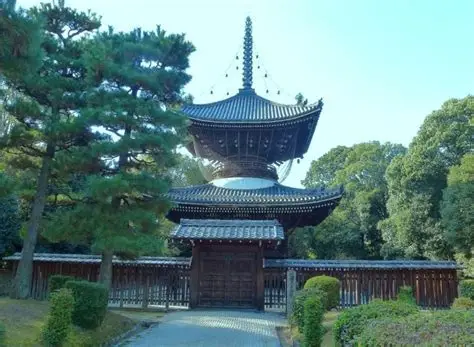
When discussing Mitsunaka and Tada, Tada-in Temple is indispensable.
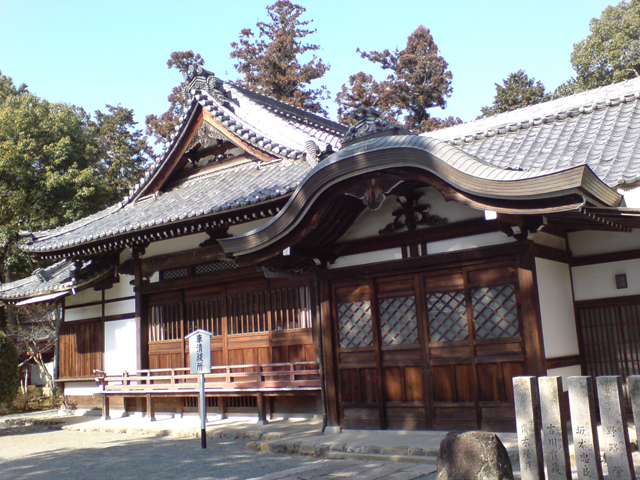
Tada-in Temple is said to have been founded in **Tenroku 1 (970)**.
It is the site that later became Tada Shrine.
A mausoleum was established here to enshrine Mitsunaka, and in later generations, it became an important site as the ancestral mausoleum of the Minamoto clan.
Mitsunaka’s establishment of Tada as a base was not simply a matter of “living in the countryside.”
While serving the Kyoto court, he maintained his power base in Settsu.
And he passed this land on to his descendants.
From Mitsunaka’s time to later generations, Tada became deeply connected with the Minamoto clan.
The present-day Tada Shrine in Kawanishi City, Hyogo Prefecture, bears witness to this history.
Mitsunaka’s Children: Yorimitsu, Yorichika, and Yorinobu
Mitsunaka’s greatest achievement was not just his own rise to prominence.
The expansion of the Minamoto clan’s influence through his children’s generation was significant.
Among Mitsunaka’s children, the most notable are:
Minamoto no Yorimitsu, Minamoto no Yorichika, and Minamoto no Yorinobu
Yorimitsu became famous for the legendary tale of slaying the demon Shuten-doji.
Yorichika is linked to the Minamoto clan’s base in Yamato.
And then there is Yorinobu.
This individual is connected to the future Kawachi Genji.
Yorinobu’s son was Minamoto no Yoriyoshi, and his son was Minamoto no Yoshiie.
By Yoshiie’s time, the Minamoto clan had strengthened its ties with the eastern warriors, becoming a formidable force in the samurai society.
This lineage continued with Minamoto no Tameyoshi, Minamoto no Yoshitomo, and Minamoto no Yoritomo.
In other words, the foundation laid during Mitsunaka’s era gradually moved to the center stage of Japanese history over several generations.
Minamoto no Yorimitsu and Minamoto no Yorinobu: Two Paths from Brothers
Following Mitsunaka’s children reveals how the Seiwa Genji branched out.
Yorimitsu forged deep connections with the regent families in Kyoto, operating close to the court society.
In contrast, Yorinobu later strengthened ties with the eastern provinces.
This distinction is crucial.
In the Heian period, the Minamoto were not initially a “clan that established a warrior government.”
They served the court, served the nobility, held provincial lands, and nurtured warrior bands there.
Through this accumulation, the Minamoto gradually developed their own military power.
Mitsunaka represents this early stage.
997: Passing at 86 Years Old
Mitsunaka passed away in **Chotoku 3 (997)**.
If born in 912, he was 86 years old.
This was an exceptionally long life for someone of the Heian period.
Mitsunaka’s life spanned from before the Taira no Masakado Rebellion, through the Fujiwara no Sumitomo Rebellion, the Anna Incident, and the abdication of Emperor Kazan.
During this time, he served as a court official, held provincial governorships, expanded his influence as a military noble, and established Settsu Tada as a key family base.
In his final years, he took the tonsure and adopted the name Mankei.
After his death, Mitsunaka was buried in Tada, where a mausoleum was built.
Afterward, Tada-in would be revered for a long time as the ancestral shrine of the Minamoto clan.
Why He Was Called the “Ancestor of the Samurai”
What is fascinating about Minamoto no Mitsunaka is that he was not just a military commander who gained fame on the battlefield.
Mitsunaka was an official of the imperial court.
He served as a provincial governor, developed land, established his power in Tada, and formed alliances with the regent family.
During the Anna Incident, he held political intelligence and exposed a rebellion.
When Emperor Kazan became a monk, he led his retainers to ensure security.
He then passed on the foundation of his house to his children.
In other words, Mitsunaka’s strength was not just in wielding a sword.
He combined court positions, land, financial power, retainers, connections with powerful nobles, and the Minamoto lineage.
It was this integration that strengthened the next generation of the Minamoto clan.
And about 30 years after Mitsunaka’s death.
In the first year of Chogen (1028), a major rebellion erupted in the eastern provinces.
This was the Taira no Tadatsune Rebellion.
The one dispatched to quell this conflict was Mitsunaka’s son, Minamoto no Yorinobu.
The foundation of the Minamoto clan that Mitsunaka built in Kyoto and Settsu expanded significantly into the eastern provinces during Yorinobu’s time.
From here, the history of the Minamoto clan becomes even more intriguing.
Minamoto no Yorinobu, Minamoto no Yoriyoshi, and Minamoto no Yoshiie.
The story of the Kawachi Genji, who would later influence the samurai society, begins.
If you want to learn more about Minamoto no Mitsunaka, this book is for you. It offers an in-depth biography, covering everything from the Anna Incident to his establishment of power in Tada, and even his son, Yorimitsu.

While feeling the connection to Minamoto no Mitsunaka in Hyogo, savoring the black soybeans of Tanba is also recommended. You can enjoy cooking these large Tanba black soybeans slowly at home.

Tanba Black Soybeans (Extra Large) / 500g【 Tomizawa Shop Official 】