August 24, 1180.
After his defeat at the Battle of Ishibashiyama, Minamoto no Yoritomo had fled deep into the forests of Sugiyama in Sagami Province.
Oba Kagechika was leading over 3,000 horsemen in pursuit. In the previous day’s battle, Yoritomo’s forces had crumbled, with many warriors either killed or scattered.
Kato Kagemitsu, Sasaki Takatsuna, and Amano Tokikage climbed the mountain paths and finally found Yoritomo.
It is said that Yoritomo was standing on a fallen tree.
Beside him was Doi Jiro Sanehira.
The warriors gathered to protect Yoritomo. However, Sanehira urged them to disperse and flee separately.
With so many followers, it would be difficult to remain hidden in the mountains.
If Yoritomo were alone, Sanehira could devise a plan to keep him hidden for ten days or even a month.
The “Azuma Kagami” records that Sanehira persuaded them in this way.
The warriors wished to stay by their lord’s side.
Sanehira insisted again.
“Now separation, later great fortune.”
Parting now would lead to future success.
To protect Yoritomo’s life and regroup to fight the enemy again, they needed to escape separately for now.
The warriors departed in tears.
Sanehira remained by Yoritomo’s side.
Four days later, on August 28, Sanehira arranged for a small boat at Manazuruzaki. The following day, on the 29th, Yoritomo crossed to Awa Province with Sanehira, where he reunited with Hojo Tokimasa and others.
Yoritomo’s resurgence in the eastern provinces was made possible by these few days of escape.
Sanehira’s efforts continued beyond this.
In Musashi Province, he handled orders confirming the lands of the vassals, and when the campaign against the Taira began, he was involved in the military and administrative affairs of Bizen, Bitchu, and Bingo.
In Bitchu Province, he reinstated officials who had lost their positions due to the Taira.
The warrior who prepared a small boat at Manazuruzaki was, four years later, managing government affairs in the provincial offices of the Chugoku region.
The Doi Clan, Descendants of the Nakamura Clan of Sagami Province
The birth year of Doi Sanehira is unknown.
He was commonly known as Doi Jiro.
His father is said to be Nakamura Shoji Munemasa, and Sanehira was his second son.
The Nakamura clan was a family descended from the Kanmu Taira lineage, establishing their influence in the western part of Sagami Province.
Nakamura Munesada was a warrior associated with areas such as Nakamura-go in Yura District, Sagami Province, and is believed to have been based in the region stretching from present-day Ninomiya Town to the eastern part of Odawara City in Kanagawa Prefecture.
The family branched out to various locations, adopting the names of their lands as their surnames.
Sanehira made his base in Doi-go, Ashigarakami District, and took on the name Doi.
His younger brother was Tsuchiya Saburo Muneto.
Muneto established his base in Tsuchiya-go, Osumi District, Sagami Province, and adopted the name Tsuchiya.
Furthermore, Nakamura Munesada’s daughter is said to have married Okazaki Yoshizane.
Okazaki Yoshizane was a warrior from the Miura clan, based in Okazaki-go, Sagami Province.
Through such kinship and marriage ties, the Nakamura clan had extensive connections in the western part of Sagami Province.
Sanehira’s son was known as Yataro Tohira.
In the fourth year of the Jisho era, both Sanehira and his son Tohira joined Yoritomo’s uprising.
Additionally, Tsuchiya Muneto and Okazaki Yoshizane also followed Yoritomo.
The support of Yoritomo’s uprising by the warriors of western Sagami Province was underpinned by these familial connections.
The Mountains and Sea Surrounding Doi-go
Doi-go, where Sanehira was based, is the area spanning present-day Yugawara Town to Manazuru Town in Kanagawa Prefecture.
To the east lies Sagami Bay, while to the west stretch the mountains of Hakone.
A road along the coast led towards Odawara, and mountain paths provided access to Hakone and Izu.
Although flat land was limited, it was a crucial hub connecting the mountains and the sea.
Sanehira lived in this land, managing his estates as a warrior.
There is a tradition that the Doi clan’s residence was located near present-day Johori in Yugawara Town.
Joganji Temple is said to have been built on the site of the Doi clan’s residence’s Buddha hall.
However, the exact location and scale of the building where Sanehira lived remain unknown.
It is difficult to reconstruct the appearance of the 12th-century residence based solely on the temple’s tradition.
On the other hand, the fact that Doi-go encompassed both mountainous and coastal areas is evident from its geography.
After Yoritomo’s defeat at Ishibashiyama, Sanehira protected his lord in the mountains, ultimately aiding his escape by sea from Manazuru Cape.
This escape likely utilized the paths of the land where Sanehira lived and his connections with the coastal inhabitants.
Connections with Yoritomo Exiled to Izu
The first year of the Eiryaku era (1160).
Minamoto no Yoritomo was exiled to Izu Province.
Minamoto no Yoshitomo, Yoritomo’s father, was defeated in the Heiji Rebellion and was killed while fleeing.
As a result, Yoritomo spent about 20 years in Izu from his youth.
It is not known when Sanehira first met Yoritomo.
The Doi region was on the route from Izu to Sagami Province, so there might have been opportunities for them to interact during Yoritomo’s exile.
However, there are no specific records of Sanehira providing food or money to Yoritomo over the years.
Their relationship is clearly documented in the “Azuma Kagami” from the preparations for the uprising in the fourth year of Jisho.
At that time, the Taira regime, led by Taira no Kiyomori, held significant power in the court.
The warriors of the eastern provinces maintained their lands by keeping ties with the Taira regime.
Following the son of Yoshitomo, who was defeated in the Heiji Rebellion, risked severing those ties.
Sanehira joined Yoritomo’s uprising.
His subsequent actions indicate that he had gained Yoritomo’s trust early on.
August 6: The Secretly Summoned Warriors
On August 6, in the fourth year of Jisho.
Yoritomo decided to attack Yamakami Kanetaka and discussed the plan with cooperating warriors.
Kanetaka was the deputy governor of Izu Province.
A deputy governor was an official who managed local administration on behalf of the provincial governor.
Kanetaka had deep ties with the Taira regime.
Yoritomo targeted Kanetaka first, but if the plan leaked, he risked being killed.
Thus, he reportedly summoned the warriors one by one in secret.
The “Azuma Kagami” lists Kudo Shigemitsu, Doi Sanehira, Okazaki Yoshizane, Usami Yushige, Amano Tokikage, Sasaki Moritsuna, and Kato Kageyasu among those summoned.
Yoritomo told each of them that he was informing them of the plan because he particularly trusted them.
The warriors were delighted and prepared for battle, as recorded.
The “Azuma Kagami” is a historical chronicle compiled after the events, and it is not certain that every word of the conversations was documented at the time.
Nonetheless, it is significant that Sanehira is noted as one of the samurai who participated in the pre-uprising discussions.
On August 17, Yoritomo launched an attack on the residence of Yamaki Kanetaka.
Kanetaka was killed, marking the beginning of Yoritomo’s uprising.
August 20: Father and Son Head to Ishibashiyama
August 20.
Yoritomo departed from Izu, heading towards Doi-go in Sagami Province.
The Miura clan, who were supposed to join forces with Yoritomo, had not yet arrived.
The “Azuma Kagami” records that Yoritomo proceeded with the samurai from Izu and Sagami.
The names of the samurai who accompanied him are listed.
Among them were Hojo Tokimasa and his son, Adachi Morinaga, Kudo Shigemitsu, Usami Sukeshige, and then the name of Doi Jiro Sanehira appears.
Immediately following is the name of Yataro Tohira.
He was Sanehira’s son.
Additionally, Tsuchiya Muneto and Okazaki Yoshizane were also present.
Samurai related to the Nakamura clan and their relatives joined Yoritomo’s forces.
Doi-go was Sanehira’s stronghold.
Yoritomo advanced to this area, aiming to unite with the samurai of Sagami Province.
However, Oba Kagechika had already gathered his forces.
Kagechika, a prominent samurai of the Taira faction, was leading the samurai of Sagami Province to defeat Yoritomo.
On August 23, Yoritomo set up camp at Ishibashiyama.
Sanehira was among his forces.
Yoritomo’s Forces Falter at Ishibashiyama
August 23.
Ishibashiyama in Sagami Province.
According to the “Azuma Kagami,” Yoritomo’s forces numbered 300 horsemen.
In contrast, Oba Kagechika commanded over 3,000 horsemen.
Additionally, behind Yoritomo’s forces in the mountains, Ito Sukechika was stationed with over 300 horsemen.
While the numbers might be exaggerated, the course of the battle indicates that Yoritomo’s side was at a significant disadvantage.
Yoritomo was waiting to join forces with the Miura clan.
However, due to heavy rain causing the river to swell, Miura Yoshizumi and his forces were unable to advance as planned.
Kagechika launched an attack before the Miura forces could arrive.
The battle continued into the night.
Sannada Yoichi Yoshitada and others were killed in action, leading to the collapse of Yoritomo’s forces.
Yoritomo himself fled into the mountains.
Sanehira accompanied Yoritomo during his escape.
Even after his victory, Kagechika continued the pursuit.
Capturing Yoritomo himself would have risked ending the uprising that began in Izu.
For Sanehira, the priority was to help his lord evade the enemy’s search.
What Sanehira Advised at Sugiyama
August 24th.
Yoritomo was in the mountains of Sugiyama.
Kato Kagemasa, Sasaki Takatsuna, and Amano Tokikage were holding off the pursuers as they advanced, finally locating their lord.
According to the Azuma Kagami, Yoritomo was standing on a fallen tree.
Sanehira was by his side.
The warriors gathered to protect Yoritomo.
However, Sanehira was concerned about the growing number of followers.
With the enemy searching the mountains with a large force, moving in a large group would make them easier to find.
Sanehira explained that if Yoritomo were alone, he could devise a plan to hide him.
The warriors still wished to remain by Yoritomo’s side.
It is said that Yoritomo also showed signs of wanting to keep them close.
Sanehira persuaded them once more.
Parting ways now would lead to another chance to fight in the future.
The Azuma Kagami records that the warriors, hearing these words, dispersed in tears.
Later, when Iida Ieyoshi came to Yoritomo, Sanehira similarly advised him to part and escape.
Sanehira repeatedly persuaded the warriors who wished to stay by their lord’s side.
The Monk from Hakone Who Delivered Supplies
In the mountains, obtaining food was also a challenge.
The Azuma Kagami entry for August 24th notes that supplies were delivered to Yoritomo.
The person who brought them was Eijitsu, a monk from Mount Hakone.
Eijitsu was the younger brother of Gyoshitsu, the administrator of Mount Hakone.
The administrator was a monk responsible for overseeing the management of temples and shrines.
Gyoshitsu had long been associated with the Minamoto clan and was said to have performed prayers for Yoritomo.
Upon learning of Yoritomo’s defeat at Ishibashiyama, Gyoshitsu sent his brother Eijitsu with supplies into the mountains.
On his way, Eijitsu encountered Hojo Tokimasa and inquired about Yoritomo’s whereabouts.
Tokimasa informed him that Yoritomo had not escaped Kagechika’s encirclement, but Eijitsu did not believe this.
Eijitsu, along with Tokimasa, proceeded to Yoritomo and offered the supplies.
The “Azuma Kagami” records that because Yoritomo and his followers were starving, the food they received was worth a fortune.
Sanehira, pleased with Nagazane’s efforts, requested Yoritomo to appoint him as the head of Hakone Shrine once peace was restored.
Yoritomo agreed to this request.
For Yoritomo to survive, he needed not only Sanehira’s judgment but also the support of the monks of Mount Hakone.
Hiding in Nagazane’s Residence
After delivering food, Nagazane continued to assist Yoritomo in his escape.
According to the “Azuma Kagami,” Yoritomo entered Mount Hakone guided by Nagazane.
His brother Yukizane’s lodging was crowded with pilgrims and monks, making it unsuitable for hiding.
Thus, he took refuge in Nagazane’s residence.
This was to avoid being seen.
At that time, Mount Hakone was a place of worship and also a transportation route connecting Izu, Sagami, and Suruga.
Monks and pilgrims frequented the temples and shrines, and there were people familiar with the surrounding roads.
Sanehira stayed by Yoritomo’s side and collaborated with the monks of Mount Hakone.
In later times, it is said that Doi Sanehira’s wife delivered food to Yoritomo in the mountains.
The “Heike Monogatari” includes an anecdote about monks carrying food and hiding it among their belongings.
However, the “Azuma Kagami” attributes the food delivery on this day to Nagazane.
The story of the wife should be treated as a tale from later military chronicles.
The Kannon Statue Taken from His Topknot
The entry for August 24 mentions a story about Yoritomo placing a small Kannon statue in a mountain cave.
Yoritomo took out a two-inch silver Kannon statue from his topknot and enshrined it in the cave.
A topknot is a hairstyle where the hair is gathered and tied on top of the head.
When Sanehira asked why, Yoritomo replied that if his head were taken by the enemy and they found this statue, it would be a disgrace as the leader of the Genji.
The “Azuma Kagami” notes that the Kannon statue was obtained by Yoritomo’s wet nurse from Kiyomizu Temple in Kyoto during his childhood.
Yoritomo, who had long revered this statue, left it in the mountains.
This story, recorded in the “Azuma Kagami,” should be read carefully as a tradition from Yoritomo’s side.
On the other hand, the exchange between Sanehira and Yoritomo about the statue’s placement is documented.
Later, when Yoritomo established his base in Kamakura, the statue was found and returned to him.
The retreat from Ishibashiyama was a moment when Yoritomo faced imminent danger to his life.
Sanehira accompanied him during this escape and was present when the Kannon statue was placed in the cave.
The Small Boat Prepared at Manazuru Cape
August 28.
Yoritomo boarded a boat from Manazuru Cape in Doi.
This corresponds to present-day Manazuru Town in Kanagawa Prefecture.
The boat was prepared by Sanehira.
The “Azuma Kagami” records the following.
“Sanehira ordered Doi resident Sadatsune to prepare a small boat.”
It is said that Sanehira instructed Sadatsune, a resident of Doi, to ready a small boat.
There is little detailed information about who Sadatsune was.
Whether he was involved in maritime work or a retainer of Sanehira is uncertain.
However, it is recorded that he prepared the boat under Sanehira’s orders.
Manazuru Cape juts out into Sagami Bay, offering a route across the sea to the Boso Peninsula.
Sanehira was a samurai based in Doi-go.
He likely had connections with people who could arrange boats along the coast.
After his defeat at Ishibashiyama, Yoritomo had been moving through the mountains to evade pursuers.
Now, he was to cross the sea.
Yoritomo boarded the small boat, accompanied by Sanehira.
Tohira Becomes an Envoy to Masako
As they set sail, Sanehira’s son, Tohira, was given a different task.
He was to be an envoy to Hojo Masako.
Masako had taken refuge in Izu-san.
Since Yoritomo’s defeat at Ishibashiyama, she had not been fully informed of his whereabouts.
According to the “Azuma Kagami” entry for August 28, Tohira was dispatched to the lady’s quarters to report on events since their separation.
Sanehira set out to sea with Yoritomo.
Tohira headed overland to Masako.
Tohira arrived on September 2.
Masako learned from Tohira that Yoritomo had been defeated at Ishibashiyama, escaped through the mountains, and boarded a boat from Manazuru Cape.
However, Tohira himself did not know Yoritomo’s condition after the departure.
Thus, Masako could not receive confirmation that Yoritomo had safely reached Awa Province at that time.
Tohira’s task was to convey the events leading up to the departure to Masako.
Sanehira and his son went in different directions, each working for Yoritomo’s cause.
August 29, Ryoshima in Awa Province
August 29.
Yoritomo and Sanehira arrived in Awa Province.
The “Azuma Kagami” records the location as Ryoshima in Hei Kita District.
This is often identified as near present-day Ryushima in Kyonan Town, Chiba Prefecture, though there are various theories about the exact landing site.
In Awa, they were welcomed by Hojo Tokimasa and others.
The “Azuma Kagami” describes this reunion as dispelling the anxieties that had been building over several days.
After his defeat at Ishibashiyama, Yoritomo had been separated from his retainers.
Now, having crossed the sea with Sanehira, he was able to reunite with his allies.
In Awa, Yoritomo began to gather forces once more.
Soon, the Miura clan joined, along with influential warriors from the Boso region like Chiba Tsunetane and Kazusa Hirotsune.
Yoritomo advanced from Shimousa Province to Musashi Province, entering Kamakura on October 6.
After defeating Yoritomo at Ishibashiyama, Oba Kagechika intended to continue fighting for the Taira clan. However, he surrendered on October 23 and was executed on the 26th.
By the time Yoritomo returned with his forces, Sanehira was also among those around him.
Welcoming Yoritomo’s Brother at Kisegawa
October 21.
A young samurai appeared at Yoritomo’s lodging by the Kisegawa River in Suruga Province.
He requested an audience with Yoritomo.
Sanehira, along with Tsuchiya Muneto and Okazaki Yoshizane, found the young man suspicious.
They could not immediately allow the stranger to meet Yoritomo.
However, upon hearing the story, Yoritomo speculated that, given the age, it might be his brother Kurou from Oshu.
He ordered the young man to be brought in, and Sanehira summoned him.
It was Minamoto no Yoshitsune.
The Azuma Kagami records that Yoritomo and Yoshitsune met and reminisced about past events, shedding tears together.
Sanehira was a samurai who had accompanied Yoritomo since his days on the run.
At Kisegawa, he also took on the role of introducing those who appeared at Yoritomo’s lodging.
On October 18 of that year, he was also dispatched by Yoritomo to convey orders to his father, Nakamura Sohei, to repair the mansion at Matsuda in Sagami Province.
Sanehira was not just a warrior on the battlefield; he also played a role in communicating Yoritomo’s intentions to those around him.
The Pursuit of the Satake Clan at Kanesawa Castle
November 4.
Yoritomo was advancing his campaign against the Satake clan in Hitachi Province.
The Satake clan was part of the Minamoto family, but its head, Satake Takayoshi, had sided with the Taira, and there were those who refused to submit to Yoritomo.
One such person was Satake Hideyoshi.
Hideyoshi holed up in Kanesawa Castle and resisted.
According to the Azuma Kagami, Yoritomo dispatched Doi Sanehira, Tsuchiya Muneto, Shimokobe Yukihira, Wada Yoshimori, Sasaki Sadatsuna, and Moritsuna, as well as Kumagai Naozane.
The forces advanced to the base of the castle.
However, Kanesawa Castle was perched atop a high mountain and was protected by rugged terrain.
Arrows and stones rained down from the castle.
The arrows fired by the attackers from below struggled to reach the top of the castle.
The path was obstructed by large rocks, hindering the advance of both men and horses.
The attack on this day faced significant difficulties.
On the following day, the 5th, Doi Sanehira and Tsuchiya Muneto sent messengers to Minamoto no Yoritomo, reporting that capturing the castle would not be easy.
The defenders were strong, and the terrain was rugged.
They advised that a different strategy should be considered.
Subsequently, Kazusa Hirotsune persuaded a member of the Satake clan to join their side and adopted a strategy to circle around to the rear of the castle.
Hideyoshi abandoned the castle and fled.
The struggle Sanehira faced in attacking Kanesawa Castle and his report to Yoritomo is documented in the “Azuma Kagami.”
At Ishibashiyama, they used mountain paths to help Yoritomo escape, while at Kanesawa Castle, the mountainous terrain hindered their attack.
Even in the same mountainous region, the situation differed greatly between the defenders and the attackers.
Sanehira Heads to the Temples and Shrines of Musashi Province
November 14th.
Sanehira was dispatched to the temples and shrines of Musashi Province.
According to the “Azuma Kagami,” there were complaints that warriors had intruded into temple grounds and were causing disturbances.
Yoritomo ordered these actions to be halted and sent Sanehira to enforce this.
At the time, warriors from various regions of the eastern provinces were gathering under Yoritomo.
As the armies moved, conflicts sometimes arose with temples and manors.
If warriors entered temples and seized land or property, complaints would be filed by the temples.
Yoritomo needed to control the actions of those who followed him.
Sanehira’s role was to implement these orders on the ground.
On the 26th of that month, Sanehira’s name appears again in a different context.
Regarding Yamanouchi Shudo Tsunetoshi, who had shot arrows at Yoritomo at Ishibashiyama, his mother, who had been Yoritomo’s wet nurse, pleaded for his life.
Yoritomo had Sanehira bring the armor, still bearing the arrow, to her.
Sanehira took the armor from the chest and placed it before Tsunetoshi’s mother.
The arrow bore Tsunetoshi’s name.
She reportedly wept upon seeing it.
Tsunetoshi was ultimately spared.
Sanehira was present at the scene where Yoritomo’s decision was conveyed.
In Charge of Confirming Land Holdings with Hojo Tokimasa
December 14th.
The “Azuma Kagami” records that orders were issued regarding the landholdings of the warriors in Musashi Province.
It was recognized that many residents of Musashi Province should continue to exercise their traditional rights as land stewards.
The officials in charge of this were Hojo Tokimasa and Doi Sanehira.
The document was drafted by Fujiwara no Kunimichi.
The “Azuma Kagami” includes the following passage:
“Hojo-dono and Doi Jiro Sanehira as officials.”
The role of land steward involved rights related to the development and management of land.
For samurai who had lived on their land for generations, having their traditional rights recognized was of great importance.
In Musashi Province, Hatakeyama Shigetada, Kawagoe Shigeyori, and Edo Shigenaga had pledged their allegiance to Yoritomo.
These were samurai who had initially sided with the Taira during the Battle of Ishibashiyama.
Yoritomo recognized the land rights of these samurai who submitted to him and incorporated them as his vassals.
Sanehira was involved in the issuance of these orders.
It had only been about four months since Yoritomo raised his army.
At the end of the year, Sanehira, who had arranged for small boats at Manazuru Cape, was dealing with land rights in Musashi Province alongside Hojo Tokimasa.
Introducing Kajiwara Kagetoki to Yoritomo
On January 11, 1181.
Kajiwara Kagetoki appeared before Yoritomo.
During the Battle of Ishibashiyama, Kagetoki had been part of Oba Kagechika‘s forces.
He is remembered for an anecdote where, despite knowing Yoritomo’s hiding place in the mountains, he did not inform Kagechika.
According to the “Azuma Kagami,” at the end of the previous year, Sanehira had accompanied Kagetoki to Yoritomo.
Kagetoki entered Yoritomo’s service through Sanehira’s mediation.
Yoritomo is said to have valued Kagetoki’s abilities.
The “Azuma Kagami” notes that although Kagetoki was not a specialist in writing, he was skilled in the art of conversation.
Kagetoki later became involved in the work of the samurai-dokoro and the campaign against the Taira, becoming a prominent vassal of the shogunate.
It is unclear how close Sanehira and Kagetoki were before these events.
However, it is recorded that Sanehira acted as an intermediary when Kagetoki appeared before Yoritomo.
Additionally, in December of 1180, Yamamoto Yoshitsune, who had come from Omi Province, also conveyed his circumstances to Yoritomo through Sanehira.
Sanehira was involved in facilitating the introduction of new samurai to Yoritomo.
Constructing Tsurugaoka Hachiman Shrine with Oba Kageyoshi
On May 13, 1181.
In Kamakura, a plan was set in motion for the full-scale construction of Tsurugaoka Wakamiya.
The previous year, upon entering Kamakura, Yoritomo had relocated Tsurugaoka Shrine to Kobayashi Village.
However, the hastily constructed shrine building was a simple structure, using pine pillars and a thatched roof.
Thus, it was decided to refurbish the building.
The Azuma Kagami names Doi Sanehira and Oba Kageyoshi as the overseers of this construction project.
Kageyoshi was the elder brother of Oba Kagechika.
Kagechika had defeated Yoritomo at Ishibashiyama, but was later executed.
Meanwhile, Kageyoshi had aligned with Yoritomo and was entrusted with the maintenance of the Kamakura estate.
Sanehira worked alongside Kageyoshi on the construction of Tsurugaoka Shrine.
The project required timber and craftsmen.
Yoritomo was establishing Kamakura as his new stronghold by organizing the construction.
Many vassals were involved in the subsequent ridgepole-raising and shrine relocation ceremonies.
Sanehira was also responsible for the development of Kamakura’s facilities.
From protecting Yoritomo’s life in the mountains to managing vassal land rights and shrine construction.
The scope of Sanehira’s responsibilities continued to expand.
The Defeat of Yoshinaka and the Battle of Ichi-no-Tani
In the second year of Juei (1183).
Minamoto no Yoshinaka (Kiso Yoshinaka) defeated the Taira forces in the Hokuriku region and entered Kyoto.
The Taira clan retreated westward, taking Emperor Antoku and others with them.
However, Yoshinaka clashed with Emperor Go-Shirakawa and on January 20 of the following year, Juei 3 (1184), he was defeated and killed by the forces of Minamoto no Noriyori and Yoshitsune.
On February 7, in the Battle of Ichi-no-Tani, the Taira suffered a major defeat.
Sanehira is also known as a warrior who participated in the pursuit of the Taira.
The Tale of the Heike depicts a scene where Yoshitsune holds a military council with Sanehira and others before a night attack on the Taira forces at Mikusayama.
Sanehira is portrayed as a samurai captain under Yoshitsune’s command, who supported the night attack.
However, the detailed conversations during the military council and the movements of the troops are described in military tales.
We cannot directly verify the same scenes from the ‘Azuma Kagami’.
It is noted in historical dictionaries that Sanehira participated in the campaign against the Taira clan.
The specific details of his role become clear after the Battle of Ichi-no-Tani.
Yoritomo assigned important tasks to Sanehira and Kajiwara Kagetoki to consolidate control over the western provinces after the Taira retreated.
February 18, 1184: Orders to the Five Western Provinces
February 18, 1184 (Juei 3).
Yoritomo sent messengers to Kyoto with instructions regarding the security of the city.
He also ordered the protection of the five provinces of Harima, Mimasaka, Bizen, Bitchu, and Bingo.
The ‘Azuma Kagami’ records that messengers were dispatched to Kagetoki and Sanehira to oversee these five provinces.
In institutional history, it is noted that Kajiwara Kagetoki was responsible for Harima and Mimasaka, while Doi Sanehira managed Bizen, Bitchu, and Bingo.
It is often explained that Sanehira was appointed as the Chief Pursuit Officer for Bizen, Bitchu, and Bingo.
The role of Chief Pursuit Officer involved apprehending criminals and hostile forces, as well as military security duties.
This role was a precursor to the position of “shugo” in the later Kamakura shogunate.
However, the authority at this time cannot be equated entirely with the later institutionalized powers of the “shugo”.
Moreover, it does not mean that Kagetoki and Sanehira could freely manage the administration of the five provinces.
They were expected to implement Yoritomo’s orders amidst the existing rights of provincial governors, local officials, temples, and estate lords.
Even after the Taira’s defeat at Ichi-no-Tani, there were still samurai along the Seto Inland Sea who remained loyal to the Taira.
Yoritomo entrusted Sanehira and others with the military and security responsibilities in these areas.
Reinstating Officials in Bitchu Province
March 25.
The ‘Azuma Kagami’ notes that Sanehira conducted governmental affairs in Bitchu Province.
“Doi Jiro Sanehira, acting as Yoritomo’s envoy, conducted administrative duties in Bitchu Province.”
It is said that Sanehira, as Yoritomo’s envoy, handled the administration of Bitchu Province.
The entry for this day also includes specific personnel actions.
Several local officials, including Fujiwara no Sukechika, were reinstated to their former positions.
They were said to have lost their positions due to the Taira clan.
The local officials were those who handled the administrative tasks at the provincial government offices.
These offices collected records of land and taxes, managed tax collection, and produced documents.
To carry out these duties, officials familiar with local affairs were necessary.
Doi Sanehira reinstated those who had lost their positions due to the Taira’s influence.
This record provides insight into the work Sanehira undertook in the western provinces.
It was necessary not only to lead forces against enemies but also to advance governance through the provincial officials.
In Bitchu Province, far from Kamakura, Sanehira was responsible for these tasks as Yoritomo’s envoy.
Notably, the Japanese calendar date for this is Juei 3.
The era name changed to Genryaku on April 16 of the same year, so articles dated February 18 and March 25 are expressed as Juei 3.
Efforts to Consolidate Control in the Western Provinces
Although the Taira clan was defeated at Ichinotani, they still maintained influence in Yashima of Sanuki Province and the Nagato region.
In the Seto Inland Sea, they used ships to move their forces and connect with local warriors.
For the Minamoto forces to advance westward, it was crucial to secure the Sanyo Road and the coastal areas of the Seto Inland Sea.
Bizen, Bitchu, and Bingo were key locations in this effort.
Sanehira is believed to have been involved in dealing with the Taira forces and maintaining order in these regions.
However, there were existing rights and relationships in the provincial lands and estates.
While there were officials under the provincial governor, there were also estates owned by temples and nobles.
Even with Yoritomo’s forces advancing, existing land rights did not disappear overnight.
Sanehira worked within this context.
The record of reinstating Fujiwara no Sukechika and others in Bitchu Province is a concrete example of this.
In the fall of Juei 3, Minamoto no Noriyori headed west to pursue the Taira clan.
Noriyori’s forces advanced along the Sanyo Road but struggled to secure provisions and ships.
The region Sanehira managed was crucial in supporting such expeditions.
However, there is no record blaming Sanehira for Noriyori’s army’s lack of provisions.
It is also unclear how much food and how many ships Sanehira actually gathered.
Work Continued After the Battle of Dan-no-ura
March 24, Genryaku 2 (1185).
In the Battle of Dan-no-ura, the Taira clan was annihilated.
Emperor Antoku sank into the sea, and Taira no Munemori and others were captured.
Doi Sanehira is said to have been involved in the pursuit of the Taira clan and in the post-war settlement.
The “Encyclopedia Nipponica” records that he escorted the captured Taira no Munemori and others to Kyoto.
Even after the Taira forces were destroyed, issues concerning the estates and provincial offices remained.
How to handle the lands of the warriors who had followed the Taira.
Who would take on the duties of the provincial offices.
How to protect the rights of temples and estate lords.
Yoritomo’s side was required to address these issues.
Sanehira had already been involved in reinstating officials in Bitchu Province.
During the time of the Taira pursuit, Sanehira was entrusted with duties in the western provinces, engaging in both military and administrative activities.
After the fall of the Taira, when relations between Yoritomo and Yoshitsune deteriorated, there is no record of Sanehira joining Yoshitsune’s side.
Sanehira continued to serve under Yoritomo.
After Yoshitsune left Kyoto, it is recorded in historical dictionaries that Sanehira was involved in the city’s security.
The specific duration and details of his duties still require examination in historical sources.
The Oshu Expedition and Yoritomo’s Journey to Kyoto
Bunji 5 (1189).
Yoritomo led a large army to Oshu to subjugate the Northern Fujiwara clan.
In the intercalary fourth month of the same year, Yoshitsune had committed suicide at Koromogawa.
Nevertheless, Yoritomo continued his campaign against the Northern Fujiwara, attacking Fujiwara no Yasuhira and others.
Sanehira is said to have participated in this Oshu campaign.
Many of Yoritomo’s vassals who had been with him since his initial uprising joined the Oshu campaign.
It is not known in detail which unit Sanehira led or in which battles he fought.
The following year, Kenkyu 1 (1190).
Yoritomo made his way to Kyoto.
It had been 30 years since he was exiled to Izu following the Heiji Rebellion.
Yoritomo entered Kyoto with many of his vassals and established relations with the Imperial Court.
Sanehira accompanied him to Kyoto.
It is said that Sanehira participated in the ceremonies when Yoritomo was appointed to positions such as the Commander of the Right Imperial Guards.
When Minamoto no Yoritomo was defeated at Ishibashiyama, Doi Sanehira was in the mountains with pursuers closing in.
Ten years later, Yoritomo entered Kyoto, and Sanehira was among his entourage.
As Yoritomo expanded his influence, Sanehira broadened his activities from the battlefield to administrative duties in Kamakura and management in the western provinces.
In Kenkyu 2, Constructing the Imperial Stables
July 18, 1191.
According to the “Azuma Kagami,” a ridgepole-raising ceremony for the stables at the Kamakura palace took place.
The officials in charge were Doi Sanehira and Okazaki Yoshizane.
The stables were buildings for housing horses.
For samurai of the time, horses were indispensable not only in battle but also for travel and ceremonies.
Building the stables at the palace was part of enhancing Kamakura’s facilities.
Sanehira had also been responsible for the construction of Tsurugaoka Wakamiya in Jisho 5.
In 1191, he was once again entrusted with construction work in Kamakura.
This entry from July 18 is known as the last record of Sanehira’s activities in the “Azuma Kagami.”
After that, the time and place of Sanehira’s death remain unknown.
Later genealogies mention that he died on November 25, 1191.
However, other traditions suggest he was active until a later period.
There is insufficient documentation to determine a definitive date of death.
Nevertheless, it is inferred from another entry in the “Azuma Kagami” that Sanehira had passed away by Kenkyu 6 (1195).
Doi’s Widow Visits Kamakura
July 13, 1195.
The “Azuma Kagami” mentions a woman referred to as “Doi’s Widow.”
She is believed to be Sanehira’s wife.
The term “widow” refers to a woman who has become a nun after her husband’s death.
On this day, Doi’s Widow visited Kamakura, bringing sake with her.
Yoritomo enjoyed the sake she brought.
The entry was brief.
Since Sanehira’s wife was referred to as a widow at this time, it is believed that Sanehira had already passed away.
On July 18, 1191, he was active as an official overseeing the construction of the stables.
By July 13, 1195, his wife appeared as a widow.
Sanehira’s death is estimated to have occurred between these dates.
However, the date of November 25, 1191, is found in later genealogies and is not recorded in the “Azuma Kagami.”
The location of Sanehira’s death is also unknown.
Details about where his wife lived and how she managed the Doi family’s estates are also lacking.
Nevertheless, it is recorded that after Sanehira’s death, his wife presented herself before Yoritomo, bringing sake.
The relationship between the Doi family and Yoritomo continued even after Sanehira’s death.
Tohira and Numata Manor in Aki Province
Doi Tohira, the son of Sanehira, joined his father in supporting Yoritomo’s uprising.
After the defeat at the Battle of Ishibashiyama, he served as a messenger to inform Masako of the situation.
Later, Tohira became involved with the Numata Manor in Aki Province.
Numata Manor corresponds to the area around present-day Hongo Town in Mihara City, Hiroshima Prefecture.
The circumstances under which Sanehira and Tohira acquired the position of steward of this land vary according to different sources.
Historical records from Mihara City suggest that Yoritomo granted Numata Manor to Tohira, marking the beginning of the Doi family’s connection with Mihara.
On the other hand, the city’s cultural heritage preservation plan states that Sanehira became the steward of Numata Manor, and his descendants settled in the area.
It is necessary to examine, including later traditions, who first acquired the stewardship, Sanehira or Tohira.
What is certain is that the Doi clan became involved with Numata Manor in Aki Province, and their rights were passed down to their descendants.
Tohira also had connections with Hayakawa Manor in Sagami Province.
It is believed that the name of this land led to the family name of the Kobayakawa clan.
However, there are differing accounts regarding who first adopted the Kobayakawa name.
Some sources attribute it to Tohira, while the Agency for Cultural Affairs explains that the Kobayakawa name began during the time of Kagehira.
The narrative that Sanehira’s descendants expanded into Aki Province and later connected to the Kobayakawa clan must consider these genealogical issues.
Lands Inherited by the Kobayakawa Clan in Western Japan
The descendants of the Doi clan who moved into Numata Manor later established their influence in Aki Province.
In the Numata River basin, the development of fields progressed, and a hub for goods emerged near the river’s mouth.
The Kobayakawa clan became involved in the management of manors and evolved into a warrior group active along the Seto Inland Sea coast.
During the Kamakura period, the clan split between Numata and Takehara, and continued into the Muromachi period.
In the Sengoku period, Mōri Motonari’s third son, Kobayakawa Takakage, was adopted into the Kobayakawa clan.
Kobayakawa Takakage supported the Mōri clan alongside his brother Kikkawa Motoharu and later served prominently under Toyotomi Hideyoshi.
There is a span of about 400 years from Sanehira to Takakage.
During this time, branch families, inheritance of estates, marriages, and adoptions occurred.
While it cannot be said that the headship was directly passed from Sanehira to Takakage, tracing the ancestors of the Kobayakawa clan leads back to the Doi family.
The descendants of Sanehira, based in Doi-go in Sagami Province, established a new family in western Japan.
Meanwhile, the Doi clan members who remained in Sagami Province became embroiled in internal conflicts within the Kamakura shogunate.
The Wada Conflict and the Doi Clan
In the first year of Kenpō (1213).
The Wada Conflict erupted in Kamakura.
This was an incident where Wada Yoshimori, who served as the head of the Samurai-dokoro, clashed with Hōjō Yoshitoki and others.
Doi Korehira, believed to be Sanehira’s grandson, is said to have joined the Wada side.
The conflict ended in defeat for the Wada side.
Korehira was reportedly captured and executed, dealing a significant blow to the Doi clan.
However, the detailed genealogy of Munetaira and Sanehira, as well as the damages suffered by their family, rely in part on genealogies from later generations.
It had been 33 years since Sanehira aided Yoritomo at Ishibashiyama.
The political situation of the Kamakura shogunate had changed significantly.
Yoritomo had already passed away, and the Hojo clan had come to wield strong influence over the shogunate’s politics.
The descendants of the families that supported Yoritomo’s uprising sometimes lost their lands or lives due to internal conflicts within the shogunate.
The influence of the Doi clan in Sagami Province had waned.
Meanwhile, the lineage of the Kobayakawa clan, which expanded into the western provinces, continued to persist.
Joganji Temple and the Doi Clan’s Graves in Yugawara
In the present-day town of Yugawara in Kanagawa Prefecture, there is Joganji Temple.
This temple is known as the family temple of the Doi clan.
Within its grounds lies the grave site of the Doi family, with many stone towers such as gorinto, hokyointo, and multi-tiered towers standing in rows.
On November 1, 1955, it was designated as a historic site by Kanagawa Prefecture.
The cultural heritage materials of Yugawara Town convey that Joganji was built on the site of a hall that housed Buddhist images within the Doi residence.
The grave site includes stone towers from the Kamakura period, but the production periods and styles of each stone tower vary.
It is difficult to determine from contemporary records which grave belongs to Sanehira himself.
Additionally, Joganji houses statues of Sanehira and his son, Tohira.
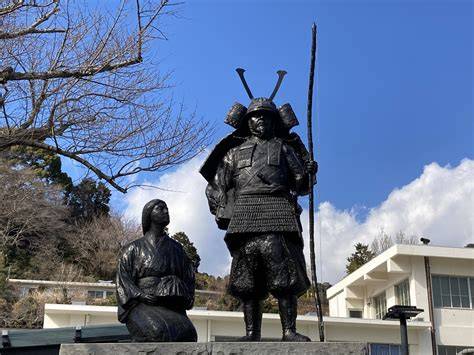
In front of Yugawara Station, there is a bronze statue depicting Sanehira and his wife.
The statue shows Sanehira in armor, with his wife seated beside him.
It is known as a statue related to the legend of the couple aiding Yoritomo during his retreat from Ishibashiyama.
While historical records differ on the specifics of the couple’s assistance, in Yugawara, Sanehira and his wife have been remembered as figures representing the history of their clan.
The Story of the Kannon Statue Left in Shitodo Cave
In the Kajiya area of Yugawara Town, there is a historic site known as the Doi Sugiyama Cave.
It is commonly referred to as “Shitodo Cave.”
This is the place where the legend says Yoritomo, defeated at Ishibashiyama, was guided by Sanehira to escape through the mountains and hide in the cave.
On November 1, 1955, it was designated as a historic site by Kanagawa Prefecture.
The Azuma Kagami records that during his flight, Yoritomo took a small Kannon statue from his topknot and placed it in the cave.
This cave has been passed down as the current Shitodo Cave.
However, it is not possible to definitively identify the cave from 1180 with any specific location today.
The cultural heritage explanation of Yugawara Town also introduces it as the place where Yoritomo is said to have hidden.
Inside and around the cave, stone Buddhas donated from the Edo period onward remain.
This site has been used not only for the legend of Yoritomo but also as a place of mountain worship since ancient times.
The fact that Sanehira protected Yoritomo in the mountains is recorded in the Azuma Kagami.
In Yugawara, the local legends connected to this escape still remain today.
A Barrel of Sake Sent to Kamakura
On July 13, 1195.
The widow of Doi Sanehira made her way to Kamakura.
According to the Azuma Kagami, she brought sake with her and approached Yoritomo.
It is said that Yoritomo enjoyed the sake.
Sanehira’s name is no longer mentioned.
The last time Sanehira appears in the Azuma Kagami is four years earlier, on July 18, 1191. It was the day he served as the overseer for the construction of the stables at the Kamakura palace.
There is no definitive record of when Sanehira passed away.
His wife became a nun and continued to visit Yoritomo even after Sanehira’s death.
On August 24, 1180, Sanehira protected Yoritomo after his defeat at Ishibashiyama.
On that day, Sanehira urged the warriors gathered around their lord to scatter and flee.
He offered to hide Yoritomo himself.
By the next day, August 29, they had crossed the sea from Manazuru Cape and arrived in Awa Province.
Four years later, Sanehira reinstated local officials in Bitchu Province.
As more years passed, Sanehira’s presence faded from the records.
July 13, 1195.
It is recorded that Yoritomo tasted the sake brought by the widow who came to Kamakura.