Episode 147
March 24, 1185, Dan-no-ura in Nagato Province.
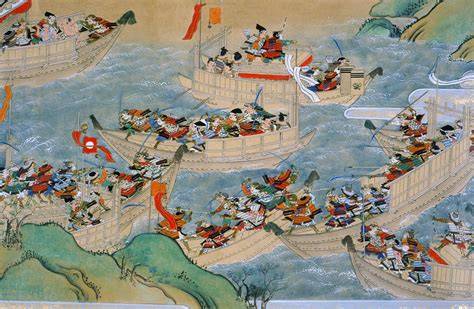
Arrows flew fiercely from the ships of both the Minamoto and Taira forces gathered in the Kanmon Straits.
Red flags fluttered on the Taira ships, while white flags adorned the Minamoto vessels.
According to the Azuma Kagami, the Minamoto had assembled over 840 ships, while the Taira had over 500.
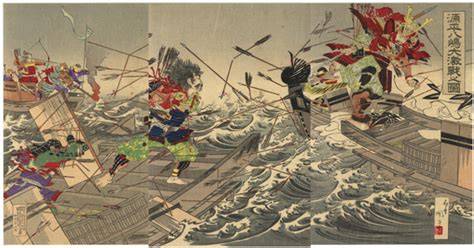
As the ships drew closer, the warriors drew their swords and spears, boarding enemy ships to fight.
Gradually, the Taira ships were overtaken by Minamoto warriors, and the sailors and helmsmen fell one by one.
Amidst the battle was the imperial ship carrying Emperor Antoku.
The emperor was just eight years old.
Born as the grandson of Taira no Kiyomori, he ascended the throne at the tender age of three.
It had been over a year and eight months since they left Kyoto. The Taira had been fighting the Minamoto while moving Emperor Antoku and the Imperial Regalia through Kyushu and the Seto Inland Sea.
However, at Dan-no-ura, the Minamoto ships closed in on the imperial vessel.
According to the eleventh volume of the Heike Monogatari, “The Former Emperor’s Drowning,” Taira no Tomomori, realizing defeat, approached the imperial ship in a small boat.
Onboard were Emperor Antoku’s mother, Kenreimon-in Tokuko, and his grandmother, Nii-no-Ama Tokiko.
Tomomori announced the defeat, then ran from bow to stern, starting to clean the ship himself.
The Minamoto warriors would soon board.
When the ladies-in-waiting asked about the battle, Tomomori reportedly laughed, saying they would soon see the rare men of the eastern provinces.
Upon hearing this, the ladies began to weep aloud.
Soon, Nii-no-Ama took Emperor Antoku in her arms and moved to the edge of the ship.
The young emperor asked his grandmother.
“Grandmother, where are you taking me?”
Where are you taking me?
Nii-no-Ama, holding back tears, bade farewell to the Ise Grand Shrine and urged him to chant a prayer for rebirth in the Pure Land of the West.
Then, she held the emperor close.
“There is a capital beneath the waves.”
There is a capital beneath the sea.
The Heike Monogatari depicts Nii-no-Ama saying this, then sinking into the sea with Emperor Antoku.
The Azuma Kagami offers a different account.
It records that it was a lady-in-waiting named Ansho who entered the water with Emperor Antoku, while Nii-no-Ama took the sacred sword into the sea.
In either account, Emperor Antoku did not return.
It was not only the eight-year-old emperor who sank beneath the waves.
Taira no Kiyomori‘s brothers, grandchildren, and the generals who supported the Taira clan’s forces fell one after another.
Munemori, the head of the Taira clan, was captured alive along with his son Kiyotsune, and one of the Imperial Regalia, the sacred sword, was lost.
The Genpei War, which had raged since 1180, reached its conclusion here at Dan-no-ura.
The Taira Clan’s Loss of Yashima, Their Final Stronghold at Hikoshima
About a month before the decisive battle at Dan-no-ura.
The Taira clan had lost their base at Yashima in Sanuki Province.
On February 19, 1185, Minamoto no Yoshitsune crossed the mountain paths from Awa Province and launched a surprise attack on Yashima.
Yoshitsune’s forces set fire to the homes in Mure and Takamatsu, and burned down the palace the Taira had built for Emperor Antoku.
Munemori and others moved Emperor Antoku onto a ship and retreated to the sea.
The Taira forces continued to resist, managing to kill Sato Tsugunobu, but they could not reclaim Yashima.
Yoshitsune continued his pursuit towards the Shido area.
Meanwhile, Kono Michinobu from Iyo Province joined the Minamoto forces with 30 warships, and Taira no Tauchisaemon also surrendered.
Having lost their base in Shikoku, the Taira retreated westward with Emperor Antoku.
Their final gathering of forces was at Hikoshima in Nagato Province.
This island, located in present-day Shimonoseki City, Yamaguchi Prefecture, lies on the western side of the Kanmon Straits.
At Hikoshima, Taira no Tomomori took charge of military operations.
Tomomori, the fourth son of Taira no Kiyomori and Munemori’s brother, had defended the Ikuta Forest area at the Battle of Ichinotani the previous year and continued to lead forces in the western provinces after the defeat.
At Ichinotani, his son Tomonaga fought to allow his father to escape, sacrificing his life in the process.
Tomomori continued to support the Taira forces, preparing for the final showdown.
The surviving generals of the Taira clan gathered at Hikoshima.
In addition to Munemori and Tomomori, Kiyomori’s brothers Taira no Norimori and Taira no Tsunemori, as well as Taira no Shigemori‘s sons, Koremori and Arimori, were also present.
Meanwhile, maritime forces from Kyushu, such as the Yamaga clan from Chikuzen Province and the Matsuura clan from Hizen Province, also aligned with the Taira.
Even after being driven from Yashima, the Taira still had the strength to mobilize ships.
Noriyori Approaches from Kyushu, Yoshitsune Advances on Honshu
It wasn’t just Yoshitsune’s forces that were closing in on the Taira.
His brother, Minamoto no Noriyori, was also leading troops in the western provinces.
In September 1184, Noriyori set out for the western provinces under Yoritomo’s orders.
He advanced along the Sanyo Road and defeated the Taira forces at Fujito in Bizen Province, but by the time he approached Nagato Province, he was struggling with a shortage of provisions and ships.
There were not enough ships to cross to Kyushu, and some warriors even expressed a desire to return to the eastern provinces due to the prolonged campaign.
At this point, Usuki Koretaka and Ogata Koreie from Bungo Province provided warships.
According to the Azuma Kagami, there were 82 ships.
Noriyori’s forces managed to cross to Kyushu and on February 1, 1185, they fought against Taira forces led by Harada Tanenao at Ashiyoura.
Ashiyoura corresponds to present-day Ashiya Town in Onga District, Fukuoka Prefecture.
Noriyori’s forces attacked Taira warriors in northern Kyushu, putting pressure on reinforcements and escape routes from Kyushu.
Meanwhile, Yoshitsune, after capturing Yashima, was also heading towards Nagato Province.
The Heike Monogatari records that Yoshitsune crossed to Suo Province and joined forces with Noriyori’s troops.
Although the details of their joining are unclear, the Genji forces were advancing on the Taira from both the Honshu and Kyushu sides.
The Taira, based on Hikoshima, had to be wary of the Genji forces even if they retreated to Kyushu.
Kumano Betto Tanzo Joins the Genji
Kumano forces from Kii Province also joined Yoshitsune.
The Heike Monogatari tells an anecdote about Kumano Betto Tanzo deciding whether to side with the Genji or the Taira.
Tanzo had long been favored by the Taira.
Thus, he could not easily join the Genji.
Tanzo performed a kagura dance at the new Kumano in Tanabe and prayed to the Kumano Gongen.
It is said that he received a divine message to follow the white flag.
Still uncertain, Tanzo prepared seven white roosters and seven red roosters and had them fight before the deity.
White represented the Genji.
Red represented the Taira.
According to the Heike Monogatari, not a single red rooster won; all were defeated by the white roosters.
Seeing this result, Tanzo decided to join the Genji.
He gathered his clan and reportedly set out for Dan-no-ura with over 200 ships carrying more than 2,000 men.
However, the Kumano forces had shown anti-Taira tendencies since Yoritomo’s uprising, making it difficult to explain their allegiance solely by the rooster fight.
The Heike Monogatari ties Tanzo’s decision to join the Genji to the divine will of the Kumano Gongen.
Regarding Kono Michinobu of Iyo Province, the Heike Monogatari states that he joined the Genji with 150 ships.
At the Yashima stage, the Azuma Kagami records Kono Michinobu’s fleet as 30 ships, indicating a discrepancy in numbers.
Nevertheless, Yoshitsune’s acquisition of naval forces from Kumano and Iyo was a significant aid in his advance towards Dan-no-ura.
Yamaga Hidechika and the Matsuura Clan: Vanguard of the Taira Fleet
The Taira fleet was supported by Yamaga Hidechika and the Matsuura clan.
Yamaga Hidechika was a samurai based in Yamaga, Ongagun, Chikuzen Province.
This area corresponds to present-day Ashiya Town in Onga District, Fukuoka Prefecture.
The Yamaga clan was a powerful samurai group active from the mouth of the Onga River to the Hibikinada Sea, involved in maritime traffic in northern Kyushu.
The “Azuma Kagami” records that Hidechika commanded the Taira fleet.
The Matsuura clan from Hizen Province also followed the Taira.
The Matsuura clan was a group of samurai with influence from northern Saga Prefecture to northern Nagasaki Prefecture, involved in maritime transport and coastal control.
Even as the Taira retreated to Nagato Province, these maritime forces from Kyushu participated in the battles.
The “Tale of the Heike” depicts Yamaga Hidechika commanding over 500 ships, the Matsuura clan over 300 ships, and the Taira family over 200 ships.
This totals over 1,000 ships.
On the other hand, the “Azuma Kagami” records the Taira fleet as having over 500 ships.
The exact number of ships gathered is unknown.
However, multiple records convey that the Yamaga clan and the Matsuura clan were integral to the Taira’s naval strength.
March 22: Yoshitsune’s Fleet Sets Sail
March 22, 1185.
The “Azuma Kagami” notes that Yoshitsune prepared dozens of warships and set sail for Dan-no-ura.
At this time, Miura no Suke Yoshizumi joined Yoshitsune.
Yoshizumi was the head of the Miura clan in Sagami Province and a prominent samurai loyal to Yoritomo.
Yoshitsune ordered Yoshizumi, familiar with the terrain of Moji Seki, to lead the way.
Yoshizumi advanced to a point about 3.3 kilometers from the Taira camp.
Upon learning of this movement, the Taira also dispatched ships from Hikoshima.
They passed Akama Seki and moved towards Tanoura, as recorded.
Thirty cho is approximately 3.3 kilometers.
At this stage, the Genji and Taira forces were already in close proximity.
Two days later, on March 24, the two forces would confront each other at sea off Dan-no-ura in Akama Seki, Nagato Province.
840 Genji Ships, 500 Taira Ships
According to the “Azuma Kagami” entry for March 24, 1185, the Genji fleet consisted of over 840 ships.
In contrast, the Taira fleet had over 500 ships.
The Taira divided their fleet into three groups, with Yamaga Hidechika and the Matsuura clan at the forefront.
Meanwhile, the “Tale of the Heike” variant text states there were over 3,000 Genji ships and over 1,000 Taira ships.
Other military chronicles report different numbers, making it difficult to determine the actual scale.
At the time, military ships included those equipped with shields for transport, carrying samurai.
The sizes varied, and so did the number of people each could carry.
Besides samurai, ships required rowers and helmsmen.
To mobilize a fleet of hundreds of ships, the cooperation of those involved in maritime transport was essential.
The “Azuma Kagami” records that on the day of the decisive battle, the two fleets faced each other at a distance of about three chō.
Three chō is approximately 330 meters.
On the other hand, “The Tale of the Heike” describes the distance between the two forces as more than thirty chō.
Was this the position of the fleets before the battle began, or the distance when the fighting started?
Including these differences in records, the exact positioning remains unclear.
The fleets gathered in the Kanmon Straits were finally ready for the decisive battle.
The Tides of the Kanmon Straits
Dan-no-ura corresponds to the eastern part of present-day Shimonoseki City in Yamaguchi Prefecture.
The opposite shore is Moji in Buzen Province.
This is now Moji Ward in Kitakyushu City, Fukuoka Prefecture.
The Kanmon Straits, located between Honshu and Kyushu, connect the Seto Inland Sea and the Hibiki Sea.
In particular, the narrow sea area known as Hayatomo Seto experiences rapid tidal currents.
The tides flow east and west with the ebb and flow, and for those navigating the ships, the direction and speed of the currents were crucial.
However, the entire strait does not flow at the same speed.
The tidal conditions differ between the narrow Hayatomo Seto and the wider areas to its east and west.
“The Tale of the Heike” depicts the Taira fleet advancing with the tide, while the Minamoto fleet was pushed back against it.
From this account, a theory emerged in later generations that the reversal of the tides determined the outcome of the battle.
However, research continues today on what the actual tidal conditions were at Dan-no-ura and how much they influenced the battle.
The Conflict Over the Vanguard Between Yoshitsune and Kajiwara Kagetoki
“The Tale of the Heike” recounts a fierce dispute between Yoshitsune and Kajiwara Kagetoki before the battle began.
Kagetoki was a prominent warrior serving Yoritomo.
On this day, Kagetoki volunteered to lead the Minamoto vanguard.
However, Yoshitsune replied that he would take the vanguard himself.
Kagetoki advised that a general should not personally advance to the front lines.
In response, Yoshitsune is said to have answered that the general of the Minamoto was his brother Yoritomo, and he was merely one of the warriors fighting under his command.
Kagetoki criticized Yoshitsune for lacking the qualities to lead others.
Yoshitsune retorted fiercely, and eventually, both reached for their sword hilts.
Kagetoki’s sons gathered around their father, while Yoshitsune’s retainers surrounded Kagetoki.
At that point, Miura Yoshiaki and Doi Sanehira intervened to stop the two, as depicted in “The Tale of the Heike.”
If allies clashed in front of the enemy, it would only bring joy to the Taira side.
Although the details of this argument come from war tales, after the victory at Dan-no-ura, Kagetoki reported Yoshitsune’s actions to Yoritomo in a critical light.
The discord between the two would later influence the events surrounding Yoshitsune after the war.
The Last Words of Taira no Tomomori
On the Taira side as well, the warriors were preparing for battle.
According to the ‘Tale of the Heike’, Tomomori stood on the deck of the ship and encouraged his soldiers with a loud voice.
“Today is the last stand for our army.”
This battle would be their final one.
It is said that Tomomori declared this.
No matter how renowned a general might be, once fate is exhausted, victory cannot be achieved.
Yet, he urged them not to tarnish the name of the samurai and not to show weakness to the warriors from the eastern provinces.
Hearing these words, the Heike warriors reportedly resolved to fight to the end.
Some remarked that while the eastern warriors were strong on horseback, they were not accustomed to battles at sea.
When land warriors come to the sea, it is as if fish have climbed a tree.
The ‘Tale of the Heike’ recounts that the Heike warriors mocked the Genji in this manner.
The Heike were accompanied by warriors experienced in maritime activities, such as the Yamaga clan and the Matsuura party.
However, the Genji side also had the Kumano forces and the Kono clan joining them.
The fleets of both sides drew near, and the war cries echoed across the Kanmon Straits.
Yamaga Hidefusa’s Five Hundred Arrows
The ‘Tale of the Heike’ depicts Yamaga Hidefusa launching a fierce attack at the start of the battle.
Hidefusa was said to be one of the finest archers in Kyushu.
He selected 500 skilled archers, albeit not as skilled as himself, and positioned them at the bow and stern of the ships.
It is said that they released their arrows all at once.
Five hundred arrows flew towards the Genji ships.
The Genji warriors defended themselves with shields and armor, but the Heike’s barrage was intense.
Yoshitsune is also depicted as fighting at the forefront.
Despite the Genji having a larger number of ships, they struggled against the concentrated volleys from the Heike.
The ‘Tale of the Heike’ narrates that at this stage, the Heike gained the upper hand, and victory cries rose from the ships.
Nevertheless, the Genji continued their assault.
Kajiwara Kagetoki reportedly hooked enemy ships near the shore and boarded them with his son and retainers.
On the ships, swords and long-handled weapons were wielded, and the battle turned into a chaotic melee.
The combat shifted from archery to close quarters.
The warriors of both sides began to vie for control of each other’s ships.
Wada Yoshimori and Nii Kishi Shiro Chikayoshi
In the eleventh volume of the ‘Tale of the Heike’, “Distant Arrows”, there is a scene where the warriors of both sides compete in archery skills.
On the Genji side, Wada Kotaro Yoshimori rode on horseback along the shore and shot arrows at the Heike offshore.
Wada Yoshimori was a member of the Miura clan from Sagami Province and had fought for the Genji since Yoritomo’s uprising.
The ‘Tale of the Heike’ states that Yoshimori’s arrows reached as far as three chō (approximately 327 meters).
His arrows bore his name.
The Heike picked up these arrows and sought someone who could shoot them back.
Called upon was Nii Kishi Shiro Chikayoshi from Iyo Province.
Shinsei caught the arrow shot by Yoshimori and fired it back towards the Genji forces.
It is said that the arrow reached the coast and struck a Miura clan warrior standing behind Yoshimori.
Seeing this, the Genji warriors mocked Yoshimori, who, in anger, boarded a small boat and charged towards the Taira forces.
Additionally, a large arrow was shot from the Taira side towards Yoshitsune’s ship.
The arrow bore the name of Nii Kiroshi Shinsei.
Yoshitsune sought someone who could return the arrow.
The one recommended was Asari Yoichi of the Kai Genji.
This was a different warrior from Nasu no Yoichi, who shot down the fan at Yashima.
Asari Yoichi took up his bow and is said to have shot an arrow towards the Taira forces.
Such exchanges of long-range arrows are anecdotes preserved in the ‘Heike Monogatari,’ and it is difficult to verify the exact range or individual achievements.
However, in battles at sea, archery attacks continued until the ships closed in on each other.
Did the Taira Lose Due to the Reversal of the Tide?
In the Battle of Dan-no-ura, it is widely known that the tide reversed midway, leading to a Genji victory.
Initially, the Taira forces gained the upper hand by riding the tide flowing from west to east, pushing back the Genji ships.
However, in the afternoon, the tide reversed, and the Genji launched a swift counterattack.
This theory was popularized by historian Kuroita Katsumi.
Kuroita estimated the tidal currents of the time, suggesting that the Taira had the advantage in the morning by riding the tide, but as it changed in the afternoon, the Genji gained the upper hand.
However, subsequent research has presented different views.
Historian Hishinuma Kazunori, based on Shizuo Nakamoto’s tidal estimates, points out that the tide during the height of the battle was likely a gentle eastward flow of about one knot.
By around 4 PM, it had become a westward flow of about one knot.
One knot is approximately 1.85 kilometers per hour.
This differs from the dramatic reversal of tidal currents assumed in Kuroita’s theory.
Research in maritime and naval history also questions explaining the outcome solely by changes in tidal currents.
The ‘Heike Monogatari’ describes Taira ships riding the tide and Genji ships being pushed back by it.
However, it does not detail the process by which the Genji achieved victory the moment the tide turned.
Additionally, the exact location where the two forces fought is not known.
The tidal currents likely affected the movement of the ships.
Nevertheless, to understand the outcome of the Battle of Dan-no-ura, one must also consider the number of ships, the difference in naval strength, the defection of Taira warriors, and the movements of the fleets during the battle.
The Battle Timing as Told by ‘Gyokuyou’
Even regarding the timing of the battle, the records in historical sources do not agree.
The ‘Azuma Kagami’ entry for March 24, Genryaku 2, states that the Taira were defeated by the hour of the horse.
The hour of the horse corresponds roughly to the period from 11 a.m. to 1 p.m. today.
Meanwhile, in the diary of Kujō Kanezane, ‘Gyokuyō,’ it is recorded that the battle lasted from around noon until about 4 p.m.
This account is believed to be based on the victory report conveyed by Minamoto no Yoshitsune to Emperor Go-Shirakawa.
Kinenuma Kazunori places great importance on the records of ‘Gyokuyō’ when considering the timing of the battle.
In that case, the battle would have lasted approximately four hours.
However, this does not match the time of the Taira’s defeat as recorded in the ‘Azuma Kagami.’
The ‘Tale of the Heike’ also describes an exchange of arrows at the hour of the rabbit, suggesting a depiction of combat starting even earlier.
At what time and in which area of the Kanmon Straits did the two forces clash?
Unless this is clarified, the impact of the tidal currents cannot be accurately assessed.
The Defection of Awa Minbu Shigenō
In the ‘Tale of the Heike,’ Awa Minbu Shigenō is introduced as a figure involved in the Taira’s defeat.
Also known as Taguchi Naruyoshi, he was a prominent warrior from Awa Province.
Shigenō served the Taira for a long time, leading warriors from Shikoku.
However, before the Battle of Dan-no-ura, Taira no Tomomori reportedly suspected Shigenō’s demeanor.
Tomomori went to Munemori and advised that Shigenō should be executed.
It is said that Munemori replied that he could not execute someone who had been loyal without concrete evidence.
Shigenō was summoned and asked to command the warriors from Shikoku to fight well.
Shigenō agreed and withdrew.
Watching him leave, Tomomori reportedly remained unconvinced.
And when the battle began, the ‘Tale of the Heike’ describes Shigenō defecting to the Minamoto side.
The victory report in the ‘Azuma Kagami’ entry for April 11 lists Minbu Dayu Naruyoshi as one of the captives.
The exact circumstances of when Shigenō defected from the Taira remain unclear.
However, after the defeat at Yashima, some warriors from Shikoku began to surrender to the Minamoto.
The forces that the Taira could command until the end were gradually diminishing.
The Taira’s Strategy Using Chinese Ships
The ‘Tale of the Heike’ recounts that the Taira’s strategy was revealed to the Minamoto due to Shigenō’s betrayal.
The Taira had placed ordinary soldiers on conspicuous Chinese ships, while important figures were moved to other vessels.
Chinese ships refer to large vessels used for trade with China and other purposes.
Since the time of Kiyomori, the Taira had been deeply involved in trade with the Song dynasty, focusing on maritime transport.
The ‘Tale of the Heike’ notes that such ships were included in their fleet at Dan-no-ura.
The Taira’s plan was for the Minamoto to mistake the Chinese ships for those carrying important figures and attack, only to be surrounded.
However, because Shigenō revealed this plan, the Minamoto avoided the Chinese ships and attacked the vessels carrying the Taira clan.
The detailed progression of this strategy relies heavily on the accounts of war tales.
Nevertheless, for the Taira, who carried Emperor Antoku and the Imperial Regalia, protecting the imperial ship was one of their most crucial duties.
As the battle progressed, the Genji ships penetrated deeply into the Heike fleet.
Enemies closed in on the ships carrying the clan’s warriors.
The Helmsmen and Rowers Fall
In the “Tale of the Heike,” Volume Eleven, “The Former Emperor’s Drowning,” it describes how the Heike ships became immobilized one after another.
The Genji warriors boarded the Heike ships.
The rowers and helmsmen were shot or cut down, it is said.
With no one to steer, the ships could no longer change direction.
It is reported that the injured and dead lay in the ship’s hold.
From this scene, the story spread that Yoshitsune’s order to target the rowers and helmsmen was a key to victory.
Once those who maneuvered the ships fell, the warriors left could not advance freely.
However, there is no definitive record that Yoshitsune planned to focus attacks on the rowers before the battle began.
Maritime historian Kanesashi Shozo questions the explanation that attacking enemy rowers was a special taboo in naval battles of the time.
Historian Motoki Yasuo also points out the possibility that the warriors who boarded the enemy ships killed or wounded the rowers and helmsmen in close combat.
The “Tale of the Heike” depicts a scene where Genji warriors board enemy ships and even take down those involved in steering.
The Heike lost control of their ships and their escape routes narrowed.
The Genji warriors were closing in on the imperial barge of Emperor Antoku.
Taira no Tomomori Heads to the Imperial Barge
Realizing defeat, Taira no Tomomori headed to Emperor Antoku’s barge in a small boat.
According to the “Tale of the Heike,” upon boarding the ship, Tomomori spoke to the court ladies.
“The world has come to this,” he said.
It was a statement of resignation.
He further urged them to discard anything unsightly into the sea.
It is said that Tomomori himself began cleaning from the bow to the stern.
The court ladies asked about the state of the battle.
Tomomori replied that they would soon see the rare men of the eastern provinces, and reportedly laughed aloud.
The court ladies, hearing his words, cried out in despair.
Tomomori was the commander who had led the Heike forces.
At Ichi-no-Tani, he lost his son Tomonaga, and at Yashima, he suffered the loss of the imperial palace to Yoshitsune’s attack.
It was this Tomomori who declared defeat on the imperial barge.
Emperor Antoku’s mother, Tokuko, and grandmother, Tokiko, were on board.
Emperor Antoku at Eight Years Old
Emperor Antoku was born in the second year of Jisho (1178).
His father was Emperor Takakura.
His mother was Tokuko, the daughter of Taira no Kiyomori.
In the fourth year of Jisho (1180), after Emperor Takakura abdicated, Prince Tokihito ascended to the throne.
He was only three years old by traditional counting.
Subsequently, battles against the Taira clan erupted across the country, and the following year, his grandfather Kiyomori also passed away.
In the second year of Juei (1183), as Minamoto no Yoshinaka’s forces approached Kyoto, the Taira clan fled the capital, taking Emperor Antoku and the Imperial Regalia with them.
In August of the same year, Emperor Go-Toba ascended the throne in Kyoto.
This resulted in a dual court situation, with the Taira supporting Emperor Antoku and the Kyoto court centered around Retired Emperor Go-Shirakawa and Emperor Go-Toba.
The Taira clan moved through Kyushu and the Seto Inland Sea, continuing to protect Emperor Antoku.
They established a temporary palace at Yashima, but it was burned down in a surprise attack by Yoshitsune, forcing them back to a life at sea.
At Dan-no-ura, Emperor Antoku found himself with no escape.
Nii-no-Ama Holds Emperor Antoku
The “Tale of the Heike” vividly depicts the scene where Nii-no-Ama lifts Emperor Antoku.
Nii-no-Ama was Taira no Tokiko.
She was Kiyomori’s wife, Tokuko’s mother, and Emperor Antoku’s grandmother.
It is said that Tokiko donned a dull-colored robe over her head, tucked the Sacred Jewel under her arm, and wore the Sacred Sword at her waist.
Then she lifted Emperor Antoku.
“Where are you taking me, grandmother?”
The emperor reportedly asked.
Tokiko, holding back tears, first bade farewell to the Grand Shrine of Ise to the east, then encouraged him to chant a Buddhist prayer for rebirth in the Western Pure Land.
Emperor Antoku joined his small hands in prayer and bowed to the east.
He then turned west and chanted the prayer.
Tokiko embraced him tightly.
“Even beneath the waves, there is a capital,”
and with that, she entered the sea, according to the “Tale of the Heike.”
The depiction of Emperor Antoku’s end in the “Tale of the Heike” became widely known as a symbol of the Taira clan’s downfall.
However, the “Azuma Kagami,” a chronicle from the same period, presents a different account.
The Lady-in-Waiting Who Held Emperor Antoku
According to the “Azuma Kagami,” entry for March 24, Genryaku 2, it was the lady-in-waiting Ansho-kyo, not Nii-no-Ama, who entered the sea carrying the Sacred Sword and holding Emperor Antoku.
Ansho-kyo was a lady-in-waiting serving Emperor Antoku.
The chronicle notes that Ansho-kyo was rescued from the sea and survived.
However, Emperor Antoku did not return.
This account also appears in the entry for April 11.
In a victory report sent by Yoshitsune to Yoritomo, it is recorded that Ansho-kyo, though she entered the sea with Emperor Antoku, survived.
Nii no Ama was among those who drowned themselves.
Meanwhile, in “The Tale of the Heike,” it is depicted that Nii no Ama sank into the sea while holding the emperor.
Jien’s “Gukansho” also contains a description suggesting that Nii no Ama entered the water holding the emperor.
From early on, there were differing accounts regarding the final moments of Emperor Antoku.
The historical records do not agree on who actually carried the emperor into the sea.
However, it is consistently recorded that the eight-year-old emperor lost his life at Dan-no-ura.
The Sword Lost to the Sea
Along with Emperor Antoku’s drowning, one of the Imperial Regalia, the sacred sword, was also lost.
The Imperial Regalia consists of the mirror, the sword, and the jewel.
These treasures are deeply tied to imperial succession, and the Taira clan had taken them to the western provinces along with Emperor Antoku during their flight from the capital in the second year of Juei.
At Dan-no-ura, it is recorded in the “Azuma Kagami” that Nii no Ama entered the sea with the sacred sword.
Meanwhile, the mirror and the jewel were secured by the Genji forces.
The “Azuma Kagami” recounts that when the Genji warriors boarded the imperial barge and attempted to open the chest containing the sacred treasures, they were suddenly struck blind.
Taira no Tokitada, who was present, stopped the warriors.
Tokitada was the brother of Kiyomori’s wife, Tokiko, and a relative of Emperor Antoku.
He had followed the Taira to the western provinces and was captured at Dan-no-ura.
The anecdote about the chest of sacred treasures reflects the awe that people of the time felt towards these regalia.
Even after the battle ended, the sacred sword was not found, prompting Yoshitsune to continue the search.
Kenreimon-in Tokuko’s Leap into the Sea
Emperor Antoku’s mother, Kenreimon-in Tokuko, also threw herself into the sea at Dan-no-ura.
Tokuko was born as the daughter of Kiyomori and Tokiko and became the consort of Emperor Takakura.
She gave birth to Emperor Antoku and continued to move through the western provinces with her son after the Taira left the capital.
It was this Emperor Antoku who sank into the sea.
According to “The Tale of the Heike,” Tokuko placed a heated stone and an inkstone in her robe and jumped into the sea.
It is said that she did this to weigh herself down and sink deeply.
However, Tokuko was rescued.
The “Azuma Kagami” records that Watanabe no Goro Maimu used a rake to pull Tokuko up.
Tokuko survived.
Her mother, Tokiko, and her son, Emperor Antoku, perished in the same sea.
The Taira clan’s warriors also followed suit, drowning one after another.
Amidst this, Tokuko was captured and returned to Kyoto.
The Drowning of Taira no Norimori, Tsunemori, and Others
In the wake of Emperor Antoku’s drowning, the Taira clan’s warriors also threw themselves into the sea one after another.
The victory report in the “Azuma Kagami” on April 11 lists the names of Norimori, Tsunemori, Kiyomori, Sukemori, Arimori, and Yukimori.
Taira no Norimori was the brother of Taira no Kiyomori and the father of Taira no Noritsune.
Taira no Tsunemori, also Kiyomori’s brother, was the father of Taira no Norimasa and Taira no Atsumori, who perished at the Battle of Ichinotani.
According to the “Azuma Kagami,” Tsunemori once went ashore to become a monk, but later returned to the sea and drowned himself.
Meanwhile, in the “Tale of the Heike,” it is depicted that Norimori and Tsunemori donned heavy anchors and entered the sea together.
It is said that Norimori’s sons, Taira no Tomomori and Taira no Arimori, also held hands and sank into the sea.
Tomomori was a military commander who held high rank within the family and continued to follow the Taira even after their fall from the capital.
His younger brother, Arimori, also remained with the family until the end.
At Ichinotani, many from the houses of Kiyomori’s sons, grandsons, and brothers fell in battle.
Yet those who survived continued to fight in the western provinces.
Many of them would later meet their fate at Dan-no-ura.
Taira no Noritsune Pursues Yoshitsune
In the “Tale of the Heike,” Taira no Noritsune, the governor of Noto, is portrayed as a warrior who continued to fight fiercely even after defeat was certain.
Noritsune was the son of Norimori, Kiyomori’s brother.
At Yashima, he is depicted as the warrior who shot Sato Tsugunobu, and at Dan-no-ura, he is said to have troubled the Genji forces with his powerful bow.
According to the “Tale of the Heike,” after exhausting his arrows, Noritsune took up a sword and a long spear and boarded a Genji ship.
He then began searching for Minamoto no Yoshitsune.
Seeing this, Taira no Tomomori reportedly told him that there was no point in defeating more enemy soldiers and urged him to target Yoshitsune.
It is said that Taira no Noritsune moved from ship to ship searching for Minamoto no Yoshitsune, asking if each impressive warrior he encountered was Yoshitsune.
Yoshitsune, wary of Noritsune’s movements, was careful not to approach easily.
However, Noritsune eventually boarded Yoshitsune’s ship.
As Noritsune lunged at him, Yoshitsune tucked his long sword under his arm and leaped to a nearby allied ship.
The Tale of the Heike records this distance as about two jō.
That’s approximately 6 meters.
This scene later became widely known as “Yoshitsune’s Eight-Boat Leap.”
However, in the Tale of the Heike Kakuichibon, it is depicted as Yoshitsune leaping to another ship.
The image of him leaping over eight boats in succession spread through later legends and performances.
The Last Moments of Noto no Kami Noritsune
After Yoshitsune escaped, Noritsune reportedly thought it was the end for him.
The Tale of the Heike describes Noritsune throwing his sword and long sword into the sea and removing his helmet.
He discarded the grass skirt of his armor and stood with his arms wide open.
Then, he is said to have provoked the Genji warriors to grapple with him.
At that moment, Aki Taro Sanemitsu and his brother Jiro stepped forward.
Noritsune reportedly grabbed both of them under his arms and plunged into the sea.
His end has been passed down as the death of a fierce general who took his enemies with him.
However, there are discrepancies in historical records regarding Noritsune’s fate.
The Azuma Kagami contains an entry stating that Noritsune was killed in the Battle of Ichinotani the previous year.
Meanwhile, the diary Gyokuyou by Kujou Kanezane reports that Noritsune survived after Ichinotani.
The Daigoji Zatsujiki also records that Noritsune committed suicide at Dan-no-ura.
Further examination is needed to determine where Noritsune actually met his end.
The scene of him cornering Yoshitsune and sinking into the sea with enemy soldiers is how the Tale of the Heike portrays Noritsune’s last moments.
“I Have Seen All There Is to See”
Taira no Tomomori also faced his final moments.
According to the Tale of the Heike, Tomomori called for his retainer, Iga Heinaizaemon Ienaga.
Ienaga was Tomomori’s wet nurse’s child.
It is said that the two had promised to share their fate until the end.
Tomomori asked if Ienaga had forgotten that promise.
Ienaga reportedly replied that he had not forgotten.
Tomomori then said,
“I have seen all there is to see.”
And with that, he resolved to enter the sea himself.
Ienaga dressed Tomomori in two suits of armor and donned two suits himself.
The heavy armor was intended to ensure they would sink into the sea.
According to the “Tale of the Heike,” the two clasped hands and entered the water together.
Seeing this, more than twenty samurai followed them into the sea.
Tomomori had experienced the glory of the Taira clan under Kiyomori and had led troops even after their fall from the capital.
At Ichi-no-Tani, he lost his son Tomoakira, and at Yashima, he faced a sudden attack by the Minamoto.
Finally, he witnessed his clan’s defeat at Dan-no-ura.
The “Tale of the Heike” leaves Tomomori with the words, “I have seen all there is to see.”
In later depictions, Tomomori is often shown sinking into the sea with a large anchor.
However, in the Kakuichi-bon version of the “Tale of the Heike,” it is recorded that he entered the water wearing two suits of armor, hand in hand with Ienaga.
Munemori and Kiyomune Captured Alive
The head of the Taira clan, Taira no Munemori, survived the battle at Dan-no-ura.
Munemori was the third son of Kiyomori and became the central figure of the clan after his elder brother Shigemori’s death.
Following Kiyomori’s death, he acted as the political leader of the Taira, taking Emperor Antoku to the western provinces.
However, at Dan-no-ura, he was captured by the Minamoto forces.
According to the “Tale of the Heike,” Munemori threw himself into the sea, but his swimming skills prevented him from sinking.
His son Kiyomune also followed him into the water.
The two swam while keeping an eye on each other, but were eventually pulled from the water by Minamoto warriors, including Ise Saburo Yoshimori.
The “Azuma Kagami” also records that Munemori and Kiyomune were captured alive by Ise Saburo Norimori.
Though details vary, it is certain that Munemori and his son were taken prisoner.
In the “Tale of the Heike,” after Munemori was captured, his wet nurse’s son, Hida Saburo Saemon Kagekyo, attempted to rescue his lord by boarding a Minamoto ship.
Kagekyo attacked Ise Saburo Yoshimori, but was surrounded by Minamoto warriors and killed in battle.
Munemori reportedly watched these events unfold while in captivity.
With Emperor Antoku lost and many of his clan submerged in the sea, Munemori and Kiyomune survived and were sent to Kyoto.
Minamoto no Yoshitsune’s Victory Report
After the Battle of Dan-no-ura, Yoshitsune gathered the prisoners and began the search for the lost imperial regalia.
On April 11, the victory report reached Kamakura.
According to the “Azuma Kagami,” Yoritomo was attending a ceremony related to the construction of the Southern Hall that day.
It was then that a messenger arrived from the western provinces.
The report by Yoshitsune was prepared by Nakahara no Nobutaka.
The report detailed the battle between over 840 Minamoto ships and more than 500 Taira ships, the drowning of Emperor Antoku, and the many Taira clan members who entered the sea.
The names of those taken prisoner were also listed.
These included Munemori, Kiyomune, Taira no Tokitada, Minbu no Daibu Naruyoshi, Minamoto no Suketsune, and Settsu no Morisumi.
Additionally, women such as Kenreimon-in Tokuko and Anzai no Tsubone were reported to have survived.
The mirror and the jewel were secured.
However, the sacred sword remained lost.
Yoshitsune reported that the search would continue.
Upon hearing this report, Yoritomo is said to have re-rolled a letter himself and sat facing the direction of Tsurugaoka Hachimangu Shrine.
The “Azuma Kagami” records that Yoritomo was unable to speak.
Afterwards, Yoritomo summoned a messenger to inquire in detail about the course of the battle.
The Heike Clan Returned to the Capital as Prisoners
Munemori and others captured at Dan-no-ura were escorted by the Genji forces back to Kyoto.
More than a year and eight months had passed since the Heike left the capital in the second year of Juei.
Previously, Munemori and his group had departed with Emperor Antoku and the Three Sacred Treasures, heading west.
Subsequently, they wandered through Kyushu and the Seto Inland Sea, retreating from Yashima to Hikoshima.
Upon returning to Kyoto, Munemori was now a prisoner of the Genji.
The “Heike Monogatari” depicts Munemori and Tokitada passing through the streets of the capital.
It had only been a short time since the Heike held high office and wielded great power at the court.
However, the Heike residences were lost, and many of their clan did not return.
Munemori was later sent to Kamakura with his son Kiyomune.
After meeting with Yoritomo, the father and son were to head back toward Kyoto, but in June of the same year, they were executed at Shinohara in Omi Province.
Taira no Shigehira, who had been captured alive at Ichi-no-Tani, was also executed in the same year.
Shigehira was the commander during the burning of the southern capital in the fourth year of Jisho.
As a result, there were strong calls from the temples of Nanto, such as Kofuku-ji and Todai-ji, for severe punishment.
The surviving Heike warriors from Dan-no-ura faced a harsh fate.
The Issues Left by the Three Sacred Treasures
The sacred sword lost at Dan-no-ura was never found.
During their flight from the capital in the second year of Juei, the Heike had taken the Three Sacred Treasures with Emperor Antoku.
Meanwhile, in Kyoto, Emperor Go-Toba ascended the throne.
This enthronement occurred without the complete set of the Three Sacred Treasures.
With the Genji’s victory at Dan-no-ura, the mirror and the jewel were returned to Kyoto.
However, the sacred sword remained lost at sea.
This raised issues at the court regarding how to conduct the imperial succession ceremonies without the sword.
The “Heike Monogatari,” volume eleven, “The Sword,” details the court’s discussions about the loss of the sacred sword.
Search efforts to recover the sword were undertaken, but the sword lost at Dan-no-ura was never found.
Among the sacred treasures that Taira no Kiyomori’s family took with them when they fled the capital, one was left at the bottom of the sea.
This issue was passed on to the imperial court after the fall of the Taira clan.
The Trials of Minamoto no Yoshitsune Beginning at Dan-no-ura
Even for Minamoto no Yoshitsune, who had defeated the Taira clan, new challenges awaited after the war.
His relationship with his brother, Minamoto no Yoritomo, began to deteriorate.
The “Azuma Kagami” records that after the Battle of Dan-no-ura, Kajiwara Kagetoki sent a critical report to Yoritomo about Yoshitsune’s actions.
Kagetoki claimed that Yoshitsune considered the military achievements to be solely his own and did not listen to the opinions of other warriors.
Additionally, the issue of Yoshitsune accepting a court position without Yoritomo’s permission also affected their relationship.
Yoshitsune headed towards Kamakura with Taira no Munemori and others.
However, he was not allowed to enter Kamakura and was detained at Koshigoe in Sagami Province.
The letter Yoshitsune is said to have sent to Oe no Hiromoto is known as the “Koshigoe Letter.”
Although there is debate about its creation and transmission, records show that Yoshitsune fell out of favor with Yoritomo and was not permitted to enter Kamakura.
Subsequently, Yoshitsune returned to Kyoto, but his conflict with Yoritomo deepened further.
Eventually, Yoshitsune became a fugitive, entering a life on the run.
This occurred just a few months after he had destroyed the Taira clan at Dan-no-ura.
Kenreimon-in Tokuko’s Retreat to Ohara
Kenreimon-in Tokuko, who was rescued from the sea at Dan-no-ura, returned to Kyoto and took religious vows.
She then entered Jakko-in in Ohara.
Jakko-in is a temple located in present-day Ohara, Sakyo-ku, Kyoto City.
There, Tokuko lived while praying for the repose of Emperor Antoku and the Taira clan.
The “Kanjō no Maki” of the “Tale of the Heike” depicts Emperor Go-Shirakawa visiting Ohara and meeting Tokuko in the “Ohara Imperial Visit.”
It is said that Tokuko recounted the days she spent in the imperial court, the fall of the Taira clan, and the events up to Dan-no-ura.
The detailed conversation is depicted in the war chronicles.
Born as Kiyomori’s daughter, Tokuko became the consort of Emperor Takakura and gave birth to Emperor Antoku.
Even after the fall of the capital, she followed her clan and ultimately threw herself into the sea at Dan-no-ura.
However, Tokuko herself was saved and returned to Kyoto.
Neither her son nor her mother, nor many of the clan’s warriors, returned.
Tokuko continued to pray for the repose of those who had passed away in the mountain village of Ohara.
Akama Shrine and Emperor Antoku’s Mausoleum
In present-day Amida Temple Town, Shimonoseki City, Yamaguchi Prefecture, stands Akama Shrine.
This shrine is dedicated to Emperor Antoku, who perished at Dan-no-ura.
There was once a temple called Amida Temple at this location.
It was long revered as a temple for mourning Emperor Antoku, and became a shrine following the separation of Shinto and Buddhism in the Meiji era.
In 1940, it was renamed Akama Shrine.
Adjacent to the shrine is Amida Temple Mausoleum, believed to be the tomb of Emperor Antoku.
Currently, the Imperial Household Agency manages it as an imperial tomb.
Additionally, within the precincts of Akama Shrine, there remains the Shichiseizuka, said to be the grave of the Taira clan.
It is known as a place that tells the tale of the Taira clan’s downfall and has been linked to the later ghost story “Hoichi the Earless.”
Regarding Emperor Antoku’s body, while the Azuma Kagami records that it was never recovered from the sea, later traditions tell of it being retrieved by a fisherman’s net.
The current tomb has been preserved through a long history of memorial services.
Heading east along the strait from Akama Shrine, you will find Mimosusogawa Park, which overlooks the historic site of the Battle of Dan-no-ura.
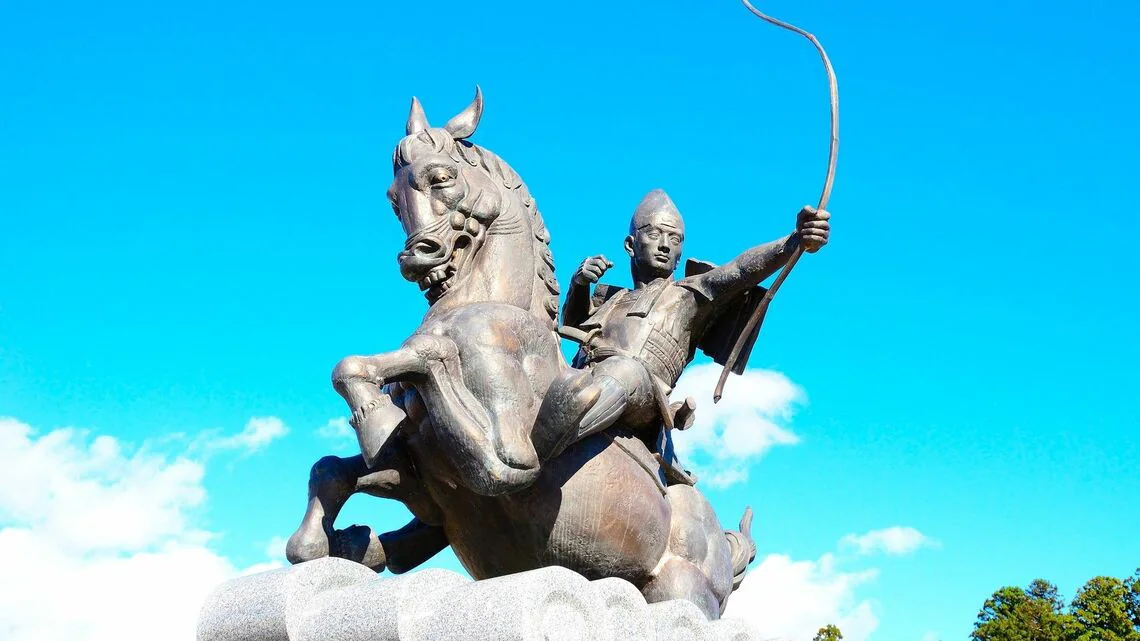
The park features statues of Minamoto no Yoshitsune and Taira no Tomomori.
Yoshitsune is depicted leaping from ship to ship.
Tomomori is shown carrying a large anchor, preparing to sink into the sea.
Both are scenes widely known from the Tale of the Heike and later legends.
In front of the park stretches the Kanmon Strait, with Kitakyushu’s Moji Ward visible on the opposite shore.
Today, the Kanmon Bridge connects the two shores, and large ships pass through the strait.
On March 24, 1185, the final battle between the Minamoto and Taira clans took place in these waters.
After the battle, many, including Emperor Antoku and the Taira clan, never returned from the sea.
At Akama Shrine, Emperor Antoku is still enshrined, and every May, the Senteisai festival is held to commemorate those who perished at Dan-no-ura.