Episode 141
February 7, 1184, Ichinotani in Settsu Province.
The Taira forces defending the Ikuta Forest were in retreat after being attacked by the Genji forces.
Their commander, Taira no Tomomori, had lost his troops and was heading towards the coast with only three horsemen.
Tomomori, a son of Taira no Kiyomori, was a prominent military leader who had supported the Taira clan’s military endeavors.
Beside him were his eldest son, Taira no Tomoakira, and a retainer, Kanemotsu Taro Yorikata.
Suddenly, about ten Genji warriors were in pursuit.
According to the “Tomoakira’s Last Stand” in the ninth volume of the “Tale of the Heike,” the pursuers carried a fan-shaped banner. They were believed to be warriors from the Kodama clan of Musashi Province.
Yorikata turned his horse and shot an arrow, bringing down the flag bearer at the front.
However, a warrior who seemed to be the leader of the pursuers advanced towards Tomomori.
His father was about to be struck down.
Tomoakira intervened between the two.
He lined up his horse with the enemy’s, grappled with him, and brought him to the ground. He pinned the opponent down and reportedly took his head.
However, as Tomoakira attempted to rise, a young retainer of the enemy attacked him.
It is said that Tomoakira was beheaded on the spot.
He was just 16 years old.
His father, Tomomori, unable to save his son, fled to the coast.
Eventually, he reached the ship where his brother Munemori was, and Tomomori pressed the sleeve of his armor to his face, shedding tears.
“Life is indeed a precious thing,” he lamented.
Had it been someone else, he might have blamed the father who abandoned his child and fled. Yet, when faced with the same situation, he could not bring himself to sacrifice his life.
The “Tale of the Heike” records that Tomomori spoke these words as he wept.
Tomoakira, born as a grandson of Taira no Kiyomori, held the position of Governor of Musashi and was a noble of the Taira clan.
There are few historical records that detail his life.
However, the 16 years of Tomoakira’s life coincided with the period when the Taira clan reached the height of its power at the imperial court, only to eventually lose the capital and retreat to the western provinces.
Born as a Grandson of Taira no Kiyomori
Taira no Tomoakira is believed to have been born in 1169, the first year of the Kaō era, as the eldest son of Taira no Tomomori.
His father, Tomomori, was born in 1152. He was the son of Taira no Kiyomori and his wife, Taira no Tokiko.
Tomomori had an elder brother, Munemori, a younger brother, Shigehira, and among his sisters was Tokuko, who later became Kenreimon-in.
For Chikazane, Kiyomori was his grandfather and Tokiko his grandmother.
By the time Chikazane was born, Kiyomori had already amassed significant power within the imperial court.
In the first year of Hogen (1156), during the Hogen Rebellion, he sided with Emperor Go-Shirakawa and defeated the forces of Emperor Sutoku.
In the first year of Heiji (1159), during the Heiji Rebellion, he also emerged victorious, defeating Minamoto no Yoshitomo and others.
Through these battles, the political standing of the Taira clan rapidly increased.
In the second year of Nin’an (1167), Kiyomori was promoted to the position of Grand Minister of State.
Kiyomori’s rise to the highest office in the court as a warrior symbolized the prosperity of the Taira clan.
Chikazane, who is believed to have been born two years later, was raised as a child of the clan that inherited the political status Kiyomori had established.
Within the Taira clan, Kiyomori’s sons and brothers, along with their children, were successively granted court ranks and occupied important positions in the imperial court.
His father, Tomomori, was also a person who had obtained official positions from a young age.
However, contemporary historical records that detail the exact date and place of Chikazane’s birth are difficult to confirm.
The “Dictionary of Japanese Biographies” states he was born in the first year of Kao, and “The Tale of the Heike” records that he was 16 years old when he died in battle at Ichi-no-Tani.
If he was 16 years old in the third year of Juei (1184), this would align with being born in the first year of Kao.
There are few specific anecdotes about Chikazane’s childhood.
It is unclear where he lived or from whom he learned academics and martial arts.
To understand Chikazane’s life, it is necessary to look at the role his father, Tomomori, played within the Taira clan.
The Path of Official and Warrior Walked by Father Taira no Tomomori
Chikazane’s father, Tomomori, was among Kiyomori’s children who obtained court positions early on.
In the first year of Heiji (1159), he was appointed to the junior fifth rank, and the following year, in the first year of Eiryaku (1160), he was appointed as Governor of Musashi.
At this time, Tomomori was nine years old.
The fact that the young son of Kiyomori received a provincial governorship demonstrates the high standing of the Taira clan at the imperial court.
Tomomori continued to rise through the ranks and eventually joined the ranks of the court nobles.
The diary of Kujō Kanezane, “Gyokuyō,” entry for December 5, 1176, contains a passage indicating that Tomomori was a particularly beloved son of Kiyomori.
Tomomori was highly regarded within the Taira family.
In 1180, when Prince Mochihito and Minamoto no Yorimasa raised an army, Tomomori joined the Taira forces sent to suppress them.
Prince Mochihito and his followers attempted to flee from Onjō-ji towards Nara, but they were defeated by the Taira forces near the Uji River.
It is said that Yorimasa took his own life at Byōdō-in.
However, anti-Taira movements continued thereafter.
In August of the same year, Minamoto no Yoritomo raised an army in Izu Province.
In Shinano Province, Minamoto no Yoshinaka (Kiso Yoshinaka) expanded his influence, and in the Hokuriku region, warriors who did not submit to the Taira began to act.
While Tomomori accumulated court titles, he also played a significant role in the battles against the Minamoto clan.
At this time, Chikashige was only twelve years old.
While his father became involved in battles across the land, there are few records of Chikashige’s own military activities.
There is no definitive evidence from historical sources that he accompanied the campaign against Minamoto no Yorimasa in 1180.
It is unclear when Chikashige began to join his father’s forces.
However, four years later at Ichinotani, he was part of the forces in the Ikuta Forest alongside his father, Tomomori.
Chikashige’s Mother, Jibukyō no Tsubone, and Tomomori’s Family
Chikashige’s mother is said to be Jibukyō no Tsubone, the wife of Taira no Tomomori.
Jibukyō no Tsubone is known as the wet nurse of Prince Morisada, later called Emperor Go-Takakura.
There is a tradition that she was the daughter of Mutō no Yorisuke, although other genealogies are also passed down.
There are records that her real name was Akiko, but further examination of historical sources is needed regarding her lineage and real name.
It is said that Jibukyō no Tsubone served around Kiyomori’s wife, Tokiko, before becoming Tomomori’s wife.
In 1179, during the third year of the Jisho era, Prince Morisada, the second son of Emperor Takakura and Fujiwara no Shokushi, was born.
Jibu no Kyo no Tsubone became the wet nurse of Prince Morisada.
The Taira clan strengthened their ties with the imperial family, and Kiyomori’s daughter, Tokuko, became the consort of Emperor Takakura.
In 1178, Tokuko gave birth to Prince Tokihito.
He would later become Emperor Antoku.
The family of Tomonaga also had deep connections with the court, as his father Tomomori held various court positions, and his mother Jibu no Kyo no Tsubone was involved in the upbringing of the prince.
However, there are no records indicating how closely Tomonaga himself interacted with Prince Morisada.
Besides Tomonaga, Tomomori’s children included Tomotada and his daughter Chūnagon no Tsubone.
There are also genealogies that mention Masamori and Chisō.
The order of birth and the mothers of these children vary across records, making it difficult to establish their family relationships definitively.
Later, Tomotada is said to have stayed in Iga Province for upbringing instead of accompanying the Taira’s retreat to the west.
On the other hand, Tomonaga is believed to have headed west with his father.
Tomonaga as Governor of Musashi
An important aspect of Tomonaga’s career was his role as Governor of Musashi.
In the ninth volume of “The Tale of the Heike,” titled “The Last Days of Tomonaga,” he is referred to as “Governor of Musashi.”
The Governor of Musashi was the chief official of Musashi Province.
Musashi Province included areas that are now part of Tokyo, Saitama Prefecture, and parts of Kanagawa Prefecture.
It was a politically and militarily significant region with many active warriors from the eastern provinces.
Tomonaga’s father, Tomomori, had also served as Governor of Musashi.
After the Heiji Rebellion, the Taira clan became deeply involved in the governance of Musashi Province as provincial governors and lords.
Tomomori was appointed Governor of Musashi in 1160.
Subsequently, other members of the Taira clan held the position, and eventually, Tomonaga also acquired the same office.
There are biographical sources that list Tomonaga as holding the rank of Senior Fifth Rank, Upper Grade, and genealogies that mention him concurrently holding the position of Left Horse Guard.
However, there are insufficient records regarding the exact dates of his appointments and promotions.
Moreover, there is no historical evidence confirming that the young Tomonaga traveled to Musashi Province to manage local administration.
In the late Heian period, it was common for appointed provincial governors to remain in Kyoto and manage provincial affairs through deputies.
While Tomonaga held the title of provincial governor, the details of his actual activities remain unclear.
Nevertheless, following in his father’s footsteps to become Governor of Musashi indicates that Tomonaga was granted status by the court as a member of the Taira clan.
The land of Musashi would also play a role in Tomonaga’s final days.
It was the warriors of the Kodama clan from Musashi Province who pursued Tomonaga at Ichinotani.
Minamoto no Yoritomo’s Uprising and Changes in Musashi Province
In August of 1180, Minamoto no Yoritomo raised an army in Izu Province.
Although Yoritomo was defeated at the Battle of Ishibashiyama, he managed to escape to Awa Province, where he rallied the samurai of the Boso Peninsula to his cause and made a comeback.
Subsequently, he advanced into Sagami Province and established Kamakura as his base, expanding his influence throughout the eastern provinces.
In Musashi Province, many warrior bands also joined Yoritomo’s side.
Musashi was home to various warrior bands, such as the Chichibu and Kodama clans, each holding power in their respective regions.
Among them, the Kodama clan was a warrior band that operated primarily around present-day Honjo City in Saitama Prefecture.
After Yoritomo’s uprising, the Kodama clan also aligned with the Minamoto and participated in battles across various regions.
Previously, the warriors of Musashi Province had served under the Taira clan as provincial governors, but now they fought against the Taira as part of the Minamoto forces.
There are no records indicating that Tomonaga had prior acquaintance with the warriors of the Kodama clan.
Additionally, there are no records of Tomonaga, who held the position of Governor of Musashi, directly commanding the local warrior bands.
Meanwhile, as Yoritomo’s influence spread in the eastern provinces, the Taira’s control gradually waned.
During the time Tomonaga claimed the title of Governor of Musashi, the Minamoto’s influence had already expanded significantly in the province.
The Death of Kiyomori and the Taira’s Military Crisis
On February 4, 1181, Taira no Kiyomori passed away.
Tomonaga was thirteen years old at the time.
After Kiyomori’s death, the central figure of the Taira clan became Munemori.
Munemori was the elder brother of Tomomori and the uncle of Tomonaga.
Tomomori, along with his younger brother Shigehira, supported Munemori, engaging in the defense of Kyoto and organizing military forces across various regions.
The “Gyokuyo” chronicles describe how the Taira clan was mobilizing troops and addressing anti-Taira forces across the country during this period.
However, in the eastern provinces, Yoritomo was solidifying his power, and in the Hokuriku region, more warriors were rallying under Yoshinaka.
In the western provinces, forces opposing Taira control were also active.
The Taira had to dispatch troops to various regions while continuing to guard the area around Kyoto.
Tomomori was a prominent military leader involved in these efforts.
On the other hand, it is unclear what kind of life Tomonaga led during this period.
Amidst the Taira’s ongoing military activities across the country, it is believed that Tomonaga eventually began to accompany his father.
Subsequently, the Taira would lose Kyoto itself.
The Fall from Grace at Fifteen in Juei 2
On May 11, 1183, the Taira forces suffered a crushing defeat at Kurikara Pass near the border of Kaga and Etchu Provinces at the hands of Minamoto no Yoshinaka.
The main forces of the Taira clan suffered significant losses, making it difficult to maintain their front lines in the Hokuriku region.
Minamoto no Yoshinaka continued his string of victories and advanced toward Kyoto.
The Taira attempted to intercept them around the capital, but due to factors like the movements at Mount Hiei, they could no longer defend Kyoto.
On July 25, Munemori and the Taira clan, accompanied by Emperor Antoku and the Imperial Regalia, left the capital.
Tomomori also headed west with the clan.
It is believed that Chikazane followed his father in leaving the capital.
At that time, he was 15 years old by traditional Japanese count.
It had only been a little over a decade since Kiyomori became Grand Minister of State and the Taira clan expanded their influence at the imperial court.
However, the Taira lost Kyoto, their long-held stronghold, and had to fight across the western provinces with Emperor Antoku.
Chikazane’s mother, Jibu no Kyo no Tsubone, was involved in raising Prince Morisada as his wet nurse.
Prince Morisada also left the capital with Emperor Antoku.
Meanwhile, it is said that Chikazane’s younger brother, Chitada, did not accompany them to the west due to his young age and was raised in Iga Province.
It is reported that Tomomori’s family members ended up living in different places after leaving the capital.
The Taira’s Continued Resistance at Mizushima and Muroyama
After leaving Kyoto, the Taira first attempted to regroup their forces in Kyushu.
However, they faced resistance from figures like Ogata Koreie in Bungo Province, preventing them from establishing a stable base in Kyushu.
Thus, the Taira returned to the Seto Inland Sea, organizing their forces around Yashima in Sanuki Province.
The ability to utilize maritime transport in the Seto Inland Sea was a crucial advantage for the Taira.
They continued to fight against the Minamoto forces in the western provinces, moving troops and supplies by ship.
In the intercalary month of October in the second year of Juei, the Taira defeated Minamoto no Yoshinaka’s forces at Mizushima in Bitchu Province.
Among Yoshinaka’s forces were Ashikaga Yoshikiyo and others, but they were defeated by the Taira’s naval forces.
Furthermore, in November, they defeated the forces of Minamoto no Yukie at Muroyama in Harima Province.
With these successive victories, the Taira regained their influence along the Seto Inland Sea coast and advanced once more towards Fukuhara.
Chikazane’s father, Tomomori, continued to be an active and influential commander in the Taira army.
However, there are no detailed records confirming Chikazane’s participation in the battles of Mizushima or the Battle of Muroyama.
Even if he was part of his father’s forces, it is unclear what role he played in the various battles.
Meanwhile, in Kyoto, tensions were rising between Minamoto no Yoshinaka and Emperor Go-Shirakawa.
Yoritomo dispatched his brothers, Minamoto no Noriyori and Minamoto no Yoshitsune, to advance on Kyoto.
In January of 1184, the forces led by Noriyori and Yoshitsune defeated those loyal to Yoshinaka.
On January 20, Yoshinaka met his end at Awazu in Omi Province.
Having secured Kyoto, the Genji forces then turned their attention to pursuing the Taira clan.
The Taira, meanwhile, positioned their troops from Fukuhara to Ichinotani, preparing to confront the Genji.
Tomomori and His Son at Ikuta Forest
In February of 1184, the Taira had established a defensive line around the Fukuhara area.
To the east lay Ikuta Forest, and to the west, Ichinotani.
The Rokko Mountains stretched to the north, while the sea spread out to the south.
The Taira intended to use this terrain to their advantage against the advancing Genji forces.
According to the “Heike Monogatari,” Tomomori became the commander at Ikuta Forest.
His brother, Taira no Shigehira, also joined the eastern forces.
On the Genji side, Noriyori’s troops advanced from the east, while Yoshitsune’s forces took a different route to approach the Taira positions.
Between February 4 and 5, Yoshitsune’s army defeated the forces of Taira no Sukemori and Taira no Arimori at Mikusayama in Harima Province.
This victory secured the Genji’s path towards Ichinotani.
However, accounts of the attack from the mountain side during the Battle of Ichinotani vary among historical sources.
The “Heike Monogatari” describes Yoshitsune charging down a steep slope on horseback, launching a surprise attack on the Taira camp.
This scene is famously known in later times as the “Descent of Hiyodorigoe.”
Meanwhile, the diary “Gyokuyo” by Kujō Kanezane records that Tada Yukitsuna attacked from the mountain side on February 8, 1184.
Debate continues about which commanders participated in the mountain-side attack and the specific locations involved.
The Battle of Ichinotani was not confined to the area around present-day Suma Ward’s Ichinotani; it unfolded across a broader region, including Ikuta Forest and Fukuhara.
Chikanao fought alongside his father in Ikuta Forest, which was to the east.
February 7: The Collapse of Ikuta Forest’s Defensive Line
On February 7, 1184, the Genji launched their attack.
Noriyori’s forces advanced on Ikuta Forest from the east, clashing with the troops of Tomomori and Shigehira.
Simultaneously, attacks began on the western front, breaking through the mountain-side defenses.
According to “Gyokuyo,” the Genji swiftly overran the Taira positions.
The forces led by Tomomori, who were defending the Ikuta Forest, were also routed.
The “Heike Monogatari” in the section “The Last Moments of Tomoakira” describes how the soldiers under Tomomori’s command scattered and many were killed in action.
Eventually, only his son, Tomoakira, and his retainer, Kanemotsu Taro Yorikata, remained by Tomomori’s side.
The three of them rode their horses toward the coast.
The Taira had ships anchored offshore, ready to take aboard those fleeing from the land.
Tomomori also aimed for those ships.
However, on the narrow path leading to the coast, pursuers were closing in from behind.
They were about ten warriors from the Genji side.
As they carried fan-shaped banners, the “Heike Monogatari” notes that they were likely members of the Kodama clan from Musashi Province.
Tomomori was a prominent general of the Taira clan.
Capturing his head would be a significant military achievement for the pursuers.
Against the three riders, there were about ten pursuers.
Yorikata turned his horse to fend off the pursuers.
Kanemotsu Taro Yorikata Shoots Down the Flag Bearer
Kanemotsu Taro Yorikata was a warrior who served Tomomori.
In the “Heike Monogatari,” he is depicted as a master archer.
Later tombstones and legends also record the name Yorikata.
As the pursuers closed in, Yorikata turned his horse back and aimed at the flag-bearing warrior at the front.
According to the “Heike Monogatari,” the arrow shot by Yorikata pierced the flag bearer’s neck bone.
The warrior fell upside down from his horse.
However, the pursuit did not stop.
A warrior who seemed to be a leader emerged from among the pursuers.
He rode alongside Tomomori, attempting to grapple with him.
It was Tomoakira who leaped in front of this warrior.
Tomoakira Grapples with the Enemy to Protect His Father
The “Heike Monogatari” describes the scene where Tomoakira tried to protect his father as follows:
“He interposed himself to prevent his father from being struck down.”
When the pursuer’s warrior drew his horse close to Tomomori, Tomoakira wedged himself between his father and the enemy.
He then aligned his horse with the opponent’s and grappled with him.
The two of them fell from their horses.
Tomoakira is said to have pinned the enemy down and taken his head.
In battles at the end of the Heian period, it was not only about shooting arrows from horseback but also about grappling with the enemy to unhorse them.
Taking the enemy’s head was a way to demonstrate military achievement and was also important for identifying the defeated individual.
Tomoakira fought to the point of defeating the warrior targeting his father and taking his head.
However, just as he was about to stand, another enemy rushed in.
The “Heike Monogatari” refers to this enemy as “a boy.”
While “boy” can mean a young man, it can also refer to a young attendant accompanying a warrior.
The age of the enemy at that moment remains unknown.
It is said that a young boy attacked Tomonaga and took his head.
He was just sixteen years old.
Tomonaga, trying to protect his father, grappled with the enemy and lost his life on the spot.
However, contemporary records detailing Tomonaga’s struggle or the actual name of the enemy who took his head are scarce.
The specific depiction of this battle is conveyed through the ‘Tale of the Heike.’
The Kodama Clan Warrior Who Defeated Tomonaga
In the ‘Tale of the Heike,’ “The Last Moments of Tomonaga,” the pursuing warriors are described as likely being from the Kodama clan.
However, the names of the warrior Tomonaga grappled with and the boy who ultimately took his head are not revealed.
On the other hand, records linking Tomonaga and the Kodama clan are preserved in the regional history of Musashi Province.
Present-day Honjo City in Saitama Prefecture introduces the activities of the Kodama clan in its historical materials.
According to these, the Kodama clan, who followed Yoritomo, joined the forces of Noriyori and Yoshitsune and played an active role in battles against the Taira.
Furthermore, during the Battle of Ichinotani, it is recorded that a unit of the Kodama clan defeated Taira no Munemori and his retainer.
In the same battle, it is also known that Shojiro Takai of the Kodama clan captured Taira no Shigehira alive.
Shigehira was the brother of Munemori, making him Tomonaga’s uncle.
At Ichinotani, the warriors of the Kodama clan fought against prominent generals of the Taira clan.
However, the regional history of Honjo City is an arrangement of records passed down through generations and does not reveal the actual name of the individual who defeated Tomonaga.
The ‘Tale of the Heike’ also describes the pursuers as likely being from the Kodama clan, using an expression that avoids certainty.
The fact that Tomonaga held the position of Governor of Musashi and was pursued by those said to be warriors from Musashi Province indicates a period when the relationship between the Taira and the eastern warriors was changing.
Kanemoto Taro Yorikata Also Falls in Battle
After Tomonaga was killed, Kanemoto Taro Yorikata rushed to the scene.
According to the ‘Tale of the Heike,’ Yorikata attacked the young boy who had killed Tomonaga and defeated him.
Earlier, Yorikata had shot down the flag bearer of the pursuers with his bow, and now he had slain the enemy who killed Tomonaga.
However, the pursuers still remained.
Yorikata continued to shoot arrows until he ran out.
Once his arrows were depleted, he drew his sword and fought.
During the battle, he was severely shot in the left knee.
The ‘Tale of the Heike’ states, “He was strongly shot in the knee of his bow hand.”
The term “yumi-te” refers to the left side.
Yorikata was unable to stand due to a wound on his knee.
Despite this, he continued to fight and is said to have died in battle while seated.
Of the three retainers, two, Tomonari and Yorikata, lost their lives in this battle.
Meanwhile, their father, Tomomori, managed to escape while they were engaged with the enemy.
The Tale of the Heike records that Tomomori took advantage of the chaos to head towards the coast.
The Famous Horse “Inoue Kuro” That Helped Tomomori Escape
The Tale of the Heike also provides a detailed account of how Tomomori reached the coast.
Tomomori was riding a renowned horse called “Inoue Kuro.”
This black horse was said to have been born in Inoue, Shinano Province.
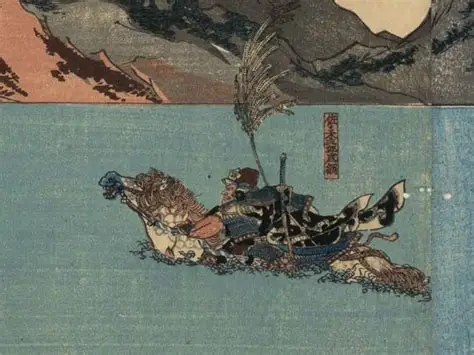
Tomomori reportedly rode this horse into the sea, aiming for Munemori’s ship floating offshore.
The Tale of the Heike describes the horse swimming over twenty cho.
One cho is approximately 109 meters, so twenty cho would be about 2.2 kilometers.
However, this distance is based on the narrative of a war tale and is not a verified record of the actual sea distance.
Tomomori reached Munemori’s ship while still on horseback.
However, the ship was already crowded with people.
There was no room left for the horse.
Tomomori sent Inoue Kuro back to the shore.
At that moment, Awa Minbu Shigeno, a Taira warrior, reportedly attempted to shoot the horse.
If such a fine warhorse were captured by the Minamoto, it would become their asset.
Shigeno nocked an arrow to his bow.
However, it is said that Tomomori stopped him.
This was the horse that had just saved his life.
Even if it became the enemy’s, he could not bring himself to kill it.
Tomomori reportedly spoke these words.
Inoue Kuro did not immediately leave the ship.
After swimming offshore for a while, it eventually returned to the shore.
According to the Tale of the Heike, it looked back at the ship and neighed two or three times.
Later, Kawagoe Kotaro Shigefusa captured Inoue Kuro and presented it to Emperor Go-Shirakawa.
There is also a story that the horse originally belonged to Emperor Go-Shirakawa.
It is said that it was given to Munemori when he became the Minister of the Interior and later entrusted to Tomomori.
Tomomori cherished Inoue Kuro and prayed for its long life by worshipping Taizan Fukun on the first day of each month.
Taizan Fukun was a deity believed to govern human life and death.
Inoue Kuro was returned to Emperor Go-Shirakawa and came to be known as “Kawagoe Kuro” after Kawagoe Shigefusa.
The Tale of the Heike records the journey of the horse that saved Tomomori’s life, back to its original owner.
On the other hand, Tomonari was unable to reach the coast.
What Tomomori Said on Munemori’s Ship
Tomomori boarded Munemori’s ship.
Munemori, the son of Kiyomori, was a central figure in the Taira clan.
According to the Tale of the Heike, Tomomori wept before his brother and recounted the events on the battlefield.
“I have fallen behind Musashi-no-kami.”
His eldest son, Musashi-no-kami Tomoakira, had died before him.
Furthermore, Kanmotsu Taro Yorikata was also killed in action.
Tomomori lamented that he now felt utterly desolate.
He recalled the moment when Tomoakira was slain.
His son had grappled with the enemy in an attempt to protect his father.
Tomomori, witnessing this, fled without being able to return to help.
If it had happened to someone else, he would have harshly judged that father.
However, when faced with the same situation himself, he found his own life too precious to risk.
The Tale of the Heike preserves Tomomori’s words.
“Indeed, life is dear, as I have now come to realize.”
Tomomori also expressed his embarrassment at what others might think of him.
It is said that Tomomori pressed his sleeves to his face and wept bitterly.
Tomomori, who had led many troops and acted as a prominent general of the Taira,
now shared the anguish of failing to save his son with his brother.
The “Tomoakira’s Last Stand” chapter of the Tale of the Heike vividly portrays both Tomoakira’s valor in defeating the enemy and the survival of his father.
However, no contemporary historical records confirm the conversation on Munemori’s ship.
Tomomori’s words are preserved within the military tale.
Munemori Mourns His Sixteen-Year-Old Nephew
It is said that Munemori, hearing Tomomori’s story, also shed tears.
According to the Tale of the Heike, Munemori praised Tomoakira for dying in place of his father.
He spoke of Tomoakira’s exceptional martial skills, strong spirit, and potential to become a great general.
Munemori then mentioned Tomoakira’s age.
“He was the same age as Kiyomune, sixteen this year.”
Kiyomune, Munemori’s eldest son, was Tomoakira’s cousin.
Kiyomune and Tomoakira were of the same age.
Munemori is said to have glanced at Kiyomune beside him, tears welling up.
Tomomori had spoken of the agony of losing his son before his eyes.
Beside Munemori was his son, of the same age as Tomoakira.
The Tale of the Heike continues to depict the two fathers.
It is said that the Taira clan members present also soaked their armor sleeves with tears.
Tomoakira’s age of sixteen is preserved in Munemori’s words.
“The Last Moments of Tomoakira” as Depicted in The Tale of the Heike
The final moments of Tomoakira are captured as an independent section in the ninth volume of The Tale of the Heike.
The section is titled “The Last Moments of Tomoakira.”
In some manuscripts, it is referred to as “The Last Moments of the Governor of Musashi.”
There are also manuscripts where Tomoakira’s name is written as “Tomoaki.”
The Tale of the Heike has multiple textual lineages, and even for the same events, differences can be found in the spelling of names and the details of the narrative.
“The Last Moments of Tomoakira” begins with the scene where Tomomori’s forces, defending the forest of Ikuta, are defeated, and he flees to the coast with Tomoakira and Yorikata.
The narrative then depicts the pursuit by warriors believed to be from the Kodama clan.
Yorikata shoots down a flag bearer, and Tomoakira grapples with a warrior targeting his father.
Just after defeating his enemy, Tomoakira is slain by another young enemy soldier.
Yorikata also continues to fight and is killed in action, leaving only Tomomori to escape to the coast.
The story then interjects with the tale of Inoue Kuro, leading to the scene where Tomomori mourns his son’s death aboard Munemori’s ship.
Tomoakira’s death is also recorded in biographical dictionaries.
Meanwhile, details such as the number of pursuers, the course of the grappling, the distance swum by Inoue Kuro, and the conversation between Tomomori and Munemori are vividly recounted in The Tale of the Heike.
Moreover, regarding the Battle of Ichinotani as a whole, there are differences in the accounts between the contemporary diaries Gyokuyo and The Tale of the Heike.
Military tales often include not only battlefield events but also vivid depictions of characters’ words and scenes.
For Tomoakira as well, there are limited parts of his life that can be traced in detail from contemporary records.
Therefore, it is impossible to confirm what words Tomoakira actually spoke or which warrior he grappled with.
Nevertheless, “The Last Moments of Tomoakira” serves as a significant section in the ninth volume of The Tale of the Heike, depicting the Heike’s retreat and the parting of father and son.
The Heike Nobles Lost at Ichinotani
In the Battle of Ichinotani, many other warriors of the Heike clan, in addition to Tomoakira, lost their lives.
Taira no Kiyomori‘s brother, Taira no Tadanori, is said to have been killed by Okabe Tadatsune.
Taira no Atsumori, the son of Kiyomori’s brother Taira no Tsunemori, is known for his duel with Kumagai Naozane.
Taira no Tsunemasa, another son of Tsunemori, also perished at the Battle of Ichinotani.
Taira no Tomomori and others, including Gyōmori, the sons of Kiyomori’s brother Taira no Norimori, also lost their lives in this battle.
Meanwhile, Taira no Shigehira, the brother of Tomomori, was captured alive by the Minamoto forces.
In just a single day of fighting, the Taira clan suffered the loss of many of its warriors.
Though Tomonori, the father of Tomonaga, managed to escape to a ship, he lost his eldest son.
Munemori and Tomomori, along with the remaining forces, retreated to the western provinces.
Emperor Antoku and the Imperial Regalia remained with the Taira.
Even after their crushing defeat at Ichinotani, the Taira continued their struggle against the Minamoto from their base at Yashima.
Tomomori’s Final Stand at Dan-no-ura
Despite the loss of Tomonaga, Tomomori continued to serve as a prominent leader of the Taira clan.
The Taira regrouped their forces around Yashima in Sanuki Province, leveraging the Seto Inland Sea routes to counter the Minamoto.
However, the Minamoto’s pursuit was relentless.
In February 1185, Minamoto no Yoshitsune launched a surprise attack on Yashima.
The Taira abandoned Yashima and retreated further west.
On March 24, they faced their final battle at Dan-no-ura in Nagato Province.
Defeated by the Minamoto forces, the Taira were shattered at sea.
It is said that Emperor Antoku, held by his grandmother Taira no Tokiko, sank into the sea.
Tomomori also met his end at Dan-no-ura.
According to the Tale of the Heike, Tomomori, having witnessed the fall of the Taira, is said to have left these words:
“I have seen all there is to see. Now, I shall end my life.”
It is said that he donned two layers of armor and, along with his wet nurse’s son, Iga Hironosuke Ienaga, threw himself into the sea.
Though Tomomori survived the loss of his son Tomoakira at the Battle of Ichi-no-Tani, he met his end about a year later at Dan-no-ura.
Tomomori’s final moments have been depicted in later joruri and kabuki plays.
In ‘Yoshitsune Senbon Zakura,’ the character Ikari Tomomori sinks into the sea with a large anchor.
This portrayal evolved in later performing arts and differs from the account of Tomomori’s drowning in ‘The Tale of the Heike.’
The Later Lives of His Mother, Jibu-no-kyo no Tsubone, and Prince Morisada
Jibu-no-kyo no Tsubone, believed to be Tomoakira’s mother, survived the fall of the Heike.
At Ichi-no-Tani, Tomoakira perished in battle, and the following year at Dan-no-ura, her husband Tomomori also lost his life.
Jibu-no-kyo no Tsubone was the wet nurse of Prince Morisada.
Prince Morisada accompanied the Heike in their flight from the capital but returned to Kyoto after Dan-no-ura.
It is said that Jibu-no-kyo no Tsubone maintained her connections with the court thereafter.
Prince Morisada later took religious vows and adopted the name Gyosho Nyudo Shinno.
In the third year of Jōkyū (1221), Emperor Go-Toba raised an army against the Kamakura shogunate.
This was the Jōkyū Rebellion.
However, the imperial forces were defeated, and Emperor Go-Toba and others were exiled.
Subsequently, Prince Morisada’s son ascended the throne as Emperor Go-Horikawa.
Although Prince Morisada never became emperor himself, he was posthumously honored with the title of Daijō Tennō and became known as the Retired Emperor Takakura.
He then assumed the role of cloistered emperor.
This occurred 36 years after the fall of the Heike.
Jibu-no-kyo no Tsubone was the woman who had raised Prince Morisada as his wet nurse.
Some biographies claim that Jibu-no-kyo no Tsubone died in the third year of Kanki (1231), but caution is needed when confirming this with reliable records.
At the very least, it is said that her life continued after the deaths of Tomoakira and Tomomori.
However, there are few specific records of how Jibu-no-kyo no Tsubone received the news of Tomoakira’s death at Ichi-no-Tani.
‘The Tale of the Heike’ depicts Tomomori weeping before Munemori, but leaves no similar conversation about his mother, Jibu-no-kyo no Tsubone.
The Pursuit of His Brother, Tomochika
Tomochika, believed to be Tomoakira’s younger brother, is said to have led a different life.
It is said that Tomochika was still a child during the Heike’s flight from the capital.
Thus, he did not accompany his father Tomomori to the western provinces but was instead raised in Iga Province, according to tradition.
Stories about Tomochika’s later life are found in variant texts of ‘The Tale of the Heike,’ such as the Enkyō-bon.
Though Tomochika survived the fall of the Heike, he eventually became a target for pursuit.
A tradition holds that around Kenkyū 7 (1196), he appeared near Hōshōji in Kyoto and was pursued.
It is said that Tomochika resisted but lost his life at a young age.
Moreover, there is a story that his mother, Jibu-no-kyo no Tsubone, identified his severed head.
However, much of the specific details and actions of these individuals are largely derived from later war tales and legends.
There are various theories about Chitata’s age and the detailed circumstances of the pursuit against him.
Chisho lost his life on the battlefield of Ichinotani.
On the other hand, there is a tradition that Chitata was pursued even more than ten years after the fall of the Taira clan.
The influence of the battles between the Taira and Minamoto clans extended to the children of Tomomori even after the conflict had ended.
The Position of Governor of Musashi Province to Hiraga Yoshinobu
The year Chisho was killed at Ichinotani, there was also a change in the appointment of the governor of Musashi Province.
On June 5, 1184, Hiraga Yoshinobu was appointed as the governor of Musashi.
Hiraga Yoshinobu was a member of the Seiwa Genji clan and a warrior who served under Minamoto no Yoritomo.
The Azuma Kagami entry for June 20, 1184, notes that Yoshinobu became the governor of Musashi during the appointments on the 5th of that month.
At the same time, Minamoto no Noriyori was appointed governor of Mikawa, and Minamoto no Hirotsuna became governor of Suruga.
These appointments were part of Yoritomo’s efforts to establish control over the eastern provinces through the imperial court.
The Taira clan had once been deeply involved in the governance of the eastern provinces as governors and lords of Musashi Province.
Chisho’s father, Tomomori, also served as governor of Musashi, and Chisho himself held the same position.
However, with Yoritomo’s uprising, the warriors of Musashi Province joined the Minamoto side, altering the power structure.
Chisho was killed at Ichinotani on February 7.
About four months later, Hiraga Yoshinobu, a member of the Minamoto clan, was appointed as governor of Musashi.
The position Chisho last held was taken over by a figure from the Minamoto side.
The political transition from the Taira to the Minamoto in Musashi Province coincided with Chisho’s lifetime.
The Gorinto of Chisho at Myosenji Temple
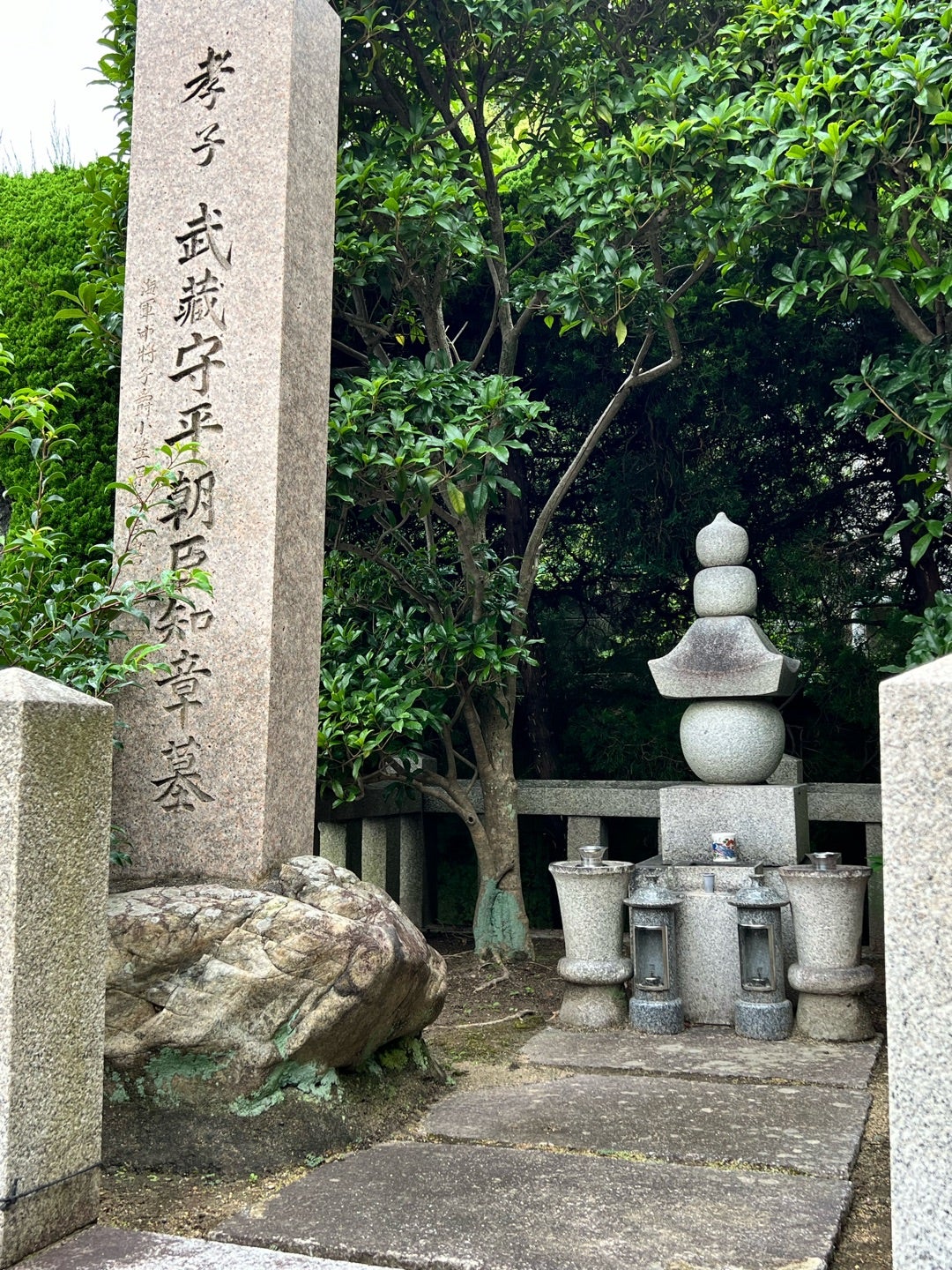
In the current Nagata Ward of Kobe City, in Myosenji Town, there remains a gorinto dedicated to the memory of Taira no Chisho.
This is at Tenjosan Myosenji, of the Rinzai sect’s Nanzenji school.
Myosenji, also known as Dainichiji, is said to have origins dating back to the Tenpyo era of the Nara period.
It is believed to have begun when Gyoki enshrined Dainichi Nyorai at the water source when he opened the lotus pond at Nishidai.
The current temple has survived through destruction and reconstruction due to warfare.
The official history of Myosenji includes an account of Chisho’s final moments.
According to tradition, in the valley north of the temple, near Monna Pond, Chisho allowed his father, Tomomori, to escape and was killed in battle.
It is said that there was once a mound dedicated to Chisho in that area.
Later, it was moved to the temple grounds by Shozo Kimura and others from the Kobe Historical Society and is now honored as a gorinto.
Today, the gorinto believed to be Chisho’s grave is enshrined in the northwest corner of Myosenji’s grounds.
However, it is difficult to confirm the exact location of Chisho’s death or burial from contemporary records.
The Heike Monogatari depicts him being attacked by pursuers on a narrow path while heading from Ikuta Forest to the coast.
The grave site at Myosenji is a place where later generations have commemorated Chisho and passed down the story of his end.
Monuments to the Brave Warriors of the Genpei War and the Grave of Kenmotsu Taro
Alongside Tomoakira, Kanemoto Taro Yorikata also fought bravely, and a stone monument believed to be his grave remains in Nagata Ward, Kobe City.
The monument is inscribed with “Grave of Kanemoto Taro Yorikata.”
There is a discrepancy in the name between Yorikata mentioned in the “Tale of the Heike” and Yorikata as inscribed on the later gravestone.
Additionally, in Gobancho 8-chome, Nagata Ward, there is a “Monument to the Genpei Warriors.”
Here, a monument engraved with the name of Taira no Tomoakira also remains.
Originally, the area was scattered with monuments related to the warriors involved in the Battle of Ichinotani.
Monuments related to Taira no Tomomori of the Taira clan, and Genji warriors such as Kimura Gengo Shigemasa and Inomata Koheirouku Noritsuna, are also said to exist.
Later, Tomoakira’s monument was moved from the vicinity of Meisenji, becoming a place to honor the warriors of the Genpei War, regardless of their allegiance.
According to regional historical materials from Kobe City, Tomoakira’s monument was honored and relocated during the Kyōhō era of the Edo period by the Confucian scholar Namikawa Seisho.
The actions of Tomoakira, who died in battle assisting his father, were praised by later generations.
Moreover, the Edo period geographical work “Settsu Meisho Zue” also contains descriptions related to the graves of Tomoakira and Kanemoto Taro.
Even after many years since Tomoakira lost his life in the Battle of Ichinotani, his name continues to be remembered in the land of Nagata.
Even today, at Meisenji, Tomoakira is honored as “Filial Son Taira no Tomoakira,” and the temple’s annual events include a memorial service on March 28.
In the northwest corner of the temple grounds stands Tomoakira’s five-ring pagoda, and in Gobancho, Nagata Ward, the monument to the Genpei warriors remains.
On February 7, 1184, the 16-year-old Musashi no Kami died in battle while trying to protect his father on the way from the Ikuta Forest to the coast.
His name is recorded in the ninth volume of the “Tale of the Heike,” “The Last Moments of Tomoakira,” and is preserved in the temples and monuments of Kobe.