On September 20, 1186.
News reached the Kyoto courtier, Kujo Kanezane, that Minamoto no Yoshitsune‘s retainers had been captured.
The retainers were Hori Yataro Kagemitsu and Sato Shirobei no Jo Tadanobu.
Kagemitsu was taken alive, while Tadanobu took his own life.
Kanezane recorded this information in his diary, “Gyokuyo.”
Two days later, “Azuma Kagami” documented the detailed events leading up to Tadanobu’s demise.
Tadanobu had been hiding in Nakamikado Higashi-no-Toin in Kyoto.
Warriors from Kamakura attacked his hideout, but Tadanobu was not easily defeated. Being a man of exceptional martial skill, it is said that a large force was required to bring him down.
In the end, he committed suicide along with two of his loyal followers.
An unexpected event is noted as the reason his location was discovered.
Tadanobu sent a letter to a woman with whom he had once been close.
She showed the letter to her husband at the time, who then informed the Kamakura warriors.
The letter itself has not survived.
Its contents remain unknown.
“Azuma Kagami” reports that this single letter led to the discovery of Tadanobu’s hiding place.
Tadanobu was a warrior who served Minamoto no Yoshitsune from the Shinobu Manor in Mutsu Province.
He joined the campaign against the Taira alongside his brother, Sato Tsuginobu, and lost his brother at Yashima.
Despite this, he remained loyal to Yoshitsune and fought alongside him during the Horikawa Night Attack in October 1185.
In later accounts, such as “Gikeiki,” he is portrayed as a loyal retainer who drew pursuers away at Yoshino Mountain, sacrificing himself for Yoshitsune.
However, what Kanezane recorded in Kyoto was not a heroic death in the mountains of Yoshino.
It was the death of Sato Tadanobu, who had become a fugitive and was hiding in the capital.
Tracing his life reveals not only his loyalty on the battlefield but also a past where he was severely reprimanded by Minamoto no Yoritomo.
The Sato Clan of Shinobu Manor in Oshu
Sato Tadanobu’s hometown was Shinobu Manor in Mutsu Province.
This area corresponds to the present-day surroundings of Fukushima City in Fukushima Prefecture.
The Abukuma River flows through this region, and a road connecting the north and south of Oshu has run through here since ancient times.
In the late Heian period, the Sato clan held power in the Shinobu region.
His father was Sato Motoharu, also known as Genji, who was referred to as the steward of Shinobu and Yu.
The steward was a position involved in the management of manors.
At that time, the Shinobu region was within the sphere of influence of the Oshu Fujiwara clan, based in Hiraizumi.
The Oshu Fujiwara clan, led by Fujiwara no Kiyohira, Motohira, and Hidehira, expanded their influence over a wide area of Mutsu and Dewa across three generations.
In Hiraizumi, they constructed Chuson-ji and Motsu-ji temples, attracting gold, horses, and other products from various regions.
They maintained relations with the Kyoto court, and Hidehira was appointed as the Governor of Mutsu and Commander of the Defense Office.
There were warriors across the regions who supported the rule of the Oshu Fujiwara clan.
The Sato clan of Shinobu was one such family.
Their reputed castle was Otori Castle.
The ruins of the castle remain in present-day Iizaka Town, Fukushima City.
Local tradition holds that Motoharu built the castle under the orders of Fujiwara no Hidehira. However, there are limited historical records to confirm the exact date of construction or the appearance of the buildings from the late Heian period.
Tadanobu was born into such a prominent warrior family in Oshu.
Saburo Tsuginobu and Shiro Tadanobu
Tadanobu had a brother named Sato Tsuginobu.
Tsuginobu was known as Saburo Hyoe-no-jo, while Tadanobu was called Shiro Hyoe-no-jo.
No contemporary documents accurately convey the birth years of Tsuginobu and Tadanobu.
Many biographies suggest Tadanobu was born in Oho 1 (1161), which would mean he died at the age of twenty-six in 1186.
However, different ages at death are recorded on memorial towers in his hometown.
Details about Tadanobu’s childhood, such as how he lived or who taught him martial arts, are not well-documented.
There are traditions concerning the Sato family, including his father Motoharu, his mother Otowa, and the wives of his brothers.
However, much of what we know about the everyday lives of families relies on genealogies and temple records from later generations.
During the time the brothers lived, the head of the Oshu Fujiwara clan was Hidehira.
Under Hidehira’s protection was Minamoto no Yoritomo‘s half-brother, Yoshitsune.
It is said that after Yoshitsune’s father, Minamoto no Yoshitomo, was defeated in the Heiji Rebellion, Yoshitsune spent his early years in Kyoto and was entrusted to Kurama Temple.
Later, he left Kyoto for Oshu, where he was under Hidehira’s protection.
When did Yoshitsune arrive in Hiraizumi, and how did he meet the Sato brothers?
There are no detailed records of these events.
However, when Yoshitsune set out to join Yoritomo, the Sato brothers accompanied him.
Tadanobu, Considered “Kin” of Hidehira
The Azuma Kagami entry for September 22, Bunji 2, contains intriguing information about Tadanobu’s origins.
Tadanobu was said to be a relative of the Chinju-fu Shogun, Fujiwara no Hidehira.
Furthermore, it is recorded that in the fourth year of Jisho (1180), when Yoshitsune headed for the Kanto region, Hidehira selected brave warriors, including Tsuginobu, to accompany Yoshitsune.
The exact nature of the “kinship” mentioned is unclear.
There is a tradition of marriage ties between the Sato and Oshu Fujiwara families, but it is not possible to verify all the genealogical connections back to that era.
Nevertheless, the fact that Tadanobu was regarded as someone closely related to Hidehira is noteworthy.
At the time of Yoritomo’s uprising, the Oshu Fujiwara clan maintained its own power.
Hidehira was not in a position to serve Yoritomo as a vassal in Kamakura.
Yet, according to the Azuma Kagami, Hidehira sent warriors to support Yoshitsune, whom he had protected.
Tsuginobu and Tadanobu were warriors sent from the Oshu clan to Yoshitsune.
Eventually, they followed Yoshitsune to battlefields in Kyoto and the western provinces.
From Kisegawa to Kyoto
In October of the fourth year of Jisho.
The Azuma Kagami recounts that Yoshitsune met Yoritomo at Kisegawa in Suruga Province.
After raising his banner in Izu, Minamoto no Yoritomo suffered a defeat at the Battle of Ishibashiyama and fled to the province of Awa.
From there, he regrouped his forces, gathering samurai from the eastern provinces, and entered Kamakura.
It was around this time that Minamoto no Yoshitsune joined him.
The exact date when Keishin and Tadanobu departed from Hiraizumi is unknown.
The route they took from Oshu to the Tokaido is also not documented.
As retainers of Yoshitsune, the two began participating in Yoritomo’s military campaigns.
In the first month of Juei 3 (1184),
Yoritomo dispatched Noriyori and Yoshitsune to defeat Minamoto no Yoshinaka, who controlled Kyoto.
Yoshitsune and his forces advanced from the Uji River area and defeated Yoshinaka’s faction.
They then launched an attack on the Taira forces at Ichinotani.
Yoshitsune was accompanied by samurai who had followed him from Oshu.
However, there are few records detailing which unit Tadanobu belonged to or which enemies he fought during this period.
The Sato brothers appear in “The Tale of the Heike” and “The Tale of Yoshitsune,” but it is important to carefully distinguish between the scenes depicted in these war tales and the actual military actions recorded at the time.
Tadanobu’s specific actions are noted in the “Azuma Kagami” during the second month of Genryaku 2 (1185) at Yashima.
Setting Fire to the Imperial Residence at Yashima
February 19th.
Yoshitsune’s forces approached Yashima in the province of Sanuki.
At Yashima, Taira no Munemori and others were sheltering Emperor Antoku, having set up an imperial residence.
Yoshitsune hurried overland from the province of Awa, launching an attack on the Taira stronghold.
Seeing this, the Taira moved Emperor Antoku and others onto ships and retreated to the sea.
The “Azuma Kagami” records the names of the warriors who set fire to the buildings at Yashima afterwards.
Sato Saburobei no Jo Keishin.
Sato Shirobei no Jo Tadanobu.
Goto Sanekiyo and his adopted son Motokiyo.
The brothers reportedly participated in the attack that set fire to the Taira’s imperial residence and Munemori’s resting place.
The flames rose high, and it is said that black smoke covered the sky.
Tadanobu was tasked with attacking the Taira stronghold under Yoshitsune’s command.
However, the Taira resistance continued.
Noticing the small number of Yoshitsune’s forces, the Taira army on the ships approached the shore and began a counterattack.
Arrows flew across the beach as the warriors of the Minamoto and Taira clans clashed fiercely.
Amidst the battle, Keishin, Tadanobu’s brother, was gravely wounded and lost his life.
The Battlefield Where the Elder Brother Fell
In the “Heike Monogatari” Volume Eleven, “The Last Stand of Tsuginobu,” it is said that Taira no Noritsune was the one who shot Tsuginobu.
Noritsune aimed his arrow at Yoshitsune.
Tsuginobu stepped forward and took the arrow, falling from his horse.
Furthermore, it is said that when Kikuomaru of the Taira side tried to take Tsuginobu’s head, Tadanobu drew his bow and shot him.
This was the image of a younger brother determined not to let his brother’s head fall into enemy hands.
However, there are embellishments in the war tales regarding Noritsune being the archer and Tadanobu shooting Kikuomaru.
The death of Tsuginobu and the family of the Sato brothers are covered in detail in the existing People Series Vol. 72.
In Tadanobu’s life, his actions afterward became significant.
After losing his brother, Tadanobu continued to serve Yoshitsune.
The following month, the Taira clan met its end at Dan-no-ura.
While the specifics of Tadanobu’s battle position at that time are unknown, records confirm that he continued to follow Yoshitsune even after the Taira’s downfall.
Having lost his brother at Yashima, the pursuit of the Taira was concluded.
However, Tadanobu soon faced severe reprimand from Yoritomo in Kamakura.
The issue at hand was his court appointment.
April 15th, Yoritomo’s Named Warriors
Genryaku 2, April 15th.
The “Azuma Kagami” records that Yoritomo issued orders to warriors who had obtained court positions without his permission.
Twenty-four individuals who had been appointed by the court without Yoritomo’s approval were called into question.
For warriors, a court position was a great honor.
Being recognized by the court for their military achievements and obtaining positions like “Hyōe no Jō” was an opportunity to elevate their status.
However, Yoritomo sought to place the appointments of his vassals under Kamakura’s control.
Yoritomo’s orders demanded that those who had been appointed without permission remain in Kyoto and fulfill the duties associated with their positions.
The harsh directive warned that if they returned to the eastern provinces without permission, they could face confiscation of their lands or even execution.
The list included Kajiwara Kagetoki’s eldest son, Kagesue.
And Tadanobu’s name was also there.
“Hyōe no Jō Tadanobu”
Yoritomo’s reprimand was directed at Tadanobu’s origins.
There was no precedent for the retainers of Hidehira being appointed to positions in the imperial guard.
Know your place.
Such was the tone of the document.
At the end, there were even words comparing Tadanobu to a weasel, intended as an insult.
Despite Tadanobu’s contributions in the battles against the Taira, Yoritomo raised the issue of his position as a retainer of Hidehira.
The Anger Directed at “Hidehira’s Retainers”
At this time, Tadanobu had already been fighting alongside Yoshitsune for a long period.
At Yashima, he joined his brother in setting fire to the imperial palace and participated in the campaign against the Taira.
However, in Yoritomo’s document, Tadanobu’s origins were called into question.
A warrior closely associated with Hidehira of the Oshu Fujiwara clan, who then followed Yoshitsune.
That was how Yoritomo viewed Tadanobu.
At the time, Yoshitsune, as Yoritomo’s brother, was leading the forces against the Taira.
However, not all of Yoshitsune’s retainers were originally vassals who had received land grants from Kamakura.
Tadanobu was a warrior who had followed Yoshitsune from Oshu.
That Tadanobu received an official court position.
Yoritomo criticized the fact that Tadanobu was appointed without Kamakura’s approval.
The issue of appointment without Yoritomo’s consent was not unique to Tadanobu.
Many vassals were subject to the same orders.
Yet, the words directed at Tadanobu contained a harsh assessment of warriors from Oshu.
It is well known that Yoshitsune’s appointment as a kebiishi led to conflict with Yoritomo.
Behind the scenes, the warriors who followed Yoshitsune were also subject to Kamakura’s orders, and their appointments were questioned.
The reprimand to Tadanobu was a specific record of this.
The Position of Shirobei no Jo
Tadanobu was known as Sato Shirobei no Jo.
The position of Shirobei no Jo belonged to the Imperial Guard Office, responsible for duties such as palace security.
In the late Heian period, it also held significant meaning as a position indicating the status and honor of a warrior.
The Yashima record in the “Azuma Kagami” already mentions the title “Shirobei no Jo.”
However, since the “Azuma Kagami” was compiled years after the events, it is possible that the title became known later and was used in past articles.
The exact date when Tadanobu became Shirobei no Jo is difficult to determine.
Furthermore, it is unclear what specific duties Tadanobu performed at court after receiving the reprimand regarding his appointment.
Subsequently, Tadanobu continued to serve as a retainer of Yoshitsune.
Even as relations with Yoritomo deteriorated, there is no record of Tadanobu separating from Yoshitsune.
More than half a year after the fall of the Taira.
Yoshitsune’s residence in Kyoto was attacked by an armed group.
That night, Tadanobu was by Yoshitsune’s side.
The Horikawa Night Attack: Opening the Gates with Yoshitsune
October 17, 1185.
Kyoto, near Rokujō.
Warriors allied with Yoritomo launched an assault on Yoshitsune’s residence.
This was the Horikawa Night Attack.
According to the Azuma Kagami, Tosabo Shoshun led over sixty horsemen, including Mizuo Tani Juro, to attack Yoshitsune’s residence at Rokujō Muromachi.
Meanwhile, the Gyokuyō by Kujō Kanezane records that over thirty horsemen from the Kodama faction of Musashi Province were involved in the attack.
The accounts of the number of attackers differ.
The Azuma Kagami notes that many of Yoshitsune’s retainers were out, leaving only a few behind at the residence.
Yoshitsune, along with the remaining warriors, opened the gates and charged out.
Among those present was a man named Tadanobu.
It is said that Yoshitsune, accompanied by Sato Shirōbyōe Tadanobu and others, fought against the attackers.
Soon, Minamoto no Yukie arrived from the rear, causing the attackers to flee.
Details about what weapon Tadanobu used or whom he defeated are not recorded.
Nevertheless, the Azuma Kagami notes that Tadanobu was by Yoshitsune’s side when he opened the gates to fight back.
In April, Tadanobu had been reprimanded by Yoritomo for accepting an official post, yet by October, he was standing with Yoshitsune to face the warriors from Kamakura.
The details of that night’s battle and the fate of Tosabo Shoshun are covered in another article, “The Horikawa Night Attack.”
After Yoshitsune Left Kyoto
The day after the Horikawa Night Attack, the imperial court issued an imperial edict to Minamoto no Yoshitsune and Minamoto no Yukie to subdue Yoritomo.
However, Yoshitsune was unable to gather enough troops to fight against Yoritomo.
November 3rd.
Yoshitsune and Yukie left Kyoto and headed west.
They attempted to cross the sea from Daimotsu Bay in Settsu Province by ship, but a storm scattered their fleet.
Yoshitsune continued to flee thereafter.
When tracing the actions of Tadanobu during this period, two different stories emerge.
One is recorded in the ‘Azuma Kagami’, where he parted ways with Yoshitsune near Uji and returned to Kyoto.
The other is depicted in the ‘Gikeiki’, where he became a decoy for Yoshitsune in Yoshino Mountain to draw away pursuers.
The ‘Gikeiki’ is a military tale that chronicles Yoshitsune’s life, detailing the actions of his retainers, including Tadanobu, who followed their lord.
In it, Tadanobu plays a significant role during the parting at Yoshino Mountain.
Snowy Yoshino Mountain
‘Gikeiki’, Volume Five.
Yoshitsune, accompanied by Shizuka Gozen and his retainers, entered Yoshino Mountain in Yamato Province.
It is said that snow remained on the mountain paths and the water in the valleys was frozen.
The group advanced along the steep paths, avoiding pursuers.
Yoshino Mountain has long been known as a center of mountain worship.
Centered around Kinpusen-ji Temple, it was a hub for temples and ascetic practitioners, and those entering the mountain could not remain unaffected by their influence.
Yoshitsune parted ways with Shizuka and ventured further into the mountains.
However, the monks of Yoshino were attempting to pursue Yoshitsune’s party.
Upon receiving this news, Tadanobu stepped forward, as depicted in the ‘Gikeiki’.
He proposed to stay behind and distract the pursuers.
Meanwhile, Yoshitsune would escape ahead.
It is said that Yoshitsune hesitated to leave Tadanobu behind.
Thus, Tadanobu expressed his intention to act as a decoy for his lord.
And he made one request to Yoshitsune.
He asked to borrow his lord’s name for just that day.
Permission to Assume the Name “Yoshitsune”
In the ‘Gikeiki’, Tadanobu was considering the actions of the pursuers.
If he were to declare himself as Sato Tadanobu, the pursuers might realize that Yoshitsune was not there.
If that were the case, they would advance along the mountain path without fighting, pursuing the fleeing Yoshitsune.
At this point, Tadanobu reportedly requested permission to use his lord’s name to create the impression that Yoshitsune was still present.
Initially, Yoshitsune hesitated at this request.
This was because there was significant meaning in a retainer using the name of their lord.
Nevertheless, Tadanobu expressed his intention to reveal his true name eventually and sought Yoshitsune’s approval.
It is said that Yoshitsune granted Tadanobu’s request.
He is also said to have given Tadanobu a cherished sword.
This conversation is part of the narrative conveyed by the ‘Gikeiki.’
However, it clearly illustrates how Tadanobu has been portrayed historically.
He is depicted not merely as a warrior facing many opponents alone, but as someone trying to buy time for his lord to escape.
A Mother Waiting in Oshu
The ‘Gikeiki,’ which depicts the parting at Mount Yoshino, includes a scene about Tadanobu’s mother.
His brother Tsuginobu was killed at Yashima.
This news had reached their hometown in Oshu.
The mother was deeply saddened by the loss of her eldest son.
Even so, she waited, believing that her younger son Tadanobu would return someday.
Tadanobu is said to have shared this image of his mother with Yoshitsune.
If he were to fall here, his mother would lose both of her sons.
In the ‘Gikeiki,’ it is said that Tadanobu thought of this and shed tears.
Yoshitsune, too, is depicted as shedding tears upon hearing Tadanobu’s words.
This was a scene where Tadanobu, despite his feelings for his family, still chose to remain in the mountains.
What Tadanobu’s mother actually knew at the time, and what words were exchanged at Mount Yoshino, remain unknown.
The war tale connects the image of a brother who lost his sibling with a mother waiting for their return in their hometown.
The warriors following Yoshitsune had families in Oshu.
By depicting these circumstances, Tadanobu’s decision to remain at Yoshino is portrayed as an even heavier one.
Facing Three Hundred with Seven
According to the ‘Gikeiki,’ Tadanobu stayed behind at Mount Yoshino with six retainers.
There were seven of them in total.
Tadanobu and his men fortified themselves in the snowy mountains, waiting for the pursuers to appear.
They cut down trees to use as shields, preparing for the enemy passing through the mountain path.
Soon, the monks of Yoshino advanced upon them.
Their numbers were depicted as two to three hundred.
Tadanobu did not charge into the enemy’s large force alone from the start.
The ‘Gikeiki’ narrates that he utilized the mountain’s terrain to shoot arrows and disrupt the pursuers’ movements.
There are scenes where they raised voices to make it seem like many warriors were waiting, shooting arrows from behind.
However, the monks had the advantage in numbers.
As the battle progressed, Tadanobu’s side was pushed to the brink, with his retainers falling one by one.
Soon, a formidable opponent appeared.
It was Yokogawa Kakuhan.
The Duel with Yokogawa Kakuhan
In the “Gikeiki,” Yokogawa Kakuhan is depicted as a fierce warrior monk skilled in martial arts.
He is said to be associated with the Suzuki clan of Kii Province, and was a formidable foe armed with a large bow and a long sword.
Kakuhan shot an arrow at Tadanobu.
Tadanobu responded by drawing his own bow.
In the tale, Tadanobu’s arrow damaged Kakuhan’s bow, leading the two to engage in a sword fight.
Kakuhan wielded his large sword and advanced on Tadanobu.
On the other hand, Tadanobu was exhausted from the prolonged battle.
He had not eaten properly and his strength was waning.
The onlookers watched to see whether Kakuhan or Tadanobu would emerge victorious.
Eventually, Tadanobu evaded Kakuhan’s attack and retreated along the mountain path.
Kakuhan, in pursuit, slipped and fell.
Seizing the opportunity, Tadanobu struck down Kakuhan.
The “Gikeiki” describes how Tadanobu took Kakuhan’s head and showed it to the onlookers.
With the defeat of the renowned Kakuhan, the onlookers withdrew.
Tadanobu had won the battle.
However, all of his remaining retainers had fallen.
Tadanobu’s Survival in Yoshino
In the “Gikeiki” account of the Battle of Mount Yoshino, Tadanobu himself did not die in battle.
This is an important point.
After defeating Yokogawa Kakuhan, Tadanobu surveyed the battlefield for his fallen retainers.
He searched for survivors, but it is said that the warriors who followed him had already perished.
Tadanobu found himself alone in the mountains.
Subsequently, he headed towards a temple in Yoshino and continued his flight, according to the tale.
Tadanobu, who stayed in Yoshino to protect Yoshitsune, repelled his enemies and survived.
While some may have the impression that Tadanobu met a heroic death at Mount Yoshino, the narrative of the “Gikeiki” is different.
In this battle, Tadanobu did not lose his life and continued to evade pursuers thereafter.
However, there are few detailed contemporary records to corroborate the battle in Yoshino itself.
The story of Tadanobu fighting in place of Yoshitsune became widely known in the world of military tales.
Today, in Yoshino Town, Nara Prefecture, there are places linked to that battle.
The Battle Remembered at Hanayakura
Hanayakura in Mount Yoshino is a site associated with the legend of Sato Tadanobu’s battle against pursuers.
From this high vantage point, one can overlook the surrounding mountains and valleys, and it is now known as a scenic viewpoint.
The story of Tadanobu facing the onlookers with a small group has been passed down, intertwined with the geography of Yoshino.
The place where Yoshitsune is said to have hidden.
The location where he is believed to have parted ways with Shizuka Gozen.
The site where Tadanobu is said to have held off the enemy.
Yoshino is rich with legendary sites related to Yoshitsune’s escape.
However, there are no contemporary documents that prove Tadanobu actually fought at Hanayakura.
The stories spread through ‘Gikeiki’ and later performing arts have intertwined with local legends.
To learn about Tadanobu’s actual end, one must return to the records in Kyoto.
Parting with Yoshitsune at Uji
The ‘Azuma Kagami’ entry for September 22, Bunji 2, also notes the place where Tadanobu parted from Yoshitsune.
It was said to be around Uji.
Tadanobu had been following Yoshitsune but is said to have parted ways and returned to Kyoto.
The date is not recorded.
The reason for his return to Kyoto is also unknown.
Was he ordered by Yoshitsune to do something?
Did he act on his own judgment?
The circumstances are not conveyed.
The battle of Yoshino in ‘Gikeiki’ and the separation at Uji recorded in ‘Azuma Kagami’ do not match in route or detailed events.
Both accounts have points that warrant examination.
‘Azuma Kagami’ is a historical text compiled in the late Kamakura period and may not directly reflect the records from the time of Yoshitsune’s escape.
On the other hand, ‘Gikeiki’ is a work that vividly depicts Tadanobu’s exploits as a narrative.
However, regarding Tadanobu’s eventual death in Kyoto, there is another historical source written by a court noble at the time called ‘Gyokuyo.’
After parting with Yoshitsune, Tadanobu lived in hiding in Kyoto.
The location was Nakamikado Higashi-no-Toin.
The Hideout at Nakamikado Higashi-no-Toin
Nakamikado Higashi-no-Toin relates to the area around Nakamikado Avenue and Higashi-no-Toin Avenue in Heian-kyo.
It was the area around what is now the Kyoto Imperial Palace grounds.
‘Azuma Kagami’ tells that Tadanobu hid in this region.
The owner of the residence is unknown.
It is unclear if someone sheltered Tadanobu or how he managed to rent a room.
In Kyoto, there were Kamakura warriors searching for Yoshitsune and his followers.
Hori Yataro Kagemitsu, who also followed Yoshitsune, is said to have hidden in the capital.
Previously, Tadanobu had held a court position alongside Yoshitsune.
However, after the failed rebellion against Yoritomo, it became difficult for him to walk openly in Kyoto.
During this time, Tadanobu sent a letter to a woman he had previously been involved with.
The location where the woman lived or when they became acquainted is not recorded.
However, ‘Azuma Kagami’ conveys that Tadanobu had been in a close relationship with her for some time.
A Letter to a Former Lover
The Azuma Kagami mentions that Tadanobu sent a letter to a woman he had once been secretly involved with, referred to as his “former clandestine lover.”
This refers to a woman with whom he had a secret relationship in the past.
At that time, the woman was already married.
When she received the letter from Tadanobu, she showed it to her husband.
The husband then informed Kazuya Tota Aritsune.
Kazuya Aritsune was a samurai of the Kamakura faction.
The Azuma Kagami records that this information led to the discovery of Tadanobu’s whereabouts, prompting a pursuit.
What could Tadanobu have written in the letter?
Did he inform her of his return to Kyoto?
Was he trying to rely on an old connection?
Or did he simply want to convey his whereabouts?
The letter itself has been lost, so its contents remain unknown.
The reason why the woman showed it to her husband is also unclear.
Was she questioned by her husband, or was it her own decision?
Even the woman’s name has not been passed down.
The Azuma Kagami notes that the letter reached the husband, who then passed the information to Kazuya Aritsune.
That was the extent of the events leading to the discovery of Tadanobu’s hideout.
Another Warrior in the Gyokuyo
The capture of Tadanobu is also recorded in the Gyokuyo.
Entry for September 20, Bunji 2.
Kujō Kanezane heard news that two of Yoshitsune’s retainers had been captured.
They were Hori Yataro Kagemitsu and Satō Shirōbei Tadanobu.
Kagemitsu was captured, while Tadanobu took his own life.
Furthermore, the name of Hiki Tōnai Tomomune is mentioned as being involved in these captures.
The following day’s entry, on the 21st, also notes that Kanezane recorded information about Hiki Tōnai Tomomune capturing Yoshitsune’s retainers the previous day.
However, in the Azuma Kagami, the person who attacked Tadanobu’s hideout is identified as Kazuya Tota Aritsune.
The names of the warriors differ between these two sources.
It’s possible that both Aritsune and Tomomune were involved in the same search.
One might have gathered the information while the other led the capture.
However, there are no records confirming such a division of roles.
The Gyokuyo‘s account is based on information Kanezane heard in Kyoto at the time.
The Azuma Kagami is a historical chronicle compiled later, providing more detailed accounts of Tadanobu’s hiding place and the letter.
It is not possible to merge these differences into a single narrative.
September 20 and 22
The date of Tadanobu’s death also varies depending on the source.
The Gyokuyo records Tadanobu’s suicide on September 20.
On the 21st, there is information that one of Yoshitsune’s retainers was captured the previous day.
From this, it can be inferred that Tadatsune’s end occurred around September 20, or at least by that time, in Kyoto.
Meanwhile, the Azuma Kagami provides a detailed account on the entry for September 22.
The dates recorded in historical documents do not necessarily match the actual date of the events.
Sometimes they reflect the day the news was received or the date when the information was later organized.
Therefore, caution is needed in considering September 22 as the definitive date of Tadatsune’s death.
However, the core of the events reported by both sources is consistent.
Tadatsune was hiding in Kyoto.
He was pursued by Kamakura warriors and took his own life.
Hori Kagemitsu was also captured around the same time.
The Azuma Kagami details the battle that took place during this time.
Kasuya Arisue’s Attack
According to the Azuma Kagami, Kasuya Tota Arisue learned of Tadatsune’s location and headed to Nakamikado Higashi-no-Toin.
Arisue was a member of the Kasuya clan, known as samurai from Sagami Province.
The Kasuya clan is associated with the area around present-day Isehara City in Kanagawa Prefecture.
When they rushed to the residence where Tadatsune was, they encountered more resistance than expected.
The Azuma Kagami describes Tadatsune as a “skilled warrior.”
This means he was a samurai proficient in martial arts.
It is noted that Arisue’s side could not easily defeat Tadatsune and attacked with a large force.
However, the number of attackers is not specified.
Whether Tadatsune used a bow or fought with a sword.
What kind of place he fought back from.
The details of the battle are not conveyed.
Tadatsune had two retainers.
It is thought that these two also fought off the pursuers.
The attack continued, and Tadatsune was gradually cornered.
Together with Two Retainers
In the end, Tadatsune and his two retainers took their own lives.
This is the conclusion recorded in the Azuma Kagami.
The names of the two retainers are not preserved.
Were they samurai who followed Tadatsune from Oshu?
Were they people who worked alongside Yoshitsune?
That too is unknown.
There is no record of what Tadatsune said at the end.
Was he asked about Yoshitsune’s whereabouts, or urged to surrender?
The sources are silent on such scenes.
The warriors who tried to capture Tadatsune were numerous.
Yet, the Azuma Kagami notes that they could not easily defeat Tadatsune.
A warrior who once fought alongside his brother at Yashima.
A man reprimanded harshly by Yoritomo for being called a retainer of Hidehira.
That loyal retainer ended his life at a Kyoto residence, separated from Yoshitsune, with two of his followers.
Meanwhile, Hori Kagemitsu was captured alive.
The “Gyokuyo” briefly records the differing fates of the two men.
Yoshitsune at That Time
Around the time of the retainer’s death, Yoshitsune himself was being pursued.
The “Gyokuyo” entry for September 22 notes that news had spread of Yoshitsune hiding in the Nanto area.
Upon receiving information that Yoshitsune was hiding in a monk’s residence, warriors set out to search for him.
However, Yoshitsune was not there.
This news was also information Kanetsune heard from others.
It was not possible to verify Yoshitsune’s exact whereabouts.
Nevertheless, it is evident that around the same time as the retainer’s demise, the search for Yoshitsune continued from Kyoto to the Nanto area.
Yoshitsune continued to flee and eventually headed to Oshu Hiraizumi.
It is unknown whether the news of the retainer’s death in Kyoto reached Yoshitsune.
It is also uncertain where the two last met.
The “Azuma Kagami” reports a parting at Uji, while the “Gikeiki” depicts a farewell at Yoshino.
Regardless of the path taken, there is no definitive record of the retainer returning to Yoshitsune.
Yoshitsune met his end in Oshu Hiraizumi in the fifth year of Bunji (1189).
It was three years after the retainer’s death.
Memorials at His Hometown, Ioji Temple
In the retainer’s hometown of Iizaka Town, Fukushima City, there is Ioji Temple.
This temple is known as the family temple of the Sato clan of Shinobu.
Within the temple grounds, there remains a group of stone memorial towers related to Sato Motoharu, his mother Otowa, and the brothers Tsuginobu and the retainer.
These are designated cultural properties of Fukushima Prefecture.
There is a story at Ioji Temple conveying the sorrow of a mother who lost her two sons.
The camellia known as “Otowa’s Camellia” is also tied to this legend.
Additionally, there is a tale that the wives of Tsuginobu and the retainer donned armor to comfort their mother.
These family legends are detailed in the existing Sato Tsuginobu edition.
Reflecting on the retainer himself, one wonders how the news reached his hometown from Kyoto.
The “Gikeiki” states that the retainer spoke words of longing for his mother at Yoshino.
However, it is unknown when his mother learned of his suicide in Kyoto.
The brothers who followed Yoshitsune to Oshu never returned to their hometown.
Even after the death of Tadanobu, the Sato clan of Shinobu remained in Oshu.
According to the Azuma Kagami, during the Oshu War in 1189, samurai from the Sato clan, who were connected to Tadanobu’s father, Motoharu, fought against the Kamakura forces.
The detailed events and the differing records regarding the life and death of Sato Shoji are discussed in the section on Tsuginobu.
The Birth of “Goban Tadanobu”
Tadanobu’s bravery was spoken of long after his death.
One such tale is “Goban Tadanobu.”
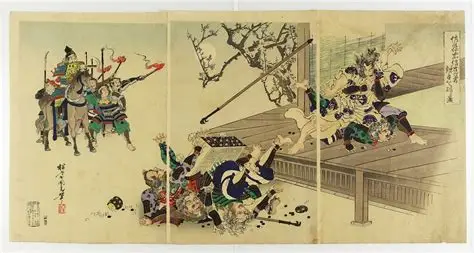
In a dramatic scene, Tadanobu, surrounded by pursuers, fought back by wielding a go board.
A go board is a tool used for playing the game of go.
He swung it as a weapon, fiercely battling against many enemies.
This story spread through early modern joruri and kabuki.
It became an iconic scene, visually representing Tadanobu’s valor.
However, the Azuma Kagami does not mention Tadanobu using a go board.
It records that at the battle at Nakamikado Higashi-no-Toin, Tadanobu was a skilled warrior, attacked by a large force.
Later generations embellished this brief record of valor into a more intense depiction.
Tadanobu defending against pursuers at Mount Yoshino.
Tadanobu wielding a go board at a Kyoto mansion.
These two images became widely known in theater and art.
Sato Tadanobu Becomes a Fox
In 1747, the puppet play Yoshitsune Senbon Zakura premiered at the Takemoto-za in Osaka.
It was a work by the second Takeda Izumo, Miyoshi Shoraku, and Namiki Senryu.
In it, a mysterious being appears, resembling Sato Tadanobu.
This is the Genkurou Fox.
The drum Hatsune, given by Yoshitsune to Shizuka Gozen.
The drum was made from the skin of a fox.
It turns out that the skin belonged to the parents of the Genkurou Fox.
The young fox, longing for its parents, wished to stay near the drum.
Thus, it transformed into Sato Tadanobu and accompanied Shizuka Gozen.
In Yoshitsune Senbon Zakura, both the real Sato Tadanobu and the fox-transformed Tadanobu appear.
When the real Tadanobu arrives at Yoshitsune’s side, Shizuka Gozen realizes the Tadanobu she traveled with was different.
Soon, it becomes clear that the Tadanobu accompanying Shizuka was a fox.
The fox confesses its attachment to the drum made from its parents’ skin.
Moved by the story, Yoshitsune gives the drum to the fox.
This tale became a popular performance in bunraku and kabuki.
The name of Tadanobu became known not only as a brave warrior but also through the image of a fox longing for its parents.
Kakuhan Also Became Someone Else
In Yoshitsune Senbon Zakura, a new setting was also added for Yokogawa Kakuhan, who appears at Mount Yoshino.
It is said that the true identity of Kakuhan was Taira no Noritsune.
This is the same Taira no Noritsune who is said to have shot Tsuginobu in “The Tale of the Heike.”
In the world of “Yoshitsune Senbon Zakura,” Noritsune survives and disguises himself as a warrior monk to pursue Yoshitsune.
To Tadanobu, he was the enemy who killed his brother.
Thus, the death of his brother at Yashima and the battle with Kakuhan at Yoshino became intertwined into a single narrative.
However, the character of Kakuhan in “Gikeiki” and “Yoshitsune Senbon Zakura” are set differently.
The survival of Taira no Noritsune is also a creation of theatrical works.
Sato Tadanobu, who was around Yoshitsune, transformed through various stories.
A loyal retainer who would stand in for his lord.
A brave general who fought with a Go board as a weapon.
And a figure borrowed by a fox.
The roles assigned to Tadanobu by later generations were not confined to just one.
The Sato Brothers Visited by Basho
Genroku 2 (1689).
Matsuo Basho traveled through Oshu.
It was the journey of “The Narrow Road to the Deep North.”
Basho entered the land of Shinobu and visited the old site of Sato Shoji.
At Ioji Temple, there were memorial towers for the brothers, and the family’s legends were preserved.
What particularly moved Basho was the story of Tsuginobu and Tadanobu’s wives.
Basho viewed the items passed down at the temple and composed the following verse:
“Adorn the palanquin and sword with paper streamers in May.”
About five hundred years had passed since the Sato brothers lost their lives.
In their homeland of Oshu, the stories of the brothers and their families were passed down.
In historical records detailing the battles of samurai, there are limited articles tracing Tadanobu’s life.
However, through temple memorials, war tales, joruri, and kabuki, Tadanobu’s name continued to be passed down.
People of each era have spoken of different aspects of Tadanobu.
The News of September 20
Bunji 2, September 20.
The Gyokuyou contains a brief entry reporting the suicide of Sato Tadanobu.
Two days later, the Azuma Kagami provides a detailed account of how Tadanobu confronted his pursuers.
It also recounts the story of how he sent a letter to a woman he had once been involved with, which eventually led to the discovery of his hiding place.
The letter itself no longer exists.
The name of the woman who received it is also unknown.
In the later Gikeiki, it is said that Tadanobu remained in Mount Yoshino, defending against his pursuers with a small group of retainers.
However, according to the contemporary Gyokuyou, his end came by suicide in Kyoto.
The warriors from Oshu who followed Yoshitsune, despite their achievements in the campaign against the Taira, were reprimanded by Yoritomo for their appointments and were eventually surrounded by Kamakura forces.
He was once referred to by Yoritomo as “Hidehira’s retainer.”
The Azuma Kagami records that Tadanobu resisted until the end and committed suicide with two of his retainers.
Within that account, there appears a letter sent from his hideout in Kyoto.
What was it he wished to convey, and to whom?
Neither the woman’s reply nor Tadanobu’s words have survived.
The Azuma Kagami notes that the letter reached her husband and was then relayed to Kasuya Aritsune.
It also details how Tadanobu was besieged by a large number of warriors and ultimately took his own life.