January 20, 1184.
Awazu in Omi Province.
A lone warrior, retreating from Kyoto, was struck down by forces loyal to Yoritomo.
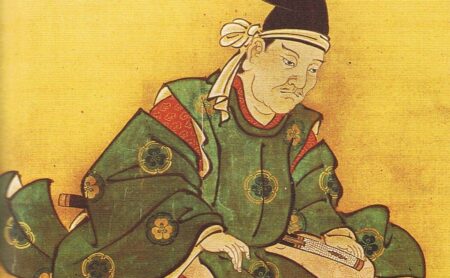
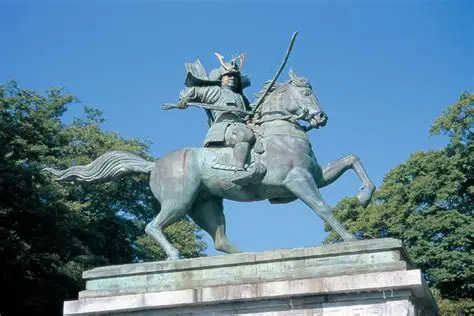
Minamoto no Yoshinaka (Kiso Yoshinaka).
He was 31 years old by traditional Japanese count.
Just six months earlier.
Yoshinaka had advanced from the Hokuriku region to Kyoto, forcing the Taira clan to flee the capital.
He defeated the Taira forces at Kurikara Pass.
He claimed victory at Shinohara as well.
And in July 1183, he entered Kyoto.
It had been about three years since he raised his banner in Shinano.
Having lost his father at a young age and raised in Kiso, this Genji warrior had risen to a position where he could influence the central political scene.
However, the situation quickly changed thereafter.
In the western provinces, the Taira clan began to regain their strength.
In Kyoto, his relationship with Emperor Go-Shirakawa deteriorated.
In the eastern provinces, his cousin Minamoto no Yoritomo was expanding his power.
Yoshinaka defeated the forces of Emperor Go-Shirakawa at the Battle of Hojuji, seizing control of Kyoto.
Then, in January of the following year.
The forces of Minamoto no Noriyori and Minamoto no Yoshitsune, dispatched by Yoritomo, broke through the defenses at Uji and Seta, causing Yoshinaka to lose Kyoto.
That same day, he retreated to Omi and met his end at Awazu.
In “The Tale of the Heike,” Yoshinaka is portrayed as a brave and compassionate figure, yet also as someone unfamiliar with Kyoto’s customs, displaying rough behavior. The National Archives of Japan also highlight these dual aspects as characteristic of Yoshinaka.
On the other hand, documents left behind reveal Yoshinaka’s efforts to secure the lands of warriors and build his power base from the moment he raised his army.
So, what kind of person was Minamoto no Yoshinaka?
How did he expand his influence from Shinano to Hokuriku and manage to drive the Taira from Kyoto?
And why did his downfall come just half a year after entering Kyoto?
This time, we will trace the 31-year life of Minamoto no Yoshinaka.
1. Minamoto no Yoshinaka, Born as the Son of Minamoto no Yoshikata
Minamoto no Yoshinaka was born in 1154.
His real name was Minamoto no Yoshinaka.
His father was Minamoto no Yoshikata.
Minamoto no Yoshikata was the son of Minamoto no Tameyoshi and the younger brother of Minamoto no Yoshitomo.
Minamoto no Yoshitomo’s son would later establish his power base in Kamakura as Minamoto no Yoritomo.
This means that Yoritomo and Minamoto no Yoshinaka (Kiso Yoshinaka) were cousins.
These two, who would later clash over Kyoto, were from the same Kawachi Genji clan.
From Yoshinaka’s childhood, fierce power struggles were ongoing within the Minamoto clan.
These conflicts would significantly alter Yoshinaka’s life.
2. The Death of His Father, Yoshikata — Moving to Kiso as a Child
In the second year of Kyūju (1155).
Yoshinaka’s father, Minamoto no Yoshikata, was killed in Okura, Musashi Province.
The attack on Yoshikata was led by Minamoto no Yoshihira.
Yoshihira was the eldest son of Minamoto no Yoshitomo and Yoritomo’s half-brother.
The young Yoshinaka lost his father.
Afterwards, Yoshinaka moved to Kiso in Shinano Province, where he was reportedly raised by Naka no Hara Kanetomo.
The National Archives also note that Yoshinaka, having lost his father Yoshikata at a young age and being raised by the Naka no Hara clan in Kiso, came to be known as “Kiso Yoshinaka.”
Stories such as those in the “Tale of the Heike” recount how Saito Sanemori saved the young Yoshinaka and helped him escape to Kiso.
These specific events should be understood as anecdotes from military tales.
The child who lost his father moved to Kiso, where he began a new chapter in his life.
The relationships he built in Kiso would later become a significant support for Yoshinaka’s forces.
3. The Network Yoshinaka Built in Kiso
From the family of Naka no Hara Kanetomo, who raised Yoshinaka, emerged key warriors who would later support him.
The most notable among them were Imai Kanehira and Higuchi Kanemitsu.
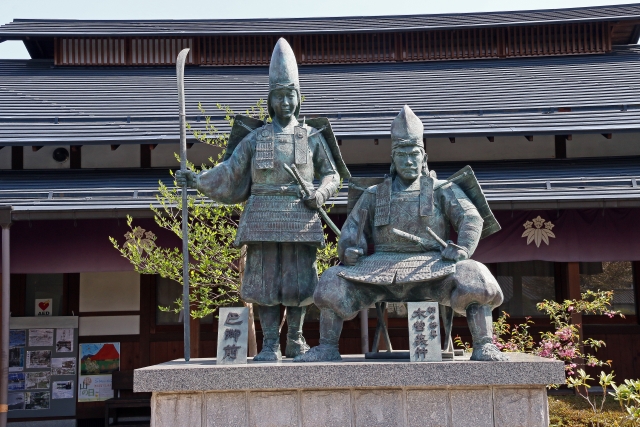
Imai Kanehira is said to have been a milk sibling of Minamoto no Yoshinaka, and after Yoshinaka raised his army, Kanehira became a central figure in the military campaigns across various regions.
The Otsu City Museum of History also introduces Yoshinaka and Imai Kanehira as milk siblings.
Tomoe, widely known from the ‘Tale of the Heike,’ is depicted as a person with a deep connection to Yoshinaka.
For Yoshinaka, Kiso was not only where he spent his youth but also the land where he formed the human connections that would support his later military endeavors.
Having lost his father, Yoshinaka found a new foundation in Kiso.
4. The Year 1180—Minamoto no Yoshinaka Raises His Army
The fourth year of the Jisho era (1180).
Spurred by the call from Prince Mochihito, son of Emperor Go-Shirakawa, to overthrow the Taira, anti-Taira movements spread across the land.
In Izu, Minamoto no Yoritomo raised his army.
In Kai, Takeda Nobuyoshi and the Kai Genji took action.
And in Shinano, Minamoto no Yoshinaka raised his forces.
According to the Nagano Prefectural Museum of History, Yoshinaka raised his army in September of the fourth year of the Jisho era to overthrow the Taira.
Furthermore, on November 13 of the same year, Yoshinaka issued a document to Fujiwara no Sukehira, acknowledging his control over his lands.
This “Kiso Yoshinaka Document” bears Yoshinaka’s own signature, and it is considered the only document with his signature that has been confirmed to date.
The document was issued about two months after he raised his army.
While leading his forces, Yoshinaka also recognized the lands of the warriors who gathered under him, establishing a network of control.
Incorporating local warriors into his ranks became the foundation for Yoshinaka’s rapid expansion.
5. The Battle of Yokota River—Consolidating Power in Shinano
In response to Yoshinaka’s expanding power, the Taira forces also took action.
The Jo clan, based in Echigo, advanced into Shinano to defeat Yoshinaka.
The fifth year of the Jisho era and the first year of the Yowa era (1181).
The two armies clashed at Yokota River.
The result was a victory for Yoshinaka’s forces.
The ‘Tale of the Heike’ describes a strategy where Yoshinaka used numerous white flags to appear as a large army, causing confusion among the enemy.
Such detailed tactics should be read as scenes conveyed by military tales.
After defeating the Jo clan at Yokota River, Yoshinaka further expanded his influence into the Hokuriku region. The National Archives of Japan also highlights the defeat of Jo Nagamochi’s forces at Yokota River as one of Yoshinaka’s remarkable advances.
Yoshinaka evolved from a regional power based in Shinano to a military leader with significant influence over the Hokuriku region.
6. Yoritomo and Yoshinaka—Two Powers from the Same Minamoto Clan
Around the same time, in the eastern provinces, Minamoto no Yoritomo was expanding his influence with Kamakura as his base.
Yoritomo and Yoshinaka were cousins.
Both raised armies against the Taira, but each established their own power base in different regions.
Yoritomo in the east.
Yoshinaka from Shinano to Hokuriku.
As their powers grew, tension began to arise between them.
Juei 2 (1183).
Yoshinaka’s son, Yoshitaka, was sent to Kamakura.
Yoshitaka was betrothed to Yoritomo’s daughter, Ohime.
Documents from Kamakura City also mention that the 11-year-old Yoshitaka was sent to Kamakura in Juei 2 as Ohime’s fiancé.
This marriage served to link Yoshinaka and Yoritomo, while also positioning Yoshitaka as a hostage.
Having avoided conflict with Yoritomo, Yoshinaka advanced his campaign against the Taira in the Hokuriku region.
7. Yoshinaka Advances in Hokuriku
Yoshinaka expanded his influence from Shinano into Hokuriku.
Warriors and local forces from various regions joined Yoshinaka’s army, increasing its size.
In addition to Yoshinaka’s own military skills, generals like Imai Kanehira and Higuchi Kanemitsu supported his forces.
Furthermore, efforts to unite local warriors and involve them in military actions continued to strengthen his power.
Juei 2 (1183).
The Taira sent a substantial army to suppress Yoshinaka, who was rapidly expanding his influence in Hokuriku.
It was here that Yoshinaka achieved one of his greatest victories.
8. The Battle of Kurikara Pass—Yoshinaka’s Greatest Victory
Juei 2 (1183).
The forces of Yoshinaka and the Taira clashed near Kurikara Pass, on the border of Etchu and Kaga provinces.
The Taira forces were led by Taira no Koremori and others.
Yoshinaka’s army emerged victorious in this battle.
The Taira suffered a significant blow, and the balance of power in Hokuriku shifted decisively in Yoshinaka’s favor.
The “fire oxen strategy,” where torches were tied to oxen horns to charge the Taira forces, is famously recounted in works like the ‘Heike Monogatari.’
This scene became widely known through later military tales.
The victory at Kurikara Pass was a pivotal event that significantly advanced Yoshinaka’s march towards Kyoto. The National Archives also highlight how Yoshinaka defeated the Taira forces at Kurikara Pass and then continued his advance westward.
Yoshinaka’s name grew in prominence in the capital due to this victory.
9.The Battle of Shinohara――The Last Stand of Saito Sanemori
After defeating the Taira forces at Kurikara Pass, Yoshinaka pursued them further.
Another battle erupted in Shinohara, Kaga Province.
This was the Battle of Shinohara.
One of the commanders who fell there was Saito Sanemori.
According to the “Heike Monogatari,” Sanemori dyed his white hair black to conceal his age from the enemy.
When Sanemori’s severed head was washed, his dyed hair turned white again.
Seeing this, Yoshinaka shed tears.
The tale further portrays Sanemori as the man who once saved the young Yoshinaka.
The National Archives also present the scene of Yoshinaka weeping over Sanemori’s head as a representative anecdote from the “Heike Monogatari.”
The specific relationship with Sanemori and the details of the scene need to be distinguished as anecdotes passed down through military tales.
This scene added a dimension of “deeply emotional warrior” to the later image of Yoshinaka.
10.The Taira’s Flight from the Capital――Reaching Kyoto Before Yoritomo
The defeats at Kurikara Pass and Shinohara severely worsened the Taira’s situation in the Hokuriku region.
Yoshinaka continued his advance towards Kyoto.
He also established ties with Enryakuji Temple on Mount Hiei, drawing closer to Kyoto.
July of the second year of Juei.
The Taira clan, accompanied by Emperor Antoku and the Imperial Regalia, left Kyoto for the western provinces.
The National Archives also describe how the Taira decided to flee the capital in response to Yoshinaka’s advance.
Subsequently, Yoshinaka entered Kyoto.
He reached the capital before Yoritomo.
Approximately three years after raising his army in Shinano.
The warrior who lost his father and grew up in Kiso had reached a position to significantly influence central politics.
This was the most dynamic period in Yoshinaka’s life.
11. Minamoto no Yoshinaka Becomes Sadaisho—From the Battlefield to the Political Center
Upon entering Kyoto, Minamoto no Yoshinaka was appointed as Sadaisho.
He is also known as the “Morning Sun General” in works like “The Tale of the Heike.” The National Archives of Japan notes that upon entering the capital, Yoshinaka was appointed Sadaisho and took control as the Morning Sun General.
From this point, Yoshinaka faced challenges of a different nature than those on the battlefield.
At the time, Kyoto was plagued by famine, food shortages, and worsening public order.
The actions of the samurai who had entered Kyoto, including arrests and disorderly conduct, also became problematic.
Emperor Go-Shirakawa called on Yoshinaka and others to restore public order.
Maintaining order in Kyoto.
Controlling a large number of samurai.
Building relationships with the court and nobility.
Pursuing the Taira clan, who had retreated to the western provinces.
Yoshinaka found himself in a position where he had to tackle many challenges simultaneously.
Having achieved a great victory on the battlefields of Hokuriku, Yoshinaka now had to navigate both political and military affairs in Kyoto.
The Battle of Mizushima—The Taira Regain Their Momentum
Having left Kyoto, the Taira clan began to rebuild their military strength in the western provinces.
In the intercalary October of the second year of Juei.
Yoshinaka’s forces clashed with the Taira army at Mizushima in Bitchu Province.
This was the Battle of Mizushima.
The result was a defeat for Yoshinaka’s side.
Though Yoshinaka had achieved a major victory against the Taira at Kurikara Pass, in the west, the Taira once again demonstrated their formidable power.
The situation surrounding Yoshinaka grew increasingly complex.
In the west, the Taira were regaining their strength.
In the east, Yoritomo was solidifying his power base.
In Kyoto, relations with Emperor Go-Shirakawa were deteriorating.
Furthermore, relations with Minamoto no Yukie were also breaking down.
The momentum Yoshinaka had upon entering Kyoto was gradually fading away.
13. Yoritomo’s Forces Begin to Enter Yoshinaka’s Former Stronghold
While Yoshinaka was struggling in Kyoto, Yoritomo’s influence continued to expand.
An intriguing document that illustrates this shift has survived.
The year was 1180.
Fujiwara no Sukehira had received confirmation of his landholdings from Yoshinaka.
However, by December 1183, the same Sukehira received a directive concerning his lands from Ano Zenjo, acting on Yoritomo’s orders.
The Nagano Prefectural Museum of History interprets this document as evidence that by the end of 1183, while Yoshinaka was still alive, Yoritomo’s control had begun to extend into northern Shinano.
Even in Shinano, which had been Yoshinaka’s stronghold, the balance of power was beginning to shift.
While Yoshinaka was dealing with the court and the Taira in Kyoto, Yoritomo was steadily expanding his influence from the east.
14.The Battle of Hojuji Temple――A Break with Emperor Go-Shirakawa
November 1183.
The conflict between Yoshinaka and Emperor Go-Shirakawa escalated into armed confrontation.
This was the Battle of Hojuji Temple.
Yoshinaka’s forces attacked the Hojuji Palace, the emperor’s residence.
In the battle, Yoshinaka’s army emerged victorious.
Yoshinaka placed Emperor Go-Shirakawa under his influence and seized political control in Kyoto.
The National Archives also recount how Yoshinaka, after entering the capital, clashed with the emperor and attacked Hojuji to seize power.
However, the armed conflict irreparably damaged his relationship with Emperor Go-Shirakawa.
As relations between the emperor and Yoritomo progressed, Yoritomo’s forces began moving toward Kyoto.
Yoshinaka, who had seized Kyoto by force, and Yoritomo, who had established a strong base in the east.
The struggle between these two Minamoto factions was heading toward a decisive battle.
15.Yoshinaka as Depicted in ‘The Tale of the Heike’――Roughness and Deep Emotion
In ‘The Tale of the Heike’, Yoshinaka’s rough behavior upon entering Kyoto is vividly portrayed.
Yoshinaka, bewildered by the customs of the capital.
Yoshinaka’s actions, differing from the norms of the courtly society.
From these scenes, the image of Yoshinaka as a “valiant country warrior” spread in later generations.
On the other hand, ‘The Tale of the Heike’ also depicts Yoshinaka’s deep emotional side.
His sorrow at the death of Saito Sanemori.
The final bond with Imai Kanehira.
Ordering Tomoe to leave the battlefield.
The National Archives also explains that, in the Heike Monogatari, Minamoto no Yoshinaka is portrayed as a deeply emotional character, yet his rough and violent nature is also emphasized.
Documents that remain reveal yet another side of Yoshinaka.
He secured his domain immediately after raising his army.
He united the local warriors.
He sent Yoshitaka to Kamakura to negotiate relations with Yoritomo.
He established connections with Mount Hiei and advanced to Kyoto.
Yoshinaka built a significant power base in a short time using both military strength and political acumen.
However, in Kyoto, he struggled to stabilize relations with the imperial court and faced simultaneous pressure from the Taira in the west and Yoritomo in the east.
Yoshinaka’s life vividly illustrates both military success and the challenges of Kyoto politics.
16. The Battle of Uji and Seta: The Collapse of Kyoto Control
January, 1184.
Forces dispatched by Yoritomo approached Kyoto.
The main commanders were Minamoto no Noriyori and Minamoto no Yoshitsune.
Noriyori advanced towards Seta.
Yoshitsune advanced towards Uji.
Yoshinaka’s forces confronted Yoritomo’s forces on two fronts.
However, at Uji, Yoshitsune’s forces broke through the defensive line.
Noriyori’s forces also advanced at Seta.
Uji and Seta.
The two crucial defensive lines protecting Kyoto from the east were breached.
Yoshinaka could no longer maintain control of Kyoto.
The timeline from the National Archives also shows the progression of Noriyori and Yoshitsune’s forces advancing into Kyoto to pursue Yoshinaka, leading to his army’s retreat.
About six months after entering Kyoto in July of the previous year.
Minamoto no Yoshinaka’s control over Kyoto ended here.
Yoshinaka left Kyoto and headed towards Omi.
17. The Battle of Awazu: Meeting His End at 31
Yoshinaka, having left Kyoto, was pursued by Yoritomo’s warriors.
He was defeated at Awazu, in the area around present-day Otsu City in Shiga Prefecture.
The Otsu City Museum of History also introduces Yoshinaka as being born in 1154, defeated at Uji and Seta in 1184, and dying in battle at Awazu.
Meanwhile, the Heike Monogatari dramatizes this end as “The Final Days of Kiso.”
A reunion with Imai Kanehira.
A farewell to Tomoe.
Yoshinaka and Kanehira fighting to the end.
And Yoshinaka trapped in a frozen marsh.
In the tales, it is said that Yoshinaka was struck down by the enemy while he was concerned about Kanehira’s situation.
These details should be read as part of a military chronicle.
In the broader historical context, Yoshinaka, having been defeated at Uji and Seta, retreated to Omi and met his end at Awazu.
He was 31 years old by traditional count.
It had been about three and a half years since he raised his army in Shinano.
After entering Kyoto, it was only about half a year.
18. Imai Kanehira—The Foster Brother Who Supported Yoshinaka to the End
When recounting the life of Yoshinaka, the presence of Imai Kanehira is indispensable.
Kanehira was raised as Yoshinaka’s foster brother and became a central figure in his forces, fighting across various regions after they raised their army.
He was with Yoshinaka from the time of his expansion, through the hardships in Kyoto, and until their final retreat.
In “The Tale of the Heike,” there is a scene where Yoshinaka and Kanehira reunite on their way to Awazu, ultimately becoming the last two standing.
Kanehira encourages Yoshinaka and takes on the enemy himself.
After learning of Yoshinaka’s death, Kanehira is said to have taken his own life.
In the traditions that remain in Otsu City, Yoshinaka and Kanehira are remembered as figures who shared their fate at Awazu.
The presence of Imai Kanehira ensured that the story of Yoshinaka’s end was passed down as a tale of strong lord-retainer bonds.
19. Tomoe—The Female Warrior Remembered Alongside Yoshinaka
Another figure widely known alongside Yoshinaka is Tomoe.
She is generally known by the name Tomoe Gozen.
In “The Tale of the Heike,” Tomoe is depicted as a female warrior skilled in archery and horsemanship.
She accompanied Yoshinaka in his retreat and is said to have been ordered by him to leave the battlefield at the end.
In “Kiso’s Last Stand,” introduced by the National Archives of Japan, there is a scene where Yoshinaka sends Tomoe away after fighting alongside her.
Tomoe’s specific actions have been passed down mainly through military chronicles like “The Tale of the Heike.”
Her story has been inherited by later literature and performing arts.
The end of Yoshinaka’s life, intertwined with the figures of Imai Kanehira and Tomoe, has remained in people’s memories.
20. After Yoshinaka’s Death—The Fate of His Son Yoshitaka
When Yoshinaka was defeated at Awazu, his son Yoshitaka was in Kamakura.
The previous year, Yoshitaka had been sent to Kamakura as the betrothed of Yoritomo’s daughter, Ohime.
With his father Yoshinaka’s opposition to Yoritomo and subsequent death, Yoshitaka’s position changed dramatically.
Yoshitaka attempted to escape from Kamakura.
It is said that Ohime tried to help Yoshitaka flee.
However, Yoshitaka was killed by pursuers.
According to records from the city of Kamakura, after Yoshinaka’s death, Yoritomo ordered Yoshitaka’s execution, and Ohime aided in his escape.
Yoshinaka himself lost his father, Yoshikata, due to internal conflicts within the Minamoto clan during his childhood.
After Yoshinaka’s death, his son also lost his life amidst the internal strife of the Minamoto.
Yoshinaka’s 31-year life was deeply intertwined with fierce power struggles within the Kawachi Genji, alongside his battles against the Taira.
21. Yoshinaka Temple—The Legacy of Minamoto no Yoshinaka Lasting Over 800 Years
The life of Minamoto no Yoshinaka came to an end in 1184 at Awazu.
Even after his death, Yoshinaka’s name has been passed down through the ages.
In Otsu, the site of his final moments, stands Yoshinaka Temple.
The temple’s name originates from the mound where Minamoto no Yoshinaka was buried.
Within the temple grounds lies Yoshinaka’s grave, which has been designated a national historic site.
Additionally, the temple is home to the grave of Edo-period haiku poet Matsuo Basho.
The story of Yoshinaka has been carried on in “The Tale of the Heike,” as well as in Noh theater, later literature, and various local legends.
A boy who lost his father and grew up in Kiso.
A military commander who raised an army in Shinano.
A military leader who defeated the Taira forces in the Hokuriku region.
A figure who advanced to Kyoto before Yoritomo and stood at the center of central politics.
And a warrior who lost Kyoto and fell at Awazu at the age of 31.
Yoshinaka left behind many faces during his brief life.
From the seal on a document from 1180, we see Yoshinaka recognizing samurai estates and attempting to build his influence.
From “The Tale of the Heike,” we see Yoshinaka’s bravery, roughness, and deep sense of compassion.
His life, from his rapid rise from Kurikara Pass to Kyoto and his retreat to Awazu in just about half a year, reflects the intense conflict between the Minamoto, Taira, and the imperial court during the Jisho-Juei War.
The name of Minamoto no Yoshinaka has endured for over 800 years because his swift rise and fall, and his stories involving people like Imai Kanehira and Tomoe, left a lasting impression on future generations.