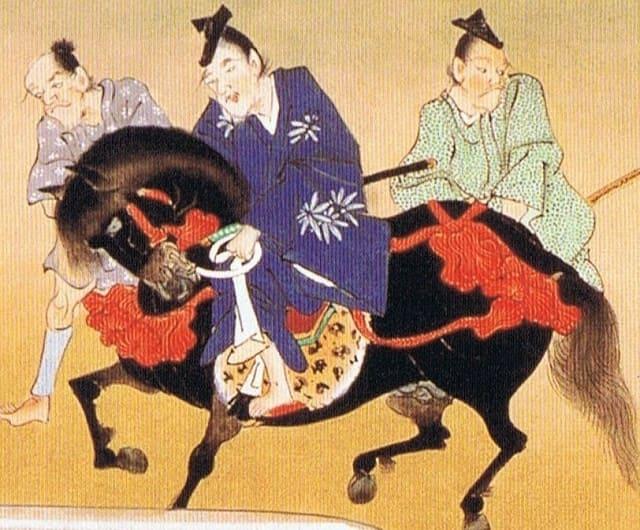
In January of 1184, the third year of the Juei era, the severed head of Minamoto no Yoshinaka was paraded through the streets of Kyoto. Following behind was a samurai.
That samurai was Higuchi Jirō Kanemitsu.
Kanemitsu was a loyal retainer of Yoshinaka and the elder brother of Imai Kanehira. Together with his lord, he had advanced from Shinano to Kyoto, engaging in numerous battles against the Taira clan. However, when Yoshinaka met his end at Awazu in Ōmi Province, Kanemitsu was on a separate mission in Kawachi Province.
According to the “Heike Monogatari,” upon learning of the deaths of Yoshinaka and his brother during his return journey, Kanemitsu instructed his troops to flee and resolved to return to Kyoto to die in battle.
Yet, Kanemitsu ultimately surrendered to the enemy.
The Kodama clan of Musashi Province intervened to save his life, and Minamoto no Yoshitsune reportedly conveyed their plea to the court. However, opposition to sparing Kanemitsu was strong, and he was eventually sentenced to death.
Once a triumphant entrant into Kyoto alongside Yoshinaka, Kanemitsu now walked the same streets as a captive, accompanying his lord’s head.
The Origins of Higuchi Kanemitsu: Son of Nakaahara Kanetō, Who Raised Minamoto no Yoshinaka
Higuchi Kanemitsu was a samurai who served Minamoto no Yoshinaka during the late Heian period.
Also known as Higuchi Jirō, he was recognized as a prominent retainer in Yoshinaka’s army. His birth year is unknown, and there are no detailed records of his early activities.
He is generally believed to be the son of Nakaahara Kanetō, a warrior from Shinano Province.
Nakaahara Kanetō was the man who raised the young Minamoto no Yoshinaka.
Yoshinaka’s father, Minamoto no Yoshikata, was killed in the Battle of Okura in Musashi Province in 1155 by Minamoto no Yoshihira.
After losing his father at a young age, Yoshinaka fled to Shinano Province, where he was raised under Kanetō’s protection.
Kanemitsu and Imai Kanehira are known as Kanetō’s sons.
Kanemitsu was the elder brother, and Kanehira the younger.
Imai Kanehira was known as Yoshinaka’s milk brother and remained by his side until the end. Kanemitsu, too, is said to have been raised like a brother to Yoshinaka.
The place name “Higuchi” remains in Tatsuno Town, Nagano Prefecture, known as a land associated with Kanemitsu.
However, there are no detailed contemporary records about Kanemitsu’s birthplace or his early life.
It is also unclear how he was raised with Yoshinaka or when he began to learn martial arts.
Imai Kanehira and Tomoe Gozen‘s Relationship
Kanemitsu’s brother, Imai Kanehira, played a crucial role in Yoshinaka’s final battle.
In the “Tale of the Heike,” Kanehira reunites with Yoshinaka at Awazu in Omi Province and attempts to protect his lord to the end.
After Yoshinaka was defeated, it is said that Kanehira also took his own life.
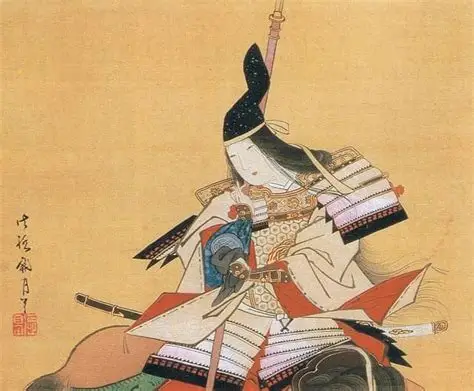
Furthermore, the female warrior known as Tomoe Gozen is traditionally said to be the daughter of Nakahara Kaneto and the sister of Kanemitsu and Kanehira.
However, Tomoe’s lineage differs among various versions of the “Tale of the Heike.”
While “The Rise and Fall of the Genpei” depicts her as Nakahara Kaneto’s daughter, other versions tell of a different genealogy.
Thus, it is impossible to definitively determine the exact familial relationship between Tomoe and Kanemitsu.
The brotherly relationship between Kanemitsu and Imai Kanehira is also mentioned in “The Tale of the Heike,” Volume Nine, “Higuchi’s Punishment.”
For Yoshinaka, the Nakahara Kaneto family were people deeply involved with him since childhood. Kanemitsu and Kanehira would later become prominent generals supporting his forces.
Kanemitsu Becomes One of the Four Heavenly Kings of Kiso
Higuchi Kanemitsu is counted as one of the Four Heavenly Kings of Kiso.
The Four Heavenly Kings of Kiso is a term referring to the four most renowned retainers who served Yoshinaka.
In the “Tale of the Heike,” the four are listed as Imai, Higuchi, Tate, and Nei.
Imai Kanehira, Higuchi Kanemitsu, Tate Chikatada, and Nei Yukichika.
Nei Yukichika was a warrior from the Saku region of Shinano Province who supported Yoshinaka’s uprising.
Tate Chikatada, his son, is said to have fought alongside his father in Yoshinaka’s army.
Kanemitsu and Kanehira also played crucial roles in Yoshinaka’s expansion of power.
However, the term “Four Heavenly Kings” appears in war tales and was not an official title at the time.
In addition to these four, many other influential warriors joined Yoshinaka’s forces.
Yoshinaka’s Uprising and the Warriors of Shinano
In 1180, uprisings against the Taira regime began across the country.
In Izu, Minamoto no Yoritomo raised an army, while in Shinano, Minamoto no Yoshinaka gathered warriors.
Yoshinaka expanded his influence by winning over the warrior bands of Shinano, eventually advancing towards the Hokuriku region.
The Nakahara family also supported Yoshinaka, with Kanemitsu and Kanehira joining his forces.
Yoshinaka’s army defeated the Taira forces in battles such as the Battle of Yokota River, intensifying their campaign in the Hokuriku region.
It is unclear whether Kanemitsu participated in all the battles from the start of the uprising.
However, the fact that Yoshinaka later entrusted him with an independent force to be dispatched to Kawachi Province indicates his significant position within the army.
The Battle of Kurikara Pass—Higuchi Kanemitsu Leading the Flanking Force
In 1183, Yoshinaka clashed with the Taira forces dispatched to the Hokuriku region.
The Taira side was led by Taira no Kiyomori’s grandson, Taira no Koremori, among others.
The two armies collided around Kurikara Pass, located on the border between Etchu and Kaga provinces.
According to the “Tale of the Heike,” Yoshinaka’s army divided into multiple units to attack the Taira forces.
In this battle, Kanemitsu emerged as a commander of the flanking force.
The flanking force is a unit that maneuvers to attack the enemy from the side or rear, in contrast to the main force attacking head-on.
The “Tale of the Heike” describes Kanemitsu leading over three thousand horsemen, using drums and conch shells to approach the enemy from behind.
Kanemitsu, accompanied by Hayashi Rokuro Mitsuaki and Togashi Nyudo, is said to have crossed Nakayama to approach the Taira forces.
Furthermore, units led by Nei Yukichika and Imai Kanehira also moved to attack the Taira forces from multiple directions, effectively surrounding them.
The troops raised a battle cry in unison, and the sound of drums and conch shells made it seem to the Taira as if a much larger army was advancing upon them.
A famous anecdote from this battle tells of torches being tied to the horns of oxen, which were then driven into the Taira forces.
However, these accounts are from the “Gikeiki,” a war chronicle.
It is difficult to confirm from contemporary records whether Kanemitsu actually led 3,000 cavalry or if the oxen attack took place.
The victory of Yoshinaka’s forces over the Taira at Kurikara Pass and the detailed tactics described in the war tales should be considered separately.
Nevertheless, it is clear from this depiction that Kanemitsu was remembered as a key commander in Yoshinaka’s army.
Yoshinaka’s forces achieved a great victory at Kurikara Pass and went on to defeat the Taira army in the subsequent Battle of Shinohara in Kaga Province.
The situation in the Hokuriku region changed dramatically, and Yoshinaka continued his advance toward Kyoto.
The Advance on Kyoto and Yoshinaka’s Predicament
In July of the second year of Juei, as Yoshinaka’s forces approached Kyoto, the Taira clan left the capital with Emperor Antoku and the Imperial Regalia.
Yoshinaka entered the capital and received orders from Emperor Go-Shirakawa to pursue the Taira.
However, his control over Kyoto was short-lived.
At that time, the effects of famine lingered in Kyoto, making it difficult to procure food.
The unruly behavior of Yoshinaka’s soldiers provoked public resentment, and relations with the court deteriorated.
Meanwhile, the Taira began to regain their strength in the western provinces.
At the Battle of Mizushima in Bitchu Province, Yoshinaka’s forces were defeated by the Taira army.
While dealing with the Taira, Yoshinaka also found himself increasingly at odds with Minamoto no Yoritomo and Emperor Go-Shirakawa.
During this time, Kanemitsu is said to have stayed in Kyoto to report on the situation to Yoshinaka.
Explanations at the Yoshinaka Residence also mention that while Yoshinaka directed his forces toward the west, Kanemitsu remained in the capital to relay information.
However, it is unclear what specific communications Kanemitsu conducted or how much he influenced political decisions.
Kanemitsu is remembered not only for his martial prowess on the battlefield but also as a warrior who supported Yoshinaka’s activities in Kyoto.
The Battle of Hōjūji—The Conflict that Changed Kanemitsu’s Fate
In November of Juei 2 (1183), the tensions between Yoshinaka and Emperor Go-Shirakawa escalated into armed conflict.
Yoshinaka launched an attack on the Hōjūji Palace, the residence of Emperor Go-Shirakawa.
This was known as the Battle of Hōjūji.
Yoshinaka’s forces defeated the imperial troops, and the palace was burned down. Many lives were lost in the battle.
Emperor Go-Shirakawa fell under Yoshinaka’s control, and influential members of the court were removed.
Although Yoshinaka temporarily seized political control of Kyoto, the Battle of Hōjūji solidified the court’s opposition against him.
Kanemitsu, as a warrior involved in this battle, is featured in war tales.
In the “Tale of the Heike,” it is recounted that when Kanemitsu was later captured, the actions of Yoshinaka’s army during the Battle of Hōjūji were called into question.
It is said that as Yoshinaka’s forces advanced, cries of “Imai” and “Higuchi” echoed throughout the palace.
The “Gikeiki” provides further details, describing how women serving at the palace were captured and stripped of their clothing, suffering humiliation.
However, the specific orders given by Kanemitsu and his actual actions remain unclear.
It is important to be cautious in attributing the actions depicted in war tales directly to Kanemitsu himself.
The attack on Emperor Go-Shirakawa’s palace by Yoshinaka’s forces during the Battle of Hōjūji left a deep resentment within the court.
This resentment would later affect Kanemitsu’s fate the following year.
Conflict with Minamoto no Yukie—Kanemitsu’s Campaign to Kawachi
As Yoshinaka’s position in Kyoto became increasingly precarious, his relationship with his uncle, Minamoto no Yukie, also deteriorated.
Minamoto no Yukie was a son of Minamoto no Tameyoshi and a brother to Yoshinaka’s father, Minamoto no Yoshikata.
He is known for delivering the imperial edict of Prince Mochihito to various Minamoto clans, and he was involved in the uprising against the Taira clan.
Initially, Yukie visited Minamoto no Yoritomo, but due to disputes over land holdings, he later allied with Yoshinaka.
However, after advancing to Kyoto, he fell out with Yoshinaka as well.
Yukie then led an expedition to the western provinces, but was defeated by the Taira forces at the Battle of Muroyama in Harima Province.
Subsequently, he is said to have entered Nagano Castle in Kawachi Province, attempting to maintain his own power base.
Nagano Castle in Kawachi Province and the Ishikawa Clan
According to the history of Tondabayashi City, Yukie’s forces at this time included Ishikawa Yoshikane, a warrior from Kawachi Province.
Ishikawa Yoshikane was a member of the Ishikawa clan, which held power in southern Kawachi.
Nagano Castle is thought to have been either Yoshikane’s stronghold or within his sphere of influence, as he supported Yukie.
After entering Nagano Castle, Yukie extended his control from southern Kawachi to the Izumi area.
It is also recorded in later documents that he adjudicated complaints from farmers in Izumi Province.
Yukie was attempting to secure his own power, independent of Yoritomo and Yoshinaka’s command.
For Yoshinaka, who was preparing to confront Yoritomo’s advancing forces towards Kyoto, Yukie’s presence in Kawachi was a concern.
Thus, Yoshinaka dispatched Kanemitsu.
The Mission Entrusted to Kanemitsu by Yoshinaka
According to the “Hogen Monogatari,” volume nine, “Higuchi’s Punishment,” Kanemitsu led over five hundred horsemen to Nagano Castle in Kawachi Province.
The target of the campaign was Minamoto no Yukie.
However, Yukie had already left Nagano Castle, and Kanemitsu was unable to capture him.
Hearing that Yukie was in Namikusa, Kii Province, Kanemitsu continued his pursuit.
Meanwhile, the “Azuma Kagami” entry for January 21, 1184, notes that Kanemitsu was dispatched to Kawachi to defeat Ishikawa Hangan-dai.
Ishikawa Hangan-dai is believed to be Ishikawa Yoshisuke, Yoshikane’s uncle.
While “Hogen Monogatari” cites Minamoto no Yukie and “Azuma Kagami” mentions Ishikawa Hangan-dai, there is a discrepancy in the target of the campaign.
Nevertheless, Yukie and the Ishikawa clan were collaborating in Kawachi.
The common point is that Kanemitsu, under Yoshinaka’s orders, launched an expedition to the Kawachi area.
According to the history of Tondabayashi City, based on records such as the “Gyokuyou,” this military expedition is organized as an event that took place on January 19, 1184.
This was the day before Yoritomo’s forces attacked Kyoto.
Yoshinaka had Kanemitsu, a powerful military commander, leave Kyoto to deal with hostile forces in the Kawachi area.
However, the following day, Yoshinaka’s army would suffer a significant defeat.
The Defeat at Uji River and Seta—The Death of Yoshinaka and Imai Kanehira
On January 20, 1184, the forces of Minamoto no Noriyori and Minamoto no Yoshitsune attacked Kyoto.
Noriyori advanced from the Seta area in Omi Province, while Yoshitsune moved in from the Uji area in Yamashiro Province.
Yoshinaka deployed troops to both areas to try to prevent their entry into Kyoto.
According to the “Heike Monogatari,” Imai Kanehira defended the Seta area, while warriors like Nei Yukichika and Tate Chikata fought in the Uji area.
However, Yoshitsune’s forces broke through at Uji River.
In the Seta area as well, Yoshinaka’s forces were at a disadvantage, and the defense line of Kyoto collapsed.
Yoshinaka fled the capital towards Omi.
According to the “Heike Monogatari,” Yoshinaka reunited with Imai Kanehira near Uchidehama in Otsu.
The two continued to fight against the pursuing enemy forces, but their allies were defeated one after another, leaving only five riders.
Among them was Tomoe, who left the battlefield on Yoshinaka’s orders.
Although Yoshinaka and Kanehira continued to fight, Yoshinaka was killed at Awazu in Omi Province.
Imai Kanehira, upon learning of his lord’s death, is said to have taken his own life.
There is a discrepancy regarding Yoshinaka’s death: the “Azuma Kagami” records it as January 20, while the “Heike Monogatari” Kakuichibon version states it was the 21st.
At that time, Kanemitsu was in the Kawachi area.
While Yoshinaka and Kanehira were fighting their final battle, Kanemitsu was leading another force in pursuit of Minamoto no Yukie.
The Great Crossing at Yodo—Learning of His Lord and Brother’s Death
The “Heike Monogatari,” Volume Nine, “Higuchi’s Punishment,” begins with Kanemitsu being informed of Yoshinaka and his brother’s deaths.
Having been dispatched to the Kawachi area, Kanemitsu hurried back upon hearing of the battle in Kyoto.
On the way, near the bridge at Yodo’s Owatari, he encountered a retainer of Imai Kanehira.
When Kanemitsu inquired about the situation in Kyoto, the retainer informed him that Yoshinaka had already been defeated and that Imai Kanehira had also taken his own life.
Kanemitsu wept.
He then addressed the soldiers who were with him.
He urged those who remained loyal to Yoshinaka to flee and survive, so they could pray for their lord’s soul.
As for himself, he intended to head to Kyoto and fight the enemy, even if it meant dying in battle.
He expressed a desire to meet Yoshinaka again in the afterlife, and to see his brother Kanehira once more.
Such were the words of Kanemitsu as recorded in the ‘Tale of the Heike.’
It is said that having lost both his lord and brother, Kanemitsu intended to lay down his own life on the battlefield.
However, there are no contemporary records that confirm this conversation actually took place.
Meanwhile, the ‘Azuma Kagami’ also notes that Kanemitsu learned of Yoshinaka’s defeat on his way back.
According to this account, Kanemitsu received the news near Owatari in Yamashiro Province, yet still intended to proceed to Kyoto.
Though the details differ, both the ‘Tale of the Heike’ and the ‘Azuma Kagami’ agree that Kanemitsu learned of his lord’s death on his return journey and still chose to advance toward Kyoto.
From Over 500 Riders to Just Over 20
According to the ‘Tale of the Heike,’ when Kanemitsu set out for Kawachi, his forces numbered over 500 riders.
However, after learning of Yoshinaka’s death, the soldiers began to desert one by one.
Kanemitsu did not force them to stay.
He told them there was a path to survival in living on to honor their lord, and he let those who wished to flee depart.
Thus, the numbers dwindled, and by the time they passed the southern gate of Toba, only a little over 20 riders remained.
These figures are drawn from war tales and do not confirm the actual numbers.
The narrative illustrates how the cohesion of the forces dissolved following Yoshinaka’s defeat, leading to a rapid decline in those who followed Kanemitsu.
Yet, some warriors continued to accompany Kanemitsu toward Kyoto.
Among them was Chino Taro Mitsuhiro, a warrior from Suwa in Shinano Province.
Chino Taro Mitsuhiro—The Warrior Who Wanted to Show His Brother the End
According to the ‘Tale of the Heike,’ Chino Taro Mitsuhiro was among the warriors in Kanemitsu’s forces.
Mitsuhiro was a resident of the Upper Shrine in Suwa, Shinano Province, and was said to be the son of Chino Dafu Mitsuie.
As Kanemitsu approached Kyoto, Yoritomo’s warriors gathered near Shichijo, Suzaku, and Shitsuka, attempting to block their path.
At that moment, Mitsuhiro charged alone into the enemy ranks.
Mitsuhiro called out loudly, asking if there was anyone among the forces of Ichijo Jiro Tadayori from Kai.
The enemy warriors laughed, wondering why he was searching only for Ichijo Jiro’s forces.
It is said that Mitsuhiro then introduced himself and explained his reason.
Among Ichijo Jiro’s forces was his brother, Kayano Shichiro.
Mitsuhiro had two children he had left behind in Shinano.
His children would surely want to know how their father met his end.
He intended to die in battle before his brother, so that his brother could recount the story accurately to his children.
After that, Mitsuhiro charged into the enemy ranks.
According to the “Heike Monogatari,” he killed three warriors, grappled with a fourth, fell from his horse, and died in a mutual kill.
Whether the details of this battle are factual cannot be confirmed.
However, it illustrates the division among Shinano warriors, with some siding with Yoshinaka and others with Yoritomo.
Mitsuhiro and Kayano Shichiro are depicted as brothers who found themselves on opposing sides.
The defeat of Yoshinaka’s army brought different fates to the warriors who followed him, including Kanemitsu.
The Connection with the Kodama Clan—The Help Extended to Kanemitsu
Even after learning of Yoshinaka and his brother’s deaths, Kanemitsu continued toward Kyoto, only to eventually become a prisoner of Yoritomo’s forces.
The “Heike Monogatari” explains this through Kanemitsu’s relationship with the Kodama clan of Musashi Province.
The Kodama clan was a warrior group based in Kodama District, Musashi Province.
They were headquartered in what is now northwestern Saitama Prefecture and were known as a powerful warrior clan in the Kanto region.
Kanemitsu was said to have had a deep connection with the Kodama clan.
The “Heike Monogatari” records that Kanemitsu had formed ties with the Kodama clan.
This relationship is sometimes interpreted as being through marriage, but due to variations in historical texts, it is difficult to establish a definitive genealogy.
The “Azuma Kagami” also notes that Kanemitsu was on friendly terms with the people of the Kodama clan.
The Kodama Clan’s Offer of Clemency
According to the “Heike Monogatari,” the Kodama clan learned that Kanemitsu was trying to return to Kyoto and gathered to discuss the matter.
They decided to help Kanemitsu.
Forming alliances with other clans was a way for warriors to ensure mutual assistance in times of need.
It was thought that Kanemitsu had formed ties with them for this very reason.
The Kodama clan sent a messenger to Kanemitsu.
Yoshinaka had already been defeated, and Imai Kanehira was also dead.
They urged him not to continue fighting but to surrender to them.
In exchange, they offered to use the merits they earned in this battle to plead for Kanemitsu’s life to be spared.
Kanemitsu accepted this.
In the “Tale of the Heike,” Kanemitsu, who was a renowned warrior, is depicted as having surrendered because his luck had run out.
It is unclear what Kanemitsu was thinking when he decided to surrender.
However, the story conveys that he entrusted his fate to the possibility of survival by accepting the Kodama clan’s offer.
In the “Azuma Kagami,” He Was Captured After Battle
On the other hand, the “Azuma Kagami” entry for January 21, Juei 3, presents a different account of Kanemitsu’s capture.
Kanemitsu, despite knowing of Yoshinaka’s death near the Owatari of Hachiman, still attempted to enter Kyoto.
There, Yoshitsune’s retainers rushed in and captured Kanemitsu alive after a battle.
Thus, “The Tale of the Heike” records his surrender to the Kodama clan, while the “Azuma Kagami” describes his capture by Yoshitsune’s retainers.
However, the “Azuma Kagami” entry for February 2 also notes that the Kodama clan petitioned for Kanemitsu’s life to be spared.
Though there are differences in the specific circumstances of Kanemitsu’s capture, multiple sources indicate that his connection with the Kodama clan influenced his treatment.
Minamoto no Yoshitsune Also Conveyed the Plea for Mercy to the Court
The Kodama clan acted to save Kanemitsu’s life.
According to the “Tale of the Heike,” upon receiving the request from the Kodama clan, the matter was relayed to Yoshitsune through Minamoto no Noriyori.
Yoshitsune then conveyed this plea to Emperor Go-Shirakawa.
The “Tale of the Heike” narrates that Kanemitsu was initially granted a reprieve from execution.
However, there was strong opposition from the court officials.
The “Azuma Kagami” entry for February 2 also records that the Kodama clan requested Kanemitsu’s life be spared as a reward for their service, and Yoshitsune reported this to the court.
However, the “Azuma Kagami” does not mention that clemency was ever granted.
It was ultimately decided that Kanemitsu’s crimes were too severe, and he was not pardoned.
There are later stories that Yoshitsune valued Kanemitsu’s bravery and considered making him a retainer.
However, at least from the relevant “Azuma Kagami” entry, it is confirmed only that Yoshitsune conveyed the plea for mercy to the court.
Between Kanemitsu’s capture and execution, there were efforts by enemy warriors to plead for his life.
The Kodama clan, who had ties with Kanemitsu, played a central role in these efforts.
The Battle of Hojuji Temple Grudge—Court Opposition That Blocked Clemency
The efforts to save Kanemitsu’s life faced strong opposition from the court.
The issue at hand was the Battle of Hojuji Temple in the previous November.
Yoshinaka’s forces attacked the palace of Emperor Go-Shirakawa, resulting in the deaths of many on the emperor’s side.
According to the ‘Tale of the Heike’, when the story of Kanemitsu’s pardon spread, courtiers, nobles, and women serving in the palace strongly opposed it.
When the Hojuji Palace was under attack, cries for Imai and Higuchi could be heard throughout the palace.
They could not accept the idea of pardoning that person.
Women of the Palace as Depicted in the ‘Gikeiki’
The ‘Gikeiki’ provides a more detailed depiction of the opposition to Kanemitsu.
During the Battle of Hojuji, women serving in the palace were captured and subjected to humiliation, such as having their clothes taken.
When they learned of Kanemitsu’s potential pardon, they strongly opposed it.
They reportedly declared that if Kanemitsu were spared, they would become nuns, leave the palace, or even throw themselves into the river.
However, this is a depiction from a war tale.
There are no definitive records confirming what actions Kanemitsu personally took or what orders he gave.
Therefore, it is not possible to attribute all the harm allegedly suffered by the women to Kanemitsu’s individual actions.
On the other hand, the deep resentment left on the imperial side by the Battle of Hojuji is an important issue when considering Kanemitsu’s fate.
While Kanemitsu, a retainer of Yoshinaka, was being considered for pardon, those harmed by Yoshinaka’s forces sought punishment.
The Danger of Sparing the Kiso Four Heavenly Kings
Another reason Kanemitsu’s pardon was not granted was the caution against keeping powerful military commanders alive.
In the ‘Tale of the Heike’, Kanemitsu being one of the Kiso Four Heavenly Kings was seen as a problem.
Imai, Higuchi, Tate, and Nei.
If Kanemitsu, one of the commanders who supported Yoshinaka, were pardoned, it might lead to future trouble.
This danger is likened to keeping a tiger.
The ‘Gikeiki’ also records similar concerns.
Kanemitsu was a powerful commander in Yoshinaka’s army, with the ability to lead troops and connections with other warrior groups.
There was a concern that even after Yoshinaka’s death, his retainers might gather troops again.
Thus, Kanemitsu was ultimately sentenced to death.
Kanemitsu Accompanying Yoshinaka’s Head
According to the ‘Tale of the Heike’, on January 24, 1184, the heads of Yoshinaka and his retainers were paraded through the streets of Kyoto.
Kanemitsu had already been taken prisoner.
However, it is said that he requested to follow his lord’s head.
The request was granted.
Kanemitsu is described as wearing indigo-dyed clothes and a tall eboshi hat, walking through the main streets of the capital with the heads of Yoshinaka and others.
On the other hand, the Azuma Kagami records the event of Yoshinaka’s head being displayed as occurring on January 26.
According to the same source, the heads of Yoshinaka, Imai Kanehira, and Nei Yukichika were handed over at Shichijo Riverbank and displayed before the prison gate.
It is recorded that the captive Kanemitsu was also made to accompany them.
There is a discrepancy in the dates between the Heike Monogatari and the Azuma Kagami, and the explanation that Kanemitsu himself requested to accompany them is not found in the Azuma Kagami.
Nevertheless, the overarching narrative that Kanemitsu, as a captive, walked through the capital with Yoshinaka’s head remains consistent.
The Genpei Seisuiki depicts Kanemitsu as being made to walk barefoot, mocked by onlookers.
After the victory at Kurikara Pass, he entered Kyoto with Yoshinaka.
In that capital, Kanemitsu became a captive, following his lord’s head.
The portrayal of Kanemitsu in the Heike Monogatari intertwines with the rise and fall of Yoshinaka’s army.
The Execution of Higuchi Kanemitsu—Varying Dates in Historical Records
Kanemitsu was not granted clemency and was executed in Kyoto.
However, there are discrepancies in the dates of his execution across different sources.
The published text of the Heike Monogatari includes versions that date the event to both January 25 and 26, requiring careful attention to textual variations.
The Genpei Seisuiki records Kanemitsu’s execution as occurring on January 27.
Meanwhile, the Azuma Kagami treats it as an event on February 2.
While it is agreed that Kanemitsu was captured after Yoshinaka’s death and executed in Kyoto, determining the exact date requires careful consideration.
Shibuya Shigekuni and Takashige as Recorded in the Azuma Kagami
The entry for February 2 in the Azuma Kagami provides detailed information on Kanemitsu’s execution.
It is said that the order for execution was given to Shibuya Shigekuni, a samurai from Sagami Province.
Shigekuni attempted to have his retainer Heita carry out the beheading of Kanemitsu.
However, Heita failed in the task.
Thus, Shigekuni’s son, Shibuya Takashige, took over and beheaded Kanemitsu.
Takashige, having been injured in the battle on January 20, performed the beheading with one hand.
However, this account raises questions from a source-critical perspective.
Issues Remaining in the Execution Account
Yamaguchi Michihiro’s research paper, “On the Shibuya Clan Entries in the Azuma Kagami—Interpretation of the Entry for February 2, Juei 3,” thoroughly examines the Azuma Kagami‘s account of Kanemitsu’s execution.
This study, through comparisons with various versions of the Heike Monogatari and the Genpei Tōjōroku, questions the reliability of the February 2 execution date and the portrayal of Shibuya Takashige performing the beheading with one hand.
Particularly, the descriptions surrounding the Shibuya clan’s family relations and executions raise questions about how these narratives were formed over time.
The Azuma Kagami is a historical chronicle compiled after the establishment of the Kamakura shogunate, and its accounts cannot be uniformly treated as contemporary facts.
Multiple historical sources report that Kanemitsu was executed.
However, the date of execution, the executor, and the specific method remain subjects of differing accounts among sources.
Imai Kanehira and Higuchi Kanemitsu—Brothers Who Met Different Ends
Kanemitsu and Imai Kanehira supported Minamoto no Yoshinaka as sons of Nakahara Kanetomo.
From Yoshinaka’s uprising to the battles in Hokuriku and the advance into Kyoto, the brothers were central figures in the army’s operations.
However, when Yoshinaka’s forces collapsed, the two were in different locations.
Kanehira defended the Seta area and reunited with the retreating Yoshinaka in Omi Province.
The Tale of the Heike recounts that after Yoshinaka was killed at Awazu, Kanehira also took his own life.
Meanwhile, Kanemitsu had been dispatched to Kawachi Province.
On his return, he learned of Yoshinaka and his brother’s deaths and attempted to return to Kyoto.
The Tale of the Heike states that although Kanemitsu sought to die in battle, he surrendered upon the request of the Kodama clan.
Subsequently, despite the possibility of clemency, he ultimately faced execution.
The younger brother perished on the same battlefield as Yoshinaka, while the elder was captured after his lord’s death and executed in Kyoto.
The difference in their fates is linked to the roles they were assigned when Yoshinaka’s army fell apart.
Kanehira remained close to Yoshinaka, while Kanemitsu led a separate force.
Moreover, the Kodama clan’s intervention in Kanemitsu’s plea for clemency suggests that various connections persisted among the warriors, despite being on opposing sides.
The warriors who made up Yoshinaka’s forces had ties not only through personal loyalty to Yoshinaka but also through regional and familial connections.
Kanemitsu’s capture and the plea for his life were events that highlighted these relationships.
Higuchi Kanemitsu as Depicted in Hirakana Seisuiki
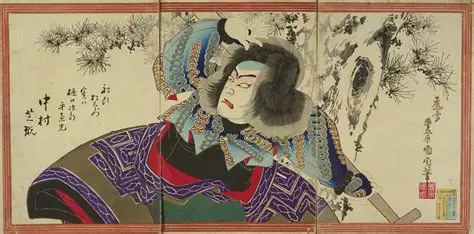
The story of Higuchi Kanemitsu was passed down through later puppet theater and kabuki performances.
A representative work is Hirakana Seisuiki.
Hirakana Seisuiki is a piece based on the Genpei War, depicting the fates of those left behind after Minamoto no Yoshinaka’s death.
The “Reverse Yoke” scene is particularly well-known.
The True Identity of Matsuemmon, the Boatman
The story unfolds around Matsuemmon, a boatman living in Fukushima, Settsu Province.
Matsuemmon became the son-in-law of the boatman Gonshiro and learned the art of navigating ships from him.
However, his true identity was Higuchi Jiro Kanemitsu.
He survived after the death of Minamoto no Yoshinaka and was waiting for a chance to avenge his lord by defeating Yoshitsune.
Matsuemmon mastered the technique of rowing a ship backward and aimed to become the captain of the ship carrying Yoshitsune.
His goal was to get close to Yoshitsune and exact his revenge.
Meanwhile, at Gonshiro’s household, a commotion arose over a mix-up involving a child.
The child Gonshiro raised as his grandchild was actually Koma Wakamaru, the orphan of Minamoto no Yoshinaka.
Matsuemmon revealed his true identity and sought to protect Koma Wakamaru.
Eventually, his true identity became known to those around him, and Kanemitsu found himself surrounded by captors.
In the story, Hatakeyama Shigetada also appears and becomes involved in the events surrounding Kanemitsu and Yoshinaka’s orphan.
In ‘Hirakana Seisuiki,’ Kanemitsu is portrayed as a warrior who, while desiring to avenge Yoshinaka, also seeks to protect his child.
Historically, Kanemitsu was captured and executed shortly after Yoshinaka’s death.
Therefore, the story of Matsuemmon in ‘Hirakana Seisuiki’ is an Edo period creation that differs from historical fact.
Nevertheless, the depiction of Kanemitsu as a loyal warrior to Yoshinaka resonates with the character portrayal in ‘The Tale of the Heike.’
Places and Legends Associated with Higuchi Kanemitsu
In Tatsuno Town, Nagano Prefecture, there is the Higuchi district, known as a place associated with Kanemitsu.
The Yoshinaka Museum introduces this area as land connected to Kanemitsu’s name.
Additionally, in the Hiyoshi district of Kiso Town, there are historical sites related to Yoshinaka and the Naka no Haru Kanetomo family.
There are also places said to have been Kanemitsu’s residence, though not all can be confirmed by contemporary sources.
Explanations based on later geographical records and local legends are also included.
There are also legends about Kanemitsu’s descendants in various places.
However, it is difficult to trace the names of the children and the subsequent family lineage through reliable historical sources.
Kanemitsu was a warrior said to have been executed in Kyoto.
Yet, his image as a retainer of Yoshinaka has been passed down through Shinano legends, ‘The Tale of the Heike,’ and kabuki, among other forms.
The Final Days of Higuchi Kanemitsu
In January of the third year of Juei, Higuchi Kanemitsu was ordered by Yoshinaka to deploy to Kawachi Province.
The mission was to defeat the forces of Minamoto no Yukie and the Ishikawa clan.
However, while Kanemitsu was away from Kyoto, the forces of Noriyori and Yoshitsune attacked the capital, leading to the destruction of Yoshinaka’s army.
Kanemitsu learned of his lord and brother’s deaths on his way back.
‘The Tale of the Heike’ recounts that Kanemitsu told his soldiers to flee and intended to return to Kyoto to die in battle.
However, Kanemitsu was captured alive.
The Kodama clan attempted to save his life, and Yoshitsune also conveyed a plea for clemency to the court.
However, during the Battle of Hojuji, strong opposition arose from those attacked by Minamoto no Yoshinaka’s forces.
There was also concern about allowing powerful commanders from Yoshinaka’s army to survive.
Kanemitsu was not granted clemency and was executed.
The “Heike Monogatari” depicts Kanemitsu, as a captive, walking along the main streets of Kyoto following Yoshinaka’s head.
The account of Kanemitsu requesting to follow his lord’s head highlights his deep connection with Yoshinaka.
Once, Kanemitsu had defeated the Taira forces and entered the capital with Yoshinaka.
Now, in that same capital, he found himself walking as a prisoner behind his lord’s head.
The exact date and method of his execution vary across sources, and what Kanemitsu thought in his final moments remains unknown.
Nevertheless, multiple sources recount that after Yoshinaka’s death, enemy warriors attempted to save Kanemitsu’s life, though he was ultimately executed.
In “Heike Monogatari” Volume Nine, following the depiction of Yoshinaka and Imai Kanehira‘s final moments in “The Last Stand of Kiso,” the section “Higuchi’s Punishment” addresses Kanemitsu’s fate.
Even after Yoshinaka’s life ended at Awazu, efforts concerning Kanemitsu’s life persisted.
And shortly after Yoshinaka’s death, Kanemitsu also lost his life in Kyoto.
Main Reference Sources
Primary Sources
- “Heike Monogatari” Volume Nine “Higuchi’s Punishment” “The Last Stand of Kiso”
- “Genpei Seisuiki” sections on the Battle of Kurikara and Kanemitsu’s execution
- “Azuma Kagami” entries for January 21 and 26, February 2, Juei 3
- Kujō Kanezane’s “Gyokuyō” entries for Intercalary October 27, Juei 2, and January 19, Juei 3
- “Genpei Tōjōroku”
- “Enkyōbon Heike Monogatari”
Research and Explanatory Materials
- “Tondabayashi City History” Volume Two “Ishikawa Yoshikane and Nagano Castle”
- Yamaguchi Michihiro, “On the Shibuya Clan Entries in Azuma Kagami: Interpretation of the Juei 3, February 2 Entry,” “Chiba University Law Review,” Vol. 32, No. 1-2, 2017
- Yoshinaka Museum “Higuchi”
- Ueda City “Minamoto no Yoshinaka’s Armed Procession Related Person Introductions”
- Ritsumeikan University Art Research Center “Fire Oxen”
- Kabuki Performance Guide: ‘Hirakana Seisuiki’
- Shōchiku’s ‘Hirakana Seisuiki’ Work Commentary