July 25, 1183, Kyoto.
As Minamoto no Yoshinaka’s forces approached, Taira no Tokitada rushed to the Imperial Palace.
Emperor Antoku was preparing to leave the capital. Emperor Go-Shirakawa had already fled to Mount Hiei. Taira no Munemori and his clan were hastily preparing to head west.
Tokitada took charge of transporting the sacred mirror and the treasures of the Imperial Palace.
His efforts on that day are recorded in Yoshida Tsunefusa’s diary, “Kikki.”
Tokitada managed the removal of the sacred mirror from the Naishidokoro, as well as the famous biwa “Genjo,” among other treasures. Many of the courtiers had already fled, leaving Tokitada to oversee the operation alone.
At the time, Tokitada held the rank of Senior Second Rank and Provisional Grand Counselor.
He was the brother of Taira no Kiyomori’s wife, Tokiko, and the great-uncle on the maternal side of Emperor Antoku.
During the period when Kiyomori wielded power at court, Tokitada also rose through the ranks, serving three times as the head of the Kebiishi.
The “Tale of the Heike” preserves words attributed to Tokitada.
“Those who are not of this clan are surely not human.”
This phrase later became known as “If you are not a Taira, you are not a person.”
However, two years after leaving Kyoto, the Taira clan met their end at Dan-no-ura.
Tokitada was captured by the Minamoto and gave his daughter in marriage to Yoshitsune.
Then, on September 23, 1185, he was exiled to Noto Province, leaving Kyoto once again.
Once a Grand Counselor who influenced court appointments, he could not overturn Minamoto no Yoritomo’s decision.
This was Tokitada’s third exile.
In his youth, he had been exiled twice to Izumo Province, returning to Kyoto each time.
Despite repeated political downfalls, he rose through the ranks to become Chief of the Kurando-dokoro, Councillor, Provisional Middle Counselor, and Provisional Grand Counselor.
About three and a half years after his final exile, news of Tokitada’s death in Noto reached Kamakura.
According to the “Azuma Kagami,” Yoritomo lamented his passing.
The Son of Taira no Tokinobu—A Different Line of the Taira Clan from Kiyomori
Taira no Tokitada was born as the son of Taira no Tokinobu in the late Heian period.
There are various theories about his birth year.
The “Nihonshi Kojiten” by Yamakawa Publishing suggests he was born in 1127, while calculations from “Kugyobunin” suggest 1130. Neither matches the age recorded in the “Azuma Kagami.”
His father, Tokinobu, was a court noble serving Emperor Toba.
Tokitada’s family belonged to the Kanmu Heishi Takamune line, traditionally serving in court positions.
Kiyomori’s family was a different branch of the Kanmu Heishi, expanding their influence as warriors in regions like Ise Province.
Tokitada, though sharing the Taira surname with Kiyomori, was raised as a court official.
His siblings included Taira no Chikamune, Taira no Tokiko, and Taira no Shigeko.
Among them, Tokiko became the principal wife of Taira no Kiyomori.
She was the mother of Munemori, Tomomori, Shigehira, and Kenreimon-in Tokuko.
Another sister, Shigeko, was favored by Emperor Go-Shirakawa and gave birth to Prince Norihito, who would later become Emperor Takakura.
She was known as Kenshunmon-in.
Tokitada and Tokiko were considered full siblings, while Shigeko was thought to have a different mother.
Through his sister Tokiko, Tokitada became related by marriage to Kiyomori, and through his sister Shigeko, he gained proximity to the court of Emperor Go-Shirakawa.
Kiyomori expanded his influence with military power.
Emperor Go-Shirakawa led the cloistered government.
Tokitada maintained deep connections with both, steadily advancing in court ranks.
However, he was not appointed to high office from a young age.
In the second year of Kyuan (1146), he became a non-courtier, and the following year, he held various positions such as courtier, assistant professor, and left guard officer.
In the fourth year of Kyuan, he also served as a police commissioner.
By the fifth year of Kyuan (1149), he was promoted to Junior Fifth Rank, Lower Grade.
This marked the beginning of his career as a court official handling practical affairs.
What significantly altered Tokitada’s life was the birth of his sister Shigeko’s child.
The First Year of Oho—The Struggle Over the Newborn Prince
In September of the first year of Oho (1161).
Tokitada’s sister, Shigeko, gave birth to a prince of Emperor Go-Shirakawa.
This was Prince Norihito.
The reigning emperor at the time was Emperor Nijo.
Despite being the son of Emperor Go-Shirakawa, there was ongoing conflict between father and son over political leadership.
Tokitada was reportedly involved in efforts to establish the newborn Prince Norihito as crown prince.
Emperor Nijo had not yet fathered a prince.
If Prince Norihito were to become crown prince, his mother Shigeko would gain the status of the future emperor’s mother.
Her brother Tokitada would also become deeply involved in the imperial succession.
However, this move provoked opposition from Emperor Nijo’s side.
On September 15, Tokitada was relieved of his official duties.
By June 23 of the following year, the second year of Oho (1162), it was decided that he would be exiled to Izumo Province.
Less than a year after his sister gave birth to a prince, Tokitada was banished from Kyoto.
Tokitada was in his thirties at the time.
He lost his official position at a time when he was aiming for advancement in the court.
There are no detailed records of how he lived during his exile in Izumo.
Meanwhile, even while Tokitada was away from the capital, the situation regarding imperial succession continued to evolve.
In July of the first year of Eiman (1165), Emperor Nijō passed away.
The throne was succeeded by the young Emperor Rokujō.
Retired Emperor Go-Shirakawa strengthened his influence at court and moved to appoint Prince Norihito as Crown Prince.
On September 14 of the same year,
Tokitada was summoned back from Izumo.
His exile, which had lasted over three years, came to an end.
Return from Izumo—Promotion to Kurōdo no Tō and Sangi
In March of the first year of Nin’an (1166),
Tokitada was reinstated to the rank of Senior Fifth Rank, Lower Grade.
In April, he became the Left Minor Controller, and by June, he was appointed Right Middle Controller, also serving as a kebiishi.
On November 16, he was appointed Kurōdo no Tō.
The Kurōdo no Tō was a crucial position, handling imperial documents and orders as a close aide to the Emperor.
This role was filled by officials well-versed in daily governance, working closely with the Emperor.
Having once been exiled to Izumo, Tokitada returned to the heart of the court in Kyoto in just over a year.
In October of the same year, Prince Norihito was appointed Crown Prince.
The prince, whom Tokitada had once tried to support and was punished for, became the legitimate heir to the throne.
On February 11 of the second year of Nin’an (1167), Tokitada was promoted to Sangi.
He joined the ranks of the kugyō, the high-ranking courtiers.
That year, his brother-in-law Kiyomori assumed the position of Daijō Daijin.
While Kiyomori rose to an unprecedented position for a warrior, Tokitada also advanced to high office as a court official.
In February of the third year of Nin’an (1168),
Emperor Rokujō abdicated, and Prince Norihito ascended the throne.
He became Emperor Takakura.
He was eight years old by traditional count.
To Tokitada, he was the son of his sister.
After the new emperor’s accession, Tokitada was promoted to Junior Third Rank, and by July, he became the head of the kebiishi.
In August, he rose to Senior Third Rank and Acting Middle Counselor.
The head of the kebiishi was the chief of the office responsible for maintaining public order and apprehending criminals in Kyoto.
Returning from exile, Tokitada became a high-ranking court official and took on the role of overseeing the capital’s security.
However, the following year, he was once again exiled to Izumo.
The First Year of Kaō—Second Downfall Due to Enryakuji’s Protest
In December of the first year of Kaō (1169),
the monks of Enryakuji descended upon Kyoto.
The conflict arose from a dispute over the manorial rights of Enryakuji’s estates with the deputy governor of Owari Province.
Owari Province was under the stewardship of Fujiwara no Narichika.
Narichika was a prominent close associate of Retired Emperor Go-Shirakawa and had risen to the rank of Gon Dainagon.
The Enryakuji side demanded punishment for Narichika and others, carrying out a forceful protest with a portable shrine.
At this time, Tokitada was serving as the Chief of Police and Judicial Affairs.
The diary of Kujo Kanezane, Gyokuyo, records the court’s deliberations on how to respond.
Tokitada reportedly advised that if they were to accept Enryakuji’s demands, they should decide quickly, and if not, they should deploy troops to drive them away.
However, the opinions of the court nobles were divided.
Some hesitated to use force, fearing damage to the sacred palanquin.
Taira no Shigemori, who was asked to deploy troops, also expressed reluctance to move soldiers at night.
Ultimately, the court decided to accept Enryakuji’s demands and dismissed Narichika from his position, exiling him.
However, a few days later, the faction supporting Emperor Go-Shirakawa recalled Narichika.
This time, Tokitada and others were held accountable.
The Hyakurensho notes the reason for their punishment as “false reporting to the court.”
It was claimed there were inaccuracies in the reports submitted to the court.
December 28th.
Tokitada was stripped of his official positions and exiled to Izumo Province.
Taira no Nobunori, who was also punished, was exiled to Bingo Province.
In the end, Tokitada, involved in handling the Enryakuji situation, was once again banished from the capital.
However, this exile did not last long.
The Second Return to the Capital—Kiyomori’s Arrival and Tokitada’s Recall
In the first month of the second year of Kaō (1170),
Kiyomori entered Kyoto.
Amidst ongoing turmoil over Enryakuji’s demands, warriors gathered in Rokuhara.
Kiyomori’s arrival in the capital began to shift the political dynamics involving Emperor Go-Shirakawa and Enryakuji.
February 6th.
Narichika’s punishment was reassessed, and Tokitada and Nobunori’s recall was approved.
Tokitada returned to the capital from his second exile in Izumo.
By December of that year, he was reinstated to the senior third rank.
In April of the following year, the first year of Jōan (1171), he resumed his position as Provisional Middle Counselor.
In the second year of Jōan (1172), February, he became the Acting Grand Steward of the Empress’s Household.
The Empress was Kiyomori’s daughter, Tokuko.
She was Tokitada’s niece, who had become the Empress of Emperor Takakura.
Through his sister Shigeko, Tokitada became a relative of Emperor Takakura and secured a position serving his niece Tokuko.
In the fourth year of Jōan (1174), he was promoted to the junior second rank.
The following year, the first year of Angen (1175), he became the Chief of Police and Judicial Affairs for the second time.
Despite losing his positions and being exiled to distant provinces, the court once again appointed Tokitada.
Having experienced two exiles, Tokitada continued to be involved in the court’s administration and personnel matters.
The title “Taira Kanpaku” was a testament to his power and influence.
“Taira Kanpaku”—Influence Over Court Appointments
Tokitada never officially assumed the position of Kanpaku.
The role of Kanpaku was traditionally held by members of the Fujiwara regency family.
However, it is said that Tokitada wielded significant influence over promotions and appointments.
Those seeking positions turned to Tokitada, who was involved in personnel matters.
The term “Taira Kanpaku” is thought to reflect this power.
Tokitada had a sister, Tokiko, and her husband, Kiyomori.
His younger sister, Shigeko, was the mother of Emperor Takakura, and his niece, Tokuko, became Empress.
Moreover, Tokitada himself held positions such as Kuroudo no To, Sangi, Gon Chunagon, and Kebiishi Betto.
He was connected to the imperial family and familiar with court affairs.
However, many court nobles criticized his conduct.
Kujō Kanezane harshly criticized Tokitada in the “Gyokuyō.”
In later years, Jien also mentioned Tokitada in the “Gukanshō” as a person who, despite his intelligence, was exiled multiple times.
While Tokitada achieved high status at court, he repeatedly fell from power due to political conflicts.
His name would later appear near the beginning of the “Tale of the Heike,” symbolizing the Taira clan’s prosperity.
“If You Are Not a Taira, You Are Not a Person”—Words from the “Tale of the Heike”
“Tale of the Heike,” Volume One, “The Shaven Head.”
In the scene describing Kiyomori’s power and the clan’s prosperity, Tokitada’s name appears.
“Those who are not of this clan are all non-persons.”
Those not belonging to the Taira clan were treated as less than human.
It is said that Tokitada spoke these words.
In later times, this became known as “If you are not a Taira, you are not a person.”
However, no contemporary records directly document Tokitada’s statement.
Moreover, the original text of the “Tale of the Heike” uses “this clan,” differing from the now-familiar phrase “If you are not a Taira.”
The tale continues with a depiction of the Taira clan’s glory.
Many sought connections with the Rokuhara people, imitating the Taira nobles’ clothing and eboshi styles.
Many court nobles and palace officials emerged from Kiyomori’s clan.
Tokitada was among them.
The “Tale of the Heike” has Tokitada, as Kiyomori’s brother-in-law, rise to high office and influence personnel matters, boasting of the clan’s prosperity.
This phrase’s spread made Tokitada known as a symbol of the Taira clan’s arrogance.
However, Tokitada’s name frequently appears in contemporary court diaries.
These records depict a court noble involved in court appointments, security, and imperial succession issues.
Three Terms as Kebiishi Betto—The Nickname “Evil Betto”
Tokitada was appointed Kebiishi Betto three times.
The first instance was in Nin’an 3 (1168).
The second was in Angen 1 (1175).
And the third was in Jisho 3 (1179), in the first month.
The Kebiishi Office was responsible for apprehending criminals, conducting trials, and executing punishments.
As its chief, Tokitada repeatedly engaged in work related to the capital’s security.
In “The Tale of the Heike,” Volume Twelve, “The Exile of Taira no Dainagon,” Tokitada’s harsh punishments during his time as Kebiishi Betto are recounted.
It is said that when he captured thieves, robbers, mountain bandits, and pirates, he would cut off their arms from the elbow and exile them.
As a result, he was called “the Evil Betto” by the people.
He was depicted as a figure who imposed severe punishments on criminals.
However, the nickname “Evil Betto” and the detailed accounts of Tokitada personally ordering punishments owe much to the descriptions in war tales.
It is necessary to distinguish between the Kebiishi Office’s involvement in corporal punishment at the time and the stories of individual punishments being carried out at Tokitada’s discretion.
Nevertheless, the court appointed Tokitada to the same position three times.
Even after experiencing two exiles, Tokitada returned to a position responsible for the capital’s security.
And in Jisho 3, relations between Kiyomori and Emperor Go-Shirakawa deteriorated decisively.
The Death of Kenreimon-in Shigeko—Conflict Between Emperor Go-Shirakawa and the Taira Clan
In Angen 2 (1176).
Tokitada’s sister, Kenreimon-in Shigeko, passed away.
Shigeko was favored by Emperor Go-Shirakawa and was the mother of Emperor Takakura.
She was also a crucial link between Emperor Go-Shirakawa and the Taira clan.
After her death, the relationship between the two parties gradually worsened.
The following year, in Jisho 1 (1177), the Shishigatani Incident occurred.
Court retainers close to the emperor, including Fujiwara no Narichika, Saiko, and Shunkan, were punished for plotting to overthrow the Taira clan.
Saiko was executed, and Narichika was exiled to Bizen, where he died.
Narichika, who had once opposed Tokitada during the Enryakuji’s strong protest in Kaō 1, was also eliminated by Kiyomori.
Furthermore, in Jisho 3 (1179), Kiyomori’s daughter, Taira no Moriko, passed away.
The handling of the Sekkan family’s estates deepened the conflict between Kiyomori and Emperor Go-Shirakawa.
In July of the same year, Kiyomori’s eldest son, Taira no Shigemori, also died.
In November, Kiyomori led his forces from Fukuhara into Kyoto.
He ousted the regent Matsudono Motofusa and installed Konoe Motomichi as the new regent, dismissing the emperor’s close retainers one after another.
Emperor Go-Shirakawa was also confined to Toba Palace.
This was the political upheaval of the third year of Jisho (Jisho 3).
In January of that year, Tokitada was promoted to Senior Second Rank.
In the same month, he was appointed to the position of Kebiishi Betto for the third time.
As Kiyomori restructured court appointments with military might as his backing, Tokitada was active as one of the high-ranking officials involved in government affairs.
The following year, Jisho 4 (1180), the prince born to his niece Tokuko ascended to the throne.
This was Emperor Antoku.
The Accession of Emperor Antoku—The Maternal Lineage of Two Emperors
February of Jisho 4.
Emperor Takakura abdicated, and Emperor Antoku ascended the throne.
He was just three years old by traditional count.
His mother was Tokuko, the daughter of Kiyomori.
To Tokitada, this child was his niece’s son.
Emperor Takakura was the son of his sister Shigeko, and Emperor Antoku was also the grandson of his sister Tokiko.
Thus, Tokitada was connected to two emperors through their maternal lineage.
However, just months after Emperor Antoku’s accession, uprisings against the Taira clan began to occur.
In May, Prince Mochihito and Minamoto no Yorimasa raised an army.
In August, Minamoto no Yoritomo rose in Izu, and by October, the punitive force led by Taira no Korehira was defeated at the Fuji River.
Though Kiyomori attempted to move the capital to Fukuhara, by November of the same year, they returned to Kyoto.
In the intercalary second month of the following year, Jisho 5 (1181), Kiyomori passed away.
Tokitada continued to rise in rank thereafter.
In the same year, he became the head of the Kenreimon-in, and by October of Juei 1 (1182), he was promoted to Middle Counselor.
On the 22nd of the first month of Juei 2 (1183), he became Provisional Grand Counselor.
Senior Second Rank, Provisional Grand Counselor.
Having handled the practical affairs of the court, Tokitada finally reached the position of Grand Counselor.
However, just six months later, Minamoto no Yoshinaka (Kiso Yoshinaka) advanced on Kyoto.
July 25, 1183 — The Removal of the Sacred Mirror from the Imperial Palace
May 1183.
The punitive expedition to the north, led by Taira no Korehira and others, suffered a major defeat at Kurikara Pass against Minamoto no Yoshinaka.
They were subsequently defeated at Shinohara in Kaga Province, and Yoshinaka’s forces advanced from Echizen to Omi.
On the night of July 24 to the early hours of July 25.
Retired Emperor Go-Shirakawa fled Kyoto and moved to Mount Hiei.
Taira no Munemori gave up on defending the capital.
On July 25, it was decided to escort Emperor Antoku to the western provinces.
The actions of Tokitada on this day are recorded in the “Gikki.”
When Emperor Antoku was about to be moved from the Imperial Palace to Rokuhara, Tokitada hurriedly arrived.
His purpose was to remove the Sacred Mirror.
The Sacred Mirror of the Naishidokoro was one of the Three Sacred Treasures related to the imperial succession.
The “Gikki” notes that Tokitada had the Sacred Mirror, along with the biwa known as Genjo and Suzuka, a flute case, and a throne, removed.
Genjo was a renowned biwa handed down in the Imperial Palace.
Tokitada oversaw the removal of the Sacred Mirror and treasures, and the entourage of Emperor Antoku headed to Rokuhara.
The “Gikki” also records that many of the courtiers present fled the scene.
Tokitada managed the palace affairs until just before the Taira clan left Kyoto.
The Sacred Mirror and treasures were subsequently taken to the western provinces with Emperor Antoku.
Tokitada’s son, Taira no Tokizane, also accompanied the clan.
The Taira clan, having left the capital, passed through Fukuhara and headed to Kyushu, but faced resistance from figures like Ogata Koreie in Bungo Province, making it difficult to remain around Dazaifu.
Eventually, they established their base at Yashima in Sanuki Province to regroup their forces.
Meanwhile, in Kyoto, Retired Emperor Go-Shirakawa enthroned a new emperor.
In August 1183, Emperor Go-Toba ascended the throne.
However, the Three Sacred Treasures had been taken to the western provinces with Emperor Antoku.
In Kyoto, Emperor Go-Toba was enthroned, while in the western provinces, Emperor Antoku remained.
Tokitada joined the Taira clan, who held the Sacred Treasures, and headed to Yashima.
The Defeat at Ichinotani — Shigehira’s Fate and the Three Sacred Treasures
February 7, 1184.
The forces of Minamoto no Noriyori and Minamoto no Yoshitsune attacked the Taira forces around Fukuhara in Settsu Province.
This was the Battle of Ichinotani.
The Taira clan suffered a crushing defeat, with Taira no Tadanori, Taira no Atsumori, and Taira no Tsunemori among those who perished in battle.
Taira no Shigehira was captured alive, and Munemori and others retreated to Yashima, taking Emperor Antoku with them.
Shigehira was the son of Kiyomori, born to Tokiko, the sister of Tokitada.
Thus, Shigehira became a prisoner of the Minamoto forces.
Emperor Go-Shirakawa began negotiations over the return of Shigehira and the Imperial Regalia.
In the tenth volume of the “Tale of the Heike,” it is recounted that an imperial decree was sent to Yashima, offering to spare Shigehira’s life in exchange for the Regalia.
Tokiko is said to have pleaded with Munemori to return the Regalia to save her son.
However, Tomomori argued that there was no guarantee Shigehira would be returned even if the Regalia were handed over.
Munemori refused to return the Regalia.
Even after leaving Kyoto, the Taira clan continued to hold Emperor Antoku and the Regalia.
Meanwhile, Emperor Go-Shirakawa had enthroned Emperor Go-Toba in Kyoto.
The return of the Regalia was a critical issue that would influence negotiations between the Taira clan and the court.
Amid these negotiations, a curious story about Tokitada is preserved in the “Tale of the Heike.”
The Branding of “Namikata”—An Anecdote of Insulting the Emperor’s Envoy
The “Tale of the Heike” narrates that the envoy carrying Emperor Go-Shirakawa’s decree was humiliated at Yashima.
The envoy’s name was Hanakata.
Tokitada reportedly summoned Hanakata and told him he would give him a memento for his long sea journey.
He then had a branding iron pressed to Hanakata’s face.
The mark read “Namikata.”
Using the character for “wave” (“nami”), they altered Hanakata’s name and branded it onto him.
Hanakata returned to Kyoto with a brand mark on his face.
According to the Tale of the Heike, Emperor Go-Shirakawa was furious when he saw the messenger’s condition.
Furthermore, even after the Taira clan’s downfall, it is said that the Emperor’s anger did not subside when Tokitada was punished.
However, the detailed circumstances of Tokitada ordering the branding are based on the depictions in war tales.
There are discrepancies in the names and events regarding the incident with the messenger, depending on the records and texts, making it difficult to accept Tokitada’s order as historical fact.
The Tale of the Heike preserved this story as an anecdote illustrating Tokitada’s harsh behavior.
Tokitada, once called the “evil bettō,” was known for imposing severe punishments on criminals.
He is also depicted as the person who humiliated the Emperor’s messenger in the western provinces.
Nevertheless, Tokitada continued to act alongside the Taira clan.
In February of Genryaku 2 (1185), Minamoto no Yoshitsune launched a surprise attack on Yashima.
The Taira retreated to the sea, heading towards Hikoshima in Nagato Province.
Then, on March 24, they faced the Battle of Dan-no-ura.
Dan-no-ura: The Divine Mirror and Jewel Return to the Genji
March 24, Genryaku 2.
On the seas of Akama in Nagato Province, the fleets of the Genji and the Taira clashed.
This was the Battle of Dan-no-ura.
The Taira were defeated, and Emperor Antoku perished in the sea.
Tokitada’s sister, Taira no Tokiko, also drowned.
Taira no Kiyomori’s son, Taira no Tomomori, and other clan warriors also lost their lives.
Munemori was captured alive along with his son, Kiyotsune.
Tokitada was also captured by the Genji.
Of the three sacred treasures, the Divine Mirror and the Jewel were secured by the Genji.
The sacred sword was lost to the sea.
The Tale of the Heike depicts the moment the Divine Mirror came into the hands of the Genji.
There is also a legend that Tokitada was spared execution due to his efforts to protect the Divine Mirror.
However, the exact details of how Tokitada protected the Divine Mirror at the Battle of Dan-no-ura remain unclear.
The removal of the Divine Mirror during the capital’s fall in Juei 2 is recorded in the Gikki.
On the other hand, the actions at Dan-no-ura and the reasons for sparing lives are largely based on military chronicles and later traditions.
Munemori and Kiyomune were captured and sent to Kamakura, where they were executed in Omi Province in June.
Tokitada was spared from execution.
He was escorted by Minamoto no Yoshitsune back to Kyoto.
However, it was there that Tokitada formed a familial bond with Minamoto no Yoshitsune.
Marrying Off a Daughter to Minamoto no Yoshitsune—The “Letter Affair” in The Tale of the Heike
After returning to Kyoto from Dan-no-ura, Tokitada lived as a captive near Minamoto no Yoshitsune.
In the eleventh volume of The Tale of the Heike, “The Letter Affair,” Tokitada’s actions during this time are detailed.
Tokitada summoned his son Tokizane and confided that a troubling situation had arisen.
A document that should not be shown to others had fallen into Yoshitsune’s hands.
If Yoritomo saw this document, not only Tokitada but many others might face punishment.
Tokitada was contemplating a way to retrieve the document.
Then Tokizane suggested that Yoshitsune was known to heed the requests of women.
Tokitada had several daughters.
Why not marry one to Yoshitsune, and after becoming close, ask for the document’s return?
This was Tokizane’s proposal.
Initially, Tokitada lamented that he had raised his daughters with the hope that they would become consorts or empresses.
However, the Taira clan had already fallen.
Without rank and as a captive, Tokitada no longer held his former power.
In The Tale of the Heike, it is said that although Tokizane recommended a 17-year-old daughter, Tokitada cherished her and instead married off a 21-year-old daughter from his first wife to Yoshitsune.
Yoshitsune gladly accepted her.
He relocated the daughter of Kawagoe Shigeyori, who was already his wife, to another place and prepared a new residence to treat the new wife with care.
Eventually, Tokitada’s daughter asked for the return of her father’s document.
It is said that Yoshitsune returned the document to Tokitada without even breaking the seal.
Tokitada immediately burned it upon receiving it.
What exactly was written in it?
The Tale of the Heike does not reveal its contents.
This entire negotiation is depicted in the military tale.
The existence of the document and the detailed circumstances of marrying off the daughter cannot be verified from contemporary records.
However, the fact that Yoshitsune became Tokitada’s son-in-law is recorded in the Azuma Kagami.
The daughter’s real name is not known.
In later generations, she is sometimes referred to as “Warabi-hime,” but this cannot be treated as her definitive name.
Yoshitsune also had a wife, the daughter of Kawagoe Shigeyori, whom he had taken in at Yoritomo’s behest.
Tokitada’s daughter was a different wife from her.
Yoshitsune, who had destroyed the Taira clan, now became Tokitada’s son-in-law.
Exile to Noto—Remaining in Kyoto Even After the Decision
May, 1185.
The imperial court was proceeding with the punishment of those associated with the Taira clan.
The May 21st entry in Kujo Kanezane’s “Gyokuyo” records details about the places of exile.
Tokitada was exiled to Noto Province.
His son, Tokizane, was also targeted for punishment.
In addition, court nobles, officials, and monks who had sided with the Taira were to be exiled to distant provinces.
According to the “Azuma Kagami,” the official decree regarding the exiles was issued on May 20th.
However, Tokitada remained in Kyoto even after that.
The same was true for Tokizane.
It wasn’t until September 23rd that Tokitada actually departed for Noto.
Nearly four months had passed since the decision for exile.
The “Azuma Kagami” notes that this delay was due to Minamoto no Yoshitsune’s familial ties.
Yoshitsune had married Tokitada’s daughter, and this connection allowed Tokitada and his son to remain.
However, this action was viewed critically by Minamoto no Yoritomo.
The relationship between Yoshitsune and Yoritomo had already deteriorated.
Yoshitsune had received an official position from Emperor Go-Shirakawa, strengthening his ties with the court.
Yoritomo was wary of his brother acting contrary to his own intentions.
Thus, the issue of Tokitada and his son was added to the mix.
Kajiwara Kagesue’s Journey to Kyoto—Yoritomo Demands Tokitada’s Exile
September 2, 1185.
Yoritomo dispatched Kajiwara Kagesue and others to Kyoto.
Kagesue, the eldest son of Kajiwara Kagetoki, was a retainer serving Yoritomo.
Their mission included preparations for the Kachōjūin temple dedication in Kamakura.
However, Yoritomo had given them another order.
Minamoto no Yukie‘s whereabouts were to be investigated, along with Yoshitsune’s activities.
Yukie was Yoritomo’s uncle.
Their relationship had soured, and Yukie was drawing closer to Yoshitsune.
Yoritomo feared that Yoshitsune might ally with Yukie and turn against Kamakura.
Additionally, the fact that those ordered into exile were still in Kyoto was seen as a problem.
The “Azuma Kagami” entry for September 2nd notes that Tokitada and others remained in Kyoto despite receiving the exile decree.
It cited Yoshitsune’s familial connection with Tokitada as the reason.
Yoshitsune had married Tokitada’s daughter, keeping the father and son in the capital.
Yoritomo was displeased with this situation.
The fact that Yoshitsune was using personal ties to keep individuals ordered into exile by the court in the capital increased Yoritomo’s distrust.
On September 12, Kageki entered Kyoto.
Subsequently, discussions with the imperial court regarding the treatment of those sentenced to exile progressed.
Then, on September 23.
Tokitada left Kyoto, heading for Noto Province.
The “Azuma Kagami” briefly records the events of this day.
“Former Dainagon Tokitada departs for his place of exile in Noto Province.”
Former Dainagon Tokitada departed for his place of exile in Noto Province.
Once a court noble who rose to the rank of Gon-Dainagon and supported the prosperity of the Taira clan, he was now expelled from Kyoto.
It was uncertain whether Tokitada would ever be able to return to the capital.
Parting with Kenreimon-in: A Meeting Recorded in “The Tale of the Heike”
The twelfth volume of “The Tale of the Heike,” titled “The Exile of Taira no Dainagon,” recounts Tokitada’s visit to Kenreimon-in Tokuko before leaving the capital.
Tokuko, the daughter of Taira no Kiyomori and Tokitada’s niece, had lost Emperor Antoku at Dan-no-ura and had thrown herself into the sea, only to be saved by the Genji forces.
Her mother, Tokiko, and many of her siblings were already deceased.
Tokitada informed Tokuko that he was to be exiled to Noto starting today.
If possible, he wished to remain in the capital and continue to look after Tokuko.
However, with his exile, that was no longer possible.
So the story goes.
Tokuko shed tears.
Among those who knew the former glory of the Taira clan, only Tokitada remained.
If even Tokitada left the capital, who would visit her?
“The Tale of the Heike” depicts their poignant farewell.
The detailed conversation of this meeting is described in the war chronicle.
Meanwhile, Tokitada’s departure for Noto on September 23 is confirmed by “Azuma Kagami” and “Sankaiki.”
As Kiyomori’s brother-in-law, Tokitada had witnessed the prosperity of the Taira clan.
He also knew the time when Tokuko became the consort of Emperor Takakura and gave birth to Emperor Antoku.
Now, Tokuko lived in Kyoto, having lost her young emperor.
And Tokitada was to be exiled to the northern provinces.
Farewell to His Wife and Son, Tokie: Leaving Kyoto
Tokitada also had a wife and children he was leaving behind in Kyoto.
According to “The Tale of the Heike,” his wife was a woman known as Sotsu no Naishi.
One of his sons was Tokie.
The story describes him as being 16 years old and not subject to exile, staying with his uncle Tokimitsu.
As the departure approached, Tokie came to his father with his mother.
It is said that the two clung to Tokitada’s sleeve, reluctant to part.
Tokitada reportedly remarked that this might not be their final farewell.
However, when he might return to the capital was uncertain.
Tokitada had previously returned to Kyoto twice after being exiled to Izumo.
The first time was after more than three years.
The second time was just a few months later.
Would he be summoned back again this time?
Tokitada had no clear prospects.
According to the “Tale of the Heike,” the group eventually left Kyoto and entered Omi Province.
They traveled along the shores of Lake Biwa, heading towards the Hokuriku Road.
Upon hearing the names of places like Karasaki, Mano Inlet, and Katata Bay along the way, Tokitada reportedly wept.
It is said he composed a poem.
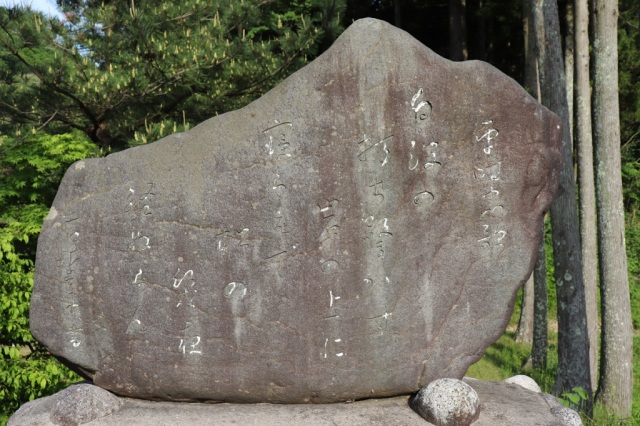
“The tears I shed, unable to return, are like the water that slips through the nets drawn at Katata.”
Just as water slips through the nets drawn at Katata Bay, his tears fell.
The poem likened his uncertain fate of returning to the capital to the place name Katata.
The “Tale of the Heike” recounts Tokitada heading north, shedding tears.
As Kiyomori’s brother-in-law, Tokitada wielded power at the court and returned from exile twice.
This time, it was his third exile.
Exile to Noto Province—A Third Exile Takes Him Far from the Capital
Noto Province, where Tokitada was exiled, corresponds to today’s Noto region in Ishikawa Prefecture.
It lay at the end of the Hokuriku Road, reached via Omi, Echizen, and Kaga from Kyoto.
The “Gikeiki” records that Tokitada was exiled to Suzu Misaki in Noto Province.
This location is associated with the area near present-day Suzu City.
However, detailed records of where Tokitada lived or how he spent his life in exile are scarce.
While “Azuma Kagami” and “Sankai Ki” record his journey to Noto, they do not describe his daily life thereafter.
In the third year of Nin’an (1168), Tokitada had once served as the acting governor of Noto.
Now, he was sent to the land he once governed, but as an exile.
Meanwhile, his son Tokizane remained in Kyoto, following Yoshitsune.
In November of the first year of Bunji, Yoshitsune left Kyoto after clashing with Yoritomo.
Tokizane joined that group.
However, as Yoshitsune and his followers fled west, they dispersed, and Tokizane was captured.
In the following year, Bunji 2 (1186), Tokizane was sent to Kamakura and later exiled to Kazusa Province.
His father Tokitada was in Noto, while Tokizane was sent to another land.
Due to their familial ties with Yoshitsune, father and son could not remain in the capital.
What news Tokitada received in Noto is unknown.
However, by the time Yoshitsune clashed with Yoritomo and Tokizane was captured, Tokitada was already far from Kyoto.
The Tokikuni Family of Noto: A Legacy of the Taira Lineage
In Noto, there are legends related to the descendants of Tokitada.
These legends pertain to the Tokikuni family in Machino, Wajima City, Ishikawa Prefecture.
The Kamitokikuni and Tokikuni families are known as descendants of Tokitada’s son, Tokikuni.
Both families became influential in Noto and were recognized as prominent families during the Edo period.
Even today, historical buildings and documents remain.
However, the existing residences were not built during the 12th century when Tokitada lived.
Some aspects of the early history of the family are based on later legends.
Additionally, there is a site in Noto believed to be Tokitada’s grave.
In the vicinity of Suzu City, stories about Tokitada’s exile and death have been passed down.
On the other hand, there are discrepancies between the date of death recorded in the “Azuma Kagami” and the dates preserved in local traditions.
Tokitada’s exile to Noto is confirmed by records from both the Kamakura and Kyoto sides.
However, details about his life in exile and how his descendants established themselves in Noto remain unclear.
Tokitada never returned to Kyoto and ended his days in Noto.
February 24, 1189: Tokitada’s Death in Noto
February 24, 1189.
Taira no Tokitada passed away in his place of exile in Noto Province.
The “Azuma Kagami” entry for March 5 notes that news of his death reached Kamakura.
Tokitada died at the hour of the goat on February 24.
In modern terms, this corresponds to around 2 PM.
Yoritomo received the news.
Once a key supporter of the Taira regime as Kiyomori’s brother-in-law, and later the father-in-law of Yoshitsune after the Battle of Dan-no-ura, Tokitada was a court noble.
Yoritomo reportedly lamented Tokitada’s death.
The “Azuma Kagami” records that Tokitada was reputed as a wise retainer and had supported the court’s affairs during Emperor Antoku’s reign.
Yoritomo remarked that Tokitada was still a valuable figure for the court.
He then inquired about Tokitada’s age.
No one could immediately answer.
Miyoshi Yasunobu answered that he was 62 years old.
However, there are different theories regarding Tokitada’s birth year.
Some suggest he was born in 1127, others calculate 1128 based on his age at death in the “Azuma Kagami,” while another theory from the “Kugyō Bunin” suggests 1130, leaving his exact birth year uncertain.
Tokitada departed for Noto on September 23, 1185.
About three and a half years had passed since then.
During two earlier exiles to Izumo in his youth, he was recalled to the court each time.
After returning from his first exile, he became the head of the Kurando-dokoro and was promoted to Sangi, a councilor.
Upon returning from his second exile, he was reinstated as Gon-Chunagon, and later advanced to Gon-Dainagon.
However, after his third exile, he was unable to return to Kyoto.
The Heike Monogatari has him saying, “Anyone not of this clan must be a non-person.”
Furthermore, it records severe punishments, such as being called “Evil Betto,” and an anecdote about branding an imperial messenger.
On the day of his departure to Noto, he is depicted parting from his wife and children, shedding tears at Katata in Omi Province.
Meanwhile, the Azuma Kagami records Yoritomo’s words upon hearing of Tokitada’s death.
Yoritomo, who had criticized Yoshitsune over Tokitada’s exile, lamented the loss of his political skills three and a half years later.
March 5, 1189.
When news of Tokitada’s death reached Kamakura, Yoritomo inquired about his age.
Miyoshi Yasunobu replied that he was 62 years old.
The Azuma Kagami concludes its account of Tokitada there.