February, 1184, Mikusayama.
In the dead of night, the sound of war cries echoed at the foot of the mountain.
The forces of Minamoto no Yoshitsune launched an attack on the Taira camp.
According to the “Tale of the Heike,” Volume Nine, “The Battle of Mikusa,” the Taira soldiers were asleep, preparing for the battle the next morning.
Although the vanguard was on alert, some in the rear guard were so relaxed that they used their helmets and armor sleeves as pillows.
It was then that the Genji forces charged in.
Those who grabbed their bows lost sight of their arrows, and those who held arrows searched for their bows.
As mounted warriors approached, the soldiers, fearing being trampled, cleared the center of the camp.
The Genji forces raced through this gap, and the Taira camp fell into disarray, as the tale recounts.
The leader of this force was Taira no Tadamori.
He was the grandson of Taira no Kiyomori and the second son of the Minister of the Interior, Taira no Shigemori.
Tadamori had three younger brothers.
Taira no Arimori, Taira no Tadabusa, Taira no Morimori.
Shigemori’s sons were attempting to halt Yoshitsune’s advancing forces from the Tanba region.
However, caught off guard by the night attack, the Taira forces were routed.
According to the “Tale of the Heike,” Tadamori, Arimori, and Tadabusa fled to Takasago in Harima Province and from there crossed by ship to Yashima in Sanuki Province.
However, Morimori took a different path from his brothers.
He headed to Ichinotani, accompanied by Taira no Naibei Kiyoka and Ebi Jiro Morikata.
Three days later.
Morimori met his end at Ichinotani.
Arimori reached Yashima and survived.
Over a year passed.
March 24, 1185, Dan-no-ura.
Arimori was once again with his brother Tadamori.
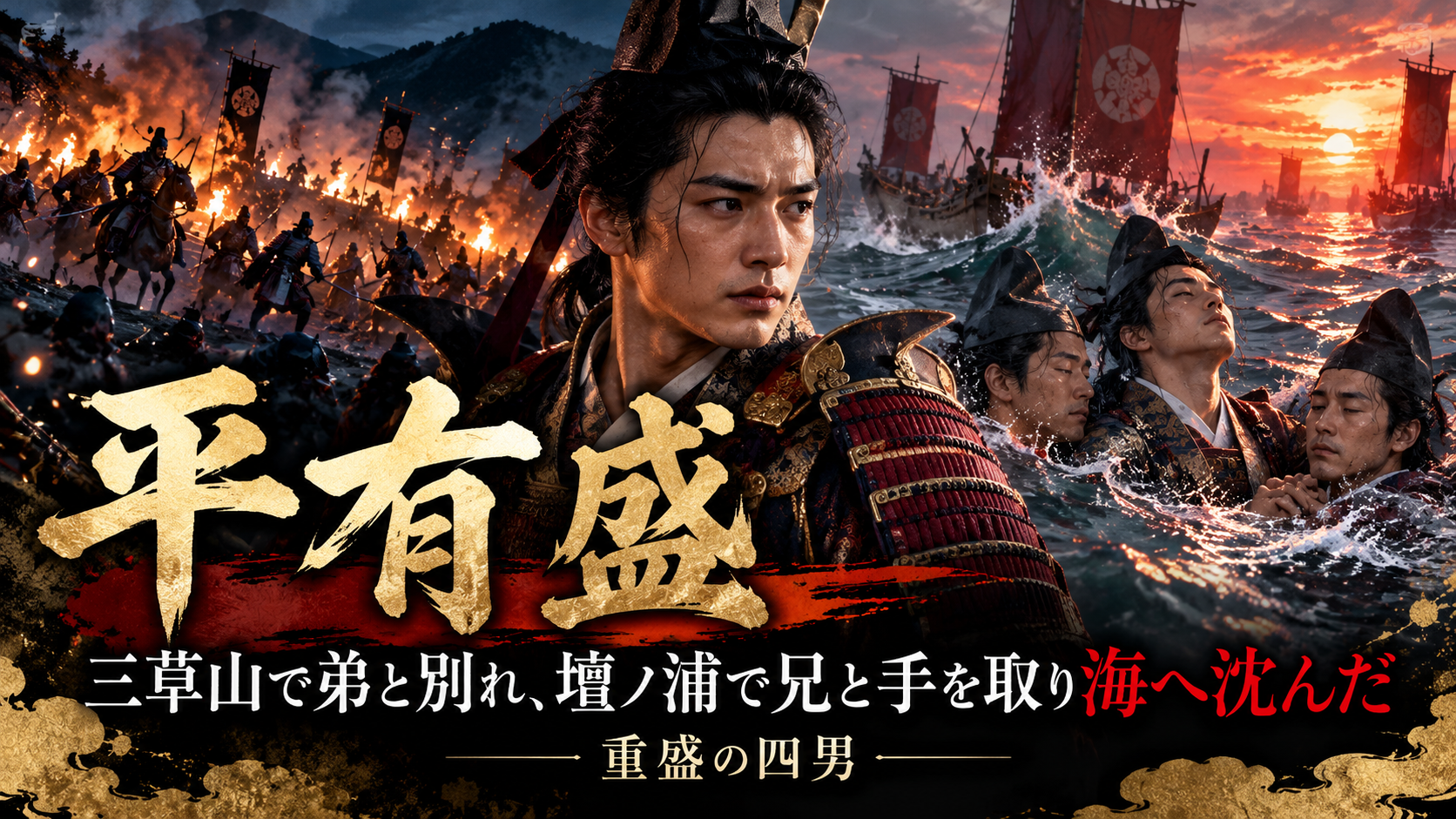
The “Tale of the Heike” records that the two, along with their cousin Taira no Tsunemori, clasped hands and sank into the sea together at the same spot.
At Mikusayama, Arimori parted ways with his brother, but at Dan-no-ura, he shared his final moments with him.
His name later reached as far as Amami Oshima.
It was said that the three who were supposed to have died at Dan-no-ura had actually survived and traveled to the southern islands.
Even today, in the Urakami area of Naze, Amami City, there remains a shrine dedicated to Arimori and a gravestone erected in the Edo period.
The Fourth Son of Taira no Shigemori—Mother was Fujiwara no Tsunekiko
Taira no Arimori is said to have been born in the second year of Chokan (1164).
His father was Taira no Shigemori.
His grandfather was Taira no Kiyomori.
Shigemori, as Kiyomori’s eldest son, participated in the Hogen Rebellion and the Heiji Rebellion, and rose to the rank of Naidaijin (Minister of the Interior) at the court.
He was regarded as Kiyomori’s successor and held a high position within the clan.
Arimori was his fourth son.
His mother was Fujiwara no Tsunekiko.
She was the daughter of Fujiwara no Ienari, a powerful close retainer of Emperor Toba, and became Shigemori’s principal wife.
Tsunekiko is also considered to have been the adopted daughter of Fujiwara no Tsunemune.
In the first year of Nin’an (1166), when Prince Norihito became Crown Prince, she served as his wet nurse.
Prince Norihito later became Emperor Takakura.
After Emperor Takakura’s ascension, Tsunekiko served at the court as a lady-in-waiting.
She was also known by titles such as Dainagon no Tsubone and Dainagon no Sanmi.
As Kiyomori’s grandson, Arimori had deep connections to the court through his maternal lineage as well.
Arimori had older brothers named Koremori, Sukemori, and Kiyotsune.
His younger brothers included Moromori and Tadachika.
Koremori and Sukemori had different mothers from Arimori, while Kiyotsune shared the same mother, Fujiwara no Tsunekiko, as Arimori.
There are genealogies that also list Moromori and Tadachika as Tsunekiko’s children.
Shigemori had multiple wives and children, with influential court families linked to each maternal side.
The eldest son, Koremori, was in line to inherit his father’s house, while the second son, Sukemori, accumulated court ranks.
The third son, Kiyotsune, was granted a high rank from a young age and advanced to a position in the Konoe government office.
Arimori also began serving the court from a young age.
It was a time when his grandfather, Taira no Kiyomori, had risen to the rank of Grand Minister of State, and his father, Taira no Shigemori, had become the Minister of the Interior.
From Junior Fifth Rank, Lower Grade to Provisional Minor Captain of the Right Division of Inner Palace Guards—The Early Career
In the first year of Angen (1175).
It is said that Arimori was awarded the Junior Fifth Rank, Lower Grade.
If he was born in the second year of Chokan, he would have been about 12 years old.
In the Heian period court, it was not uncommon for children of influential aristocrats and military families to be granted official ranks from a young age.
Kiyomori’s grandchildren were also steadily acquiring official positions.
His brother, Sukemori, became the governor of Echizen at a young age, and Kiyotsune was also granted a high rank early on.
Arimori continued to advance, backed by the status of his father, Shigemori, and grandfather, Kiyomori.
In the second year of Jisho (1178), he advanced to the Senior Fifth Rank, Lower Grade, and became a Chamberlain.
Around the same time, it is said he also held the position of Provisional Assistant Governor of Izumo.
The Chamberlain served close to the Emperor, involved in court ceremonies and events.
The Provisional Assistant Governor of Izumo was a position associated with the provincial governor of Izumo Province.
There are no records confirming that Arimori traveled to Izumo to govern, but he held the title of a provincial official while serving at court.
Later, he became the Provisional Minor Captain of the Right Division of Inner Palace Guards and is said to have risen to Junior Fourth Rank, Lower Grade.
In “The Tale of the Heike,” he is referred to as “Komatsu Shosho Arimori.”
The Konoe government office was responsible for the Emperor’s protection and court ceremonies, and the position of Minor Captain was a senior role within it.
Arimori grew up as a young noble of the Taira clan while holding court positions.
However, the father who supported this life passed away.
This was in the third year of Jisho (1179).
The Shishigatani Incident and Shigemori’s Death—The Loss of His Father’s Connections
Arimori’s mother, Fujiwara no Tsuneko, had a brother named Fujiwara no Narichika.
He was a close associate of Retired Emperor Go-Shirakawa and rose to the rank of Provisional Major Counselor.
To Arimori, Narichika was his maternal uncle.
While having family ties with the Taira clan, Narichika was active around the Retired Emperor Go-Shirakawa.
However, in the first year of Jisho (1177), he was arrested for involvement in a plot to overthrow the Taira clan.
This was the Shishigatani Incident.
Kiyomori captured Narichika and executed Saiko.
Shunkan and others were exiled to Kikaigashima, and Narichika was banished to Bizen Province.
Narichika died in exile that same year.
“The Tale of the Heike” recounts how Shigemori struggled to save Narichika’s life.
Narichika was the brother of Shigemori’s wife and had deep ties with Shigemori’s sons.
It is said in genealogies that Narichika’s daughter married either Koremori or Kiyotsune.
There were multiple marital connections between Shigemori’s family and Narichika’s family.
It is unclear how Arimori himself perceived his uncle’s downfall.
Two years later, his father, Shigemori, also passed away.
On July 29, 1179.
He was 42 years old.
Shigemori was the eldest son of Kiyomori and was regarded as his successor.
He had a close relationship with Emperor Go-Shirakawa and sometimes acted as a political mediator between Kiyomori and the Emperor.
With Shigemori’s death, the central figure of the Taira clan became his younger brother, Munemori.
Munemori was the son of Kiyomori’s lawful wife, Taira no Tokiko, and was also the brother of Tokuko, the consort of Emperor Takakura.
Although Shigemori’s eldest son, Koremori, was in a position to inherit his father’s household, it was his uncle Munemori who became the leader of the entire clan.
In November of the same year, Kiyomori led his forces into Kyoto and imprisoned Emperor Go-Shirakawa in the Toba Palace.
This was known as the Political Change of the Third Year of Jisho.
The following year, in Jisho 4 (1180), Prince Mochihito and Minamoto no Yorimasa raised an army.
In August, Minamoto no Yoritomo also raised his forces in Izu.
His brother Koremori became the commander of the punitive expedition to the eastern provinces, but his forces collapsed at the Fuji River and retreated westward.
Furthermore, in the intercalary second month of Jisho 5 (1181), their grandfather Kiyomori also passed away.
Having lost both his father Shigemori and grandfather Kiyomori, Arimori faced the anti-Taira forces across various regions under Munemori’s leadership.
July of Juei 2 — Departing Kyoto with His Brothers
In May of Juei 2 (1183).
The northern punitive force led by Taira no Koremori suffered a crushing defeat at Kurikara Pass against Minamoto no Yoshinaka (Kiso Yoshinaka).
They were also defeated in the subsequent Battle of Shinohara, and Yoshinaka’s forces advanced into Omi.
The forces defending Kyoto dwindled, and even Enryaku-ji Temple refused to cooperate with the Taira.
During the night of July 24 to the early hours of July 25, Emperor Go-Shirakawa fled Kyoto and moved to Mount Hiei.
Munemori abandoned any hope of resistance in the capital.
July 25.
The Taira clan, accompanying Emperor Antoku and the Imperial Regalia, headed west.
Arimori, along with his brothers Koremori, Sukemori, Kiyotsune, and his younger brothers Morimori and Tadabumi, also left Kyoto.
Koremori left his wife and children behind in the capital.
The “Tale of the Heike” describes a scene where Sukemori and others visit Koremori, urging him to depart quickly despite his reluctance to leave.
Sukemori also parted ways with Kenreimon-in Ukyō no Daibu.
In Ukyō no Daibu’s poetry collection, it is recorded that Sukemori, sensing his impending death, wished for prayers for his soul in the afterlife.
It is not recorded with whom or how Arimori said his farewells when leaving the capital.
He was around twenty years old at the time.
Even the young noble who had risen to the rank of Konoe Shōshō followed the clan accompanying Emperor Antoku westward.
Though they aimed to regroup in Kyushu, they were met with rebellion by Ogata Koreyoshi in Bungo Province and were forced to leave Dazaifu.
The clan fled to Yamaga and Yanagigaura, eventually returning to the Seto Inland Sea.
During this escape, it is said that Arimori lost one of his brothers.
It was his full brother, Kiyotsune.
Tragic News at Yanagigaura—The Drowning of Full Brother Kiyotsune
In the autumn of the second year of Juei.
The “Tale of the Heike,” Volume Eight “The Fall of Dazaifu,” records that Kiyotsune drowned himself at Yanagigaura in Buzen Province.
Kiyotsune was the third son of Taira no Shigemori and was Arimori’s full brother.
Chased by the forces of Minamoto no Yoshinaka in Kyoto and driven out of Kyushu by Ogata Koreyoshi, a former retainer of their father, Kiyotsune found himself with no place to escape.
It is said that Kiyotsune lamented the fate of his clan.
“Like a fish caught in a net,”
he described himself as a fish trapped in a net.
No matter where he tried to flee, pursuers were closing in.
The “Tale of the Heike” recounts that he spoke in this manner.
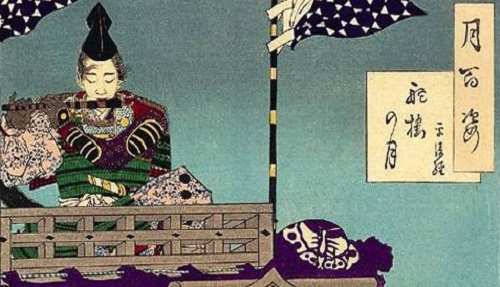
Then, on a moonlit night, he stepped out from the cabin of the ship.
He played the flute and began to chant poetry.
Eventually, he recited sutras and chanted prayers before sinking himself into the sea.
It is unknown which ship Arimori was on that night.
It is also unclear when he learned of Kiyotsune’s drowning.
However, the death of Shigemori’s son in Kyushu was passed down in later generations as a tragedy of the Taira clan in the “Tale of the Heike.”
Even after losing his brother Kiyotsune, Arimori continued to fight alongside Munemori and others.
In the intercalary 10th month of the second year of Juei, the Taira clan defeated the forces of Minamoto no Yoshinaka at Mizushima in Bitchu Province.
In November, they also achieved victory over the forces of Minamoto no Yukie at Muroyama in Harima Province.
Having regained their strength in the western provinces, the Taira clan advanced to the vicinity of Fukuhara by the New Year of the following year.
The exiled family was once again approaching the Kinai region.
Among their forces was the figure of Arimori.
January of Juei 3—The Taira Return to Fukuhara
January of Juei 3 (1184).
The Taira clan advanced their forces from Yashima to the area around Fukuhara.
Fukuhara was the place where their grandfather, Taira no Kiyomori, had developed the port of Owada and temporarily established the capital.
About half a year had passed since their fall from the capital.
The family once again secured a foothold in the Kinai region.
Meanwhile, in Kyoto, Minamoto no Yoshinaka (Kiso Yoshinaka) was defeated by the forces of Minamoto no Noriyori and Minamoto no Yoshitsune and met his end at Awazu in Omi Province.
Noriyori and Yoshitsune then turned their attention to pursuing the Taira clan.
Noriyori led the main forces, while Yoshitsune advanced from the rear.
The Taira set up their positions in Ikuta no Mori and Ichi-no-Tani near Fukuhara to face the advancing Genji forces.
They fortified the Ikuta no Mori area against Noriyori’s forces advancing along the coastal road.
Meanwhile, to block Yoshitsune’s forces advancing through the mountain roads from the Tanba region, they deployed another contingent.
According to the “Heike Monogatari,” the defense was entrusted to the sons of Shigemori.
Sadamori, Arimori, Tadafusa, and Morimori.
Their father, Shigemori, had already passed away, and their grandfather, Kiyomori, was no longer alive.
The four young commanders of the family stood in the path of Yoshitsune’s advance.
Mikusayama—Shigemori’s Sons Defend the Tanba Route
“Heike Monogatari,” Volume Nine, “The Battle of Mikusa.”
As the Taira’s commanding general, Sadamori is first mentioned.
Komatsu Shin Sanmi Chujo, Sadamori.
Likewise, Komatsu Shosho, Arimori.
Tango no Saisho, Tadafusa.
Bitchu no Kami, Morimori.
The samurai commanders included Iga Heinaibei Kiyoke and Ebi Jiro Morikata.
Their forces were recorded as numbering over three thousand horsemen.
On the other hand, the “Azuma Kagami” reports the Taira forces as over seven thousand horsemen, indicating a discrepancy in numbers.
The exact size of the forces each side gathered remains uncertain.
Regarding the location of Mikusayama, two theories are known.
Commonly introduced as the battlefield is Mikusayama in present-day Kato City, Hyogo Prefecture.
According to the “Heike Monogatari,” Yoshitsune’s forces advanced from Onobara in Tanba and attacked the Taira forces positioned on the western side of Mikusayama.
On the other hand, the “Azuma Kagami” identifies Mikusayama as a mountain in Settsu Province.
Based on this description, some theories suggest that the battlefield was Mikusayama, located on the border between Inagawa Town in Hyogo Prefecture and Nose Town in Osaka Prefecture.
The “Takarazuka City History” focuses on this Settsu side of Mikusayama when examining Yoshitsune’s route.
There is still debate regarding the exact location of the battlefield.
However, both the “Heike Monogatari” and the “Azuma Kagami” recount that Yoshitsune’s forces advanced from the mountain path towards the Ichinotani area, and the troops of Sukemori and Arimori attempted to block them.
Yoshitsune then decided to attack during the night.
“Should We Launch a Night Attack Tonight?” — Yoshitsune’s Decision
According to the “Heike Monogatari,” Yoshitsune’s forces reached Onobara, on the eastern side of Mikusayama.
The distance to the Taira camp was said to be about three ri.
As night fell, Yoshitsune summoned the samurai general Doi Sanehira.
Should they launch a night attack tonight?
Or should they wait until the next morning?
Then, Tashiro Noritsuna stepped forward.
If they waited until tomorrow, reinforcements might join the Taira forces.
It would be better to attack tonight.
He advised as such.
The “Heike Monogatari” describes the Taira forces as numbering over three thousand riders, while Yoshitsune’s forces numbered over ten thousand.
The Genji side, with superior numbers, was preparing to launch a night assault.
Doi Sanehira also agreed with Tashiro Noritsuna’s opinion.
Yoshitsune ordered the advance.
However, the mountain path was dark.
The soldiers complained that it was too dark to proceed.
So Yoshitsune ordered large torches to be prepared.
The “Heike Monogatari” also records that they set fire to the houses in Onobara.
The fire spread to the grass and trees of the fields and mountains, making it as bright as day.
Yoshitsune’s forces crossed the three-ri mountain path by the light of the fire.
The arson of the houses is a scene depicted in the “Heike Monogatari” and does not necessarily reflect the exact methods of the night march.
Nevertheless, if the story is to be believed, the villages along the route would have been caught up in the flames of war.
Having crossed the mountain path at night, Yoshitsune’s forces approached the Taira camp.
Meanwhile, Arimori and his troops were preparing for the battle the next morning.
Soldiers Sleeping with Helmets as Pillows — The Night Attack at Mikusayama
According to the “Heike Monogatari,” the Taira forces did not anticipate an attack that night.
They expected the battle to begin the next morning.
With this in mind, the soldiers were resting.
The vanguard remained vigilant.
However, many in the rear guard were asleep.
Some used their helmets as pillows.
Others rested their heads on the sleeves of their armor.
Some slept with their quivers as pillows.
Then, around midnight,
the sound of war cries echoed from the western side of the mountain.
It was Minamoto no Yoshitsune’s forces launching an attack.
The “Tale of the Heike” describes the ensuing chaos in the Taira camp as follows:
“Those who took up bows knew not where their arrows were, and those who grabbed arrows could not find their bows.”
The soldiers who held bows couldn’t find arrows, and those who picked up arrows searched frantically for bows.
It is said that the surprise attack left them unprepared for battle.
At that moment, the mounted warriors of the Minamoto clan charged in.
The Taira soldiers, fearing the trampling horses, left the center of their camp open.
The Minamoto forces dashed through this gap, causing the camp to collapse, as the story goes.
Yoshitsune’s forces pursued the fleeing soldiers.
According to the “Tale of the Heike,” over five hundred were killed, and many were wounded.
These numbers might include the typical exaggerations of war tales.
However, the fact that the Taira forces were caught off guard and routed is a common theme in the records of the Battle of Mikusayama.
The “Tale of the Heike” depicts it as a night raid on February 4th, while the “Azuma Kagami” records an attack the following morning on the 5th.
Despite differences in dates and troop numbers, the narrative of Yoshitsune’s forces launching a nighttime assault and defeating the Taira army is consistent.
Arimori and his companions were forced to retreat from here.
From Takasago to Yashima—The Retreat of Sukemori, Arimori, and Tadafusa
When the camp at Mikusayama fell, the commander Sukemori also withdrew.
The “Tale of the Heike” provides detailed accounts of their subsequent actions.
Sukemori, Arimori, and Tadafusa headed towards Takasago in Harima Province.
Takasago was a port facing the Harima Sea.
From there, they could board a ship to Yashima in Sanuki Province.
The three reportedly took a small boat and crossed to Yashima.
The “Tale of the Heike” adds the following words to this scene:
“How disgraceful they must have felt.”
Perhaps they were ashamed of their defeat.
While we cannot know what Sukemori and his companions truly thought, the war tale narrates it this way.
Having been defeated at Mikusayama, the three did not return to Ichinotani but retreated by sea to Yashima.
Meanwhile, Morimori, who was in the same camp, took a different path.
Morimori, the Governor of Bitchu.
He was Arimori’s younger brother.
Morimori reportedly headed towards Ichinotani with Heiuchi Heibei Kiyoka and Ebi Jiro Morikata.
At Mikusayama, four brothers were part of the same force.
Yet, during the retreat, they split into three and one.
Sukemori, Arimori, and Tadafusa went to Yashima.
Morimori went to Ichinotani.
At Ichinotani, the main forces of the Genji and Heike clans were preparing to face off.
Morimori, who had just suffered defeat at the hands of Yoshitsune’s army, headed to the battlefield.
Three Days Later at Ichinotani—The Death of Morimori
February 7, 1184.
The forces of Minamoto no Noriyori and Minamoto no Yoshitsune attacked the Heike troops around Fukuhara.
This was the Battle of Ichinotani.
The Genji forces attacked from the east and west, breaking through the Heike lines.
Heike commanders such as Taira no Tadanori, Taira no Atsumori, and Taira no Tsunemori were killed in succession.
Taira no Shigehira was captured.
Morimori also lost his life in this battle.
The “Rakujaku” chapter of the The Tale of the Heike lists the prominent Heike members who were killed at Ichinotani.
Among them is Morimori, the governor of Bitchu.
Three days earlier, Morimori had been at Mikusayama with Arimori and others.
After a night attack by Yoshitsune, he parted ways with his brothers and headed to Ichinotani.
However, Ichinotani also came under attack by the Genji forces.
Morimori was killed in action.
Meanwhile, Arimori was at Yashima.
Sanemori and Tadafusa also crossed over to Yashima.
It is unknown when or how the news of Morimori’s death reached Arimori.
However, among the brothers who were separated during the night attack at Mikusayama, only Morimori lost his life at Ichinotani.
Arimori survived the retreat from Mikusayama and continued to follow the clan’s forces.
Yet, the Heike were defeated at Ichinotani as well, losing their positions around Fukuhara.
The last major stronghold left was Yashima.
A Year at Yashima—Yoshitsune Approaches Again
Even after their defeat at Ichinotani, the Taira clan continued to fight in the western provinces.
Munemori and Tomomori, among others, gathered their forces around Emperor Antoku at Yashima in Sanuki Province.
Arimori also joined his brothers, including Sukemori, retreating to Yashima with the rest of the clan.
Yashima was close to the Seto Inland Sea routes, making it an ideal location for movement and resupply by ship.
The Taira had long maintained their power by utilizing maritime transport in the western regions.
With warships, they could move to coastal strongholds and easily respond to enemies advancing by land.
However, the situation gradually became more difficult.
In the first year of Genryaku (1184), Minamoto no Noriyori’s forces advanced into the western provinces.
Though the Taira resisted along the Seto Inland Sea coast, many local warriors shifted their allegiance to the Minamoto as the tide of battle turned.
There are few detailed records of what duties Arimori undertook during this year.
At Mikusayama, he was in a leadership position alongside his brother Sukemori.
It is believed he acted as one of the young commanders of the clan at Yashima as well.
Then, in the second year of Genryaku (1185), in February.
Minamoto no Yoshitsune approached Yashima.
Yoshitsune crossed from Settsu Province to Awa Province and advanced overland to Sanuki.
The Taira were wary of attacks from the sea, but Yoshitsune’s forces launched a surprise assault from land.
Caught off guard, the Taira abandoned their camp at Yashima and retreated to their ships.
The “Heike Monogatari” recounts the story of Nasu no Yoichi shooting down the fan target, and the tale of Yoshitsune retrieving a bow that had fallen into the sea.
It is unclear which unit Arimori commanded during the Battle of Yashima.
The Taira lost Yashima and moved westward.
They would make their final stand around Hikoshima in Nagato Province.
Noriyori’s forces also advanced into Kyushu, further restricting the Taira’s range of movement by ship.
Having defeated Arimori and others at Mikusayama, Yoshitsune now captured Yashima.
Arimori retreated further west, facing his final battle at sea in Nagato Province.
March 24, Genryaku 2—The Battle of Dan-no-ura
On March 24, Genryaku 2.
In the waters off Akama-ga-seki in Nagato Province, the fleets of the Minamoto and Taira clashed fiercely.
This is the Battle of Dan-no-ura.
On the Genji side was Minamoto no Yoshitsune.
On the Taira side, Munemori and Tomomori, among others, fought at sea while supporting Emperor Antoku.
The Taira had warriors familiar with the maritime routes of the Seto Inland Sea under their command.
However, the Genji also allied with the western naval forces, gathering warships.
As the battle progressed, the Taira fleet found itself increasingly cornered.
Eventually, their defeat became inevitable.
Taira no Kiyomori’s wife, Taira no Tokiko, sank into the sea with Emperor Antoku in her arms.
Emperor Antoku was just eight years old by traditional counting.
Taira no Tomomori, Taira no Norimori, and Taira no Tsunemori, among other family generals, also lost their lives in succession.
Munemori was captured along with his son, Kiyotsune.
At sea, ships fleeing and pursuing were in disarray.
In the midst of this, Arimori is said to have been with his brother Sukemori.
Furthermore, their cousin Taira no Yukimori was reportedly nearby.
The “Tale of the Heike,” Volume Eleven, “The End of the Lord of Noto,” briefly records the end of these three.
Sukemori, Arimori, and Yukimori—The End Where Three Held Hands
The “Tale of the Heike” contains the following passage.
“Komatsu Shin Sanmi Chujo Sukemori, the same Shosho Arimori, cousin Sama no Kami Yukimori”
Sukemori was the second son of Shigemori.
Arimori was his brother, the fourth son of Shigemori.
Yukimori was the son of Kiyomori’s second son, Taira no Koremori.
The three were close relatives.
The “Tale of the Heike” describes their end as follows.
“They took each other’s hands and sank together in one place.”
The three are said to have held hands and sunk into the sea at the same spot.
Arimori, along with his brother Sukemori, faced a night attack by Yoshitsune’s forces at Mikusayama.
Defeated there, the two fled from Takasago to Yashima.
They continued to follow the Taira family, moving to Nagato Province after losing Yashima.
At Dan-no-ura, they were once again in the same place as his brother.
The “Tale of the Heike” adds Yukimori to the two, depicting the three’s entry into the water.
It is unclear on which ship the three were or how they ended up in the sea.
The scene of them sinking hand in hand is a depiction left in the war tale.
It is said that the three perished at Dan-no-ura.
If he was born in the second year of Chokan, Arimori would have been 22 years old by traditional age reckoning.
According to the Tale of the Heike, Arimori, who faced off against Yoshitsune’s forces at Mikusayama and escaped a night attack, ultimately sank into the sea with his brothers.
However, a different ending is told on a distant southern island.
It is said that Sanemori, Arimori, and Yukimori survived Dan-no-ura.
From Kikaijima to Amami Oshima—The Legend of the Three’s Survival
In the Amami Islands of Kagoshima Prefecture, many legends about the Heike fugitives remain.
One such story is that Sanemori, Arimori, and Yukimori fled to Amami.
The Tale of the Heike records that the three sank into the sea at Dan-no-ura.
However, according to Amami’s lore, the three escaped the Genji pursuit and headed for the southern islands.
The first place they reached was Kikaijima.
After that, they are said to have moved to Amami Oshima.
It is said that the three established bases in different parts of the island and stationed their retainers.
Yukimori was in present-day Toguchi, Tatsugo Town.
Arimori was in Naze Urakami, Amami City.
Sanemori was in Shodon, Kakeromajima.
The three are said to have defended their respective locations against potential sea-borne threats.
This legend is also introduced in the cultural heritage and historical site guide of Amami City.
No twelfth-century record confirming that the three actually escaped from Dan-no-ura and reached Amami has been found.
However, their names have been preserved in the island’s place names and shrines.
There is a shrine dedicated to Arimori in the Urakami district of Naze, Amami City.
Naze Urakami, Amami City—The Place Where Arimori is Said to Have Built a Castle
Arimori Shrine is located in Naze Urakami, Amami City.
According to legend, after Arimori fled to Amami, he established his residence in Urakami.
He stationed his retainers around the area to prepare for a Genji attack.
The castle Arimori is said to have built is also known as Arimori Castle.
According to the cultural heritage guide of Amami City, remains such as trenches can be found on the hill at the back of the Arimori Shrine grounds.
Trenches are facilities cut into ridges to prevent enemy intrusion.
In mountain castles, they were set up to block enemies advancing along ridges.
The city introduces these as remains believed to be from a medieval mountain castle.
Behind the shrine, there remains terrain considered to be defensive structures.
However, no record has been found that Arimori himself built the castle.
Further investigation is needed to determine when the trenches were made and who used them.
The legend of Arimori has been told in the region for a long time, and his name has been linked to the shrine and castle ruins.
And within the shrine grounds, there remains a tombstone inscribed with Arimori’s name.
It was erected during the Edo period.
The Year Bunka 13—The Tombstone of Arimori Erected by the Ōshima Administrator
Deep within the grounds of Arimori Shrine, near the summit of a hill, stands the tombstone of Taira no Arimori.
According to records from Amami City, it was erected in the year Bunka 13 (1816) through the donation of the Ōshima administrator, Higo Onosuke.
More than six hundred years had passed since the Battle of Dan-no-ura.
At that time, Amami Ōshima was under the control of the Satsuma Domain.
On the island, legends of the Heike refugees were passed down, and the Arimori Shrine in Urakami was also cherished.
The fact that the Ōshima administrator erected the tombstone suggests that the tradition of worshipping Arimori had taken root in the region during the Edo period.
However, the tombstone was erected more than six hundred years after the events of 1185.
It does not serve as contemporary evidence that Arimori crossed over to Amami.
Nevertheless, it is a historical site indicating that Arimori’s name was long remembered on the island.
At Arimori Shrine, there is also a stone statue of Benzaiten.
It is said to have been donated by a Satsuma official, Tashiro Kiyokata, who prayed for safe voyages.
Amami City has designated this Benzaiten statue as a tangible cultural property.
Furthermore, the forest within the grounds of Arimori Shrine is a natural monument of the city.
Ships traveling from Amami Ōshima to Satsuma once had to navigate the challenging waters near the Tokara Islands.
People prayed for safe voyages at Arimori Shrine.
Shrines dedicated to the warriors of Dan-no-ura became places where people crossing the sea offered their prayers during the Edo period.
Gyōsei Shrine and Daiton Shrine—The Three Names Left in Amami
In Amami, not only Arimori but also the names of Sukemori and Gyōsei have been preserved.
Gyōsei is enshrined at Gyōsei Shrine in Toguchi, Tatsugo Town.
According to tradition, Gyōsei built a castle in Toguchi and fortified the surrounding defenses.
Sukemori is said to have moved to Shodon on Kakeroma Island, located on the southern side of Amami Ōshima.
In Shodon, there is Daiton Shrine, which is dedicated to Sukemori.
The three of them are said to have lived in different parts of the island, each placing their retainers accordingly.
It is said that lookout points were established to prepare for the approach of the Genji pursuit forces from the sea.
Throughout Amami, there are legends linked to these lookout roles.
Heike legends are also passed down in places like Gamōzaki in Kasari and Imaizaki in Tatsugo Town.
However, it is difficult to verify the names and roles of the retainers recorded there as historical facts from the twelfth century.
What remains in Amami are stories that have been passed down over many years.
The intriguing aspect is the combination of these three individuals.
Sukemori, Arimori, Gyōsei.
They are precisely the three individuals whom the “Tale of the Heike” records as having sunk into the sea together at Dan-no-ura.
His name is passed down in Amami as a warrior enshrined in separate villages.
In the Mountainous Areas of Sanuki—The Legend of Changing His Name to “Ariki”
The places that tell of Arimori’s survival are not limited to Amami.
In the Ariki area of Onohara Town, Kanonji City, Kagawa Prefecture, there remains a legend of Taira no Arimori as a fallen warrior.
According to the Kanonji City Tourism Association, Arimori, defeated at the Battle of Dan-no-ura, fled to this mountainous region and lived under the name “Ariki.”
Today, the Ariki area is home to the Sanbu Shrine.
Locally, it is also affectionately called “Arimori-san,” and has been cherished as a shrine connected to Arimori.
According to the legend, when Arimori fled, he brought with him an Amida Nyorai statue and a war drum.
The seated Amida Nyorai statue is still carefully preserved in the area today.
The statue is designated as a tangible cultural property by Kagawa Prefecture.
Additionally, the region retains place names such as Arimori’s residence, Arimori Bridge, and Arimori Road.
Locals also tell stories of how Arimori’s descendants and retainers settled in the land after he changed his name.
However, there are few records from the 12th century that verify Arimori himself brought the Amida Nyorai statue or the origin of the place names.
In Amami, Arimori crossed the sea and built a castle at Urakami.
In Sanuki, he fled to the mountains and lived under a new name.
For the same Arimori, different survival legends remain in two distant regions.
The seaside of Amami and the mountainous area of Sanuki.
Arimori’s name has been passed down in each land for a long time.
Why Arimori, Who Died at Dan-no-ura, Was Enshrined in Various Places
The “Tale of the Heike” records that Sanemori, Arimori, and Yukimori joined hands and sank into the sea at Dan-no-ura.
On the other hand, in Amami, it is said that the three crossed to Amami Oshima via Kikaijima and built separate castles.
In Sanuki, there remains a story of Arimori hiding in the mountains.
The outcomes of these stories differ.
The drowning of the three at Dan-no-ura is primarily conveyed through war tales.
The specifics of which ship they boarded and what transpired at sea remain unknown.
Meanwhile, no 12th-century documents confirm their escape to Amami or Sanuki.
The legends in each region have been passed down intertwined with local history.
The legends of fallen Heike warriors are numerous in the mountainous areas and remote islands across the country.
These are tales of warriors defeated in the Genpei War who fled far away and lived under new names.
In Arimori’s case, there are war tales recounting his actions at Mikusayama and Dan-no-ura, while survival legends remain in various places.
In Amami, a shrine was built to honor Arimori, and a tombstone was erected in the Edo period.
In Sanuki, the Sanbu Shrine and Amida Hall preserve legends connected to Arimori.
In each land, Arimori’s name has been preserved.
The Final Days of Taira no Arimori—Parting at Mikusayama, Joining Hands at Dan-no-ura
Taira no Arimori was born as the fourth son of Taira no Shigemori.
His mother was Fujiwara no Tsuneko, who served as a wet nurse to Emperor Takakura.
During the era when his grandfather, Taira no Kiyomori, wielded power at the imperial court, Arimori was granted official ranks at a young age, rising to the position of Provisional Minor Captain of the Right Division of Inner Palace Guards.
However, in the third year of the Jisho era (1179), his father Shigemori passed away.
Furthermore, in the fifth year of the Jisho era (1181), his grandfather Kiyomori also died.
As the conflict with the Minamoto clan spread, the Taira family began dispatching punitive forces across various regions.
On July 25, in the second year of the Juei era (1183).
Arimori left Kyoto with his brothers.
Aiming for a comeback in Kyushu, they were driven out of Dazaifu and eventually relocated their base to Yashima.
During this escape, it is said that his full brother Kiyotsune drowned himself at Yanagigaura.
The following February, in the third year of the Juei era.
Arimori, along with his brother Sukemori, and his younger brothers Tadanobu and Morimori, confronted Yoshitsune’s forces at Mikusayama.
The Taira forces suffered a crushing defeat in a night attack.
According to the “Tale of the Heike,” Arimori fled from Takasago to Yashima with Sukemori and Tadanobu.
Morimori headed towards Ichinotani.
Three days later, Morimori was killed in battle at Ichinotani.
Arimori survived at Yashima and continued to follow his family.
However, in the second year of the Genryaku era, Yashima was also lost due to Yoshitsune’s surprise attack.
The Taira retreated to Nagato Province and faced their final battle at Dan-no-ura on March 24.
According to the “Tale of the Heike,” Arimori clasped hands with his brother Sukemori and cousin Yukimori there.
“They clasped hands and sank together.”
It is said that the three sank into the sea at the same place.
Arimori was about 22 years old.
Afterwards, a legend emerged in distant Amami Oshima that the three survived.
It is said that Arimori built a castle at Urakami, Sukemori settled in Shodon on Kakeromajima, and Yukimori established a base at Toguchi.
Today, there is an Arimori Shrine in Urakami, Naze, Amami City.
In the back of the shrine’s grounds, there remains a trench believed to be the remains of a medieval mountain castle, and in the 13th year of the Bunka era (1816), a tombstone for Arimori was erected by the island’s magistrate, Higo Onosuke.
This stone monument was erected more than six hundred years after the Battle of Dan-no-ura.
In the mountain villages of Sanuki Province, there is also a tradition that Arimori lived under the name “Ariki.”
Arimori, who faced Yoshitsune’s night attack at Mikusayama.
He fled to Yashima with his brother, parting ways with Morimori there.
And at Dan-no-ura, it is said in the ‘Tale of the Heike’ that he was once again in the same place as Taira no Sukemori.
“Hand in hand, they sank together.”
The names of these three individuals recorded in that passage were passed down even to distant Amami Oshima.
At the Arimori Shrine in Urakami, the gravestone of Taira no Arimori still remains today.