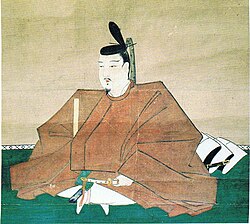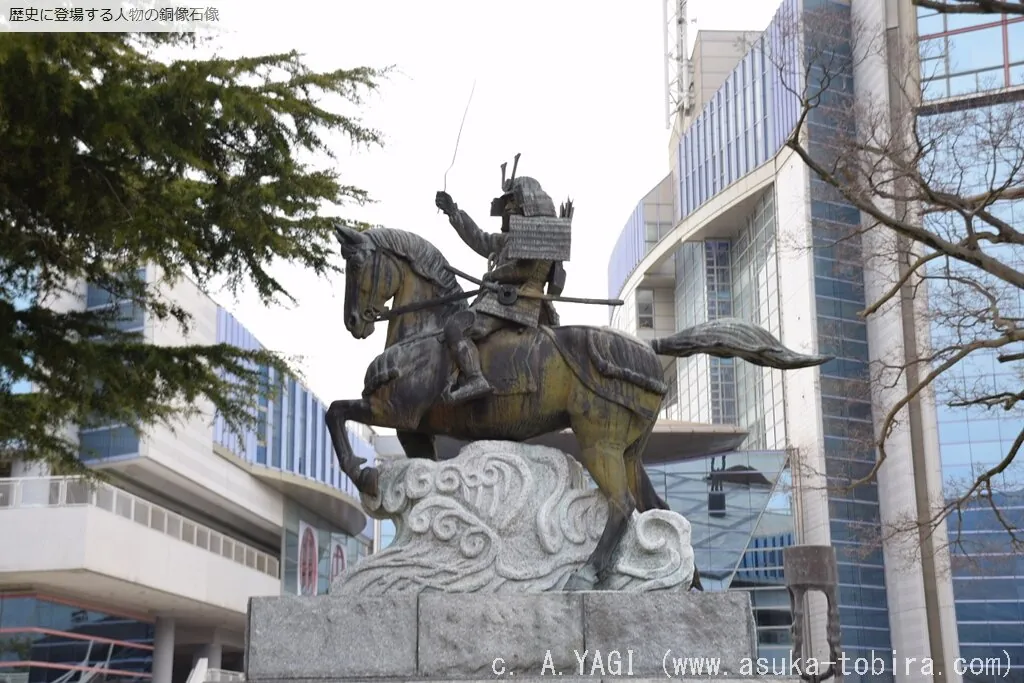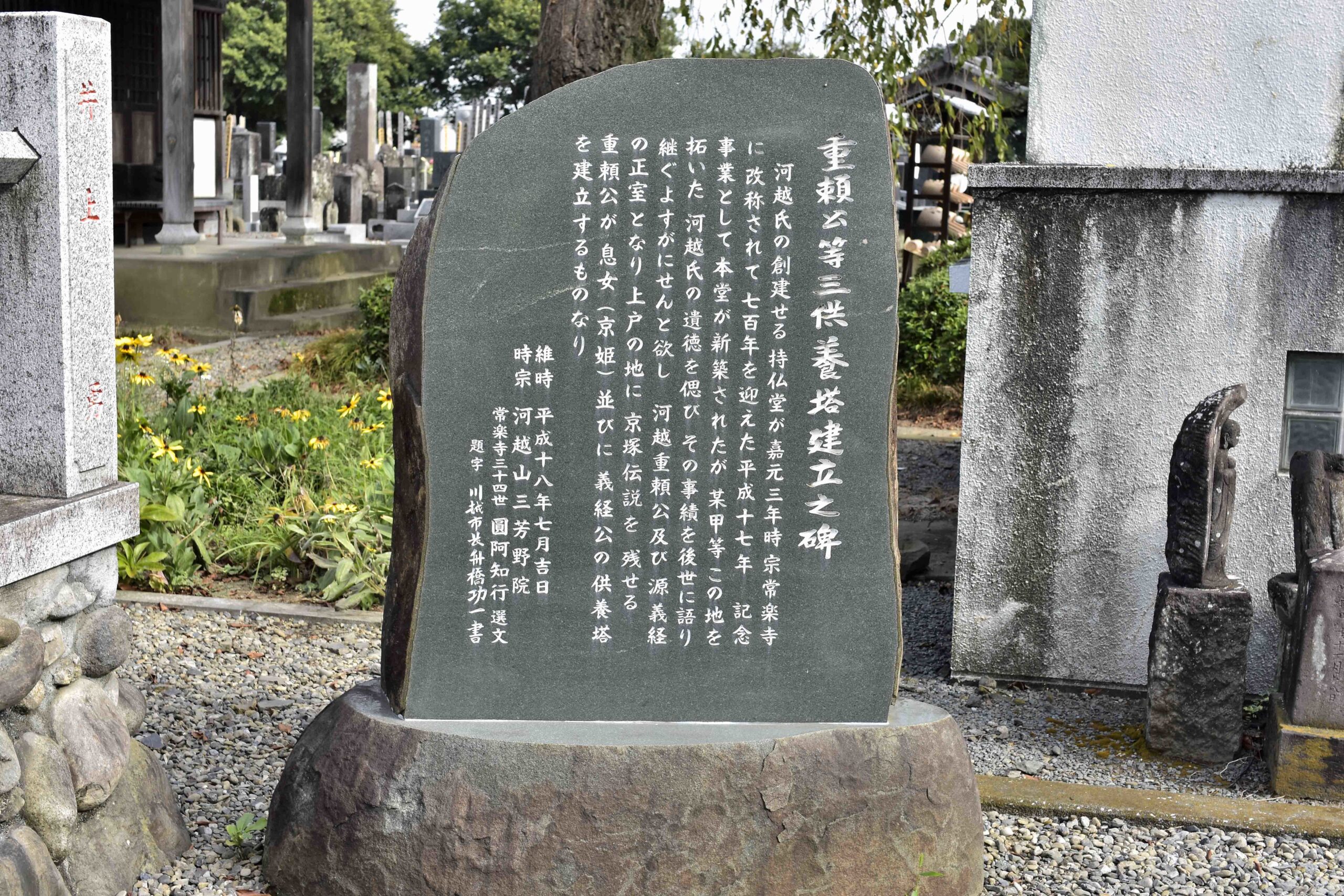
On November 12, 1185.
In Kamakura, a decision was made regarding the fate of Kawagoe Shigeyori, a powerful gokenin of Musashi Province.
The Azuma Kagami records the reason for the confiscation of Shigeyori’s lands.
“This is because he is related to Yoshitsune.”
It meant that he was a relative of Minamoto no Yoshitsune.
Shigeyori had joined Minamoto no Yoritomo in his uprising and advanced to Kyoto with his eldest son Shigefusa to subdue Minamoto no Yoshinaka (Kiso Yoshinaka). His wife was the daughter of Yoritomo’s wet nurse, Hiki no Ama, and she was entrusted with the role of giving the first milk to Yoritomo’s newborn eldest son.
Furthermore, on September 14, 1184, Shigeyori sent his daughter to Kyoto.
Her intended husband was Yoritomo’s brother, Minamoto no Yoshitsune.
The Azuma Kagami notes that this marriage had been promised by Yoritomo’s command from the start.
It was not a union arranged by Shigeyori on his own initiative.
However, the following year, after the Taira clan was defeated, Yoritomo and Yoshitsune came into conflict. After Yoshitsune fled Kyoto, his relatives in Kamakura faced repercussions.
Among Shigeyori’s lands, Katori Gogo in Ise Province was given to Oi no Sanesuke, while his remaining lands were entrusted to Shigeyori’s elderly mother.
Shigeyori himself was later killed on Yoritomo’s orders.
It was just over a year after he had married his daughter to Yoshitsune.
His widow was left with the Kawagoe Manor in Musashi Province. However, the manor’s stewards and peasants did not obey her commands, prompting Yoritomo to issue new orders.
Tracing the life of Kawagoe Shigeyori reveals how Yoritomo commanded the warriors of the eastern provinces and what transpired when those ties were severed.
The Kawagoe Clan, Descendants of the Chichibu Clan of Musashi Province
The birth year of Kawagoe Shigeyori is unknown.
His father was Kawagoe Yorinaga, also known as Katsunuki Yorinaga, a warrior from the Chichibu clan, which descended from the Kanmu Taira lineage.
The Chichibu clan was a warrior group that expanded its influence across Musashi Province in the late Heian period. From this clan emerged the Kawagoe, Hatakeyama, Edo, and Toshima families, among others.
Shigeyori’s grandfather, Chichibu Shigetaka, was a prominent figure in Musashi Province.
The Chichibu clan developed lands along river basins, establishing power by controlling farmland and transportation routes.
The Kawagoe clan’s stronghold was in the area around present-day Kamitotsuka in Kawagoe City, Saitama Prefecture.
Their residence was built on the west bank of the Iruma River.
In the Musashi Province at the time, it was often the case that local influential figures took on the duties of the provincial government office, instead of the officials dispatched from Kyoto.
The provincial government office, known as the kokuga, was where provincial governors conducted local administration.
Within the Chichibu clan, the position of Musashi Province’s Chief Inspector of the Guardian Office was traditionally passed down.
This position was said to involve responsibilities related to the inspection of documents and land associated with the kokuga. According to the later “Azuma Kagami,” it was a role inherited from the time of Chichibu Shigetuna.
However, the specific powers varied over time, and careful consideration is needed to determine the extent of involvement in the kokuga’s work during the era of Shigeyori.
The Kawagoe clan were not only samurai managing land but also a family involved in the administration of Musashi Province.
The Battle of Okura and the Loss of a Grandfather
In the second year of Kyūju (1155).
A battle among the Minamoto clan erupted in Okura, Hiki District, Musashi Province.
The combatants were Minamoto no Yoshitomo‘s eldest son, Minamoto no Yoshihira, and Yoshitomo’s younger brother, Minamoto no Yoshikata.
Yoshikata was the father of Minamoto no Yoshinaka (Kiso Yoshinaka).
Yoshikata had expanded into Musashi Province, forming alliances with figures like Chichibu Shigetaka to build his power. Meanwhile, Yoshihira, backed by his father Yoshitomo’s Eastern forces, opposed Yoshikata.
Yoshihira attacked Yoshikata at Okura, resulting in Yoshikata’s death in battle.
Chichibu Shigetaka is also said to have lost his life in this conflict.
For Shigeyori, this was a significant defeat that occurred during his grandfather’s time.
Shigeyori’s father, Noryu, was Shigetaka’s son and was based in the Katsunuki area. Later genealogies and studies suggest that Noryu contested with the Hatakeyama clan over the leadership of the Chichibu clan.
However, it is unknown how old Shigeyori was at the time of the Battle of Okura. There are no records of him participating in the battle.
Several decades after the Battle of Okura, Shigeyori came to serve Yoritomo, the younger brother of Minamoto no Yoshihira.
The fact that his grandfather opposed Yoshihira and that Shigeyori served Yoritomo illustrates the shifting political landscape faced by the samurai of Musashi Province.
The Kawagoe Lands Donated to Emperor Go-Shirakawa
Around the first year of Eiryaku (1160), it is believed that the Kawagoe clan moved their base to the area around present-day Kamitotsuka in Kawagoe City.
During this period, the lands of Kawagoe were donated to the Shin-Hiyoshi Shrine in Kyoto, becoming a shōen (manor estate).
The Shin-Hiyoshi Shrine was a shrine established by Emperor Go-Shirakawa.
By donating the land, the Kawagoe clan forged ties with influential figures in Kyoto.
However, donating the land did not mean that the Kawagoe clan relinquished control over it.
In a shōen, there were higher-level rights holders known as honke and ryōke, while local officials called shōkan were responsible for collecting taxes and managing the land.
The Kawagoe clan continued to be involved in the management of the land while paying income to the higher-ranking lords.
This was the Kawagoe Manor under the Shin-Hiyoshi Shrine.
The exact year of the establishment of the Kawagoe Manor is not confirmed, but it is considered to be around the first year of Eiryaku. The period when the Kawagoe clan began to use the name “Kawagoe” is also thought to be linked to the establishment of this manor.
At the time, during the Heiji Rebellion, Minamoto no Yoshitomo was defeated and killed, and the Taira clan, led by Taira no Kiyomori, was consolidating power at the court.
Musashi Province also became a domain under Taira control, with figures like Taira no Tomomori involved in the provincial administration.
The Kawagoe clan maintained their status in Musashi Province by cultivating relationships with Emperor Go-Shirakawa and the Taira regime.
Eventually, when Yoritomo raised his army, Shigeyori switched allegiance to the Minamoto side.
The Kawagoe clan adapted their alliances based on the political climate between Kyoto and the eastern provinces.
Marrying the Daughter of Yoritomo’s Wet Nurse, Hiki no Ama
Shigeyori’s wife was the daughter of Hiki no Ama.
Hiki no Ama is known as the wet nurse of Minamoto no Yoritomo.
Even after Yoritomo was exiled to Izu, she supported his livelihood, as recorded in the ‘Azuma Kagami’.
Hiki no Ama, along with her husband Hiki Kamon no Jo, moved to Hiki District in Musashi Province and continued to aid Yoritomo for a long time.
Their daughter married Kawagoe Shigeyori.
The exact timing and details of the marriage are unclear.
There is a tradition that Yoritomo was involved in arranging the marriage, but there are few historical records to confirm this directly.
It is clearly stated in the ‘Azuma Kagami’ that Shigeyori’s wife was Hiki no Ama’s daughter.
The Hiki family continued to hold an important position even after Yoritomo established his base in Kamakura.
The Hiki clan formed marital ties with influential samurai in Musashi Province and developed deep connections with Yoritomo’s family.
Shigeyori was not only a prominent figure in Musashi Province but also the son-in-law of Yoritomo’s wet nurse’s family.
However, this marriage did not automatically make Shigeyori an ally of Yoritomo from the start.
In the fourth year of Jisho (1180), when Yoritomo raised an army in Izu, Shigeyori joined the Taira side and headed to the battlefield.
The Battle of Kinugasa Castle Against the Miura Clan
August, fourth year of Jisho.
Minamoto no Yoritomo raised an army in Izu but was defeated by Oba Kagechika and others at the Battle of Ishibashiyama and fled to Awa Province.
Meanwhile, in Sagami Province, the Miura clan, who supported Yoritomo, clashed with Hatakeyama Shigetada and others on the Taira side.
The Hatakeyama clan, like the Kawagoe clan, belonged to the Chichibu clan.
On August 26, Hatakeyama Shigetada gathered warriors from Musashi Province to attack the Miura clan.
The ‘Azuma Kagami’ lists the names of Kawagoe Shigeyori, Nakayama Shigezane, Edo Shigenaga, the Kaneko clan, and the Murayama clan.
They advanced on Kinugasa Castle, the Miura clan’s stronghold.
The Miura clan stationed warriors on the east and west gates to confront the enemy.
It is said that Miura Yoshizumi and Sahara Yoshitsune were at the eastern gate, while Wada Yoshimori and Kaneda Yoritsugu were at the western gate.
However, the Miura clan was exhausted from the battles that had continued from the previous day.
The “Azuma Kagami” records that the forces led by Shigeyori numbered several thousand horsemen. While there is room for debate regarding the actual number of troops, it is evident that many warriors from Musashi joined the attack.
As night fell, the Miura clan decided to abandon the castle and flee.
At this time, Miura Yoshiaki, the elder of the clan, declared that he would remain in the castle.
The “Azuma Kagami” recounts that Yoshiaki spoke of his longstanding service to the Minamoto family and expressed his hope that his descendants would achieve great deeds under Yoritomo.
Yoshizumi and others left Yoshiaki behind and escaped from the castle.
On the following day, the 27th, it is recorded that Shigeyori’s forces attacked Kinasaki Castle and killed Yoshiaki.
Considering that Kawagoe Shigeyori later became a prominent vassal of Yoritomo, this was an unexpected battle.
Shigeyori was among those who attacked the Miura clan’s stronghold for Yoritomo and killed their elder.
Surrendering to Yoritomo at Nagai no Watashi
After his defeat at Ishibashiyama, Yoritomo regrouped his forces from Awa Province.
With the addition of Chiba Tsunetane and Kazusa Hirotsune, his power rapidly expanded.
As Yoritomo advanced into Musashi Province, the position of Shigeyori and his allies changed.
October 4th, 1180 (Jisho 4).
The “Azuma Kagami” notes that Hatakeyama Shigetada, Kawagoe Shigeyori, and Edo Shigenaga joined Yoritomo at Nagai no Watashi.
These were the warriors who had defeated Miura Yoshiaki at Kinasaki Castle.
By then, Yoritomo was already surrounded by Yoshizumi and other descendants of Yoshiaki.
Accepting Shigeyori and Shigetada meant that the Miura clan had to serve the same lord as the men who had killed their father and grandfather.
According to the “Azuma Kagami,” Yoritomo had explained the situation to the Miura clan in advance.
He emphasized that without winning over the powerful warriors of Musashi Province, achieving great endeavors would be difficult. Loyalty required letting go of past grudges.
The Miura clan raised no objections and sat alongside Shigeyori and his allies.
The specific terms Shigeyori might have proposed upon surrender are not recorded.
Yoritomo accepted them, acknowledging their influence in Musashi Province.
Thus, warriors who had previously been adversaries joined Yoritomo’s advancing forces towards Kamakura.
The Duties Assigned to Edo Shigenaga in Musashi Province
On the day after Shigeyori and his allies submitted to Yoritomo, October 5th, 1180.
Yoritomo entrusted Edo Shigenaga with various tasks in Musashi Province.
The “Azuma Kagami” states that he was given the authority to direct local officials and district governors in managing the province’s affairs.
The Edo clan was also a branch of the Chichibu clan.
This role was closely related to the position of Musashi Province’s overseer, a post traditionally held by the ancestors of the Kawagoe clan.
However, it cannot be definitively stated that Shigenaga was formally appointed to this position.
Both Shigeyori and Shigenaga were warriors with their own influence in Musashi Province.
There is no clear explanation as to why Yoritomo assigned this work to Shigenaga instead of Shigeyori.
Some believe it was an attempt to balance the power between the two.
While bringing the warriors of Musashi Province under his control, Yoritomo also began to involve himself in the traditional functions of the provincial government.
Shigeyori continued his activities as a vassal under his lord.
However, it was more than 40 years after Shigeyori’s death that the Kawagoe clan regained the position they claimed to have inherited from their ancestors.
Shigeyori’s Wife Called on the Day of Yoriie’s Birth
August 12, 1182.
In Kamakura, the first son of Yoritomo and Hojo Masako was born.
This child would later become the second shogun, Minamoto no Yoriie.
According to the “Azuma Kagami,” Masako gave birth to a boy at the hour of the Rooster.
At the hour of the Dog, Shigeyori’s wife was summoned.
It was for the “first feeding.”
The first feeding is a ceremony where the newborn receives milk for the first time.
The “Azuma Kagami” also notes that Shigeyori’s wife was the daughter of Hiki no Ama.
She was chosen for this important ceremony on the day Yoritomo’s legitimate son was born.
While it cannot be immediately concluded that she continued as Yoriie’s wet nurse just because she performed the first feeding,
it is evident from this record that Yoritomo and Masako regarded Shigeyori’s wife as a close associate.
Two years earlier, Shigeyori had attacked the Miura clan as a warrior on the Taira side.
Now, his wife was involved in the birth of Yoritomo’s legitimate son.
The relationship between the Kawagoe clan and Kamakura had significantly changed since Yoritomo’s uprising.
And two years later, Shigeyori’s daughter would marry Yoritomo’s brother.
Father and Son Enter Kyoto Together
In July 1183, Minamoto no Yoshinaka entered Kyoto.
The Taira clan retreated to the western provinces, taking Emperor Antoku and the Imperial Regalia with them.
However, Yoshinaka clashed with Retired Emperor Go-Shirakawa, and in November, he attacked the Hojuji Palace.
Yoritomo dispatched his brothers, Minamoto no Noriyori and Minamoto no Yoshitsune, with forces to Kyoto.
On January 20, 1184,
Noriyori advanced from the Seta area, and Yoshitsune from the Uji area, defeating Yoshinaka’s forces.
On this day, the “Azuma Kagami” mentions both Kawagoe Shigeyori and his heir, Shigefusa.
After defeating Yoshinaka’s forces, Noriyori and Yoshitsune, accompanied by Kawagoe Taro Shigeyori, his son Kotaro Shigefusa, Sasaki Takatsuna, Hatakeyama Shigetada, Shibuya Shigekuni, and Kajiwara Kagesue, rushed to the Rokujō Palace.
The Rokujō Palace was the residence of Emperor Go-Shirakawa.
It is recorded that they were tasked with guarding the Emperor.
Shigeyori, along with his son Shigefusa, entered Kyoto as part of Yoritomo’s forces.
Kawagoe Kotaro Shigefusa was considered to be Shigeyori’s eldest son.
According to the “Genpei Seisuiki,” Shigefusa was said to be 16 years old at the time. He was introduced as a young warrior serving Yoshitsune in front of Emperor Go-Shirakawa.
However, the details of his age and conversations are found in military tales and cannot be confirmed by contemporary records.
What is certain is that Shigeyori and Shigefusa both attended the Rokujō Palace.
The fact that the father and son joined the same forces and acted together with Yoshitsune in Kyoto is an important record when considering the repercussions they faced the following year.
Shigeyori’s Role in the Pursuit of the Taira
After Yoshinaka was defeated, Yoritomo’s forces turned their attention to pursuing the Taira.
On February 7, 1184, the Battle of Ichi-no-Tani took place.
Noriyori attacked the Taira front from the Ikuta Forest, while Yoshitsune launched an assault from another direction.
The Taira were defeated, and many of their clan, including Taira no Tadanori and Taira no Atsumori, lost their lives.
Kawagoe Shigeyori is also known as a warrior who participated in the pursuit of the Taira.
Military tales record the exploits of Shigeyori and Shigefusa.
However, the specifics of which locations Shigeyori attacked and which enemy commanders he defeated vary between sources.
The “Heike Monogatari” and “Genpei Seisuiki” often detail the names and duels of warriors.
It is important to distinguish between the parts of the Kawagoe clan’s exploits that are passed down in later tales and those recorded in documents like the “Azuma Kagami.”
Regarding Shigeyori’s military activities, it is clearly recorded in the “Azuma Kagami” that he entered Kyoto with his son to pursue Yoshinaka.
In the same year, a new relationship was established between Shigeyori’s family and Yoshitsune.
This was a marriage arranged by Yoritomo.
The Marriage with Yoshitsune Decided by Yoritomo
On September 14, 1184.
The “Azuma Kagami” records that Kawagoe Shigeyori’s daughter headed to Kyoto.
The purpose was to marry Minamoto no Yoshitsune.
“This was by the order of the military governor, and had been agreed upon for some time.”
This means it was previously arranged by Yoritomo’s command.
Yoritomo himself was involved in this marriage.
Earlier that year, Yoshitsune had defeated Minamoto no Yoshinaka in January and achieved military success in the Battle of Ichi-no-Tani in February.
He remained in Kyoto afterwards and was appointed as a kebiishi in August.
The kebiishi were court officials responsible for maintaining public order and cracking down on crime in Kyoto.
While Yoritomo was in Kamakura commanding the eastern warriors, Yoshitsune was active in Kyoto, maintaining relations with the court.
During this period, Shigeyori’s daughter, from the influential Kawagoe clan of Musashi Province, was to marry Yoshitsune.
Shigeyori’s wife was the daughter of Hiki no Ama, Yoritomo’s wet nurse.
The daughter marrying Yoshitsune was thus connected to Yoritomo’s wet nurse’s family through her mother.
This marriage united Yoshitsune of the Minamoto clan and the Kawagoe clan of Musashi Province.
For Yoritomo, it likely served to strengthen the relationship between the two parties.
There is also a theory that Shigeyori’s daughter was married off to monitor Yoshitsune, but there is no direct record indicating Yoritomo had such intentions.
The “Azuma Kagami” clearly states that the marriage was arranged by Yoritomo’s order.
The 30-Plus People Accompanying the Daughter
When the daughter set out for Kyoto, Shigeyori sent many attendants with her.
The “Azuma Kagami” notes that there were two keko and over thirty roju.
Keko refers to samurai who are relatives of the lord or have close ties to them. Roju are retainers serving the samurai family.
This means the daughter traveled to Kyoto with a party of over thirty people.
The journey from Musashi Province to Kyoto was long.
The group needed to ensure safety along the way and arrange for lodging and provisions.
That they could send such a large group indicates that the Kawagoe clan had considerable resources.
However, it remains unclear whether the retainers stayed with Minamoto no Yoshitsune after arriving in Kyoto, or what specific roles they played.
The daughter’s age is also not recorded.
In later generations, she is sometimes referred to as “Gozen of the Village” or “Kyoto Princess.”
However, her real name cannot be confirmed from records of the time.
In the “Azuma Kagami,” she is mentioned only as the daughter of Kawagoe Shigeyori.
Regarding the woman who became Yoshitsune’s wife, the “Heike Monogatari” also contains a story about a daughter of Taira no Tokitada marrying him.
Some narratives equate Kawagoe Shigeyori’s daughter with Taira no Tokitada’s daughter, but such explanations include embellishments from later periods.
It is confirmed from the “Azuma Kagami” that Shigeyori’s daughter went to Kyoto to marry Yoshitsune under Yoritomo’s orders.
After the daughter became Yoshitsune’s wife, it is unknown how much contact Shigeyori himself had with Yoshitsune.
The Conflict Between Yoshitsune and Yoritomo
On March 24, 1185, in the second year of Genryaku, the Taira clan was defeated at Dan-no-Ura.
Yoshitsune distinguished himself in the naval battle and captured Taira no Munemori and others.
However, relations between Yoritomo and Yoshitsune began to deteriorate thereafter.
Yoshitsune continued his activities in Kyoto as a kebiishi, strengthening his ties with the court.
Meanwhile, Yoritomo sought to consolidate his authority by commanding the gokenin of the eastern provinces and asserting control over military actions and appointments.
The brothers’ conflict deepened over issues such as Yoshitsune’s appointments and his handling of Minamoto no Yukie.
In May, Yoshitsune headed to Kamakura with the captured Taira no Munemori and others, but according to the “Azuma Kagami,” he was not allowed to enter the city.
In the autumn, Yoritomo ordered Yoshitsune to pursue Minamoto no Yukie.
However, Yoshitsune refused, citing illness as the reason.
On October 9, Yoritomo dispatched Tosabo Shoshun to Kyoto.
On the night of the 17th, Shoshun attacked Yoshitsune’s residence but failed.
The following day, on the 18th, an imperial edict was issued for the pursuit of Yoritomo by Yoshitsune and Yukie.
Just over six months after the fall of the Taira, the brothers found themselves in a position to pursue each other.
It had been about a year since Shigeyori’s daughter married Yoshitsune.
Now, his son-in-law was in conflict with Yoritomo.
There is no record of what Shigeyori thought about this conflict.
Moreover, no definitive records have been found suggesting that Shigeyori plotted rebellion against Yoritomo with Yoshitsune.
October 23: Shigefusa’s Name Disappears
October 23, 1185.
An entry appears in the ‘Azuma Kagami’ indicating a change in the status of the Kawagoe clan.
In preparation for the memorial service at the Shōchōju-in temple scheduled for the following day, Yoritomo was selecting vassals to participate as guards.
The Shōchōju-in temple was established by Yoritomo to honor the memory of his father, Minamoto no Yoshitomo.
Many monks and influential vassals were expected to gather for the memorial service.
Kawagoe Kotaro Shigefusa was initially selected as one of the guards.
However, on October 23, he was removed from the list.
The ‘Azuma Kagami’ records the reason for this.
“Excluded due to being a relative of Yoshu.”
It states that he was excluded because he was a relative of Yoshu, meaning Yoshitsune.
The previous year, Shigefusa had entered Kyoto with his father Shigeyori and attended the court of Emperor Go-Shirakawa alongside Yoshitsune and others.
Now, Shigefusa was excluded from the Kamakura ceremony due to his familial ties with Yoshitsune.
The memorial service on the 24th was attended by many influential vassals, including Hatakeyama Shigetada, Miura Yoshizumi, Chiba Tsunemasa, Hojo Yoshitoki, and Oi Sanemitsu.
Shigefusa was not permitted to join the ranks of the guards.
There is no record of Shigefusa opposing the pursuit of Yoshitsune.
Nor is there any record of him gathering troops to aid Yoshitsune’s escape.
The reason given in the ‘Azuma Kagami’ was that he was a relative of Yoshitsune.
Twenty days before his father Shigeyori’s lands were confiscated, his son’s circumstances had already changed.
November When Yoshitsune Left Kyoto
In late October, Yoritomo dispatched forces to Kyoto to pursue Yoshitsune and others.
Yoshitsune also tried to gather troops in Kyoto but failed to gain sufficient support.
On November 3, Yoshitsune left Kyoto with Minamoto no Yukie and others.
They were heading towards the western provinces.
The ‘Azuma Kagami’ records the names of the samurai who followed Yoshitsune.
They included Izu Arimasa, Hori Kagemitsu, Sato Tadanobu, Ise Yoshimori, and Musashibo Benkei.
The name of Kawagoe Shigeyori does not appear among them.
There is also no record confirming that Shigefusa joined Yoshitsune’s group.
On November 6, Yoshitsune attempted to set sail from Daimotsu in Settsu Province but was caught in a storm.
The fleet was scattered, and Yoshitsune continued his escape with only a few retainers.
Yoritomo, reacting to the situation in Kyoto, canceled his advance to the capital and returned to Kamakura.
Orders were issued across the land to search for Yoshitsune, and preparations for his capture were underway.
Yoshitsune had already left Kyoto.
It is unknown whether Shigeyori had any contact with Yoshitsune.
However, in Kamakura, a decision was made to punish the Kawagoe clan, the family of Yoshitsune’s wife.
November 12: Confiscation of Kawagoe Shigeyori’s Lands
On November 12, 1185.
The ‘Azuma Kagami’ records that Kawagoe Shigeyori’s lands were confiscated.
The reason was his connection to Yoshitsune.
No specific charges such as joining Yoshitsune’s escape or raising troops against Yoritomo are mentioned.
The fact that his daughter was Yoshitsune’s wife was the reason for the punishment.
Among the confiscated lands, the Katori Five Villages in Ise Province were given to Oi Mitsuharu.
Mitsuharu was a vassal loyal to Yoritomo and had participated as an escort in the memorial service at Shochoujuin on October 24.
Though Shigeyori was based in Musashi Province, he also held lands in Ise Province.
The circumstances under which he acquired the Katori Five Villages remain unclear.
However, it is clearly stated in the ‘Azuma Kagami’ that they were confiscated on November 12, 1185, and given to Oi Mitsuharu.
Meanwhile, the remaining lands were entrusted to Shigeyori’s elderly mother.
This elderly mother is thought to be the mother of Shigeyori.
She is a different person from Hiki no Ama, who was Yoritomo’s wet nurse.
Shigeyori’s wife was the daughter of Hiki no Ama, and it is important to distinguish her from the elderly mother who was entrusted with the estates.
While Yoritomo confiscated Shigeyori’s estates, he did not give all of them to another retainer.
The estates, including the main lands in Musashi Province, were to be managed by an elderly woman of the family.
Subsequently, Shigeyori’s wife also became involved in the management of the Kawagoe estate.
The Punishment Also Extended to Shimokobe Masayoshi
On the same day, November 12.
Another warrior had his lands confiscated.
It was Shimokobe Shiro Masayoshi.
The “Azuma Kagami” records that Masayoshi also had his lands taken away.
The reason was that he was the son-in-law of Kawagoe Shigeyori.
Masayoshi was a warrior who had married Shigeyori’s daughter.
The Shimokobe clan was a powerful family centered in Shimousa Province, known as retainers loyal to Yoritomo.
Among the same clan was Shimokobe Yukihira, who had distinguished himself in the western expedition.
There is no record confirming that Masayoshi was involved in Yoshitsune’s escape.
His connection to Yoshitsune was through his marriage to Shigeyori’s daughter.
Nevertheless, his lands were confiscated.
Because Shigeyori’s daughter married Yoshitsune, Shigeyori himself was punished.
Furthermore, Masayoshi, as Shigeyori’s son-in-law, was also punished.
The punishment extended to families connected by marriage.
The retainers loyal to Yoritomo were interconnected through familial and marital ties.
While these connections helped elevate a family’s status, they could also lead to repercussions for other families if one fell from grace.
The confiscation of the Kawagoe clan’s estates illustrates this severity.
When Was Shigeyori Killed?
The year of Kawagoe Shigeyori’s death is generally considered to be Bunji 1 (1185).
However, the “Azuma Kagami” entry for November 12 records only the confiscation of his estates.
It does not state that Shigeyori was executed on the same day.
The location and method of his execution are not mentioned in the entry for that day.
Shigeyori’s death is clearly recorded in the entry for October 5, Bunji 3 (1187).
It states that Shigeyori was executed due to his connection with Yoshitsune.
This record confirms that Shigeyori was killed by October 1187.
Sources like the “Kokushi Daijiten” suggest that he was likely executed within 1185, following the confiscation of his estates in November of that year.
However, there is no historical evidence directly supporting this date.
There are also discrepancies in the records regarding his eldest son, Shigefusa.
The “Genpei Seisuiki” contains an account stating that both Shigeyori and Shigefusa were executed.
Historical records from Kawagoe City and the ‘Comprehensive History of Japanese Place Names’ explain that the father and son were executed.
On the other hand, the ‘Azuma Kagami’ does not provide detailed information about the exact time of Shigefusa’s death.
It is difficult to determine whether Shigefusa was killed on the same day as his father or at a different time.
What can be confirmed from the ‘Azuma Kagami’ is that on October 23, 1185, Shigefusa was removed from his position as a retainer related to Yoshitsune, and on November 12, his father’s estate was confiscated, and later Shigeyori was executed.
Regarding Shigeyori’s end, even with later accounts, there remain unclear points.
The Kawagoe Clan’s Estate Entrusted to the Elderly Mother
What happened to the Kawagoe Clan’s main estate after Shigeyori was dealt with?
According to the ‘Azuma Kagami’ entry for November 12, the estate, excluding the five villages of Katori in Ise Province, was entrusted to Shigeyori’s elderly mother.
There are no detailed records on how the elderly mother actually managed the estate.
Later, it was confirmed that there was a young lord at the Kawagoe Manor.
It is thought that after Shigeyori’s death, there was still an heir within the Kawagoe family who had not yet fully matured.
However, it is unclear which of Shigeyori’s children this young lord was.
There is a possibility that the elderly mother acted as a guardian, but no documents detailing the succession process have survived.
The Kawagoe Manor was part of the New Hiyoshi Shrine’s estate in Kyoto.
There were farmers cultivating the land and a headman collecting the annual tribute.
Even if the local lord changed, the tribute from the manor still needed to be delivered to Kyoto.
After Shigeyori was gone, who would take on that responsibility?
The following year, issues concerning the payment of the tribute surfaced.
Tribute from Kawagoe Manor Not Delivered
July 28, 1186 (Bunji 2).
The ‘Azuma Kagami’ features an article about the non-payment of tribute from Kawagoe Manor.
The complaint was that the steward of the Kawagoe Manor, part of the New Hiyoshi Shrine’s estate, had not delivered the previous year’s tribute.
Kawagoe Manor was managed in a system called ‘uke-sho.’
‘Uke-sho’ was a system where local lords or others undertook the responsibility of delivering a fixed amount of tribute.
The steward was responsible for delivering the determined tribute.
However, at Kawagoe Manor, the delivery was delayed.
At this time, the ‘Azuma Kagami’ also mentions that the lord was young.
Suspecting there might be some unfair handling of the tribute, Yoritomo ordered an investigation.
Furthermore, on August 5, Yoritomo sent a reply to Kyoto.
In it, he explained the circumstances that led to the delay in tribute.
He stated that due to the death of the manor’s lord the previous year, it was unclear to whom the tribute should be delivered.
He clarified that the steward had not appropriated the tribute for himself and instructed that it be delivered once a new lord was appointed.
The lord was the senior authority entitled to receive the income from the manor.
At Kawagoe Manor, changes occurred on the local lord’s side due to Shigeyori’s punishment.
Meanwhile, in Kyoto, the lord had passed away, changing the recipient of the tribute.
The circumstances on both sides were overlapping.
Given the presence of a young lord, it is possible that the internal affairs of the Kawagoe clan were unstable.
However, the direct reason for the unpaid taxes, as explained by Yoritomo, was the issue of where to send the taxes due to the death of the estate owner.
The cause of the unpaid taxes cannot be explained solely by Shigeyori’s punishment.
Shigeyori’s Wife Becomes a Nun
On October 5, 1187.
In the “Azuma Kagami,” Kawagoe Shigeyori’s wife appears again.
After Shigeyori was executed due to his connection with Yoshitsune, Yoritomo took pity on the remaining family and granted Musashi Province’s Kawagoe Manor to the widow nun.
A widow nun is a woman who has lost her husband and taken religious vows.
Shigeyori’s wife became a nun after her husband’s death.
She was granted the management of Kawagoe Manor.
However, problems arose within the manor.
News reached Kamakura that the local leaders and farmers were not obeying the widow nun’s orders.
The local leaders were influential figures involved in tax collection and land management within the manor.
If these leaders did not follow the widow nun’s instructions, it would hinder the management of the manor.
The specific reasons why they did not comply are not recorded.
It is possible that the authority of the Kawagoe clan weakened after Shigeyori’s death, but the historical records do not specify the cause.
Yoritomo issued an order regarding this issue.
The content was that from now on, whether in estate affairs or miscellaneous duties, all should follow the widow nun’s instructions.
“Henceforth, in estate affairs and miscellaneous duties, nothing should be done without following the nun’s orders.”
He demanded that all work related to the manor be handled according to her commands.
Even after Shigeyori’s execution, his wife was tasked with managing Kawagoe Manor.
The Later Life of the Woman Who Nursed Yoriie
On August 12, 1182, Shigeyori’s wife served as the wet nurse for Yoritomo’s eldest son, Yoriie.
Five years later, Yoritomo recognized the same woman for managing Kawagoe Manor and ordered the local leaders and farmers to obey her.
She was the daughter of Hiki no Ama.
Hiki no Ama was known as a woman who supported Yoritomo since his days living as an exile in Izu.
Shigeyori’s wife, as her daughter, was also involved in the birth of Yoritomo’s heir.
These records suggest that Yoritomo trusted her.
However, the reason for granting Kawagoe Manor might not solely be due to her connection with Hiki no Ama.
At that time, there were other instances where women who lost their husbands managed estates and maintained the household until their young children grew up.
It is believed that after Shigeyori’s death, the Kawagoe clan had a young successor.
In maintaining the household, the wife’s role in managing the estate was crucial.
Yoritomo’s decision to grant Kawagoe Manor to the widow nun likely stemmed from both his relationship with the wet nurse’s family and the necessity of preserving the Kawagoe clan’s household.
It remains unknown when she passed away.
Furthermore, the details of how the management of the Kawagoe estate was transferred from the widow nun to her children remain undocumented.
Nevertheless, a record from October 5, 1187, clearly states that she was recognized as the administrator of the estate, holding the authority to issue orders to the local people.
The Sister of Shigeyori Who Married into the Shodai Clan
The continuation of the Kawagoe clan was also influenced by Shigeyori’s sister.
It is said that she married Shodai Yukihira, a member of the Kodama clan, a samurai group from Musashi Province.
This woman is referred to as “Kawagoe Nun” in later historical records.
One such record is the “Shodai Iju Okibumi.”
An okibumi is a document left to descendants detailing the history of a family, its estates, and inheritance matters.
The Shodai Iju Okibumi is believed to have been created in the early 14th century, more than 100 years after Shigeyori’s time.
It recounts how the Kawagoe Nun was entrusted with documents passed down in the Shodai family.
Yukihira entrusted his wife, the Kawagoe Nun, with important documents such as decrees and official orders received from Yoritomo, and later, the successor of Yukihira’s house requested their return.
Decrees and official orders were crucial documents indicating land rights and commands.
For a samurai family, documents received by ancestors served as evidence to assert control over land.
The story of the Kawagoe Nun safeguarding these documents provides insight into how women were involved in managing their marital family’s estates and documents.
However, this record was written after Shigeyori’s time, and not all of the Kawagoe Nun’s actions can be verified with contemporary sources.
Shigeyori’s wife was connected to the Hiki clan, and his sister married into the Shodai clan.
The women of the Kawagoe clan, even after forming ties with other families through marriage, remained involved in the estates and assets of their respective families.
After Shigeyori’s punishment, they were an indispensable presence in considering the survival of the clan.
Forty Years Later, the Appointment of Kawagoe Shigekazu
Following Shigeyori’s death, records of the Kawagoe clan’s activities became sparse.
However, the clan did not become extinct.
On April 10, 1226.
The “Azuma Kagami” notes that Kawagoe Saburo Shigekazu was appointed to the position of General Inspector of the Musashi Province’s Guardian Office.
Shigekazu is considered to be the third son of Shigeyori.
More than 40 years had passed since Shigeyori’s punishment.
The “Azuma Kagami” explains that this position had been inherited since the time of their ancestor, Chichibu no Dewa no Gon no Kami.
The position of General Inspector of the Musashi Province’s Guardian Office was one that the Chichibu clan had long been involved with.
It is believed that during Shigeyori’s time, the Kawagoe clan held this position, which was later succeeded by Hatakeyama Shigetada.
Shigetada was killed in 1205 due to conflicts with the Hojo clan.
What happened to the General Inspector position afterward is unclear.
Shigekazu’s appointment in 1226 signified a renewed recognition of the Kawagoe clan’s ancestral position.
However, not all the powers from Shigeyori’s time were restored.
The political structure of the Kamakura shogunate had changed significantly, with the Hojo clan wielding strong influence in Musashi Province.
The Four Duties Shigezane Petitioned For
April 2, 1231.
Kawagoe Shigezane complained that four duties associated with the position of overseer of the Rususho had not been carried out in recent years.
The Azuma Kagami records that Shigezane requested to perform his duties according to precedent.
In response to Shigezane’s petition, Hojo Yasutoki, the governor of Musashi Province, ordered an investigation at the Rususho in Musashi.
On April 20, the results of the investigation reached Kamakura.
It was recorded that the duties Shigezane claimed had been performed from the time of Chichibu Yoshitsuna to Hatakeyama Shigetada.
These duties included adding signatures to provincial documents and inspecting lands.
Shigezane’s claims matched the reports from the local officials.
Therefore, it was decided that the duties could be carried out as before.
Shigezane asserted the status of his ancestors and had its legitimacy confirmed through the investigation.
Even after Shigeyori’s execution, the Kawagoe family retained the memory of their lineage and rights.
Subsequently, Shigezane’s descendants continued to serve as vassals of the Kamakura shogunate.
It took many years for the Kawagoe family to reemerge as influential figures in Musashi Province.
The Bronze Bell Dedicated in 1260
November 22, 1260.
Tsuneharu, a descendant of the Kawagoe family, dedicated a bronze bell to the Shin-Hie Sanno Shrine in Kawagoe Manor.
This bronze bell is now designated as an Important Cultural Property of Japan.
The inscription bears the name of “Musashi Province, Kawagoeshi Manor” and the name of the dedicator, Taira no Ason Tsuneharu.
The bell was cast by an artisan named Tanji Hisatomo.
The inscription indicates that the relationship between Kawagoe Manor and the Shin-Hie Shrine continued into the mid-13th century.
Approximately 75 years since Shigeyori’s time.
The descendants of the Kawagoe family maintained the shrine on the land their ancestors had established and had the economic power to dedicate a bronze bell.
Afterward, the Kawagoe family continued to serve as vassals of the Kamakura shogunate, forming ties with the Hojo and Ashikaga families.
However, the influence of the Kawagoe family did not continue in the same form as during Shigeyori’s time.
The duties of the provincial office and the control of estates changed with the establishment of the Kamakura shogunate and the rise of the Hojo family.
The Kawagoe family managed to sustain their household amidst these changes.
The Fate of the Daughter Married to Yoshitsune
There are few records of Shigeyori’s daughter after she went to Kyoto.
In November of the first year of Bunji, when Yoshitsune fled Kyoto, the Azuma Kagami mentions the company of Shizuka Gozen and others.
However, it is unclear where Kawagoe Shigeyori’s daughter was at that time.
Later stories tell of Yoshitsune’s party being separated by a storm at Daimotsu Bay, with his wife eventually reuniting with him in Oshu.
However, no contemporary records directly confirm this sequence of events.
The entry for February 10, 1187, in the third year of Bunji, notes that Yoshitsune headed to Oshu with his wife and children.
Furthermore, on the intercalary 30th day of the 4th month in the 5th year of Bunji (1189).
When Fujiwara no Yasuhira’s forces attacked Minamoto no Yoshitsune at Koromogawa, the Azuma Kagami records the final moments of Yoshitsune.
It is said that Yoshitsune entered his private Buddhist chapel, killed his wife and daughter, and then took his own life.
His wife was recorded to be 22 years old, and his daughter 4 years old.
This wife is often thought to be the daughter of Kawagoe Shigeyori.
However, in this entry of the Azuma Kagami, neither her family background nor her name is specified.
While the explanation that Shigeyori’s daughter died at Koromogawa is widely known, there is no description in the historical records that conclusively identifies her as the same person.
How the daughter, married to Yoshitsune by Yoritomo’s order, learned of her father’s confiscated lands and execution is unknown.
No records convey her feelings about these events.
On the 14th day of the 9th month in the 1st year of Genryaku, she set out for Kyoto accompanied by more than 30 retainers.
This is one of the few events clearly recorded in the Azuma Kagami as her own actions.
The Remains of Kawagoe Residence by the Iruma River
In present-day Kamito, Kawagoe City, Saitama Prefecture, the remains of the Kawagoe residence can be found.
Located on the west bank of the Iruma River, it is believed to be the site of the Kawagoe clan’s residence.
In 1984, it was designated as a national historic site.
Excavations have confirmed the presence of moats, wells, and the remains of buildings with pillar foundations.
The Kawagoe residence was used over a long period, undergoing renovations in later eras.
Not all of the existing structures were built during Shigeyori’s time.
Nevertheless, it remains an important historical site that conveys the Kawagoe clan’s establishment in this area.
Near the residence remains is Jorakuji Temple, associated with the Kawagoe clan.
Additionally, Kamito Hie Shrine is known as a shrine related to the new Hiyoshi Shrine enshrined in Kawagoe Manor.
The land of Kawagoe, where Shigeyori is said to have lived, retains temples, shrines, and residence remains from later generations.
It reveals the history of the Kawagoe clan’s advance into this area at the end of the Heian period, and their descendants’ continued use of it as a base.
On the other hand, it is unclear in which building Shigeyori actually lived and where he was executed.
No definitive location remains to convey his final moments.
Orders Left After Shigeyori’s Death
On the 5th day of the 10th month in the 3rd year of Bunji.
The Azuma Kagami records that Kawagoe Shigeyori’s wife was troubled over the management of the manor.
The local leaders and farmers did not obey her orders.
Yoritomo ordered that, regarding the affairs of Kawagoe Manor, they should henceforth follow the instructions of the widow nun.
That woman had been entrusted with nursing Yoritomo’s firstborn son on the day of his birth five years earlier.
Her husband, Shigeyori, had followed Yoritomo’s call to arms and advanced to Kyoto with his heir. Marrying their daughter to Yoshitsune was also by Yoritomo’s order.
On the 14th day of the 9th month in the 1st year of Genryaku, Shigeyori sent his daughter to Kyoto with more than 30 retainers.
On the 23rd day of the 10th month in the following 1st year of Bunji, his heir, Shigefusa, was removed from the ranks of the guards at Kachojyuin due to his connection with Yoshitsune.
On the 12th of November, Shigeyori’s lands were confiscated.
Later, it is recorded in the Azuma Kagami that Shigeyori was executed.
After losing her husband, his wife became a nun and took charge of managing the Kawagoe estate.
However, reports soon came in that the local leaders and farmers were not complying, prompting Yoritomo to reaffirm her authority.
In 1184, Yoritomo ordered that Shigeyori’s daughter be married to Yoshitsune.
In 1185, the same Yoritomo confiscated Shigeyori’s lands.
The reason for this action, recorded in the Azuma Kagami entry for November 12, was singular.
“A relative of Yoshitsune.”
The marriage ordered by Yoritomo became the justification for seizing Shigeyori’s estate.