July 25, 1183.
The Taira clan was leaving Kyoto, heading west.
Minamoto no Yoshinaka’s forces were closing in on the capital, and Emperor Go-Shirakawa had already fled. Taira no Munemori had decided to evacuate the capital, taking Emperor Antoku and the Imperial Regalia with him.
During this retreat, a commander leading over five hundred horsemen encountered the procession.
This was Taira no Sadayoshi, the Governor of Higo.
He was known as a trusted retainer of Taira no Kiyomori and had also served his eldest son, Shigemori.
According to “The Tale of the Heike,” Sadayoshi urged Munemori to return to the capital and fight.
However, Munemori refused to listen.
Sadayoshi entrusted most of his troops to Shigemori’s sons and returned to Kyoto with only a small group of followers.
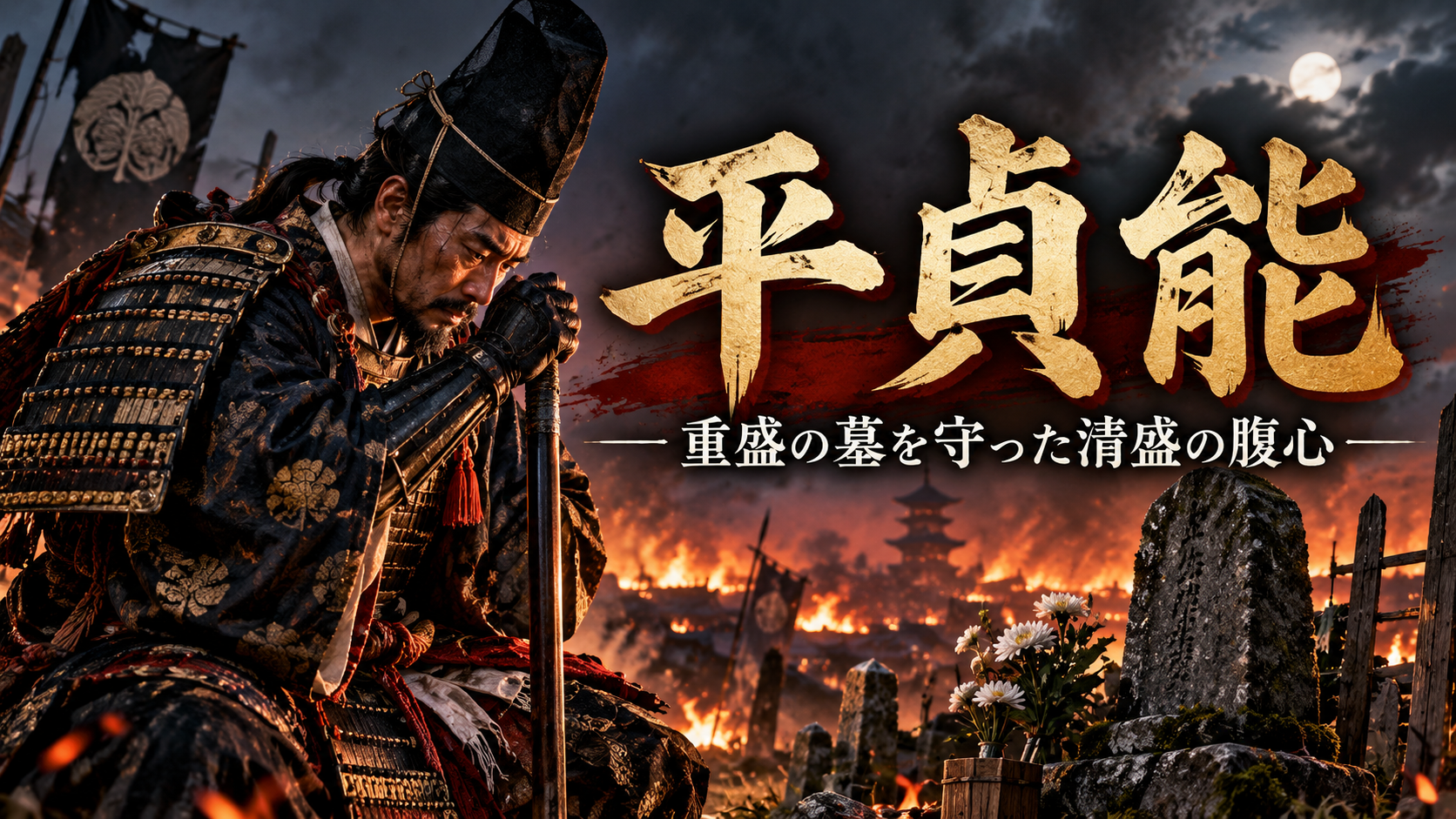
It is said that he then exhumed the grave of his late lord, Shigemori, who had died four years earlier.
On the day the Taira abandoned the capital, Sadayoshi wept before the remains of his deceased lord.
Two years later.
After the Taira’s downfall at Dan-no-ura, Sadayoshi appeared before Utsunomiya Tomotsuna, who served Minamoto no Yoritomo.
Tomotsuna was a warrior who had once been allowed to return home from Kyoto thanks to Sadayoshi’s intercession.
Serving Kiyomori as the Son of Taira no Iesada
The birth year of Taira no Sadayoshi is unknown.
His father was Taira no Iesada.
He was a prominent retainer who had served since the time of Taira no Tadamori, Kiyomori’s father, supporting the Taira clan’s administration and military.
Even after Kiyomori succeeded to the family headship, Iesada continued to be an active senior retainer, supporting the expansion of the Taira’s influence.
The Taira clan had many powerful retainers, including Ito no Tadakiyo, Taira no Morikuni, Seo no Kaneyasu, and Taira no Moritoshi.
Sadayoshi also served Kiyomori as a hereditary retainer, continuing the legacy from his father’s time. He was considered a warrior with strong ties to Iga Province.
In 1156, the Hogen Rebellion broke out due to the conflict between Emperor Sutoku and Emperor Go-Shirakawa. The Hogen Rebellion occurred.
Taira no Kiyomori joined forces with Emperor Go-Shirakawa and, alongside Minamoto no Yoshitomo and others, emerged victorious.
During the Heiji Rebellion of 1159, Kiyomori defeated Yoshitomo.
Through these two conflicts, Kiyomori elevated his status at the imperial court, rising to the position of Chancellor in 1167.
During this period, it is believed that Sadayoshi was active as a retainer of Kiyomori. However, his specific achievements in the Hogen and Heiji Rebellions remain unclear.
Eventually, as Kiyomori stepped back from the forefront of politics, his eldest son, Taira no Shigemori, took on a central role within the Taira clan.
Sadayoshi was also deeply involved with Shigemori’s household, supporting the young lords of the Komatsu family.
Shigemori and the Young Lords of the Komatsu Family
Taira no Shigemori, Kiyomori’s eldest son, rose through the ranks at the imperial court following the Hogen and Heiji Rebellions.
By 1177, he had become the Minister of the Interior, engaging in politics as the heir of the Taira clan.
While assisting Kiyomori, Shigemori also maintained a careful relationship with Retired Emperor Go-Shirakawa, often mediating between the two.
His residence earned him the nickname Komatsu-dono.
Shigemori’s eldest son, Koremori, was closely associated with his wet nurse’s father, Itō Tadakiyo, while Sadayoshi is thought to have supported his second son, Sukemori, and others.
Koremori, Sukemori, Kiyotsune, Arimori, Moromori, and Tadayuki.
After obtaining court positions, Shigemori’s sons would eventually march to various battlefields during the Genpei War.
Sadayoshi was a warrior who served the Komatsu family even when they were still in Kyoto.
In the third volume of “The Tale of the Heike,” in the chapter “Mumon,” there is a scene where Shigemori gives a keepsake sword to Koremori.
Sadayoshi was present at that moment as well.
The Sword Without Inscription—Shigemori’s Keepsake to Koremori
In 1179.
According to “The Tale of the Heike,” Shigemori had an ominous dream one night.
Near the torii gate of Kasuga Daimyojin, a large crowd had gathered, and among them, the head of Kiyomori was displayed.
Afterwards, Shigemori called his eldest son, Koremori, who was about to attend court.
At that time, Koremori held the position of a minor captain.
Shigemori ordered sake to be served and summoned Sadayoshi.
Sadayoshi prepared the sake, which Shigemori first received three times, followed by Koremori, who also received it three times.
Then Shigemori instructed Sadayoshi to bring a parting gift for his son.
What Sadayoshi brought was a sword wrapped in a brocade bag.
Koremori thought it might be the famous family sword, Kogarasu-maru.
However, when he opened the bag, it contained a plain sword without any inscriptions.
This was the sword used for a minister’s funeral.
Koremori was shocked and suspected that Sadayoshi had made a mistake.
Then Shigemori explained that he had given it to him intentionally.
Originally, it was the sword he had prepared to wear at his father Kiyomori’s funeral.
However, it seemed that he would pass away first.
Therefore, he was passing it on to Koremori.
Koremori was at a loss for words and did not attend court that day, returning to his residence instead, as recounted in the ‘Heike Monogatari’.
Afterwards, Shigemori made a pilgrimage to Kumano.
Shortly after returning, he fell ill and passed away on the 29th of the intercalary seventh month of Jisho 3 (1179). He was 42 years old.
The story of Shigemori sensing his impending death is an anecdote depicted in the ‘Heike Monogatari’.
In it, Sadayoshi fulfills the role of offering sake to Koremori and delivering the plain sword, as instructed by Shigemori.
Four years after Shigemori’s death, Sadayoshi appears again in a significant scene in the ‘Heike Monogatari’.
Sadayoshi, Supporting the Taira Control in Kyushu
Sadayoshi is said to have served as the governor of Chikuzen, Chikugo, and Higo provinces.
In the ‘Heike Monogatari’, he is mentioned as the governor of Higo during the fall of the capital, and in the ‘Azuma Kagami’, as the former governor of Chikugo.
During Kiyomori’s era, the Taira clan expanded their influence across various parts of Kyushu.
Dazaifu served as the administrative center overseeing Kyushu, and the Taira strengthened their influence through official positions and relationships with local warriors.
Kiyomori himself once held the position of Dazai Daini.
In Kyushu, there were powerful warrior groups such as the Harada clan of Chikuzen, the Kikuchi clan of Higo, the Matsuura party of Hizen, and the Ogata clan of Bungo.
Each held power in their respective regions, and their relationships with the Taira were not uniform.
Sadayoshi’s father, Iesada, is also said to have been involved in the Taira’s activities in Kyushu.
Sadayoshi himself supported the Taira’s military activities while maintaining connections with the lands and transportation routes in Kyushu.
In Jisho 4 (1180), when Minamoto no Yoritomo raised an army in Izu, anti-Taira movements began to spread across the country.
Rebellions also erupted in Kyushu.
Kikuchi Takanao of Higo Province rose in rebellion against the Taira.
Kikuchi Takanao’s Uprising and the Expedition to Chinzei
Kikuchi Takanao was a prominent samurai based in Kikuchi District, Higo Province.
In the fourth year of the Jisho era, taking advantage of Prince Mochihito’s uprising and Yoritomo’s rise, Takanao also rebelled against the Taira clan.
His forces advanced towards Dazaifu, clashing with samurai loyal to the Taira.
Harada Tanenao and others were compelled to respond to the rebellion, spreading the conflict to the Dazaifu area.
For the Taira, Kyushu was a crucial region, connecting sea routes in the Seto Inland Sea and trade with the continent.
In the eastern provinces, Yoritomo was expanding his influence, while in the Hokuriku region, Minamoto no Yoshinaka was beginning his activities.
If they lost Kyushu, the Taira’s control would be further undermined.
In the fifth year of the Jisho era (1181), Sadayoshi was dispatched to Kyushu to quell the rebellion in the western provinces.
In the intercalary second month of the same year, Kiyomori passed away.
Afterwards, under the Taira regime led by Munemori, Sadayoshi continued to address the rebellious forces in Kyushu.
Although Kikuchi Takanao’s resistance persisted, it is said that by the fourth month of the second year of the Yowa era (1182), he was forced to surrender.
Through his activities in the western provinces over two years, Sadayoshi temporarily subdued the rebellion in Kyushu.
However, there was no guarantee that the samurai in various regions would continue to follow the Taira.
Forces like the Ogata clan in Bungo continued to resist the Taira.
Sadayoshi then gathered his forces in Kyushu and returned to Kyoto.
According to the “Heike Monogatari,” volume seven “The Emperor’s Departure from the Capital,” he returned to the capital leading the Kikuchi, Harada, and Matsuura clans.
The number of troops was said to be over three thousand, but it is difficult to take the figures in military tales at face value.
By the time Sadayoshi returned to Kyoto, the Taira were facing a severe crisis.
The Defeat at Kurikara Pass and the Return to Kyoto
In the second year of the Juei era (1183), in May.
The Taira punitive force led by Taira no Koremori was defeated by Minamoto no Yoshinaka at Kurikara Pass in the Hokuriku region.
Following their defeat at the Battle of Shinohara, Yoshinaka’s forces advanced towards Kyoto.
In the eastern provinces, Yoritomo was consolidating his power, while in the Hokuriku region, Yoshinaka was making significant progress.
According to the “Heike Monogatari,” Sadayoshi returned to Kyoto on July 14.
What awaited Sadayoshi, who had returned after quelling the rebellion in Kyushu, was the advance of Minamoto no Yoshinaka and the series of defeats suffered by the Taira forces.
Munemori attempted to defend the capital, but was unable to turn the tide of the battle.
The warrior monks of Mount Hiei also refused to cooperate with the Taira clan.
Furthermore, during the night of July 24th into the early hours of the 25th, Emperor Go-Shirakawa fled Kyoto.
Munemori decided to retreat to the western provinces, taking Emperor Antoku and the Imperial Regalia with him.
On July 25th, the Taira clan left Kyoto.
During their journey, Sadayoshi met with Munemori.
The Meeting at Udono—Sadayoshi’s Attempt to Halt the Departure
According to the “Tale of the Heike,” Sadayoshi had received news that Genji forces were at Kawajiri, and he set out with over five hundred horsemen.
However, he found no trace of the enemy.
On his way back, he encountered the procession of the Taira clan near Udono.
They were escorting Emperor Antoku as Munemori and others headed west.
Sadayoshi leapt off his horse and approached Munemori.
He inquired about their destination.
He argued that if they fled to the western provinces, they would be hunted down as fugitives.
He insisted that they should remain in Kyoto and fight to the end.
Sadayoshi made this plea.
However, Munemori explained that Yoshinaka’s forces were closing in and Emperor Go-Shirakawa had already left the capital.
If it were just the men of the clan, they could fight in Kyoto.
But they could not risk the safety of Kenreimon-in, Nii no Ama, and Emperor Antoku.
That was Munemori’s response.
Sadayoshi’s counsel was not heeded.
So Sadayoshi requested leave from Munemori.
“Sadayoshi was granted leave and resolved to face his fate in the capital,” the “Tale of the Heike” recounts.
He entrusted the over five hundred horsemen he led to Shigemori’s sons and returned to Kyoto with about thirty riders.
The young lords of the Komatsu family continued on to the western provinces with the clan.
Meanwhile, Kiyomori’s brother, Yorimori, remained in Kyoto.
According to the “Tale of the Heike,” when Yorimori heard that Sadayoshi had returned to Kyoto, he feared Sadayoshi might have come to kill him.
But Sadayoshi did not head towards Yorimori.
He went to Nishihachijo, where Kiyomori’s residence had been.
A Night at the Burned Nishihachijo
As the Taira clan departed the capital, they set fire to their own residences.
Kiyomori’s residence at Nishihachijo was also burned down.
According to the “Tale of the Heike,” Sadayoshi pitched a large tent on the charred remains and spent the night there.
He waited for the return of the Taira lords to the capital, but none appeared.
He recalled the days when he served Kiyomori and Shigemori.
Nishihachijo, once bustling with many lords and retainers.
Now the residence was in ruins, and only a handful of followers remained with Sadayoshi.
In response, Sadayoshi decided to exhume the grave of the late Shigemori.
With Yoshinaka’s forces entering Kyoto, there was a risk that the grave might be trampled by enemy horses.
The Heike Monogatari records that Sadayoshi retrieved Shigemori’s remains and, weeping, spoke to them.
“Behold the End of Our Clan”
“What a pitiful sight, behold the end of our clan.”
What a terrible state of affairs. Please witness the fate of our family.
Sadayoshi lamented to the late Shigemori about the Taira clan being driven from the capital.
“All who live must perish. After joy comes sorrow.”
All living things must eventually die, and after prosperity comes grief.
During Shigemori’s lifetime, the Taira clan held key positions in the court, with Kiyomori at its helm.
Shigemori passed away in the third year of Jisho (1179).
Just two years later, Kiyomori also died, and the Taira found themselves battling the Minamoto forces across the land.
Now, Shigemori’s sons are leaving Kyoto, heading west.
Sadayoshi regretted not following Shigemori in death when he passed.
Having lived on, he was now forced to witness his clan being expelled from the capital.
He wished to be welcomed into the same Pure Land as Shigemori after his own death.
“When my time comes, please ensure I am received in the same Buddha land.”
The Heike Monogatari variant known as the Kakuichibon states that Sadayoshi sent Shigemori’s remains to Mount Koya and had the surrounding soil washed into the Kamo River.
Afterward, he reportedly went east, opposite to the rest of the clan heading west.
However, the story of exhuming Shigemori’s grave is an anecdote from military tales.
There are historical records indicating that Shigemori’s remains were already interred at Mount Koya before the fall of the capital, leading to discrepancies about the handling of his remains.
There are also differences among the various texts of the Heike Monogatari, leaving Sadayoshi’s path after the fall of the capital unclear.
The diary Gyokuyo by Kujō Kanezane contains information that Sadayoshi became a monk in Kyushu.
Sadayoshi’s Ordination in Kyushu as Told by Gyokuyo
Intercalary October 2, second year of Juei.
Kujō Kanezane’s diary Gyokuyo records the movements of the Taira clan as they retreated from Kyushu.
Sadayoshi’s name appears among them.
The information states that Sadayoshi became a monk in Kyushu, separating from the main Taira forces.
According to the Kakuichibon version of the Heike Monogatari, Sadayoshi retrieved Shigemori’s remains in Kyoto and then went east.
On the other hand, if we follow the information in Gyokuyo, Sadayoshi might have moved with the Taira clan towards Kyushu and then parted ways there.
This was not a direct account from Kanezane in Kyoto but rather an article of hearsay.
Nevertheless, it shows that there were differing accounts of Sadayoshi’s actions after the fall of the capital.
After leaving Kyoto, the Taira moved through Fukuhara towards Kyushu.
They attempted to regroup around Dazaifu, but the local warriors did not necessarily follow them.
Once a place where Taira no Sadayoshi had quelled a rebellion, Kyushu was no longer a safe haven for the Taira clan.
The Rebellion of Ogata Koreyoshi and the Taira Clan’s Retreat from Kyushu
In August of the second year of Juei (1183), the Taira clan, escorting Emperor Antoku, entered Kyushu.
They attempted to regroup their forces around Dazaifu, but the local situation was dire.
In Bungo Province, Ogata Koreyoshi resisted the Taira.
Koreyoshi, also known as Ogata Koreei, was a warrior with significant influence in Bungo Province.
It is said that he once served under Taira no Shigemori.
According to the “Heike Monogatari,” Shigemori’s second son, Taira no Sukemori, attempted to persuade Ogata.
“Have you forgotten the favors you received from my father, Shigemori?” Sukemori asked.
Despite this, Ogata did not comply.
The Taira were driven out of Dazaifu and had to move along the coast of Kyushu.
Subsequently, they left Kyushu and established a base on Yashima in Sanuki Province.
From Yashima, the Taira launched a counterattack.
In the intercalary tenth month of the second year of Juei, they defeated Minamoto no Yoshinaka’s forces at Mizushima in Bitchu Province, and in November, they also triumphed over the army of Minamoto no Yukie at Muroyama in Harima Province.
However, there are no reliable records of Sadayoshi leading troops at Yashima during this period.
If the account in “Gyokuyo” of Sadayoshi becoming a monk in Kyushu is true, it suggests he had separated from the main Taira forces by then.
Information about Sadayoshi continued to reach Kyoto thereafter.
News of Sukemori and Sadayoshi’s Capture
On February 19, in the third year of Juei (1184).
“Gyokuyo” records information that Taira no Sukemori and Sadayoshi were captured alive by the residents of Bungo Province.
Sukemori was the second son of Shigemori, and Sadayoshi had long served the Komatsu family, to which Sukemori belonged.
During the fall of the capital, Sadayoshi entrusted most of the troops he commanded to Shigemori’s sons.
Thus, it was reported that Sadayoshi and Sukemori were captured together in Kyushu.
According to “Gyokuyo,” although this story had been rumored before, people did not believe it until it was reported as fact.
However, Kanezane did not personally verify their capture.
This was an article based on information that had reached Kyoto.
Furthermore, “Heike Monogatari” states that Sukemori continued to act with the Taira clan and met his end at Dan-no-ura.
There are discrepancies in historical sources regarding whether Sukemori was captured in Bungo and what transpired afterward.
As for Sadayoshi, it is difficult to fully trace his movements due to the information about his monastic life and capture in Kyushu.
During this period, the Taira clan suffered a major defeat at the Battle of Ichinotani.
Many members of the clan, including Taira no Tadamori, Taira no Atsumori, and Taira no Morimori, lost their lives in battle.
Despite continuing to fight from their base at Yashima, the Taira clan lost Yashima in the second month of Genryaku 2 (1185).
Then, on March 24, they were defeated at the Battle of Dan-no-ura.
Emperor Antoku drowned himself, while Munemori and his son Kiyomune were captured.
The Taira regime, built by Kiyomori, came to an end here.
Sadayoshi did not appear at the Battle of Dan-no-ura.
According to the “Azuma Kagami,” he had been missing since before the Taira’s defeat in the western seas.
However, just over three months after Dan-no-ura, Sadayoshi reappeared in the eastern provinces.
Sadayoshi Appears Before Utsunomiya Tomotsuna
Genryaku 2 (1185), July 7.
The “Azuma Kagami” records the whereabouts of Sadayoshi.
Sadayoshi, referred to as the former governor of Chikugo, was introduced as Kiyomori’s closest confidant.
Sadayoshi, who had been missing since before the defeat in the western seas, appeared before Utsunomiya Saemon-no-jo Tomotsuna.
Utsunomiya Tomotsuna was a warrior based in Shimotsuke Province, serving Minamoto no Yoritomo at the time.
Sadayoshi had already taken Buddhist vows.
According to the “Azuma Kagami,” he foresaw the downfall of the Taira clan and became a monk to avoid sharing the same fate as his kin.
He expressed his desire to live hidden in the mountains, dedicating himself to Buddhism and praying for salvation.
However, without Yoritomo’s permission, it was difficult to live in peace.
So Sadayoshi asked Asatsuna to appeal to Yoritomo to take him under his protection.
Asatsuna accepted this request and conveyed it to Yoritomo.
But Yoritomo was not easily persuaded to grant permission.
Sadayoshi had been a prominent retainer at the heart of the Taira clan for many years.
He had served as a close confidant of Kiyomori and had been involved in suppressing rebellions in Kyushu.
According to the Azuma Kagami, Yoritomo expressed skepticism about accepting Sadayoshi as a defector, neither clearly granting nor denying permission.
In response, Asatsuna began to recount the favors he had once received from Sadayoshi.
Sadayoshi Returns Asatsuna and Others from Kyoto
In the fourth year of Jisho (1180), Minamoto no Yoritomo raised his army in Izu.
At that time, some warriors from the eastern provinces had gone up to Kyoto to serve the Taira clan.
Utsunomiya Asatsuna was one of them.
Others included Hatakeyama Shigeno and Oyamada Arishige.
Upon learning of Yoritomo’s uprising, Asatsuna and his companions wished to return to the east.
However, the Taira side did not permit their return.
The Azuma Kagami records that a prominent Taira figure, referred to as the former minister, did not allow Asatsuna and the others to return.
This was likely because, if they returned to the east, they might join Yoritomo’s forces.
The Hatakeyama and Oyamada clans were powerful warrior groups with significant influence in the eastern provinces.
Their movements were also crucial to the Taira clan.
It was Sadayoshi who interceded on behalf of Asatsuna and the others.
The Azuma Kagami notes that thanks to Sadayoshi’s intervention, Asatsuna, Shigeno, and Arishige were allowed to return home.
Asatsuna safely returned to the east and later served Yoritomo.
The warrior whom Sadayoshi once helped return home became a retainer of Yoritomo, who defeated the Taira clan.
And after the fall of the Taira clan, Sadayoshi turned to Asatsuna for support.
Asatsuna had not forgotten the favor he received in Kyoto.
A Plea for Mercy with the Fate of Descendants at Stake
Asatsuna strongly appealed to Yoritomo to pardon Sadayoshi.
He explained that when he was in Kyoto, he was not allowed to return home even after learning of Yoritomo’s uprising.
But thanks to Sadayoshi’s intervention, he was able to return safely to the east.
Afterwards, he served Yoritomo and fought against the Taira clan.
Asatsuna explained this to Yoritomo.
The Azuma Kagami records that Asatsuna argued that Sadayoshi’s mediation was not just a personal favor to them but ultimately a contribution to Yoritomo’s cause.
Nevertheless, Sadayoshi was a person who had been a close confidant of Kiyomori.
It was not unreasonable to suspect that he might rebel again after being accepted.
Therefore, Asatsuna spoke even more forcefully.
“If in the future this monk should plot rebellion, I will ensure that my descendants are forever cut off.”
If in the future, Sadayoshi were to plot a rebellion, it would be acceptable to completely eradicate Asatsuna’s descendants.
He staked the continuation of his own family to guarantee Sadayoshi’s safety.
Yoritomo accepted Asatsuna’s plea.
On July 7, 1185, Sadayoshi was pardoned and entrusted to Asatsuna.
When the Taira still held power, Sadayoshi had facilitated Asatsuna’s return to his homeland from Kyoto.
Subsequently, Asatsuna served Yoritomo, and the Taira met their end at Dan-no-ura.
Even after the tables turned, Asatsuna did not forget the favor he received from Sadayoshi.
Life After Taking Vows and the Legend of Anzenji
After receiving Yoritomo’s pardon, Sadayoshi was placed under the care of Utsunomiya Asatsuna.
According to the “Azuma Kagami,” Sadayoshi secluded himself in the mountains, devoting himself to Buddhism and aspiring for rebirth in paradise.
Details of his later life cannot be thoroughly traced from contemporary records.
However, in the northern Kanto region, temples with legends related to Sadayoshi still exist.
One such temple is Anzenji in Mashiko Town, Tochigi Prefecture.
According to temple tradition, Sadayoshi founded the temple in 1194.
It is said that Sadayoshi, whose life was spared through the intervention of Utsunomiya Asatsuna, prayed for the repose of the Taira clan and Shigemori.
However, it is difficult to directly confirm Sadayoshi’s founding of the temple or his activities at that time from contemporary sources.
These should be regarded as part of the temple’s tradition.
Additionally, in Komatsuji in Shirosato Town, Ibaraki Prefecture, there are legends related to Sadayoshi and Shigemori.
The Graves of Shigemori and Sadayoshi at Komatsuji
Kamiiro, Shirosato Town, Higashiibaraki District, Ibaraki Prefecture.
On the mid-slope of Mt. Hakuunzan behind Komatsuji, there remains a stupa said to be the grave of Taira no Shigemori.
Designated as a historical site by Ibaraki Prefecture, it is known as the “Grave of the Legendary Minister of the Interior, Taira no Shigemori.”
Beside it, there is also a five-tiered pagoda said to be the graves of Sadayoshi and Shigemori’s wife.
The cultural property explanation by the Ibaraki Prefecture Board of Education introduces the legend that Sadayoshi protected Shigemori’s remains and, accompanied by Shigemori’s wife and her sister, took vows at Mount Koya.
He is said to have entered Hitachi Province via Hokuriku and Kozuke, where he buried Shigemori’s remains.
Sadayoshi is said to have taken the name Komatsu Itten and founded a temple to pray for Shigemori’s repose.
The temple name Komatsuji is said to derive from Shigemori’s nickname, Komatsu-dono.
There is also a legend that Sadayoshi died at the age of 89.
However, there are no reliable contemporary sources to confirm this age or year of death.
The stupa believed to be Shigemori’s grave is said to date from the Kamakura period, and it cannot be confirmed as the actual grave from the time of Shigemori’s death in 1179.
The Tale of the Heike depicts the scene where Sadayoshi digs up Shigemori’s grave on the day of the capital’s fall, attempting to protect his remains.
According to the legend of Komatsu Temple, he carried these remains to the eastern provinces and continued to hold memorial services for Shigemori.
Though these stories were passed down through later generations, the bond between Sadayoshi and Shigemori remains in this place.
After the Fall of the Heike, a Warrior Returns a Favor
The year of Taira no Sadayoshi’s death is unknown.
An important record from his later years in the Azuma Kagami is the plea for his life by Utsunomiya Tomotsuna on July 7, 1185.
Sadayoshi served Taira no Kiyomori as the son of Taira no Sadayoshi and supported Shigemori’s household.
The Tale of the Heike depicts him serving beside the father and son when Shigemori handed a plain sword to Koremori.
Even after Shigemori’s death, he continued to serve the Komatsu family and was involved in suppressing the rebellion of Kikuchi Takanao in Kyushu.
In 1183, when the Taira clan was driven from Kyoto, Sadayoshi reportedly urged Munemori to fight in the capital.
His advice was not heeded, and Sadayoshi parted from the clan and returned to Kyoto.
The Tale of the Heike recounts that he spent a night in the burnt ruins of Nishi-Hachijo and dug up Shigemori’s grave.
There are many unclear points about his subsequent movements.
The Gyokuyo mentions his taking vows in Kyushu and being captured with Sukemori.
Eventually, Sadayoshi went to the eastern provinces and appeared before Utsunomiya Tomotsuna.
Tomotsuna was a warrior who had once been able to return home from Kyoto thanks to Sadayoshi’s intercession.
When Sadayoshi expressed his wish to retire and live in seclusion, Tomotsuna petitioned Yoritomo for his life.
He declared that if Sadayoshi were to rebel, it would be acceptable to extinguish his own lineage.
Tomotsuna went so far to protect his former benefactor.
Yoritomo pardoned Sadayoshi and entrusted him to Tomotsuna.
When Sadayoshi helped Tomotsuna return home, the Taira clan was still in power.
A few years later, Sadayoshi, once a confidant of Kiyomori, found himself seeking the pardon of Yoritomo, who had defeated the Taira.
Thanks to Tomotsuna’s helping hand, Sadayoshi’s life was spared.
July 7, 1185.
The Azuma Kagami records that Sadayoshi was entrusted to Utsunomiya Tomotsuna.